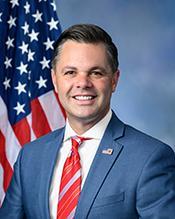
U.S. Representative for Iowa’s 3rd district
Republican
119th Congress, two-year term
Missed 4.6% of roll calls. Chamber median 1.9%.
The full voting recordCounts roll calls where most Democrats and most Republicans voted differently, leaving out procedural votes.
How we countFrom FEC filings, Voteview roll calls and Congress.gov.
Republican. In Congress since 2023, 2 terms in total.
Following saves Nunn to your list, which Chamber & Street keeps on its server, linked to a cookie on this browser and not to your name or email. Email alerts will come with constituent verification.
Bills and resolutions where Nunn is the primary sponsor. Most bills never leave committee; that is normal for every member. Source: Congress.gov, last updated Oct 29, 2026.
48 of 61 have at least one cosponsor from the other party.
Fight for Families Act of 2025
Introduced Mar 14, 2025. 2 cosponsors, 1 from the other party. H.R. 2153 on Congress.gov
Introduced
Infant Formula Made in America Act of 2025
Introduced Mar 10, 2025. 5 cosponsors, 3 from the other party. H.R. 2008 on Congress.gov(opens in a new tab)
Introduced
Delivering for Rural Seniors Act of 2025
Introduced Feb 24, 2025. 27 cosponsors, 19 from the other party. H.R. 1538 on Congress.gov(opens in a new tab)
Introduced
Delivering for Rural Seniors Act of 2025
This bill directs the Food and Nutrition Service (FNS) to award competitive grants to state agencies under a home delivery pilot program for participants in the Commodity Supplemental Food Program (CSFP).
As background, the CSFP works to improve the health of low-income persons at least 60 years of age by supplementing their diets with nutritious Department of Agriculture foods.
Under the pilot program, a state agency must distribute grant funds to an eligible entity (i.e., a local agency or subdistributing agency) to operate projects that facilitate home delivery of commodities to CSFP participants. Grant funds may be used for costs associated with
• transportation and distribution of commodities to CSFP participants,
• staffing required to operate home delivery services, and
• home delivery outreach to CSFP participants or potential participants.
A state agency must prioritize eligible entities that serve CSFP participants who reside in rural areas.
A state agency must also submit an annual report to FNS about the project, including best practices regarding the use of home delivery to improve the effectiveness of the CSFP.
Safeguarding Social Security and Medicare Act
Introduced Feb 13, 2025. 1 cosponsor, 1 from the other party. H.R. 1339 on Congress.gov(opens in a new tab)
Introduced
Safeguarding Social Security and Medicare Act
This bill requires the Government Accountability Office to study and provide recommendations to Congress with respect to the effect of inflation and cost-of-living increases on Medicare and Social Security.
Train More Primary Care Doctors Act of 2025
Introduced Feb 4, 2025. 3 cosponsors, 3 from the other party. H.R. 958 on Congress.gov(opens in a new tab)
Introduced
Train More Primary Care Doctors Act of 2025
This bill reauthorizes through FY2030 the Health Resources and Services Administration’s Primary Care Training and Enhancement program, which provides various grants to entities such as hospitals and schools for enhancing training and education for the primary care workforce.
Public and Private Sector Ransomware Response Coordination Act of 2025
Introduced Jan 28, 2025. 2 cosponsors, 2 from the other party. H.R. 807 on Congress.gov(opens in a new tab)
Introduced
Public and Private Sector Ransomware Response Coordination Act of 2025
This bill requires the Department of the Treasury to report on the coordination between the public and private sectors and among government agencies in response to, and for the prevention of, a ransomware attack on a financial institution.
Extraordinary Measures Transparency Act
Introduced Jan 24, 2025. 1 cosponsor, 1 from the other party. H.R. 737 on Congress.gov(opens in a new tab)
Introduced
Extraordinary Measures Transparency Act
This bill requires the Department of the Treasury to report to Congress regarding extraordinary measures used to avoid exceeding the federal debt limit.
(The term extraordinary measures refers to a series of actions that Treasury may implement to allow the United States to borrow additional funds without exceeding the debt limit. The measures often include suspensions of debt sales and suspensions or redemptions of investments in certain government funds.)
If Treasury determines that the public debt will reach the limit in 30 days, Treasury must submit a report to Congress that includes
• a description of the extraordinary measures that Treasury intends to use if the debt limit is not raised,
• an estimate of the cost of the measures,
• a projection of how long the measures will fund the federal government, and
• a projection of the administrative cost of taking the measures.
Treasury must also submit specified daily reports to Congress when the measures are being used. After using the measures, Treasury must report to Congress regarding the measures that were used and the administrative cost of the measures.
Protect Small Businesses from Excessive Paperwork Act of 2025
Introduced Jan 24, 2025. 12 cosponsors, 2 from the other party. H.R. 736 on Congress.gov(opens in a new tab)
Passed the House
Protect Small Businesses from Excessive Paperwork Act of 2025
This bill extends the deadline for certain companies that are required to file beneficial ownership information with the Financial Crimes Enforcement Network (FinCEN). Specifically, the bill requires companies formed or registered before January 1, 2024, to submit this information to FinCEN by January 1, 2026, instead of by January 1, 2025, as required under current regulations.
Back to Work Act
Introduced Jan 13, 2025. 1 cosponsor. H.R. 357 on Congress.gov(opens in a new tab)
Introduced
Back to Work Act
This bill limits federal agency employees' telework to up to 40% of the work days in any pay period and eliminates certain pay increases for teleworking employees.
Under current law, executive agencies must maintain policies detailing how their employees may work remotely and enter into telework agreements with participating employees. The bill requires telework agreements to cap employees' telework at 40% of the work days in a pay period, specify that the agency will monitor employees' telework via remote technical methods, and make telework subject to annual review by the agency. The bill also eliminates locality-based and automatic annual pay adjustments for employees with telework agreements.
The bill authorizes agencies to further restrict the amount of telework permitted based on an employee's specific role or other circumstances (e.g., working with classified information). Agencies may also waive the limitation for inclement weather or exigent circumstances or for an employee who (1) is married to a member of the Armed Forces or federal law enforcement officer; (2) holds a position requiring highly specialized experience or frequent travel; or (3) holds a position that is difficult to fill.
Additionally, the bill requires annual agency reports to Congress describing the effectiveness of agency telework policies. The Government Accountability Office must evaluate the accuracy and thoroughness of each report in an accompanying report to Congress.
No Corruption in Government Act
Introduced Jan 13, 2025. 2 cosponsors, 2 from the other party. H.R. 358 on Congress.gov(opens in a new tab)
Introduced
No Corruption in Government Act
This bill lengthens the limitations on former Congress Members' contact with the legislative branch and restricts certain financial transactions by Members and their spouses.
Specifically, the bill lengthens the cooling off period that prohibits former Members from contacting Members, officers, or employees of the House or Senate on behalf of a third party. During this post-employment waiting period, a former Member may not communicate with the intent to influence the official actions of a Member, officer, or employee of the House of Representatives or Senate. The bill lengthens the waiting period from one to three years after a Member of the House leaves office and from two to six years after a Senator leaves office.
Next, the bill prohibits Members of Congress and their spouses from holding, buying, or selling financial instruments such as stocks, securities futures, and commodities while the Member holds office. However, covered financial instruments may be held in a qualified blind trust. A Member or spouse who violates this provision must disgorge any resulting profits, may not take a related financial loss as an income tax deduction, and may be fined up to $50,000. The supervising ethics office of each chamber must audit Members' compliance with these requirements every two years.
Additionally, the bill eliminates automatic annual increases to Members' pay beginning in the 120th Congress.
Proposing a balanced budget amendment to the Constitution of the United States.
Introduced Jan 3, 2025. 15 cosponsors. H.J.Res. 10 on Congress.gov(opens in a new tab)
Introduced
This joint resolution proposes a constitutional amendment prohibiting total outlays for a fiscal year from exceeding total receipts for that fiscal year unless Congress authorizes the excess by a three-fifths roll call vote of each chamber. The prohibition excludes outlays for repayment of debt principal and receipts derived from borrowing.
The amendment requires a three-fifths roll call vote of each chamber to increase the public debt limit. It prohibits a bill to increase revenue from becoming law unless it has been approved by a majority roll call vote of each chamber.
The amendment also requires the President to submit an annual budget in which total outlays do not exceed total receipts.
Congress may waive these requirements due to a declaration of war or a military conflict that causes an imminent and serious military threat to national security.