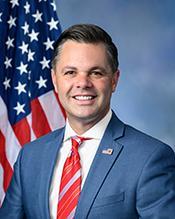
U.S. Representative for Iowa’s 3rd district
Republican
119th Congress, two-year term
Missed 4.6% of roll calls. Chamber median 1.9%.
The full voting recordCounts roll calls where most Democrats and most Republicans voted differently, leaving out procedural votes.
How we countFrom FEC filings, Voteview roll calls and Congress.gov.
Republican. In Congress since 2023, 2 terms in total.
Following saves Nunn to your list, which Chamber & Street keeps on its server, linked to a cookie on this browser and not to your name or email. Email alerts will come with constituent verification.
Bills and resolutions where Nunn is the primary sponsor. Most bills never leave committee; that is normal for every member. Source: Congress.gov, last updated Oct 29, 2026.
48 of 61 have at least one cosponsor from the other party.
Expressing support for law enforcement officers.
Introduced May 7, 2026. 25 cosponsors. H.Con.Res. 96 on Congress.gov
Passed the House
This concurrent resolution expresses support for law enforcement officers. It also appreciates the contributions and recognizes the sacrifices of law enforcement officers.
ELEVATE Act of 2025
Introduced May 8, 2025. 1 cosponsor, 1 from the other party. H.R. 3301 on Congress.gov(opens in a new tab)
Passed the House
This bill provides statutory authority for certain requirements related to registration statements submitted to the Securities and Exchange Commission (SEC).
First, the bill allows under statute an emerging growth company to submit profit and loss statements from the previous two years, rather than the previous three years as is required of other reporting companies. In addition, the bill allows under statute any issuer of securities to submit a draft registration statement to the SEC for confidential review prior to a public filing.
Expressing support for the designation of May 2025 as Renewable Fuels Month to recognize the important role that renewable fuels play in reducing carbon impacts, lowering fuel prices for consumers, supporting rural communities, and lessening reliance on foreign adversaries.
Introduced May 1, 2025. 15 cosponsors, 5 from the other party. H.Res. 375 on Congress.gov(opens in a new tab)
Passed the House
GUARD Act
Introduced Apr 21, 2025. 54 cosponsors, 24 from the other party. H.R. 2978 on Congress.gov(opens in a new tab)
Passed the House
Guarding Unprotected Aging Retirees from Deception Act of 2026 or the GUARD Act of 2026
This bill allows state, local, and tribal law enforcement agencies and grantees that receive funds from certain law enforcement grant programs to use the funds to investigate general financial fraud, elder financial fraud, and pig butchering. Pig butchering refers to a confidence and investment fraud in which a victim is gradually lured into transferring increasing amounts of money, generally in the form of cryptocurrency, into a fake virtual investment.
The bill allows federal law enforcement agencies to assist state, local, and tribal law enforcement agencies and fusion centers in the use of tracing tools for blockchain and related technology tools.
Finally, the bill requires the Financial Crimes Enforcement Network (FinCEN) to report on efforts to combat general financial fraud, elder financial fraud, pig butchering, and scams, including an evaluation of any legislative recommendations to improve the efforts. The bill also requires FinCEN to report on the state of general financial fraud, elder financial fraud, pig butchering, and scams in the United States, including trends in the crimes.
Financial Technology Protection Act of 2025
Introduced Mar 26, 2025. 4 cosponsors, 2 from the other party. H.R. 2384 on Congress.gov(opens in a new tab)
Passed the House
Financial Technology Protection Act of 2025
This bill establishes the Independent Financial Technology Working Group to Combat Terrorism and Illicit Financing. The working group must study and report on terrorist and illicit use of digital assets and other related emerging technologies and develop proposals to improve anti-money laundering and counterterrorist financing efforts.
The working group terminates four years after the bill's enactment or after the working group completes any ongoing activities, whichever is later.
In addition, the Department of the Treasury must (1) report on the potential use of digital assets and other emerging technologies by states, nonstate actors, and terrorist groups for the purpose of evading sanctions to threaten the national security of the United States; and (2) describe a strategy to mitigate and prevent this usage.
Protect Small Businesses from Excessive Paperwork Act of 2025
Introduced Jan 24, 2025. 12 cosponsors, 2 from the other party. H.R. 736 on Congress.gov(opens in a new tab)
Passed the House
Protect Small Businesses from Excessive Paperwork Act of 2025
This bill extends the deadline for certain companies that are required to file beneficial ownership information with the Financial Crimes Enforcement Network (FinCEN). Specifically, the bill requires companies formed or registered before January 1, 2024, to submit this information to FinCEN by January 1, 2026, instead of by January 1, 2025, as required under current regulations.