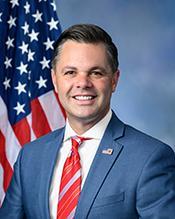
U.S. Representative for Iowa’s 3rd district
Republican
119th Congress, two-year term
Missed 4.6% of roll calls. Chamber median 1.9%.
The full voting recordCounts roll calls where most Democrats and most Republicans voted differently, leaving out procedural votes.
How we countFrom FEC filings, Voteview roll calls and Congress.gov.
Republican. In Congress since 2023, 2 terms in total.
Following saves Nunn to your list, which Chamber & Street keeps on its server, linked to a cookie on this browser and not to your name or email. Email alerts will come with constituent verification.
Bills and resolutions where Nunn is the primary sponsor. Most bills never leave committee; that is normal for every member. Source: Congress.gov, last updated Oct 29, 2026.
48 of 61 have at least one cosponsor from the other party.
TRAPS Act
Introduced Aug 8, 2025. 57 cosponsors, 29 from the other party. H.R. 4936 on Congress.gov
Passed committee
U.S.-Taiwan Defense Innovation Partnership Act
Introduced Aug 1, 2025. 6 cosponsors, 4 from the other party. H.R. 4860 on Congress.gov(opens in a new tab)
Introduced
Safe Drinking Water for Disadvantaged Communities Act
Introduced Jul 29, 2025. 2 cosponsors, 2 from the other party. H.R. 4816 on Congress.gov(opens in a new tab)
Introduced
Safe Schools and Communities Act of 2025
Introduced Jul 23, 2025. 2 cosponsors, 2 from the other party. H.R. 4713 on Congress.gov(opens in a new tab)
Introduced
Neutralizing Unfair Chinese Export Subsidies Act of 2025
Introduced Jul 17, 2025. 0 cosponsors. H.R. 4522 on Congress.gov(opens in a new tab)
Introduced
PEACE Act of 2025
Introduced Jul 10, 2025. 4 cosponsors, 3 from the other party. H.R. 4346 on Congress.gov(opens in a new tab)
Introduced
PEACE Act of 2025
Introduced Jul 7, 2025. 1 cosponsor, 1 from the other party. H.R. 4301 on Congress.gov(opens in a new tab)
Introduced
Cybersecurity in Agriculture Act of 2025
Introduced Jun 17, 2025. 3 cosponsors, 3 from the other party. H.R. 4046 on Congress.gov(opens in a new tab)
Introduced
Cybersecurity in Agriculture Act of 2025
This bill directs the National Institute of Food and Agriculture (NIFA) to establish an agriculture cybersecurity program.
Under the program, NIFA must provide grants to or enter into cooperative agreements with eligible colleges or universities. These institutions must establish a network of five Regional Agriculture Cybersecurity Centers to carry out research, development, and education on agriculture cybersecurity related to seed agriculture, horticulture, animal agriculture, and the agriculture supply chain.
An eligible college or university must have programs in food and agriculture sciences and cybersecurity that coordinate regional industry partners, cooperatives, government authorities, and other stakeholders to (1) strengthen security, privacy, and resiliency; (2) bolster the independent networks; and (3) develop a skilled workforce.
The program must also establish a national network of such regional centers and designate one college or university to coordinate the national network's activities.
Preventing Lethal Agricultural and National Threats (PLANT) Act
Introduced Jun 13, 2025. 3 cosponsors, 2 from the other party. H.R. 4014 on Congress.gov(opens in a new tab)
Introduced
SNAP Anti-Theft and Victim Compensation Act of 2025
Introduced Jun 10, 2025. 1 cosponsor. H.R. 3887 on Congress.gov(opens in a new tab)
Introduced
Expressing support for the designation of June as "National Annuity Awareness Month".
Introduced Jun 3, 2025. 1 cosponsor, 1 from the other party. H.Res. 464 on Congress.gov(opens in a new tab)
Introduced
Joint Reserve Detachment (JRD) Formalization Act
Introduced May 23, 2025. 5 cosponsors, 2 from the other party. H.R. 3599 on Congress.gov(opens in a new tab)
Introduced
FORCE Act
Introduced May 21, 2025. 1 cosponsor, 1 from the other party. H.R. 3561 on Congress.gov(opens in a new tab)
Introduced
HEALTH for MOM Act of 2025
Introduced May 13, 2025. 3 cosponsors, 3 from the other party. H.R. 3365 on Congress.gov(opens in a new tab)
Introduced
Harnessing Effective and Appropriate Long-Term Health for Moms On Medicaid Act of 2025 or the HEALTH for MOM Act of 2025
This bill allows state Medicaid programs to cover services that are provided by maternity health homes (designated providers or health teams that provide pregnancy and postpartum coordinated care services).
Participating maternity health homes must meet standards set by the Centers for Medicare & Medicaid Services (CMS), including the ability to coordinate prompt access to services, develop individualized care plans, provide supportive services, and coordinate with pediatric care providers. States must conduct outreach to providers, pregnant women, and other relevant stakeholders on the availability of such health homes and must report specified information relating to the implementation and outcomes of such services.
The CMS must award grants to states to develop plans for implementation. The bill also temporarily increases the Federal Medical Assistance Percentage (i.e., federal matching rate) for maternity health home services.
ELEVATE Act of 2025
Introduced May 8, 2025. 1 cosponsor, 1 from the other party. H.R. 3301 on Congress.gov(opens in a new tab)
Passed the House
This bill provides statutory authority for certain requirements related to registration statements submitted to the Securities and Exchange Commission (SEC).
First, the bill allows under statute an emerging growth company to submit profit and loss statements from the previous two years, rather than the previous three years as is required of other reporting companies. In addition, the bill allows under statute any issuer of securities to submit a draft registration statement to the SEC for confidential review prior to a public filing.
Agricultural Biorefinery Innovation and Opportunity Act of 2025
Introduced May 7, 2025. 2 cosponsors, 2 from the other party. H.R. 3253 on Congress.gov(opens in a new tab)
Introduced
Fortifying U.S. Markets From Chinese Military Aggression Act
Introduced May 5, 2025. 18 cosponsors, 6 from the other party. H.R. 3197 on Congress.gov(opens in a new tab)
Introduced
Providing a point of order in the House of Representatives during the 119th Congress against reconciliation measures that reduce benefits under the Medicaid program or the supplemental nutrition assistance program.
Introduced May 5, 2025. 2 cosponsors. H.Res. 382 on Congress.gov(opens in a new tab)
Introduced
This resolution establishes a point of order against considering budget reconciliation legislation in the House during the 119th Congress that (1) reduces enrollment or benefits for specified individuals enrolled in the Medicaid program, or (2) reduces eligibility or benefits for households that include specified individuals and participate in the Supplemental Nutrition Assistance Program (SNAP).
The individuals specified in the bill include individuals who are under the age of 19, individuals who are 65 or older, pregnant women, and individuals with a disability.
The point of order does not apply to any provision in reconciliation legislation that reduces improper payments, eliminates fraudulent billing, or enhances data verification to ensure eligibility for applicable benefits.
(Under current law, reconciliation bills are considered by Congress using expedited legislative procedures that prevent a filibuster and restrict amendments in the Senate.)
Expressing support for the designation of May 2025 as Renewable Fuels Month to recognize the important role that renewable fuels play in reducing carbon impacts, lowering fuel prices for consumers, supporting rural communities, and lessening reliance on foreign adversaries.
Introduced May 1, 2025. 15 cosponsors, 5 from the other party. H.Res. 375 on Congress.gov(opens in a new tab)
Passed the House
ReConnecting Rural America Act of 2025
Introduced Apr 30, 2025. 19 cosponsors, 11 from the other party. H.R. 3119 on Congress.gov(opens in a new tab)
Introduced
GUARD Act
Introduced Apr 21, 2025. 54 cosponsors, 24 from the other party. H.R. 2978 on Congress.gov(opens in a new tab)
Passed the House
Guarding Unprotected Aging Retirees from Deception Act of 2026 or the GUARD Act of 2026
This bill allows state, local, and tribal law enforcement agencies and grantees that receive funds from certain law enforcement grant programs to use the funds to investigate general financial fraud, elder financial fraud, and pig butchering. Pig butchering refers to a confidence and investment fraud in which a victim is gradually lured into transferring increasing amounts of money, generally in the form of cryptocurrency, into a fake virtual investment.
The bill allows federal law enforcement agencies to assist state, local, and tribal law enforcement agencies and fusion centers in the use of tracing tools for blockchain and related technology tools.
Finally, the bill requires the Financial Crimes Enforcement Network (FinCEN) to report on efforts to combat general financial fraud, elder financial fraud, pig butchering, and scams, including an evaluation of any legislative recommendations to improve the efforts. The bill also requires FinCEN to report on the state of general financial fraud, elder financial fraud, pig butchering, and scams in the United States, including trends in the crimes.
Daniel J. Harvey, Jr. and Adam Lambert Improving Servicemember Transition to Reduce Veteran Suicide Act
Introduced Apr 10, 2025. 25 cosponsors, 20 from the other party. H.R. 2878 on Congress.gov(opens in a new tab)
Introduced
Daniel J. Harvey, Jr. and Adam Lambert Improving Servicemember Transition to Reduce Veteran Suicide Act
This bill requires the Department of Veterans Affairs (VA) and Department of Defense (DOD) to provide additional information and assistance related to mental health care to veterans in the Solid Start program and members of the Armed Forces in the Transition Assistance Program.
Specifically, the bill requires that counseling provided under DOD’s Transition Assistance Program include additional mental health information, including information about the risk of suicide and other potential stressors associated with separation from the Armed Forces.
The bill also expands the activities that must be carried out by the VA under the Solid Start program, which is an outreach program for veterans in their first year of separation from service. Specifically, under the program, the VA must (1) assist eligible veterans who elect to enroll in the VA health care system, and (2) educate veterans about mental health and counseling services available through the Veterans Health Administration.
Maximum Pressure Act
Introduced Apr 1, 2025. 55 cosponsors. H.R. 2570 on Congress.gov(opens in a new tab)
Introduced
Financial Technology Protection Act of 2025
Introduced Mar 26, 2025. 4 cosponsors, 2 from the other party. H.R. 2384 on Congress.gov(opens in a new tab)
Passed the House
Financial Technology Protection Act of 2025
This bill establishes the Independent Financial Technology Working Group to Combat Terrorism and Illicit Financing. The working group must study and report on terrorist and illicit use of digital assets and other related emerging technologies and develop proposals to improve anti-money laundering and counterterrorist financing efforts.
The working group terminates four years after the bill's enactment or after the working group completes any ongoing activities, whichever is later.
In addition, the Department of the Treasury must (1) report on the potential use of digital assets and other emerging technologies by states, nonstate actors, and terrorist groups for the purpose of evading sanctions to threaten the national security of the United States; and (2) describe a strategy to mitigate and prevent this usage.
AI PLAN Act
Introduced Mar 14, 2025. 7 cosponsors, 5 from the other party. H.R. 2152 on Congress.gov(opens in a new tab)
Introduced
Artificial Intelligence Practices, Logistics, Actions, and Necessities Act or the AI PLAN Act
This bill requires the Department of the Treasury, the Department of Homeland Security (DHS), and the Department of Commerce to submit a report on the risks posed by the use of artificial intelligence in the commission of financial crimes by adversarial actors.
The report must
• describe interagency, intergovernmental, and public-private partnership activities, policies, and procedures to defend U.S. interests against the national and economic security risks posed by the use of artificial intelligence in the commission of financial crimes;
• provide a list of readily available resources that can be immediately deployed by federal agencies to combat these risks, and
• provide a list of resources needed by federal agencies to combat these risks.
Risks that must be considered by the report include deepfakes, voice cloning, foreign election interference, synthetic identities, false flags that disrupt market operations, AI-supported social engineering, and general digital fraud.
After submission of this report, Treasury, DHS, and Commerce must make recommendations for legislation and best practices for businesses and government entities to address these risks.