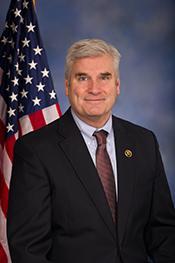
U.S. Representative for Minnesota’s 6th district
Republican
119th Congress, two-year term
Missed 1.3% of roll calls. Chamber median 1.9%.
The full voting recordCounts roll calls where most Democrats and most Republicans voted differently, leaving out procedural votes.
How we countFrom FEC filings, Voteview roll calls and Congress.gov.
Republican. In Congress since 2015, 6 terms in total.
Following saves Emmer to your list, which Chamber & Street keeps on its server, linked to a cookie on this browser and not to your name or email. Email alerts will come with constituent verification.
Bills and resolutions Emmer signed on to as a cosponsor. An original cosponsor signed on the day the bill was introduced. Source: govinfo bill status files, last updated Nov 6, 2026.
Promoting Innovation in Blockchain Development Act
Sponsor Scott Fitzgerald (R). Joined Oct 29, 2026. 22 cosponsors. H.R. 7732 on Congress.gov
Introduced
Voter Vouching Transparency Act
Sponsor Pete Stauber (R). Original cosponsor. 3 cosponsors. H.R. 10637 on Congress.gov(opens in a new tab)
Introduced
North Platte Canteen Congressional Gold Medal Act
Sponsor Adrian Smith (R). Joined Sep 16, 2026. 270 cosponsors. H.R. 1502 on Congress.gov(opens in a new tab)
Introduced
North Platte Canteen Congressional Gold Medal Act
This bill provides for the award of a Congressional Gold Medal to recognize the individuals and communities that provided financial and other support for the North Platte Canteen in North Platte, Nebraska, during World War II.
Consumer Financial Protection Accountability and Reform Act of 2026
Sponsor Andy Barr (R). Original cosponsor. 30 cosponsors. H.R. 10184 on Congress.gov(opens in a new tab)
Passed committee
To authorize the President to award the Medal of Honor to Earl L. Nolte for acts of valor as a member of the Army during World War II.
Sponsor Brad Finstad (R). Original cosponsor. 1 cosponsor. H.R. 10021 on Congress.gov(opens in a new tab)
Introduced
Fair Access to Banking Act
Sponsor Andy Barr (R). Joined Jul 22, 2026. 151 cosponsors. H.R. 987 on Congress.gov(opens in a new tab)
Introduced
Fair Access to Banking Act
This bill places restrictions on certain banks, credit unions, and payment card networks if they refuse to do business with a person who complies with the law. Restrictions include prohibiting the use of electronic funds transfer systems and lending programs, termination of an institution's depository insurance, and specified civil penalties.
Banks and other specified financial institutions are allowed to deny financial services to a person only if the denial is justified by a documented failure of that person to meet quantitative, impartial, risk-based standards established in advance by the institution. This justification may not be based upon reputational risks to the institution.
The bill establishes the right for a person to bring a civil action for a violation of this bill.
FRAUD Act
Sponsor Pete Stauber (R). Original cosponsor. 4 cosponsors. H.R. 9588 on Congress.gov(opens in a new tab)
Introduced
America’s Olympic and Paralympic Games Commemorative Coins Act
Sponsor Brad Sherman (D). Joined Jun 10, 2026. 313 cosponsors. H.R. 4382 on Congress.gov(opens in a new tab)
Introduced
To designate the facility of the United States Postal Service located at 200 1st Avenue Southeast in Austin, Minnesota, as the "John Madden Memorial Post Office".
Sponsor Brad Finstad (R). Original cosponsor. 9 cosponsors. H.R. 9025 on Congress.gov(opens in a new tab)
Introduced
This bill designates the facility of the United States Postal Service located at 200 1st Avenue Southeast in Austin, Minnesota, as the "John Madden Memorial Post Office".
Make Elections Great Again Act
Sponsor Bryan Steil (R). Joined Feb 5, 2026. 70 cosponsors. H.R. 7300 on Congress.gov(opens in a new tab)
Introduced
SAVE America Act
Sponsor Chip Roy (R). Joined Feb 5, 2026. 111 cosponsors. H.R. 7296 on Congress.gov(opens in a new tab)
Introduced
Safeguard American Voter Eligibility Act or the SAVE America Act
This bill requires individuals to provide documentary proof of U.S. citizenship when registering to vote, and requires photo identification to vote, in federal elections.
Specifically, the bill prohibits states from accepting and processing an application to register to vote in a federal election unless the applicant presents documentary proof of U.S. citizenship. The bill specifies what documents are considered acceptable proof of U.S. citizenship, such as identification that complies with the REAL ID Act of 2005 that indicates U.S. citizenship.
Further, the bill (1) prohibits states from registering an individual to vote in a federal election unless, at the time the individual applies to register to vote, the individual provides documentary proof of U.S. citizenship; and (2) requires states to establish an alternative process to demonstrate U.S. citizenship.
Each state must take affirmative steps on an ongoing basis to ensure that only U.S. citizens are registered to vote, which shall include establishing a program to identify individuals who are not U.S. citizens using information supplied by certain sources.
Additionally, states must remove noncitizens from their official lists of eligible voters.
The bill (1) provides for a private right of action for certain violations, and (2) establishes criminal penalties for certain offenses.
Individuals voting in federal elections must present an eligible photo identification document. An individual who votes by absentee ballot must submit a copy of their identification document with both the request for, and the submission of, the absentee ballot.
Minnesota Voter Integrity Act of 2026
Sponsor Pete Stauber (R). Original cosponsor. 3 cosponsors. H.R. 7320 on Congress.gov(opens in a new tab)
Introduced
Main Street Capital Access Act
Sponsor J. Hill (R). Original cosponsor. 33 cosponsors. H.R. 6955 on Congress.gov(opens in a new tab)
Passed the House
Main Street Capital Access Act or the Main Street Act
This bill lessens and otherwise modifies banking regulations, including those regarding institution formation, supervision by federal financial regulators, and bank merger requirements.
Under the bill, new banks have a three-year phase-in period to meet certain capital requirements. The bill also reduces the leverage ratio for certain rural community banks.
Financial regulators must (1) tailor regulatory actions to limit burdens on financial institutions and must consider the institutions' risk profiles and business models, and (2) review their regulations more frequently and expand the scope of these reviews.
The bill eases requirements regarding bank mergers, for example, by allowing financial regulators to approve certain bank mergers without considering if the merger is noncompetitive or monopolistic.
The bill increases the dollar asset thresholds for various fees, reporting requirements, and other regulatory requirements so that more financial companies and banks are exempt from these requirements. For example, the bill increases the total asset threshold above which financial holding companies need Federal Reserve Board approval to acquire a company, thereby allowing for more acquisitions without board approval. The bill also raises certain asset thresholds so as to allow additional small bank holding companies to operate with higher debt levels and additional small banks to qualify for a longer examination cycle.
The bill also provides flexibilities regarding the use of reciprocal deposits, the resolution of failed banks, and other regulated activities.
Protection of Lawful Commerce in Stone Slab Products Act
Sponsor Tom McClintock (R). Joined Sep 18, 2025. 16 cosponsors. H.R. 5437 on Congress.gov(opens in a new tab)
Passed committee
Protection of Lawful Commerce in Stone Slab Products Act
This bill prohibits civil actions in federal or state court against manufacturers or sellers of certain stone slab products. The term stone slab product includes a product made with quartz, mineral, crystal, glass, porcelain, or other stone, ceramic or similar material, that has been shipped or transported in interstate or foreign commerce.
Specifically, the bill prohibits a civil action against a manufacturer or seller of a stone slab product for injuries arising from or related to the fabrication of the stone slab product by another party, including injuries caused by exposure to respirable silica or other substances.
The bill requires any such civil action that is pending on the date of enactment to be dismissed.
Honoring the life and legacy of Charles Charlie James Kirk.
Sponsor Mike Johnson (R). Original cosponsor. 196 cosponsors. H.Res. 719 on Congress.gov(opens in a new tab)
Passed the House
This resolution (1) condemns the assassination of Charles "Charlie" James Kirk and all forms of political violence; and (2) honors the life, leadership, and legacy of Charlie Kirk.
Honoring the victims and survivors of the mass shooting at Annunciation Catholic Church and School in Minneapolis, Minnesota.
Sponsor Ilhan Omar (D). Original cosponsor. 7 cosponsors. H.Res. 669 on Congress.gov(opens in a new tab)
Introduced
Condemning the attacks on Minnesota lawmakers in Brooklyn Park and Champlin, Minnesota, and calling for unity and the rejection of political violence in Minnesota and across the United States.
Sponsor Kelly Morrison (D). Original cosponsor. 7 cosponsors. H.Res. 519 on Congress.gov(opens in a new tab)
Passed the House
This resolution condemns the June 14, 2025, attacks on Minnesota state legislators and calls on all people in the United States to reaffirm our commitment to a safe, civil, and peaceful democracy.
The resolution also honors (1) the lives of Speaker Emerita Melissa Hortman and her husband Mark Hortman who were killed, (2) Senator John Hoffman and his wife Yvette Hoffman who were critically injured, and (3) the law enforcement officers who rapidly responded to the attacks and apprehended the suspected perpetrator.
Digital Asset Market Clarity Act
Sponsor J. Hill (R). Original cosponsor. 21 cosponsors. H.R. 3633 on Congress.gov(opens in a new tab)
Passed the House
Digital Asset Market Clarity Act of 2025 or the CLARITY Act of 2025
This bill establishes a regulatory framework for digital commodities, defined by the bill as digital assets that rely upon a blockchain for their value.
The Commodity Futures Trading Commission must generally regulate digital commodities transactions, including digital commodity exchanges, brokers, and dealers. To qualify for trade on an exchange (1) a digital commodity’s blockchain must be mature, or on a blockchain system that has achieved decentralized control as defined by the bill; or (2) the issuer of the digital commodity must file certain reports. The bill establishes requirements for trade monitoring, recordkeeping, and the commingling of customer assets.
The bill exempts digital commodities on mature blockchains (and digital commodities on blockchains expected to mature within certain timeframes) from Securities and Exchange Commission (SEC) registration requirements if annual sales fall under a certain amount and other requirements are met. The bill provides the SEC with jurisdiction over digital commodity activities and transactions engaged in by certain brokers and dealers on alternative trading systems and by national securities exchanges.
Digital commodity exchanges, brokers, and dealers are subject to the Bank Secrecy Act for anti-money laundering and related purposes.
The bill also sets forth requirements for alternative trading systems, previously issued digital commodities, and provisional registration until the bill is implemented.
For more information on this bill, see CRS Insight IN12583, Crypto Legislation: An Overview of H.R. 3633, the CLARITY Act.
Business Owners Protection Act of 2025
Sponsor Andy Barr (R). Original cosponsor. 7 cosponsors. H.R. 3484 on Congress.gov(opens in a new tab)
Introduced
Affordable Housing Credit Improvement Act of 2025
Sponsor Darin LaHood (R). Original cosponsor. 168 cosponsors. H.R. 2725 on Congress.gov(opens in a new tab)
Introduced
STABLE Act of 2025
Sponsor Bryan Steil (R). Original cosponsor. 17 cosponsors. H.R. 2392 on Congress.gov(opens in a new tab)
Introduced
Stablecoin Transparency and Accountability for a Better Ledger Economy Act of 2025 or the STABLE Act of 2025
This bill establishes a regulatory framework for payment stablecoins (digital assets which an issuer must redeem for a fixed value).
Under the bill, only permitted issuers may issue a payment stablecoin in the United States, subject to certain exceptions. Permitted issuers must be a subsidiary of an insured depository institution, a federal-qualified nonbank payment stablecoin issuer, or a state-qualified payment stablecoin issuer. Permitted issuers must be regulated by the appropriate federal or state regulator. A state regulator must certify that the state regulatory regime meets or exceeds federal requirements as established by the bill.
Permitted issuers must maintain reserves backing the stablecoin on a one-to-one basis using U.S. currency or other similarly liquid assets, as specified. Permitted issuers must also publicly disclose their redemption policy and publish monthly the details of their reserves.
The bill specifies requirements for (1) reusing reserves; (2) providing safekeeping services for stablecoins; and (3) supervisory, examination, and enforcement authority over federal-qualified issuers.
The bill places a two-year moratorium on new endogenously collateralized stablecoins (i.e., stablecoins that rely on the value of another digital asset created or maintained by the same originator to maintain the fixed price).
Under the bill, permitted payment stablecoins are not considered securities under securities law. However, permitted issuers are subject to the Bank Secrecy Act for anti-money laundering and related purposes.
AM Radio for Every Vehicle Act of 2025
Sponsor Gus Bilirakis (R). Joined Feb 26, 2025. 317 cosponsors. H.R. 979 on Congress.gov(opens in a new tab)
Passed the House
AM Radio for Every Vehicle Act of 2025
This bill requires the Department of Transportation (DOT) to issue a rule requiring AM radio capabilities to be standard in all new passenger vehicles. (AM radio is often used to deliver emergency alerts and news and entertainment programming; some newer vehicles do not include AM equipment.)
Specifically, this bill applies to passenger vehicles (1) manufactured in the United States for sale in the United States, imported into the United States, or shipped in interstate commerce; and (2) manufactured after the rule's effective date. The rule must require all such vehicles to have devices that can receive signals and play content transmitted by AM stations or digital audio AM stations installed as standard equipment and made easily accessible to drivers.
Prior to the rule's effective date, manufacturers that do not include devices that can access AM radio as standard equipment (1) must inform purchasers of this fact through clear and conspicuous labeling, and (2) may not charge an additional or separate fee for AM radio access.
DOT may assess civil penalties for any violation of the rule. The Department of Justice may also bring a civil action to enjoin a violation.
The rule, including DOT’s authority to enforce it, must expire 10 years after the bill’s enactment.
Further, the Government Accountability Office must study and report on the dissemination of emergency alerts to the public, including by conducting an assessment of AM radio relative to other Integrated Public Alert and Warning System communication technologies.
Supporting the Local Radio Freedom Act.
Sponsor Steve Womack (R). Joined Feb 26, 2025. 233 cosponsors. H.Con.Res. 12 on Congress.gov(opens in a new tab)
Introduced
This concurrent resolution declares that Congress should not impose any new performance fee, tax, royalty, or other charge relating to the public performance of sound recordings on a local radio station for broadcasting sound recordings over the air, or on any business for such public performance of sound recordings.
Death Tax Repeal Act
Sponsor Randy Feenstra (R). Original cosponsor. 182 cosponsors. H.R. 1301 on Congress.gov(opens in a new tab)
Introduced
Pet and Livestock Protection Act
Sponsor Lauren Boebert (R). Original cosponsor. 37 cosponsors. H.R. 845 on Congress.gov(opens in a new tab)
Passed the House
Pet and Livestock Protection Act of 2025
This bill directs the Department of the Interior to remove protections for the gray wolf under the Endangered Species Act of 1973 (ESA). Specifically, the bill requires Interior to reissue the final rule titled Endangered and Threatened Wildlife and Plants; Removing the Gray Wolf (Canis lupus) From the List of Endangered and Threatened Wildlife and published on November 3, 2020.
The rule removed the gray wolf in the lower 48 United States, except for the Mexican wolf (C. l. baileyi) subspecies, from the endangered and threatened species list. However, the U.S. District Court for the Northern District of California vacated the rule on February 10, 2022. As a result, the gray wolf reattained the protection status it had prior to the rule's promulgation.
The bill also prohibits the reissuance of the rule from being subject to judicial review.