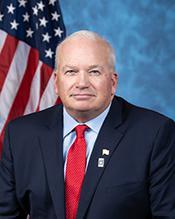
U.S. Representative for Wisconsin’s 5th district
Republican
119th Congress, two-year term
Missed 1.2% of roll calls. Chamber median 1.9%.
The full voting recordCounts roll calls where most Democrats and most Republicans voted differently, leaving out procedural votes.
How we countFrom FEC filings, Voteview roll calls and Congress.gov.
Republican. In Congress since 2021, 3 terms in total.
Following saves Fitzgerald to your list, which Chamber & Street keeps on its server, linked to a cookie on this browser and not to your name or email. Email alerts will come with constituent verification.
Bills and resolutions Fitzgerald signed on to as a cosponsor. An original cosponsor signed on the day the bill was introduced. Source: govinfo bill status files, last updated Nov 6, 2026.
Fitzgerald also withdrew as a cosponsor from 1 bill, not listed here.
PFC Joseph P. Dwyer Peer Support Program Act
Sponsor Nick LaLota (R). Original cosponsor. 32 cosponsors. H.R. 438 on Congress.gov
Introduced
PFC Joseph P. Dwyer Peer Support Program Act
This bill requires the Department of Veterans Affairs (VA) to establish the PFC Joseph P. Dwyer Peer Support Program to make grants to eligible entities for peer-to-peer mental health programs for veterans.
Eligible entities include (1) a nonprofit organization that has historically served the mental health needs of veterans; (2) a congressionally chartered veteran service organization; or (3) a state, local, or tribal veteran service agency, director, or commissioner.
The VA shall establish an advisory committee to create appropriate program standards.
Small Business Regulatory Flexibility Improvements Act
Sponsor Ben Cline (R). Original cosponsor. 6 cosponsors. H.R. 421 on Congress.gov(opens in a new tab)
Passed committee
Small Business Regulatory Flexibility Improvements Act
This bill modifies the rulemaking requirements and procedures of federal agencies under the Regulatory Flexibility Act of 1980 and the Small Business Regulatory Enforcement Fairness Act of 1996, including how agencies consider economic impact with respect to small entities.
Specifically, the bill requires agencies to consider the direct, and the reasonably foreseeable indirect, economic effect of a rule on small entities when determining whether a rule is likely to have a significant economic impact. Further, the regulatory flexibility analysis for rules with a significant economic impact must include a detailed description of alternatives to a proposed rule that minimize any adverse significant economic impact or maximize any beneficial significant economic impact on small entities. The bill also expands the types of agency actions (e.g., revisions to land management plans) that are subject to a regulatory impact analysis.
The bill removes the authority for an agency to waive the regulatory flexibility analysis requirements and requires the Office of Advocacy of the Small Business Administration to issue rules for compliance with such requirements.
The bill also modifies the procedures for the (1) gathering of comments for a proposed rule, (2) periodic review of agency rules, and (3) judicial review of final rules.
Ensuring Accountability in Agency Rulemaking Act
Sponsor Ben Cline (R). Original cosponsor. 11 cosponsors. H.R. 418 on Congress.gov(opens in a new tab)
Introduced
Ensuring Accountability in Agency Rulemaking Act
This bill requires, subject to a limited exception, that any agency rule promulgated under notice and comment procedures must be (1) initiated by a senior appointee (e.g., an individual who was appointed by the President or is a non-career member of the Senior Executive Service), and (2) issued and signed by an individual who was appointed by the President and confirmed by the Senate.
The Office of Information and Regulatory Affairs must issue guidance for agencies to implement this requirement.
One Agency Act
Sponsor Ben Cline (R). Original cosponsor. 3 cosponsors. H.R. 384 on Congress.gov(opens in a new tab)
Introduced
One Agency Act
This bill consolidates federal antitrust enforcement authority in one department by transferring the Federal Trade Commission's (FTC) antitrust functions, employees, assets, and funding to the Department of Justice (DOJ).
The bill provides a one-year period for DOJ to implement the transition and allows DOJ to extend the period once for an additional 180 days. During the transition period, DOJ may restructure the department's antitrust division and deputize FTC antitrust employees to investigate and prosecute antitrust violations on behalf of DOJ prior to the completion of the transfer of personnel from the FTC to DOJ.
DOJ is also authorized to require businesses to file annual or special reports about the business’s organization, conduct, practices, management, and relationship to other businesses filing such reports.
Border Safety and Security Act of 2025
Sponsor Chip Roy (R). Original cosponsor. 47 cosponsors. H.R. 318 on Congress.gov(opens in a new tab)
Introduced
Border Safety and Security Act of 2025
This bill requires the Department of Homeland Security (DHS) to suspend the entry of any non-U.S. nationals (aliens under federal law) without valid entry documents during any period when DHS cannot detain such an individual or return the individual to a foreign country contiguous to the United States. A state may sue DHS to enforce this requirement.
(Under current law, non-U.S. nationals who arrive at the border without entry documents are generally subject to expedited removal. However, if such an individual is found to have a credible fear of persecution, they are typically subject to detention while their asylum claim is being considered.)
The bill also authorizes DHS to suspend the entry of non-U.S. nationals without entry documents at the border if DHS determines that such a suspension is necessary to achieve operational control over such a border.
Defund Planned Parenthood Act of 2025
Sponsor Michelle Fischbach (R). Original cosponsor. 60 cosponsors. H.R. 271 on Congress.gov(opens in a new tab)
Introduced
Defund Planned Parenthood Act of 2025
This bill restricts federal funding for Planned Parenthood Federation of America, Inc. or any of its affiliates or clinics for one year.
Specifically, it prohibits providing federal funding to those entities unless they certify that the affiliates and clinics will not perform, and will not provide funds to entities that perform, abortions during that year. If the certification requirement is not met, the Department of Health and Human Services and the Department of Agriculture must recoup any federal assistance received by those entities.
However, the bill's funding restriction does not apply to abortions performed in cases of rape or incest or when necessary to resolve a physical condition that endangers a woman's life.
The bill also provides additional funding for community health centers for the one-year period. These funds are subject to the same abortion-related restrictions and exceptions.
Born-Alive Abortion Survivors Protection Act
Sponsor Ann Wagner (R). Joined Jan 6, 2025. 163 cosponsors. H.R. 21 on Congress.gov(opens in a new tab)
Passed the House
Born-Alive Abortion Survivors Protection Act
This bill establishes requirements for the degree of care a health care practitioner must provide in the case of a child born alive following an abortion or attempted abortion.
Specifically, a health care practitioner who is present must (1) exercise the same degree of care as would reasonably be provided to any other child born alive at the same gestational age, and (2) ensure the child is immediately admitted to a hospital. Additionally, a health care practitioner or other employee who has knowledge of a failure to comply with the degree-of-care requirements must immediately report such failure to law enforcement.
A health care practitioner who fails to provide the required degree of care, or a health care practitioner or other employee who fails to report such failure, is subject to criminal penalties—a fine, up to five years in prison, or both.
An individual who intentionally kills or attempts to kill a child born alive is subject to prosecution for murder.
The bill bars the criminal prosecution of a mother of a child born alive under this bill and allows her to bring a civil action against a health care practitioner or other employee for violations.
Constitutional Concealed Carry Reciprocity Act of 2025
Sponsor Richard Hudson (R). Original cosponsor. 189 cosponsors. H.R. 38 on Congress.gov(opens in a new tab)
Introduced
Constitutional Concealed Carry Reciprocity Act
This bill establishes a federal statutory framework to regulate the carry or possession of concealed firearms across state lines.
Specifically, an individual who is eligible to carry a concealed firearm in one state may carry or possess a concealed handgun (other than a machine gun or destructive device) in another state that allows its residents to carry concealed firearms.
It sets forth requirements for lawful concealed carry across state lines. The bill preempts most state and local laws related to concealed carry and establishes a private right of action for a person adversely affected by interference with a concealed-carry right established by this bill.
Agent Raul Gonzalez Officer Safety Act
Sponsor Juan Ciscomani (R). Original cosponsor. 32 cosponsors. H.R. 35 on Congress.gov(opens in a new tab)
Passed the House
Agent Raul Gonzalez Officer Safety Act
This bill establishes new federal criminal offenses for operating a motor vehicle within 100 miles of the U.S. border while fleeing from a U.S. Border Patrol agent or a federal, state, or local law enforcement officer who is actively assisting or under the command of the U.S. Border Patrol.
The bill establishes criminal penalties for an offense, including a mandatory minimum prison term for an offense resulting in death or serious bodily injury. Additionally, a non-U.S. national who is convicted of or admits to committing an offense is inadmissible, deportable, and ineligible for immigration relief (including asylum).
Preventing Violence Against Women by Illegal Aliens Act
Sponsor Nancy Mace (R). Original cosponsor. 60 cosponsors. H.R. 30 on Congress.gov(opens in a new tab)
Passed the House
Preventing Violence Against Women by Illegal Aliens Act
This bill establishes certain criminal grounds for making non-U.S. nationals (aliens under federal law) inadmissible and expands the crimes for which a non-U.S. national is deportable.
First, the bill establishes that a non-U.S. national is inadmissible if the individual has admitted to or is convicted of acts constituting the essential elements of stalking, child abuse, child neglect, child abandonment, a sex offense, conspiracy to commit a sex offense, a violation of certain protection orders, or domestic violence (including physical or sexual abuse or a pattern of coercive behavior when it occurs within certain close relationships).
Next, the bill establishes additional grounds for deportation. Under current law, a non-U.S. national is deportable for certain criminal convictions, including domestic violence, stalking, and child abuse. The bill makes any sex offense (including crimes against minors) or conspiracy to commit a sex offense a basis for deportation. The bill also expands the domestic violence crimes that make a non-U.S. national deportable to include physical or sexual abuse or a pattern of coercive behavior when it occurs within certain close relationships.
Laken Riley Act
Sponsor Mike Collins (R). Original cosponsor. 54 cosponsors. H.R. 29 on Congress.gov(opens in a new tab)
Passed the House
Laken Riley Act
This bill requires the Department of Homeland Security (DHS) to detain certain non-U.S. nationals (aliens under federal law) who have been arrested for burglary, theft, larceny, or shoplifting. The bill also authorizes states to sue the federal government for decisions or alleged failures related to immigration enforcement.
Under this bill, DHS must detain an individual who (1) is unlawfully present in the United States or did not possess the necessary documents when applying for admission; and (2) has been charged with, arrested for, convicted of, or admits to having committed acts that constitute the essential elements of burglary, theft, larceny, or shoplifting.
The bill also authorizes state governments to sue for injunctive relief over certain immigration-related decisions or alleged failures by the federal government if the decision or failure caused the state or its residents harm, including financial harm of more than $100. Specifically, the state government may sue the federal government over a
• decision to release a non-U.S. national from custody;
• failure to fulfill requirements relating to inspecting individuals seeking admission into the United States, including requirements related to asylum interviews;
• failure to fulfill a requirement to stop issuing visas to nationals of a country that unreasonably denies or delays acceptance of nationals of that country;
• violation of limitations on immigration parole, such as the requirement that parole be granted only on a case-by-case basis; or
• failure to detain an individual who has been ordered removed from the United States.
Protection of Women and Girls in Sports Act of 2025
Sponsor W. Steube (R). Original cosponsor. 83 cosponsors. H.R. 28 on Congress.gov(opens in a new tab)
Passed the House
Protection of Women and Girls in Sports Act of 2025
This bill generally prohibits school athletic programs from allowing individuals whose biological sex at birth was male to participate in programs that are for women or girls.
Specifically, the bill provides that it is a violation of Title IX of the Education Amendments of 1972 for federally funded education programs or activities to operate, sponsor, or facilitate athletic programs or activities that allow individuals of the male sex to participate in programs or activities that are designated for women or girls. (Title IX prohibits discrimination on the basis of sex in federally funded education programs or activities, including in public elementary and secondary schools and in colleges and universities.) Under the bill, sex is based on an individual's reproductive biology and genetics at birth.
The bill does not prohibit male individuals from training or practicing with programs or activities for women or girls as long as such training or practice does not deprive any female of corresponding opportunities or benefits.
The Government Accountability Office must report on the benefits for women or girls in single-sex sports that would be lost as a result of male participation. In particular, the report must document the negative psychological, developmental, participatory, and sociological effects of male participation on girls.
HALT Fentanyl Act
Sponsor H. Griffith (R). Original cosponsor. 61 cosponsors. H.R. 27 on Congress.gov(opens in a new tab)
Passed the House
Halt All Lethal Trafficking of Fentanyl Act or the HALT Fentanyl Act
This bill permanently places fentanyl-related substances as a class into schedule I of the Controlled Substances Act. A schedule I controlled substance is a drug, substance, or chemical that has a high potential for abuse; has no currently accepted medical value; and is subject to regulatory controls and administrative, civil, and criminal penalties under the Controlled Substances Act.
Under the bill, offenses involving fentanyl-related substances are triggered by the same quantity thresholds and subject to the same penalties as offenses involving fentanyl analogues (e.g., offenses involving 100 grams or more trigger a 10-year mandatory minimum prison term).
Additionally, the bill establishes a new, alternative registration process for certain schedule I research.
The bill also makes several other changes to registration requirements for conducting research with controlled substances, including
• permitting a single registration for related research sites in certain circumstances,
• waiving the requirement for a new inspection in certain situations, and
• allowing a registered researcher to perform certain manufacturing activities with small quantities of a substance without obtaining a manufacturing registration.
Finally, the bill expresses the sense that Congress agrees with the interpretation of Controlled Substances Act in United States v. McCray, a 2018 case decided by the U.S. District Court for the Western District of New York. In that case, the court held that butyryl fentanyl, a controlled substance, can be considered an analogue of fentanyl even though, under the Controlled Substances Act, the term controlled substance analogue specifically excludes a controlled substance.
Equal Representation Act of 2025
Sponsor Chuck Edwards (R). Original cosponsor. 66 cosponsors. H.R. 151 on Congress.gov(opens in a new tab)
Introduced
Equal Representation Act
This bill requires that the statement sent by the President to Congress after the decennial census indicating the number of persons in each state exclude noncitizens. (This statement is the basis for reapportionment of U.S. Representatives.)
The bill also requires any questionnaire used in the decennial census to include a checkbox or other similar option for respondents to indicate whether the respondent and each household member is (1) a U.S. citizen, (2) a U.S. national but not a citizen, (3) a non-U.S. national (alien under federal law) lawfully residing in the United States, or (4) a non-U.S. national unlawfully residing in the United States.
The Department of Commerce must make public the number of persons in each state, disaggregated by each of these four categories.
Regulations from the Executive in Need of Scrutiny Act of 2025
Sponsor Kat Cammack (R). Original cosponsor. 93 cosponsors. H.R. 142 on Congress.gov(opens in a new tab)
Introduced
Regulations from the Executive in Need of Scrutiny Act of 2025
This bill revises provisions relating to congressional review of agency rulemaking.
Specifically, the bill establishes a congressional approval process for a major rule. A major rule may only take effect if Congress approves of the rule. A major rule is a rule that has resulted in or is likely to result in (1) an annual effect on the economy of $100 million or more; (2) a major increase in costs or prices for consumers, individual industries, government agencies, or geographic regions; or (3) significant adverse effects on competition, employment, investment, productivity, innovation, or the ability of U.S.-based enterprises to compete with foreign-based enterprises.
The bill generally preserves the current congressional review process for a nonmajor rule.