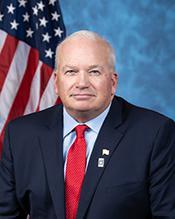
U.S. Representative for Wisconsin’s 5th district
Republican
119th Congress, two-year term
Missed 1.2% of roll calls. Chamber median 1.9%.
The full voting recordCounts roll calls where most Democrats and most Republicans voted differently, leaving out procedural votes.
How we countFrom FEC filings, Voteview roll calls and Congress.gov.
Republican. In Congress since 2021, 3 terms in total.
Following saves Fitzgerald to your list, which Chamber & Street keeps on its server, linked to a cookie on this browser and not to your name or email. Email alerts will come with constituent verification.
Bills and resolutions Fitzgerald signed on to as a cosponsor. An original cosponsor signed on the day the bill was introduced. Source: govinfo bill status files, last updated Nov 6, 2026.
Fitzgerald also withdrew as a cosponsor from 1 bill, not listed here.
Limiting Liability for Critical Infrastructure Manufacturers Act
Sponsor Mariannette Miller-Meeks (R). Joined Feb 4, 2026. 21 cosponsors. H.R. 4194 on Congress.gov
Introduced
Make Elections Great Again Act
Sponsor Bryan Steil (R). Joined Feb 2, 2026. 70 cosponsors. H.R. 7300 on Congress.gov(opens in a new tab)
Introduced
Gio’s Law
Sponsor Laura Gillen (D). Joined Jan 27, 2026. 9 cosponsors. H.R. 4019 on Congress.gov(opens in a new tab)
Introduced
McCarran-Ferguson Restoration Act
Sponsor Troy Downing (R). Original cosponsor. 5 cosponsors. H.R. 7130 on Congress.gov(opens in a new tab)
Introduced
Special Diabetes Program Reauthorization Act of 2025
Sponsor Diana DeGette (D). Joined Jan 16, 2026. 49 cosponsors. H.R. 5461 on Congress.gov(opens in a new tab)
Introduced
Protecting TPLF From Abuse Act
Sponsor Darrell Issa (R). Original cosponsor. 3 cosponsors. H.R. 7015 on Congress.gov(opens in a new tab)
Introduced
Stop Insider Trading Act
Sponsor Bryan Steil (R). Original cosponsor. 93 cosponsors. H.R. 7008 on Congress.gov(opens in a new tab)
Passed the House
Stop Insider Trading Act
This bill generally prohibits Members of Congress and their spouses and dependent children from purchasing stocks and requires public notice before these individuals may sell stocks.
Specifically, Members of Congress and the spouses and dependent children of Members of Congress may not purchase covered investments. Between 7 and 14 days before a Member or a covered spouse or dependent sells a covered investment, the relevant Member must file public notice of the intent to sell with the Clerk of the House of Representatives or the Secretary of the Senate, as appropriate. The Clerk or Secretary must publish this notice online. If the individual decides not to sell the covered investment, the notice must be withdrawn.
Under the bill, a covered investment is a security issued by a publicly traded company or a comparable economic interest. Some investments are exempt, including interest in a widely held investment fund and certain investments held in a trust.
Violations of these provisions are subject to a fee and, in the case of a purchase, a requirement to sell the covered investment. The fee must equal (1) the greater of $2,000 or 10% of the transaction value, and (2) any net gain realized from the transaction during a specified period. The fee may not be paid using campaign donations or Members’ official allowances.
Certain transactions by covered spouses and dependents are exempt, including transactions made on behalf of another person or made as part of compensation from the individual’s employer.
Main Street Capital Access Act
Sponsor J. Hill (R). Original cosponsor. 33 cosponsors. H.R. 6955 on Congress.gov(opens in a new tab)
Passed the House
Main Street Capital Access Act or the Main Street Act
This bill lessens and otherwise modifies banking regulations, including those regarding institution formation, supervision by federal financial regulators, and bank merger requirements.
Under the bill, new banks have a three-year phase-in period to meet certain capital requirements. The bill also reduces the leverage ratio for certain rural community banks.
Financial regulators must (1) tailor regulatory actions to limit burdens on financial institutions and must consider the institutions' risk profiles and business models, and (2) review their regulations more frequently and expand the scope of these reviews.
The bill eases requirements regarding bank mergers, for example, by allowing financial regulators to approve certain bank mergers without considering if the merger is noncompetitive or monopolistic.
The bill increases the dollar asset thresholds for various fees, reporting requirements, and other regulatory requirements so that more financial companies and banks are exempt from these requirements. For example, the bill increases the total asset threshold above which financial holding companies need Federal Reserve Board approval to acquire a company, thereby allowing for more acquisitions without board approval. The bill also raises certain asset thresholds so as to allow additional small bank holding companies to operate with higher debt levels and additional small banks to qualify for a longer examination cycle.
The bill also provides flexibilities regarding the use of reciprocal deposits, the resolution of failed banks, and other regulated activities.
Expressing the sense of the House of Representatives that European laws and regulations unfairly and unreasonably burden American speech and innovation.
Sponsor Jefferson Van Drew (R). Original cosponsor. 6 cosponsors. H.Res. 967 on Congress.gov(opens in a new tab)
Introduced
Promoting Physical Activity for Americans Act
Sponsor Blake Moore (R). Joined Dec 17, 2025. 11 cosponsors. H.R. 6121 on Congress.gov(opens in a new tab)
Introduced
Promoting Physical Activity for Americans Act
This bill requires the Department of Health and Human Services (HHS) to continue issuing at least every 10 years physical-activity guidelines based on the most current scientific and medical knowledge.
HHS must also publish updated reports that detail evidence-based practices and highlight continuing physical-activity issues between iterations of the guidelines.
Medal of Sacrifice Act
Sponsor Brian Mast (R). Joined Dec 11, 2025. 36 cosponsors. H.R. 3497 on Congress.gov(opens in a new tab)
Became law
Medal of Sacrifice Act of 2025
This act directs the President to issue a medal of sacrifice for eligible law enforcement officers and first responders who are killed in the line of duty.
The act also directs the President to establish a commission on the medal of sacrifice and appoint its members. The act sets forth responsibilities of the commission, including to advise on the design of the medal and determine how the medal will be presented.
Under the act, eligible law enforcement officers and first responders include federal, state, local, tribal, or territorial law enforcement officers or first responders who are not subject to an official act of wrongdoing (e.g., a determination that the officer or first responder acted outside the scope of their duties or in a manner that was not in accordance with official policies or procedures).
A law enforcement officer or first responder who is subject to an official act of wrongdoing is generally not eligible for the medal of sacrifice. However, in the case of such an officer or first responder, the act requires the commission to investigate the circumstances surrounding the officer or first responder's cause of death and issue a final determination on their eligibility.
Healthcare Freedom and Choice Act
Sponsor Earl Carter (R). Joined Dec 4, 2025. 11 cosponsors. H.R. 379 on Congress.gov(opens in a new tab)
Introduced
Healthcare Freedom and Choice Act
This bill nullifies a rule regarding short-term, limited-duration health insurance plans. The rule was promulgated by the Internal Revenue Service, Employee Benefits Security Administration, and Department of Health and Human Services; is titled Short-Term, Limited-Duration Insurance and Independent, Noncoordinated Excepted Benefits Coverage; and was published April 3, 2024.
Short-term, limited-duration health insurance plans are plans that may only offer coverage for a limited amount of time and are exempt from the market requirements of the Patient Protection and Affordable Care Act (e.g., coverage of individuals with preexisting conditions).
The rule limits the length of the initial contract period for such a plan to no more than three months and, taking into account any renewals or extensions, the maximum coverage period to no more than four months. The rule also includes within the maximum renewal period limitation a new plan sold by the same issuer, or any issuer that is a member of the same controlled group, to the same policyholder within a 12-month period.
Regulations in effect prior to the rule this bill nullifies permitted short-term, limited-duration health insurance plans with an initial contract period of fewer than 12 months and a maximum coverage period of up to 36 months, including renewals and extensions.
Association Health Plans Act
Sponsor Tim Walberg (R). Joined Dec 4, 2025. 32 cosponsors. H.R. 2528 on Congress.gov(opens in a new tab)
Introduced
Conscience Protections for Medical Residents Act
Sponsor Gregory Murphy (R). Original cosponsor. 26 cosponsors. H.R. 6219 on Congress.gov(opens in a new tab)
Introduced
Protecting Americans from Russian Litigation Act of 2025
Sponsor Wesley Hunt (R). Original cosponsor. 7 cosponsors. H.R. 6194 on Congress.gov(opens in a new tab)
Passed committee
Protecting Americans from Russian Litigation Act of 2025
This bill generally prohibits private parties from filing civil claims in federal or state court to enforce certain judgments or arbitration awards issued by foreign courts. The prohibition applies if (1) the foreign judgment or arbitration award arose from a claim where actions to comply with U.S. sanctions impeded the performance of a contract, or (2) the foreign court or tribunal asserted jurisdiction based on the imposition of U.S. sanctions or export controls (or a foreign law enacted in response to U.S. sanctions or export controls).
The bill provides an exception for the federal government, which may continue to file these claims.
The general prohibition established by this bill applies to claims that are pending on or after this bill's date of enactment.
No Taxpayer Funded Abortion Travel for Illegal Aliens Act
Sponsor Mark Harris (R). Original cosponsor. 35 cosponsors. H.R. 6191 on Congress.gov(opens in a new tab)
Introduced
Living Donor Protection Act of 2025
Sponsor Don Bacon (R). Joined Nov 20, 2025. 168 cosponsors. H.R. 4583 on Congress.gov(opens in a new tab)
Introduced
To amend the Family and Medical Leave Act of 1993 and title 5, United States Code, to clarify that organ donation surgery qualifies as a serious health condition.
Sponsor Don Bacon (R). Joined Nov 20, 2025. 168 cosponsors. H.R. 4582 on Congress.gov(opens in a new tab)
Introduced
SEC Data Protection Act
Original cosponsor. 21 cosponsors. H.R. 6161 on Congress.gov(opens in a new tab)
Progress not on file
To designate the facility of the United States Postal Service located at 202 South Chestnut Avenue in Marshfield, Wisconsin, as the "Army Corporal Gordon 'Gordy' Richard Schmoll Post Office Building".
Sponsor Thomas Tiffany (R). Original cosponsor. 8 cosponsors. H.R. 6119 on Congress.gov(opens in a new tab)
Introduced
This bill designates the facility of the United States Postal Service located at 202 South Chestnut Avenue in Marshfield, Wisconsin, as the "Army Corporal Gordon 'Gordy' Richard Schmoll Post Office Building".
Non-Domiciled CDL Integrity Act
Sponsor David Rouzer (R). Joined Nov 17, 2025. 80 cosponsors. H.R. 5688 on Congress.gov(opens in a new tab)
Passed committee
Cashless Bail Reporting Act
Sponsor Mark Harris (R). Joined Nov 17, 2025. 23 cosponsors. H.R. 5625 on Congress.gov(opens in a new tab)
Passed the House
Cashless Bail Reporting Act
This bill requires the Department of Justice to publish annually a list of state and local governments that permit individuals who are charged with certain criminal offenses that pose a clear threat to public safety and order to be released pending trial on personal recognizance or upon execution of an unsecured appearance bond.
Under the bill, the criminal offenses that pose a threat to public safety and order include criminal offenses involving a violent or sexual act (e.g., burglary, murder, or rape) and offenses that promote public disorder (e.g., looting or vandalism).
On August 25, 2025, President Donald Trump issued an executive order that required the Department of Justice to submit to the Assistant to the President for Homeland Security a list of state and local jurisdictions that have substantially eliminated cash bail as a potential condition for pretrial release for crimes that pose a clear threat to public safety and order, including offenses involving violent, sexual, or indecent acts, or burglary, looting, or vandalism.
Choice Arrangement
Sponsor Kevin Hern (R). Joined Nov 17, 2025. 11 cosponsors. H.R. 5463 on Congress.gov(opens in a new tab)
Introduced
Veteran Burial Timeliness and Death Certificate Accountability Act
Sponsor Tom Emmer (R). Joined Nov 17, 2025. 158 cosponsors. H.R. 4398 on Congress.gov(opens in a new tab)
Introduced
Energy Choice Act
Sponsor Nicholas Langworthy (R). Joined Nov 17, 2025. 157 cosponsors. H.R. 3699 on Congress.gov(opens in a new tab)
Introduced
Energy Choice Act
This bill prohibits a state or local government from banning or limiting the connection, reconnection, modification, installation, transportation, distribution, expansion, or access to an energy service based on the type or source of energy (e.g., natural gas) that is sold.