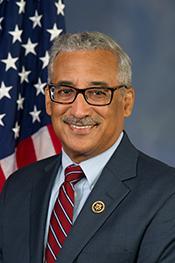
U.S. Representative for Virginia’s 3rd district
Democrat
119th Congress, two-year term
Missed 0.6% of roll calls. Chamber median 1.9%.
The full voting recordCounts roll calls where most Democrats and most Republicans voted differently, leaving out procedural votes.
How we countFrom FEC filings, Voteview roll calls and Congress.gov.
Democrat. In Congress since 1993, 17 terms in total.
Following saves Scott to your list, which Chamber & Street keeps on its server, linked to a cookie on this browser and not to your name or email. Email alerts will come with constituent verification.
Bills and resolutions Scott signed on to as a cosponsor. An original cosponsor signed on the day the bill was introduced. Source: govinfo bill status files, last updated Nov 6, 2026.
Workplace Violence Prevention for Health Care and Social Service Workers Act
Sponsor Joe Courtney (D). Original cosponsor. 134 cosponsors. H.R. 2531 on Congress.gov
Introduced
Workplace Violence Prevention for Health Care and Social Service Workers Act
This bill requires the Department of Labor to address workplace violence in health care, social service, and similar sectors.
Specifically, Labor must issue an occupational safety and health standard that requires certain employers to take actions to protect workers and other personnel from workplace violence. The standard applies to employers in the health care sector, in the social service sector, and in sectors that conduct activities similar to those in the health care and social service sectors. Among other elements, the standard must require each employer to (1) develop a workplace violence prevention plan, (2) promptly investigate incidents of workplace violence, and (3) provide relevant training and education to employees.
The bill requires certain hospitals and skilled nursing facilities to comply with this standard as a condition of Medicare participation.
COST of Relocations Act
Sponsor Suhas Subramanyam (D). Original cosponsor. 33 cosponsors. H.R. 2470 on Congress.gov(opens in a new tab)
Introduced
Virginia Beach Heroes Act
Sponsor Jennifer Kiggans (R). Original cosponsor. 7 cosponsors. H.R. 2330 on Congress.gov(opens in a new tab)
Introduced
Paycheck Fairness Act
Sponsor Rosa DeLauro (D). Original cosponsor. 221 cosponsors. H.R. 17 on Congress.gov(opens in a new tab)
Introduced
Recognizing the significance of equal pay and the disparity between wages paid to men and women.
Sponsor Lois Frankel (D). Original cosponsor. 132 cosponsors. H.Con.Res. 21 on Congress.gov(opens in a new tab)
Introduced
FAIR Act
Joined Mar 21, 2025. 36 cosponsors. H.R. 493 on Congress.gov(opens in a new tab)
Progress not on file
Federal Adjustment of Income Rates Act or the FAIR Act
This bill modifies pay rates for federal employees in 2026. Specifically, the bill increases rates under the statutory pay systems and for prevailing rate employees by 3.3% and increases locality pay by 1%.
Rights for the TSA Workforce Act
Sponsor Bennie Thompson (D). Joined Mar 21, 2025. 190 cosponsors. H.R. 2086 on Congress.gov(opens in a new tab)
Introduced
Feed Hungry Veterans Act of 2025
Sponsor Jahana Hayes (D). Original cosponsor. 68 cosponsors. H.R. 2195 on Congress.gov(opens in a new tab)
Introduced
Feed Hungry Veterans Act of 2025
This bill expands eligibility for the Supplemental Nutrition Assistance Program (SNAP) for certain disabled veterans, including those determined to be catastrophically disabled. In addition, those disabled veterans who are eligible for SNAP under this bill are exempt from the general SNAP work registration and employment and training requirements.
The bill takes effect on October 1, 2030.
Chesapeake Bay Conservation Acceleration Act of 2025
Sponsor Robert Wittman (R). Original cosponsor. 6 cosponsors. H.R. 2091 on Congress.gov(opens in a new tab)
Introduced
Caring for Survivors Act of 2025
Sponsor Jahana Hayes (D). Original cosponsor. 134 cosponsors. H.R. 2055 on Congress.gov(opens in a new tab)
Introduced
Caring for Survivors Act of 2025
This bill increases the monthly rate of dependency and indemnity compensation payable to surviving spouses through the Department of Veterans Affairs (VA).
Dependency and indemnity compensation is a monthly payment made to eligible survivors (i.e., spouses, parents, or children) of (1) certain veterans who died as a result of a service-connected condition; (2) service members killed while on active military duty or active or inactive duty for training; or (3) veterans who did not die from a service-connected condition, but were totally disabled by a service-connected disability for a certain period of time.
The bill also (1) reduces, from 10 years to 5 years, the period of time that certain veterans must have been rated totally disabled due to a service-connected disability in order for a survivor to qualify for benefits; and (2) specifies the amount that is payable to survivors of veterans who were rated totally disabled for a period of less than 10 years before their death.
Department of Defense PFAS Discharge Prevention Act
Sponsor Jennifer McClellan (D). Original cosponsor. 18 cosponsors. H.R. 1938 on Congress.gov(opens in a new tab)
Introduced
John R. Lewis Voting Rights Advancement Act of 2025
Sponsor Terri Sewell (D). Original cosponsor. 221 cosponsors. H.R. 14 on Congress.gov(opens in a new tab)
Introduced
John R. Lewis Voting Rights Advancement Act of 2025
This bill establishes new criteria for determining which states and political subdivisions must obtain preclearance before changes to voting practices may take effect. Preclearance is the process of receiving preapproval from the Department of Justice (DOJ) or the U.S. District Court for the District of Columbia before making legal changes that would affect voting rights.
A state and all of its political subdivisions shall be subject to preclearance of voting practice changes for a 10-year period if, during the previous 25 years:
• 15 or more voting rights violations occurred in the state;
• 10 or more violations occurred, at least 1 of which was committed by the state itself; or
• 3 or more violations occurred and the state administers the elections.
A political subdivision as a separate unit shall also be subject to preclearance for a 10-year period if three or more voting rights violations occurred there during the previous 25 years.
States and political subdivisions that meet certain thresholds regarding minority groups must preclear covered practices before implementation, such as redistricting.
States and political subdivisions must notify the public of changes to voting practices.
The bill authorizes DOJ to require states or political subdivisions to provide certain documents or answers to questions for enforcing voting rights.
The bill outlines factors courts must consider when hearing challenges to voting practices, such as the extent of any history of official voting discrimination in the state or political subdivision.
Redesignating the Robert E. Lee Memorial as the "Arlington House National Historic Site".
Sponsor Donald Beyer (D). Original cosponsor. 175 cosponsors. H.J.Res. 63 on Congress.gov(opens in a new tab)
Introduced
This joint resolution redesignates the memorial to Robert. E. Lee in Arlington National Cemetery as the Arlington House National Historic Site.
American Dream and Promise Act of 2025
Sponsor Sylvia Garcia (D). Original cosponsor. 221 cosponsors. H.R. 1589 on Congress.gov(opens in a new tab)
Introduced
American Dream and Promise Act of 2025
This bill provides certain non-U.S. nationals (aliens under federal law) with a path to receive permanent resident status and contains other immigration-related provisions.
The Department of Homeland Security (DHS) or the Department of Justice (DOJ) shall provide conditional permanent resident status for 10 years to a qualifying individual who entered the United States as a minor and (1) is deportable or inadmissible, (2) has deferred enforced departure (DED) status or temporary protected status (TPS), or (3) is the child of certain classes of nonimmigrants. The bill imposes various qualifying requirements, such as the individual being continuously physically present in the United States since January 1, 2021, passing a background check, and being enrolled in or having completed certain educational programs.
DHS shall remove the conditions placed on permanent resident status granted under this bill if the individual applies and meets certain requirements, such as completing certain programs at an educational institution, serving in the military, or being employed.
Furthermore, DHS or DOJ shall provide lawful permanent resident status to certain individuals who had TPS, were eligible for TPS, or were eligible for DED status on certain dates. Such individuals must meet certain requirements and apply for such status within three years of this bill's enactment.
This bill also repeals a restriction that bars a state from providing higher education benefits to undocumented individuals unless those benefits are available to all U.S. nationals without regard to residency in the state.
Providing amounts for the expenses of the Committee on Education and Workforce in the One Hundred Nineteenth Congress.
Sponsor Tim Walberg (R). Original cosponsor. 1 cosponsor. H.Res. 140 on Congress.gov(opens in a new tab)
Introduced
This resolution provides amounts for the expenses of the House Committee on Education and Workforce for the 119th Congress.
Taxpayer Data Protection Act
Sponsor Haley Stevens (D). Original cosponsor. 205 cosponsors. H.R. 1101 on Congress.gov(opens in a new tab)
Introduced
Taxpayer Data Protection Act
This bill restricts access to any public money receipt or payment system belonging to the Department of the Treasury.
Specifically, access is limited to authorized Treasury officers, employees, or contractors meeting certain performance standards who have held a qualified position for at least a year, or who hold other qualifications as provided by the bill. The bill specifically prohibits special government employees (i.e., temporary appointees hired to perform specific tasks) from having access to such systems. The bill also provides that an individual accessing such systems shall be treated as an executive branch employee for purposes of federal criminal conflict of interest laws.
Treasury's Office of Inspector General must investigate and report on each instance of unauthorized use or other access of such payment systems.
Right to Contraception Act
Sponsor Lizzie Fletcher (D). Original cosponsor. 211 cosponsors. H.R. 999 on Congress.gov(opens in a new tab)
Introduced
Right to Contraception Act
This bill sets out statutory protections for an individual's right to access and a health care provider's right to provide contraception and related information. Contraception refers to an action taken to prevent pregnancy, including the use of contraceptives (i.e., a device or medication used to prevent pregnancy), fertility-awareness based methods, and sterilization procedures.
Generally, the bill prohibits measures that single out and impede access to contraception and related information. However, a party may defend against a claim that a measure violates the bill's prohibitions by demonstrating, through clear and convincing evidence, that the measure significantly advances the safety of contraception and cannot be achieved through less restrictive means. The bill also specifies that the prohibition preempts inconsistent state and local laws and applies notwithstanding other federal laws, including the Religious Freedom Restoration Act of 1993.
The Department of Justice, individuals, or health care providers may bring a lawsuit to enforce this bill, and states are not immune from suits for violations.
Rosa Parks Commemorative Coin Act
Sponsor Joyce Beatty (D). Original cosponsor. 66 cosponsors. H.R. 916 on Congress.gov(opens in a new tab)
Introduced
Rosa Parks Commemorative Coin Act
This bill directs the Department of the Treasury to mint and issue coins in recognition and celebration of Rosa Parks. All sales of coins issued under this bill must include a surcharge to be paid to the Rosa and Raymond Parks Institute for Self Development.
Recognizing the cultural and historical significance of Lunar New Year in 2025.
Sponsor Grace Meng (D). Original cosponsor. 51 cosponsors. H.Res. 75 on Congress.gov(opens in a new tab)
Introduced
This resolution recognizes the cultural and historical significance of the Lunar New Year.
The resolution expresses, in observance of this Lunar New Year, the Year of the Snake, the deepest respect of the House of Representatives for Asian Americans and all individuals throughout the world who celebrate this significant occasion.
The resolution wishes Asian Americans and all individuals who observe this holiday a happy and prosperous new year.
Expressing strong disapproval of the President's announcement to withdraw the United States from the Paris Agreement.
Sponsor Bradley Schneider (D). Original cosponsor. 162 cosponsors. H.Res. 68 on Congress.gov(opens in a new tab)
Introduced
Proxy Voting for New Parents Resolution
Sponsor Brittany Pettersen (D). Joined Jan 23, 2025. 175 cosponsors. H.Res. 23 on Congress.gov(opens in a new tab)
Introduced
Proxy Voting for New Parents Resolution
This resolution authorizes proxy voting in the House of Representatives for a Member who has given birth or whose spouse has given birth and pregnant Members who are unable to travel safely or have a serious medical condition.
Under the resolution, a qualifying Member may designate a proxy to cast a vote in a committee, the Committee of the Whole, or on the House floor; however, proxies will not be counted for purposes of establishing a quorum. The proxy designation is valid for up to 12 weeks.
To designate a proxy for House and Committee of the Whole votes, the Member must submit a signed and dated letter to the Clerk stating the Member’s qualifying circumstances and the name and state of the Member who has agreed to be designated as proxy. A Member who has designated a proxy according to these requirements may also designate a proxy for committee votes. To designate a proxy for committee votes, the Member must provide the committee chair and ranking minority member with a signed and dated letter specifying another member of the committee to cast a proxy vote.
The resolution further provides that a Member may revoke the proxy authorization by (1) casting the Member’s own vote; (2) recording the Member’s own presence in the House or in the Committee of the Whole; or (3) in a committee, by submitting a signed letter to the chair and ranking minority member.
Neighbors Not Enemies Act
Sponsor Ilhan Omar (D). Original cosponsor. 67 cosponsors. H.R. 630 on Congress.gov(opens in a new tab)
Introduced
Neighbors Not Enemies Act
This bill repeals provisions authorizing the President to apprehend and remove from the United States the citizens of a particular nation, if the United States has declared war against that nation or that nation has threatened an invasion against the United States.
Supporting the goals and ideals of Korean American Day.
Sponsor Jimmy Gomez (D). Original cosponsor. 72 cosponsors. H.Res. 33 on Congress.gov(opens in a new tab)
Introduced
This resolution expresses support for the goals and ideals of Korean American Day and honors the 122nd anniversary of the arrival of the first Korean immigrants to the United States.
Washington, D.C. Admission Act
Sponsor Eleanor Norton (D). Original cosponsor. 209 cosponsors. H.R. 51 on Congress.gov(opens in a new tab)
Introduced
Washington, D.C. Admission Act
This bill provides for the establishment of the State of Washington, Douglass Commonwealth, and its admission into the United States.
The state is composed of most of the territory of the District of Columbia (DC), excluding a specified area that encompasses the U.S. Capitol, the White House, the U.S. Supreme Court building, federal monuments, and federal office buildings adjacent to the National Mall and the U.S. Capitol. The excluded territory shall be known as the Capital and serve as the seat of the government of the United States, as provided for in Article I of the Constitution. The state may not impose taxes on federal property except as Congress permits.
The bill provides for the DC Mayor to issue a proclamation for the first elections to Congress of two Senators and one Representative of the state. The bill eliminates the office of Delegate to the House of Representatives.
The bill applies current DC laws to the state. DC judicial proceedings and contractual obligations shall continue under the state’s authority. The bill also provides for specified federal obligations to transfer to the state upon its certification that it has funds and laws in place to assume the obligations. These include maintaining a retirement fund for judges and operating public defender services.
The bill establishes a commission that is generally comprised of members who are appointed by DC and federal government officials to advise on an orderly transition to statehood.