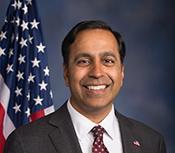
U.S. Representative for Illinois’s 8th district
Democrat
119th Congress, two-year term
Missed 2.1% of roll calls. Chamber median 1.9%.
The full voting recordCounts roll calls where most Democrats and most Republicans voted differently, leaving out procedural votes.
How we countFrom FEC filings, Voteview roll calls and Congress.gov.
Democrat. In Congress since 2017, 5 terms in total.
Following saves Krishnamoorthi to your list, which Chamber & Street keeps on its server, linked to a cookie on this browser and not to your name or email. Email alerts will come with constituent verification.
Bills and resolutions Krishnamoorthi signed on to as a cosponsor. An original cosponsor signed on the day the bill was introduced. Source: govinfo bill status files, last updated Nov 6, 2026.
Recognizing and honoring teachers who have earned or maintained National Board Certification.
Sponsor Julia Letlow (R). Original cosponsor. 28 cosponsors. H.Res. 218 on Congress.gov
Introduced
This resolution honors the teachers who have earned or maintained National Board Certification as of March 2025.
Condemning the Members of Congress constituting the leadership team of the House Republican Conference.
Sponsor Sylvia Garcia (D). Original cosponsor. 125 cosponsors. H.Res. 216 on Congress.gov(opens in a new tab)
Introduced
Medicare Dental, Vision, and Hearing Benefit Act of 2025
Sponsor Lloyd Doggett (D). Original cosponsor. 132 cosponsors. H.R. 2045 on Congress.gov(opens in a new tab)
Introduced
Medicare Dental, Vision, and Hearing Benefit Act of 2025
This bill provides for Medicare coverage of dental, vision, and hearing care. Coverage includes (1) routine dental cleanings and exams, basic and major dental services, emergency dental care, and dentures; (2) routine eye exams, eyeglasses, and contact lenses; and (3) routine hearing exams, hearing aids, and exams for hearing aids. With respect to such care, the bill establishes special payment rules, limitations, and coinsurance requirements.
Stop Comstock Act
Sponsor Becca Balint (D). Original cosponsor. 146 cosponsors. H.R. 2029 on Congress.gov(opens in a new tab)
Introduced
Joint Task Force to Counter Illicit Synthetic Narcotics Act of 2025
Sponsor Dan Newhouse (R). Original cosponsor. 9 cosponsors. H.R. 2024 on Congress.gov(opens in a new tab)
Introduced
Mikaela Naylon Give Kids a Chance Act
Sponsor Michael McCaul (R). Joined Mar 11, 2025. 313 cosponsors. H.R. 1262 on Congress.gov(opens in a new tab)
Passed the House
Give Kids a Chance Act of 2025
This bill expands the Food and Drug Administration’s (FDA’s) authority with respect to research on rare pediatric diseases, including by permitting the FDA to take enforcement action against drug sponsors that fail to satisfy pediatric study requirements and by reauthorizing programs that support pediatric research.
Specifically, the bill
• modifies requirements relating to molecularly targeted pediatric cancer investigations to permit research on new drugs in combination with active ingredients that have already been approved, provided certain conditions are met;
• permits the FDA to take enforcement action against drug sponsors that fail to comply with pediatric study requirements, if such sponsors demonstrated a lack of due diligence in satisfying the requirement;
• renews the FDA’s authority to award priority review vouchers to sponsors of new products intended to treat rare pediatric diseases through September 30, 2029; and
• reauthorizes through FY2027 certain funding for the National Institutes of Health to support priority pediatric research.
The bill also provides statutory authority for the FDA’s interpretation of the orphan drug exclusivity period. The bill specifies, consistent with FDA regulations, that the seven-year market exclusivity period for drugs for rare diseases or conditions (i.e., orphan drugs) prohibits the approval of the same drug for the same approved use or indication with respect to the disease or condition. (In Catalyst Pharmaceuticals, Inc. v. Becerra, a court rejected the FDA’s interpretation and held that orphan drug exclusivity extends to all uses or indications for the disease or condition.)
Department of Education Protection Act
Sponsor Jahana Hayes (D). Joined Mar 10, 2025. 132 cosponsors. H.R. 433 on Congress.gov(opens in a new tab)
Introduced
Department of Education Protection Act
This bill prohibits the use of appropriated funds made available to the Department of Education (ED) to decentralize, reduce the staffing level of, or alter the responsibilities or functionality of ED compared to its organization or operation on January 1, 2025.
American Teacher Act
Sponsor Frederica Wilson (D). Original cosponsor. 102 cosponsors. H.R. 2021 on Congress.gov(opens in a new tab)
Introduced
American Teacher Act
This bill establishes grants to increase the minimum salary of public elementary and secondary school teachers. It also authorizes a national campaign regarding the value of the teaching profession.
First, the bill directs the Department of Education (ED) to award four-year grants to state educational agencies (SEAs) and, through them, subgrants to local educational agencies to establish a minimum annual salary of $60,000 (to be adjusted annually for inflation) for these teachers.
Second, the bill directs ED to award grants to eligible SEAs to provide cost-of-living adjustments to the annual base salary of teachers.
Finally, the bill authorizes ED to carry out a national campaign to (1) increase awareness about the importance of teachers and the value of the teaching profession, (2) encourage secondary school and college students to consider teaching as a professional career, and (3) diversify the pool of individuals who enter the teaching profession.
Tyler’s Law
Sponsor Ted Lieu (D). Original cosponsor. 65 cosponsors. H.R. 2004 on Congress.gov(opens in a new tab)
Passed the House
Tyler’s Law
This bill requires the Department of Health and Human Services (HHS) to complete, within one year after the bill’s enactment, a study on how frequently Medicare-participating hospital emergency departments test for fentanyl in patients experiencing an overdose, the costs associated with such testing, and how such testing may impact patients.
Within six months after the study’s completion and based on its results, HHS must issue guidance regarding (1) whether hospital emergency departments should implement fentanyl testing as a routine procedure for patients experiencing an overdose, (2) how to ensure clinicians know which substances they are testing for in routine drug tests, and (3) how fentanyl testing may affect the future risk of overdose and other health outcomes.
Securing American Agriculture Act
Sponsor Ashley Hinson (R). Original cosponsor. 18 cosponsors. H.R. 1995 on Congress.gov(opens in a new tab)
Introduced
Securing American Agriculture Act
This bill directs the Department of Agriculture (USDA) to assess, on an annual basis, U.S. dependency on critical agricultural products or inputs that could be exploited in the event that China weaponizes such a dependency. USDA must submit a report to Congress on the assessment, which must include recommendations to reduce U.S. dependency on China to supply critical agricultural products or inputs.
Under the bill, critical inputs include all farm management, agronomic, and field-applied production inputs (e.g., agricultural equipment, fertilizers, veterinary drugs, and seed).
The bill specifies that, in conducting the assessment, USDA may not require a private entity to provide information to USDA. Further, the bill requires USDA to comply with certain confidentiality requirements and restricts disclosures of the information.
American Innovation and R&D Competitiveness Act of 2025
Sponsor Ron Estes (R). Original cosponsor. 81 cosponsors. H.R. 1990 on Congress.gov(opens in a new tab)
Introduced
Do No Harm Act
Sponsor Robert Scott (D). Original cosponsor. 125 cosponsors. H.R. 1954 on Congress.gov(opens in a new tab)
Introduced
Do No Harm Act
This bill prohibits the application of the Religious Freedom Restoration Act of 1993 (RFRA) to specified federal laws or the implementation of such laws. Currently, RFRA prohibits the government from substantially burdening a person's exercise of religion even if the burden results from a rule of general applicability, except in furtherance of a compelling governmental interest when using the least restrictive means.
Under the bill, RFRA is inapplicable to laws or the implementation of laws that
• protect against discrimination or require the promotion of equal opportunity (e.g., the Civil Rights Act of 1964);
• require employers to provide wages, other compensation, or benefits, including leave;
• protect collective activity in the workplace;
• protect against child labor, abuse, or exploitation; or
• provide for access to, information about, referrals for, provision of, or coverage for any health care item or service.
The bill prevents RFRA from being used to deny (1) goods or services the government has agreed to provide to a beneficiary of or participant in a program or activity funded by a government contract, grant, agreement, or other award; or (2) a person's full and equal enjoyment of a government-provided good, service, benefit, facility, privilege, advantage, or accommodation.
In order for a person to assert a RFRA claim or defense in a judicial proceeding, the government must be a party to the proceeding.
ProTECT Act of 2025
Sponsor Ted Lieu (D). Original cosponsor. 7 cosponsors. H.R. 1934 on Congress.gov(opens in a new tab)
Introduced
Farewell to Foam Act of 2025
Sponsor Lloyd Doggett (D). Original cosponsor. 86 cosponsors. H.R. 1918 on Congress.gov(opens in a new tab)
Introduced
Richard L. Trumka Protecting the Right to Organize Act of 2025
Sponsor Robert Scott (D). Original cosponsor. 217 cosponsors. H.R. 20 on Congress.gov(opens in a new tab)
Introduced
Disclosing Foreign Influence in Lobbying Act
Sponsor Mariannette Miller-Meeks (R). Original cosponsor. 2 cosponsors. H.R. 1883 on Congress.gov(opens in a new tab)
Introduced
Protecting Americans’ Social Security Data Act
Sponsor John Larson (D). Original cosponsor. 152 cosponsors. H.R. 1877 on Congress.gov(opens in a new tab)
Introduced
Protecting Americans’ Social Security Data Act
This bill prohibits political appointees and special government employees from accessing Social Security data systems that contain personally identifiable information about Social Security beneficiaries.
Specifically, political appointees and special government employees may not access systems maintained by the Social Security Administration (SSA) that issue or record Social Security account numbers, that are used to determine eligibility for or to pay Social Security benefits, or that otherwise contain personally identifiable information about individuals receiving or applying for benefits.
The bill also establishes a civil right of action for an individual whose information was negligently accessed or disclosed in violation of these provisions. The individual may bring suit against the United States if the violator was a U.S. employee or officer, or against the violator if they were not a U.S. employee or officer. Such a claim must be brought within two years of the affected individual’s discovery of the violation. Upon a finding of liability, defendants are liable for specified monetary damages.
If an individual is criminally charged or subject to proposed disciplinary or adverse action by a federal or state agency for having accessed or disclosed information in violation of these provisions, SSA must notify the individual whose information was accessed or disclosed of the violation as soon as practicable.
Finally, the bill requires the SSA Office of the Inspector General to investigate and report to Congress on any unauthorized access to or disclosure of information in a beneficiary data system.
Keeping Our Field Offices Open Act
Sponsor John Larson (D). Original cosponsor. 130 cosponsors. H.R. 1876 on Congress.gov(opens in a new tab)
Introduced
Keeping Our Field Offices Open Act
This bill temporarily prohibits the closure or consolidation of, or other limitation of access to, Social Security Administration (SSA) offices and stations, and sets forth procedural requirements for future changes to office and station availability.
Specifically, the bill prohibits through at least January 21, 2029, the closure or consolidation of, or other limitation of access to, SSA field offices, hearing offices, and resident stations. On or after that date, SSA must submit a report to Congress justifying its process for selecting stations and offices to be closed, consolidated, or limited. The prohibition is lifted 180 days after the submission of such report.
The bill also sets forth requirements that must be met before SSA may close, consolidate, or otherwise limit access to an office or station after the initial moratorium expires. At least 120 days before such a change takes effect, SSA must provide public notice to individuals in affected areas, including information on how lost access to SSA services will be replaced. SSA must also conduct at least two public hearings on each such change.
Further, SSA must provide a hearing to any individual who makes a timely showing that a determination to close, consolidate, or limit an office or station is arbitrary, capricious, or deficient in another specified manner.
Finally, a closure, consolidation, or limitation may not result in the total number of SSA offices or stations falling below the number of such offices or stations in operation on January 20, 2025.
Protecting American Industry and Labor from International Trade Crimes Act of 2026
Sponsor Ashley Hinson (R). Original cosponsor. 44 cosponsors. H.R. 1869 on Congress.gov(opens in a new tab)
Passed the House
Protecting American Industry and Labor from International Trade Crimes Act of 2025
This bill requires the Department of Justice to establish a task force, program, or other similar structure within its Criminal Division to investigate and prosecute trade-related crimes.
Conrad State 30 and Physician Access Reauthorization Act
Sponsor David Valadao (R). Joined Mar 5, 2025. 66 cosponsors. H.R. 1585 on Congress.gov(opens in a new tab)
Introduced
Conrad State 30 and Physician Access Reauthorization Act
This bill modifies the Conrad 30 Waiver program, which incentivizes qualified foreign physicians to serve in underserved communities. It also extends statutory authority for the program for three years from this bill's enactment.
Individuals coming to the United States under a J-1 nonimmigrant visa to receive medical training typically must leave the country and reside for two years abroad before being eligible to apply for an immigrant visa or permanent residence. The Conrad program waives this requirement for individuals who meet certain qualifications, including serving for a number of years at a health care facility in an underserved area.
The bill increases the number of waivers that a state may obtain each fiscal year from 30 to 35 if a certain number of waivers were used the previous year, and provides for further adjustments depending on demand.
A physician may be employed at an academic medical center to meet the Conrad program's employment requirements if the physician's work is in the public interest, even if the medical center is not in an underserved area.
Employment contracts for physicians under the Conrad program shall contain certain information, such as the maximum number of on-call hours per week the physician shall have to work.
Certain physicians (along with the physician's spouse and children) shall be exempt from the direct annual numerical limits on immigration, including those physicians that have met certain requirements related to visas for physicians to serve in underserved areas.
John R. Lewis Voting Rights Advancement Act of 2025
Sponsor Terri Sewell (D). Original cosponsor. 221 cosponsors. H.R. 14 on Congress.gov(opens in a new tab)
Introduced
John R. Lewis Voting Rights Advancement Act of 2025
This bill establishes new criteria for determining which states and political subdivisions must obtain preclearance before changes to voting practices may take effect. Preclearance is the process of receiving preapproval from the Department of Justice (DOJ) or the U.S. District Court for the District of Columbia before making legal changes that would affect voting rights.
A state and all of its political subdivisions shall be subject to preclearance of voting practice changes for a 10-year period if, during the previous 25 years:
• 15 or more voting rights violations occurred in the state;
• 10 or more violations occurred, at least 1 of which was committed by the state itself; or
• 3 or more violations occurred and the state administers the elections.
A political subdivision as a separate unit shall also be subject to preclearance for a 10-year period if three or more voting rights violations occurred there during the previous 25 years.
States and political subdivisions that meet certain thresholds regarding minority groups must preclear covered practices before implementation, such as redistricting.
States and political subdivisions must notify the public of changes to voting practices.
The bill authorizes DOJ to require states or political subdivisions to provide certain documents or answers to questions for enforcing voting rights.
The bill outlines factors courts must consider when hearing challenges to voting practices, such as the extent of any history of official voting discrimination in the state or political subdivision.
Freedom to Invest in Tomorrow’s Workforce Act
Sponsor Robert Wittman (R). Joined Mar 5, 2025. 203 cosponsors. H.R. 1151 on Congress.gov(opens in a new tab)
Introduced
Freedom to Invest in Tomorrow’s Workforce Act
This bill expands the expenses eligible for tax-free withdrawals from a qualified tuition program (known as a 529 plan) to include tuition, fees (including test fees), books, supplies, equipment, and other expenses related to the enrollment or attendance in a recognized postsecondary credentialing program.
Under the bill, a recognized postsecondary credentialing program includes certain programs identified by a state as providing training services, a program listed in the Web Enabled Approval Management System (WEAMS) maintained by the Department of Veterans Affairs, certain examinations required to obtain or maintain a credential, and other reputable credentialing programs.
Further, under the bill, such programs must be designed for an individual to obtain
• an industry-recognized postsecondary employment credential (e.g., project management professional certificate, advanced emergency medical technician certificate, and welding supervisor certificate),
• a certificate of completion of a registered and certified apprenticeship,
• an occupational or professional license issued or recognized by a state or the federal government (and any certification required for obtaining such license), or
• an associate or baccalaureate degree.
Of inquiry requesting the President to transmit certain information to the House of Representatives referring to the termination, removal, placement on administrative leave, moved to another department of Federal employees and Inspectors General of agencies.
Sponsor Kweisi Mfume (D). Original cosponsor. 20 cosponsors. H.Res. 187 on Congress.gov(opens in a new tab)
Introduced
Of inquiry requesting the President to transmit certain documents to the House of Representatives relating to the conflicts of interest of Elon Musk and related information.
Original cosponsor. 20 cosponsors. H.Res. 186 on Congress.gov(opens in a new tab)
Progress not on file
Redesignating the Robert E. Lee Memorial as the "Arlington House National Historic Site".
Sponsor Donald Beyer (D). Joined Mar 4, 2025. 175 cosponsors. H.J.Res. 63 on Congress.gov(opens in a new tab)
Introduced
This joint resolution redesignates the memorial to Robert. E. Lee in Arlington National Cemetery as the Arlington House National Historic Site.