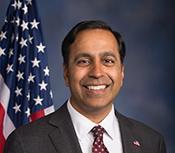
U.S. Representative for Illinois’s 8th district
Democrat
119th Congress, two-year term
Missed 2.1% of roll calls. Chamber median 1.9%.
The full voting recordCounts roll calls where most Democrats and most Republicans voted differently, leaving out procedural votes.
How we countFrom FEC filings, Voteview roll calls and Congress.gov.
Democrat. In Congress since 2017, 5 terms in total.
Following saves Krishnamoorthi to your list, which Chamber & Street keeps on its server, linked to a cookie on this browser and not to your name or email. Email alerts will come with constituent verification.
Bills and resolutions Krishnamoorthi signed on to as a cosponsor. An original cosponsor signed on the day the bill was introduced. Source: govinfo bill status files, last updated Nov 6, 2026.
Supporting the designation of the week of September 21 through September 25, 2026, as "National Hazing Awareness Week".
Sponsor Lucy McBath (D). Original cosponsor. 11 cosponsors. H.Res. 1580 on Congress.gov
Introduced
Expressing support for the recognition of September 27, 2026, to October 3, 2026, as "Asian American and Native American Pacific Islander-Serving Institutions Week".
Sponsor Judy Chu (D). Original cosponsor. 35 cosponsors. H.Res. 1574 on Congress.gov(opens in a new tab)
Introduced
Encouraging the recognition of a "National LGBTQ+ Servicemembers and Veterans Day".
Sponsor Emily Randall (D). Joined Sep 24, 2026. 14 cosponsors. H.Res. 1572 on Congress.gov(opens in a new tab)
Introduced
Stop Spam Calls Act
Sponsor Suhas Subramanyam (D). Original cosponsor. 7 cosponsors. H.R. 10610 on Congress.gov(opens in a new tab)
Introduced
Civilian Climate Corps for Jobs and Justice Act
Sponsor Alexandria Ocasio-Cortez (D). Original cosponsor. 36 cosponsors. H.R. 10585 on Congress.gov(opens in a new tab)
Introduced
Acknowledging that in the aftermath of September 11, 2001, individuals experienced hate and were targeted by the government on account of their faith, race, national origin and immigration status, and suggesting various forms of relief to support those affected.
Sponsor Pramila Jayapal (D). Joined Sep 21, 2026. 8 cosponsors. H.Res. 741 on Congress.gov(opens in a new tab)
Introduced
Diversify Act
Sponsor Jesús García (D). Original cosponsor. 12 cosponsors. H.R. 10518 on Congress.gov(opens in a new tab)
Introduced
Artificial Intelligence Education and Workforce Readiness Act of 2026
Sponsor Suzanne Bonamici (D). Original cosponsor. 8 cosponsors. H.R. 10515 on Congress.gov(opens in a new tab)
Introduced
Expressing support for the designation of the week beginning on September 14, 2026, as "National Hispanic-Serving Institutions Week".
Sponsor Joaquin Castro (D). Original cosponsor. 61 cosponsors. H.Res. 1559 on Congress.gov(opens in a new tab)
Introduced
This resolution expresses support for the designation of National Hispanic-Serving Institutions Week.
Relief Without Delay Act
Sponsor Wesley Bell (D). Original cosponsor. 22 cosponsors. H.R. 10486 on Congress.gov(opens in a new tab)
Introduced
American Procurement Improvement Act of 2026
Sponsor Steny Hoyer (D). Original cosponsor. 9 cosponsors. H.R. 10443 on Congress.gov(opens in a new tab)
Introduced
Food for Thought Act of 2026
Sponsor Nanette Barragán (D). Original cosponsor. 36 cosponsors. H.R. 10415 on Congress.gov(opens in a new tab)
Introduced
WIC for Kids Act
Sponsor Jahana Hayes (D). Original cosponsor. 33 cosponsors. H.R. 10393 on Congress.gov(opens in a new tab)
Introduced
Proposing an amendment to the Constitution of the United States to prohibit the use of slavery and involuntary servitude as a punishment for a crime.
Sponsor Nikema Williams (D). Original cosponsor. 54 cosponsors. H.J.Res. 216 on Congress.gov(opens in a new tab)
Introduced
Affordable Premiums for Seniors Act of 2026
Sponsor Terri Sewell (D). Original cosponsor. 20 cosponsors. H.R. 10374 on Congress.gov(opens in a new tab)
Introduced
Providing for congressional disapproval under chapter 8 of title 5, United States Code, of the rule submitted by U.S. Immigration and Customs Enforcement of the Department of Homeland Security relating to "Establishing a Fixed Time Period of Admission and an Extension of Stay Procedure for Nonimmigrant Academic Students, Exchange Visitors, and Representatives of Foreign Information Media".
Sponsor Pramila Jayapal (D). Original cosponsor. 63 cosponsors. H.J.Res. 215 on Congress.gov(opens in a new tab)
Introduced
Keep STEM Talent Act of 2025
Sponsor Bill Foster (D). Joined Sep 10, 2026. 26 cosponsors. H.R. 2627 on Congress.gov(opens in a new tab)
Introduced
Keep STEM Talent Act of 2025
This bill addresses issues relating to non-U.S. nationals (aliens under federal law) with advanced degrees in a science, technology, engineering, or mathematics (STEM) field, including exempting certain such individuals from direct limitations on the number of immigrant visas granted per year.
To be exempt from the annual numerical limitations on immigrant visas, the individual must (1) have earned a master's level or higher degree in certain STEM fields while in the United States attending an accredited higher education institution, (2) be employed (or have an offer) to perform work directly related to the degree and earn higher than the median wage for that occupation, and (3) meet certain labor certification requirements.
The bill also allows an individual seeking a nonimmigrant F-1 (student) visa for an advanced STEM degree to obtain the nonimmigrant visa even if the individual seeks lawful permanent resident status. (Generally, an individual may be denied a nonimmigrant visa if the individual actually intends to seek immigrant status, unless dual intent is allowed for that visa.)
Under this bill, to be approved for an F-1 visa for an advanced STEM degree, the applicant must apply for the visa before beginning the advanced degree program.
The bill also requires an individual who is inside the United States and applying for an F-1 visa for an advanced STEM degree to undergo the same vetting (e.g., verifying academic credentials and undergoing background checks) as an individual applying from outside the United States.
Recognizing suicide as a serious public health problem, expressing support for the designation of September 8, 2026, as "988 Day" and the role of the 988 Suicide and Crisis Lifeline, and for other purposes.
Sponsor Wesley Bell (D). Original cosponsor. 20 cosponsors. H.Res. 1514 on Congress.gov(opens in a new tab)
Introduced
Taxpayer Relief from Big Oil Act
Sponsor Maxine Dexter (D). Original cosponsor. 19 cosponsors. H.R. 10256 on Congress.gov(opens in a new tab)
Introduced
Penalties for Polluters Act
Sponsor Maxine Dexter (D). Original cosponsor. 19 cosponsors. H.R. 10255 on Congress.gov(opens in a new tab)
Introduced
Launching with Healthcare Act
Sponsor Janelle Bynum (D). Original cosponsor. 16 cosponsors. H.R. 10252 on Congress.gov(opens in a new tab)
Introduced
Back-to-School Supplies Affordability Act
Sponsor Brendan Boyle (D). Original cosponsor. 10 cosponsors. H.R. 10251 on Congress.gov(opens in a new tab)
Introduced
SIMPLE Act
Sponsor Suzanne Bonamici (D). Original cosponsor. 6 cosponsors. H.R. 10220 on Congress.gov(opens in a new tab)
Introduced
Hands Off Our Great Lakes Act
Sponsor Debbie Dingell (D). Joined Sep 1, 2026. 31 cosponsors. H.R. 10186 on Congress.gov(opens in a new tab)
Introduced
Connected Vehicle Security Act of 2026
Sponsor John Moolenaar (R). Joined Aug 31, 2026. 146 cosponsors. H.R. 8730 on Congress.gov(opens in a new tab)
Introduced
Connected Vehicle Security Act of 2026
This bill prohibits the importation, manufacture, sale, resale, or introduction into U.S. interstate commerce of connected vehicles and related software and hardware components associated with China, Russia, Iran, or North Korea.
Connected vehicle means a vehicle that (1) integrates onboard networked hardware with automotive software systems to communicate with any other network or device using certain methods (e.g., wireless spectrum connectivity); or (2) is designed, manufactured, or originally equipped to communicate via such methods, regardless of whether such capability is enabled, disabled, or removed at the time the vehicle enters the United States.
Current regulations administered by the Department of Commerce's Bureau of Industry and Security (BIS) prohibit transactions involving vehicle connectivity system hardware and covered software designed, developed, manufactured, or supplied by persons owned by, controlled by, or subject to the jurisdiction or direction of China or Russia.
The bill expands the BIS regulatory framework, including by (1) expanding the countries covered by the prohibition to include China, Russia, Iran, and North Korea (Current BIS regulations apply only to China and Russia.); and (2) specifying that certain artificial intelligence components are covered by the prohibition.
By January 1, 2027, BIS must publish a list of items that are authorized for the importation, manufacture, sale, resale, or introduction into U.S. interstate commerce and would otherwise be subject to the bill's prohibition.
The bill also includes enforcement mechanisms, including that BIS must assess civil penalties for violations of the prohibition.