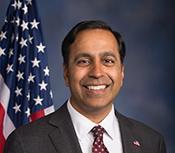
U.S. Representative for Illinois’s 8th district
Democrat
119th Congress, two-year term
Missed 2.1% of roll calls. Chamber median 1.9%.
The full voting recordCounts roll calls where most Democrats and most Republicans voted differently, leaving out procedural votes.
How we countFrom FEC filings, Voteview roll calls and Congress.gov.
Democrat. In Congress since 2017, 5 terms in total.
Following saves Krishnamoorthi to your list, which Chamber & Street keeps on its server, linked to a cookie on this browser and not to your name or email. Email alerts will come with constituent verification.
Bills and resolutions Krishnamoorthi signed on to as a cosponsor. An original cosponsor signed on the day the bill was introduced. Source: govinfo bill status files, last updated Nov 6, 2026.
Supporting Our Shelters Act
Sponsor Veronica Escobar (D). Original cosponsor. 5 cosponsors. H.R. 5020 on Congress.gov
Introduced
Protecting Health Care and Lowering Costs Act of 2025
Sponsor Adam Gray (D). Joined Aug 22, 2025. 142 cosponsors. H.R. 4849 on Congress.gov(opens in a new tab)
Introduced
Protecting Health Care and Lowering Costs Act 2025
This bill makes permanent temporary provisions that generally expand eligibility for and increase the amount of the premium tax credit. This bill also repeals multiple Medicaid, Medicare, and health-related tax provisions enacted by the One Big Beautiful Bill Act (OBBBA).
Currently, eligible taxpayers may claim the premium tax credit, which applies toward the cost of obtaining health insurance through health insurance exchanges. To qualify, a taxpayer’s household income must meet or exceed 100% of the federal poverty level (FPL) and, after 2025, may not exceed 400% of the FPL (maximum income limit). For 2021-2025, the maximum income limit is eliminated, which generally expands eligibility for the premium tax credit.
Further, under current law, the amount of the premium tax credit is partially based on the taxpayer’s household income multiplied by the applicable percentage. The applicable percentage varies depending on which of six income ranges (adjusted for inflation after 2025) the taxpayer’s household income falls within. For 2021-2025, the applicable percentages are lowered and the adjustment of the applicable percentages for inflation is eliminated, which generally increases the amount of the premium tax credit.
The bill permanently eliminates the 400% maximum income limit, lowers the applicable percentages, and eliminates the inflation adjustment for the applicable percentages.
Finally, the bill repeals multiple Medicaid, Medicare, and health-related tax provisions enacted by the OBBBA, including
• certain Medicare and Medicare eligibility and verification requirements,
• the reduced window for retroactive Medicaid coverage, and
• premium tax credit verification requirements.
Terminating the emergency determined by the President on August 11, 2025, in the Executive Order titled "Declaring a crime emergency in the District of Columbia".
Sponsor Jamie Raskin (D). Joined Aug 22, 2025. 103 cosponsors. H.J.Res. 115 on Congress.gov(opens in a new tab)
Introduced
Shielding Students from Wildfire Smoke Act
Sponsor Maxine Dexter (D). Original cosponsor. 21 cosponsors. H.R. 4976 on Congress.gov(opens in a new tab)
Introduced
340B PATIENTS Act of 2025
Sponsor Doris Matsui (D). Joined Aug 15, 2025. 21 cosponsors. H.R. 4581 on Congress.gov(opens in a new tab)
Introduced
Student Loan Bankruptcy Improvement Act of 2025
Sponsor J. Correa (D). Joined Aug 15, 2025. 24 cosponsors. H.R. 4444 on Congress.gov(opens in a new tab)
Introduced
Health Care Affordability Act of 2025
Sponsor Lauren Underwood (D). Joined Aug 15, 2025. 165 cosponsors. H.R. 247 on Congress.gov(opens in a new tab)
Introduced
Health Care Affordability Act of 2025
This bill makes permanent temporary changes enacted by the American Rescue Plan Act of 2021 (ARPA) and the Inflation Reduction Act of 2022 (IRA) that generally expand eligibility for and increase the amount of the premium tax credit.
Currently, eligible taxpayers may be able to claim the premium tax credit, which applies toward the cost of obtaining health insurance through health insurance exchanges. To be eligible for the premium tax credit, a taxpayer’s household income must meet or exceed 100% of the federal poverty level (FPL) and, after 2025, may not exceed 400% of the FPL (maximum income limit). For 2021-2025, the ARPA and IRA eliminated the maximum income limit, which generally expands eligibility for the premium tax credit.
Further, under current law, the amount of the premium tax credit is (1) generally the plan premium (conditions apply), minus (2) the taxpayer’s household income multiplied by the applicable percentage. The applicable percentage is a specific percentage that varies depending on which of six income ranges (adjusted for inflation after 2025) the taxpayer’s household income falls within. For 2021-2025, the ARPA and IRA lowered the applicable percentages and eliminated the adjustment of the applicable percentages for inflation, which generally increases the amount of the premium tax credit.
The bill makes permanent the elimination of the 400% maximum income limit, the lower applicable percentages, and the elimination of the inflation adjustment for the applicable percentages.
VA Employee Fairness Act of 2025
Sponsor Mark Takano (D). Joined Aug 8, 2025. 120 cosponsors. H.R. 3261 on Congress.gov(opens in a new tab)
Introduced
Expanding the VOTE Act
Sponsor Nikema Williams (D). Original cosponsor. 72 cosponsors. H.R. 4917 on Congress.gov(opens in a new tab)
Introduced
Expanding the Voluntary Opportunities for Translations in Elections Act or the Expanding the VOTE Act
This bill expands access to voting materials for individuals with limited proficiency in the English language.
Section 203 of the Voting Rights Act of 1965 (VRA) requires covered states and political subdivisions to provide voting materials and other language assistance to persons who are American Indian, Asian American, Alaskan Natives, or of Spanish heritage and whose ability to speak or understand English limits electoral participation. A state or political subdivision that is subject to Section 203 is prohibited from providing English-only voting materials in an election. Among other requirements, this bill (1) requires the Department of Justice to issue a notice of prohibition, including the trigger threshold at which the prohibition applies, to certain states and political subdivisions; and (2) requires covered states and political subdivisions to provide written translations of all voting materials, with the consent of any applicable tribal government, to election workers.
Additionally, the bill requires the Election Assistance Commission to make incentive grants for states and political subdivisions to provide translated voting materials.
The bill also directs the Government Accountability Office to study and report on the impact of (1) reducing the threshold requirement under Section 203 of the VRA, and (2) expanding the definition of language minorities to include native speakers of additional languages.
Youth Voting Rights Act
Sponsor Nikema Williams (D). Original cosponsor. 47 cosponsors. H.R. 4916 on Congress.gov(opens in a new tab)
Introduced
Youth Voting Rights Act
This bill expands voting access for youth.
Specifically, the bill establishes a private right of action to enforce the Twenty-Sixth Amendment, which prohibits denying or abridging the right to vote based on age. Further, the bill authorizes the Department of Justice to enforce the Twenty-Sixth Amendment against age-based restrictions for voting by mail.
Additionally, the bill directs each state to
• designate as voter registration agencies all offices within public institutions of higher education (IHEs) that provide assistance to students,
• implement a preregistration process to allow minors who are 16 years or older to register to vote in federal elections that take place when or after the preregistered individual turns age 18, and
• ensure the availability of polling places on campuses of IHEs (with the availability of waivers).
The bill prohibits durational residency requirements for voting in all federal elections. Currently, this prohibition applies only to voting for the offices of President and Vice President.
States and local jurisdictions with voter identification requirements must treat IHE-issued student identification cards as voter identification.
The Election Assistance Commission (EAC) must make grants to states to increase the involvement of individuals under age 18 in public election activities.
The Government Accountability Office must report to Congress on trends related to voter registration, absentee voting, and provisional voting. The EAC must also collect and make publicly available certain data from states.
Election Mail Act
Sponsor Nikema Williams (D). Original cosponsor. 54 cosponsors. H.R. 4915 on Congress.gov(opens in a new tab)
Introduced
Election Mail Act
This bill addresses the delivery and processing of election mail for federal elections, including by establishing certain standards for mail-in ballots.
Specifically, the bill requires the U.S. Postal Service (USPS) to
• ensure (to the maximum extent practicable) same-day processing of mail-in ballots,
• postmark each ballot,
• carry election mail (e.g., voter registration applications and mail-in ballots) as first-class mail that is free of postage,
• appoint an election mail coordinator at each area office and district office, and
• consult annually with Indian tribes regarding barriers to voting for eligible voters living on Indian lands.
The bill prohibits the USPS, within 120 days of a federal election, from making any operational change that would restrict the prompt and reliable delivery of election mail.
Each state and jurisdiction must provide with each mail-in ballot a return envelope with an intelligent mail barcode. This requirement does not apply to a state or jurisdiction that uses an alternative system that enables voters to track the ballot through the mail.
The bill requires election officials to count mail-in ballots that are postmarked by election day and arrive within seven days after the election.
Unhoused Voter Opportunity Through Elections Act
Sponsor Nikema Williams (D). Original cosponsor. 51 cosponsors. H.R. 4914 on Congress.gov(opens in a new tab)
Introduced
Unhoused Voter Opportunity Through Elections Act or the Unhoused VOTE Act
This bill expands voter registration and voting access for unhoused individuals.
The bill specifies that no state or political subdivision may deny or abridge the right of any U.S. citizen to vote because the citizen resides at or in a nontraditional abode.
Additionally, the bill requires jurisdictions that allow for ballot drop boxes to ensure that these drop boxes are available for in-person use and are accessible and clearly labeled.
If a state requires individuals to show proof of residence in order to vote in a federal election, then the state must accept the individual’s written attestation of residence. A state may not prohibit an individual who is residing in a homeless shelter from using the shelter as the individual’s residence for purposes of voting in a federal election.
The bill requires chief state election officials to conduct outreach to unhoused individuals.
The bill directs the Election Assistance Commission to (1) develop best practices for election officials regarding voter registration and voting access for unhoused individuals, and (2) make grants to eligible states and local governments for programs and activities to support access to voting for unhoused individuals.
The bill also revises the National Voter Registration Act of 1993, including by (1) treating emergency shelters as voter registration agencies, and (2) allowing an unhoused individual to use an unsheltered street location as the individual's place of residence for purposes of a voter registration application.
CHALLENGES Act
Sponsor Nikema Williams (D). Original cosponsor. 33 cosponsors. H.R. 4913 on Congress.gov(opens in a new tab)
Introduced
Help America Run Act
Sponsor Nikema Williams (D). Original cosponsor. 34 cosponsors. H.R. 4912 on Congress.gov(opens in a new tab)
Introduced
POLL Act
Sponsor Nikema Williams (D). Original cosponsor. 39 cosponsors. H.R. 4911 on Congress.gov(opens in a new tab)
Introduced
People Over Long Lines Act or the POLL Act
This bill sets forth provisions related to voting and the administration of federal elections.
Specifically, the bill requires states to ensure that voters wait no more than 30 minutes at any polling place to cast their vote in a federal election, establishes a private right of action for voters who experience longer waiting times, and directs the Election Assistance Commission to make payments to eligible states to prevent unreasonable waiting times.
Next, the bill requires each state to provide for the minimum required number of voting systems, poll workers, and other election resources for each polling location on the day of any federal election and each day of early voting. The Department of Justice's Civil Rights Division must issue uniform standards regarding the minimum number and distribution of such systems, workers, and other resources.
The bill also prohibits a chief state election administration official from taking an active part in political management or in a political campaign with respect to any federal election over which the official has supervisory authority, with certain exceptions.
Sustaining Our Democracy Act
Sponsor Nikema Williams (D). Original cosponsor. 57 cosponsors. H.R. 4910 on Congress.gov(opens in a new tab)
Introduced
Sustaining Our Democracy Act
This bill establishes and provides funds through FY2035 for the State Election Assistance and Innovation Trust Fund for purposes of promoting election activities.
Specifically, the bill establishes the Democracy Advancement and Innovation Program, through which the Office of Democracy Advancement and Innovation (also established by this bill) shall make allocations to states for carrying out democracy promotion activities. These activities include improving the administration of federal elections, recruiting and training nonpartisan election officials and poll workers, and increasing voting access.
The bill requires each state, in order to receive allocated funds, to (1) submit a plan for approval that describes how the state will distribute resources and carry out democracy promotion activities, and (2) establish uniform and nondiscriminatory state-based administrative complaint procedures.
The bill prohibits states from using funds for certain activities, including any activity that diminishes the ability of any eligible voter to participate in the electoral process.
Voters on the Move Registration Act of 2025
Sponsor Nikema Williams (D). Original cosponsor. 52 cosponsors. H.R. 4909 on Congress.gov(opens in a new tab)
Introduced
Time Off to Vote Act
Sponsor Nikema Williams (D). Original cosponsor. 54 cosponsors. H.R. 4908 on Congress.gov(opens in a new tab)
Introduced
Time Off to Vote Act
This bill requires an employer, upon the request of an employee, to provide the employee with a minimum of two consecutive hours of paid leave while polls or sites that facilitate voting-related activity are open on the day of a federal election. This allotted time may be used to vote, return a mail-in ballot, or perform other voting-related activities.
The employer may determine the two-hour period, excluding any lunch break or other break.
Taking such leave shall not result in the employee losing accrued employment benefits.
The bill makes it unlawful for an employer to interfere with the right to take such leave or for an employer to discriminate against an employee for taking such leave. Further, the bill makes it unlawful for any employer to retaliate against an employee for (1) opposing any practice made unlawful by this bill; (2) filing a charge, or instituting or causing to be instituted any proceeding, under or related to this bill; or (3) testifying or preparing to testify in an inquiry or proceeding relating to such leave.
The bill specifies penalties for employers who violate these provisions.
Reproductive Rights are Human Rights Act of 2025
Sponsor Julie Johnson (D). Original cosponsor. 59 cosponsors. H.R. 4888 on Congress.gov(opens in a new tab)
Introduced
Reproductive Freedom for Veterans Act
Sponsor Julia Brownley (D). Original cosponsor. 154 cosponsors. H.R. 4876 on Congress.gov(opens in a new tab)
Introduced
PHDs First Act
Sponsor Shri Thanedar (D). Joined Aug 5, 2025. 2 cosponsors. H.R. 4867 on Congress.gov(opens in a new tab)
Introduced
Honoring the life of Dr. Paul Farmer by recognizing the duty of the Federal Government to adopt a 21st-century global health solidarity strategy and take actions to address past and ongoing harms that undermine the health and well-being of people around the world.
Sponsor Janice Schakowsky (D). Original cosponsor. 14 cosponsors. H.Res. 629 on Congress.gov(opens in a new tab)
Introduced
Veteran Families Health Services Act of 2025
Sponsor Rick Larsen (D). Original cosponsor. 19 cosponsors. H.R. 4855 on Congress.gov(opens in a new tab)
Introduced
Protect Our Hospitals Act
Sponsor Greg Landsman (D). Joined Aug 1, 2025. 23 cosponsors. H.R. 4807 on Congress.gov(opens in a new tab)
Introduced
Medical Debt Relief Act of 2025
Sponsor Nikema Williams (D). Original cosponsor. 17 cosponsors. H.R. 4827 on Congress.gov(opens in a new tab)
Introduced