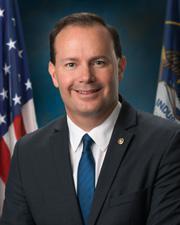
U.S. Senator for Utah
Republican
Senate term end not loaded yet
Missed 3.1% of roll calls. Chamber median 2.1%.
The full voting recordCounts roll calls where most Democrats and most Republicans voted differently, leaving out procedural votes.
How we countFrom FEC filings, Voteview roll calls and Congress.gov.
Republican. In Congress since 2011, 3 terms in total.
Following saves Lee to your list, which Chamber & Street keeps on its server, linked to a cookie on this browser and not to your name or email. Email alerts will come with constituent verification.
Bills and resolutions where Lee is the primary sponsor. Most bills never leave committee; that is normal for every member. Source: Congress.gov, last updated Oct 29, 2026.
14 of 139 have at least one cosponsor from the other party.
Ensuring Coast Guard Readiness Act
Introduced Feb 5, 2025. 1 cosponsor. S. 407 on Congress.gov
Introduced
A joint resolution disapproving the rule submitted by the Financial Crimes Enforcement Network relating to "Anti-Money Laundering Regulations for Residential Real Estate Transfers".
Introduced Feb 5, 2025. 0 cosponsors. S.J.Res. 15 on Congress.gov(opens in a new tab)
Introduced
This joint resolution nullifies the final rule issued by the Financial Crimes Enforcement Network (FinCEN) titled Anti-Money Laundering Regulations for Residential Real Estate Transfers and published on August 29, 2024. This rule requires persons involved in real estate closings and settlements to report to FinCEN any non-financed (i.e., cash) transfers of residential property to certain legal entities and trusts.
A resolution expressing the vital importance of the Panama Canal to the United States.
Introduced Feb 4, 2025. 4 cosponsors. S.Res. 54 on Congress.gov(opens in a new tab)
Introduced
This resolution expresses that the Panama Canal is vital to U.S. regional security, hemispheric hegemony, and economic interests. The resolution also assesses that Chinese-backed investment in Panama's port infrastructure and canal operations violates the Neutrality Treaty (i.e., the Treaty Concerning the Permanent Neutrality and Operation of the Panama Canal, signed in 1977) and urges the administration to ensure that the canal remains neutral.
SHUSH Act
Introduced Jan 30, 2025. 8 cosponsors. S. 345 on Congress.gov(opens in a new tab)
Introduced
Silencers Help Us Save Hearing Act or the SHUSH Act
This bill removes silencers from regulation under federal firearms laws.
Specifically, it removes silencers from the list of firearms subject to regulation (i.e., registration and licensing requirements) under the National Firearms Act (NFA). Additionally, it excludes a muffler or silencer from the list of firearms subject to regulation (e.g., background check requirements) under the Gun Control Act of 1968 (GCA).
Additionally, the bill does the following:
• preempts state or local laws that tax or regulate firearm silencers,
• specifies that a person who lawfully acquires or possesses a silencer under provisions of the GCA meets the registration and licensing requirements of the NFA,
• eliminates mandatory minimum prison terms for a crime of violence or drug trafficking offense in which a defendant uses or carries a firearm equipped with a silencer or muffler, and
• permits active and retired law enforcement officers to carry a concealed silencer.
Finally, the bill excludes firearm mufflers and silencers from regulation by the Consumer Product Safety Commission. (Current law generally excludes firearms from regulation by the commission.)
Knife Owners’ Protection Act of 2025
Introduced Jan 30, 2025. 2 cosponsors. S. 346 on Congress.gov(opens in a new tab)
Introduced
Knife Owners’ Protection Act of 2025
This bill permits an individual to transport a knife between two places (e.g., states) where knife possession, carry, or transport is legal. The knife must be transported in compliance with the bill's accessibility and secure storage requirements, unless it is an emergency knife or tool designed to cut seat belts.
An individual who is transporting a knife in compliance with this bill may not be arrested or detained for a knife violation unless there is probable cause to believe the individual failed to comply with the accessibility or secure storage requirements. An individual may assert compliance with this bill as a claim or defense in any civil or criminal proceeding.
ACE Act
Introduced Jan 29, 2025. 2 cosponsors. S. 311 on Congress.gov(opens in a new tab)
Introduced
Achieving Choice in Education Act or the ACE Act
This bill expands the expenses that may be paid for with tax-free distributions from a qualified tuition program (known as a 529 plan) to include certain elementary, secondary, and homeschool education expenses and makes other changes related to 529 plans. The bill also limits the tax exclusion for interest on state or local bonds.
Under current law, 529 plan distributions are excluded from gross income if they are used to pay for qualified higher education expenses, which includes up to $10,000 (per year and per beneficiary) for tuition at an elementary or secondary public, private, or religious school.
The bill expands the expenses that may be paid for with tax-free 529 plan distributions to include homeschooling tuition and the following expenses related to elementary, secondary, and homeschool education:
• curriculum,
• books,
• instructional and online educational materials,
• tutoring or educational classes outside the home,
• testing fees,
• fees for dual enrollment in a higher education institution, and
• educational therapies for disabled students.
The bill also increases the amount of tax-free 529 plan distributions that may be used to pay for elementary, secondary, and homeschool education expenses to $20,000.
The bill increases the annual gift tax exclusion by $20,000 for contributions made to a 529 plan. (Under current law, up to $19,000 may be excluded from taxable gifts in 2025.)
Finally, the bill limits the tax exclusion for interest on state or local bonds to bonds issued by states that meet minimum school choice requirements or political subdivisions of such states.
Abortion Is Not Health Care Act of 2025
Introduced Jan 24, 2025. 7 cosponsors. S. 253 on Congress.gov(opens in a new tab)
Introduced
Abortion Is Not Health Care Act of 2025
This bill excludes amounts paid for an abortion from the itemized tax deduction for qualified medical and dental expenses, subject to exceptions.
Under current law, individuals who itemize their tax deductions may deduct qualified medical and dental expenses to the extent that such expenses exceed 7.5% of the individual’s adjusted gross income for the tax year. Further, under current law, the calculation of the itemized tax deduction for medical and dental expenses may include amounts paid for a legal abortion.
Under the bill, amounts paid for an abortion may not be claimed as part of the itemized deduction for medical and dental expenses. However, under the bill, amounts paid for an abortion may be included in the itemized deduction for medical and dental expenses if (1) the pregnancy is the result of rape or incest; or (2) a woman is suffering from a physical disorder, injury, or illness (including a life-endangering physical condition caused by or arising from the pregnancy itself) that would, as certified by a physician, place the woman in danger of death if an abortion were not performed.
Protecting Life in Foreign Assistance Act
Introduced Jan 24, 2025. 13 cosponsors. S. 250 on Congress.gov(opens in a new tab)
Introduced
Protecting Life in Foreign Assistance Act
This bill prohibits the provision of funding for purposes outside the United States to certain foreign or domestic organizations that perform or promote abortions, furnish or develop items intended to procure abortions, or provide financial support for an entity that conducts such activities.
Protecting Life in Health Savings Accounts Act
Introduced Jan 24, 2025. 7 cosponsors. S. 251 on Congress.gov(opens in a new tab)
Introduced
Protecting Life in Health Savings Accounts Act
This bill excludes expenses paid for an abortion from qualified medical expenses eligible for reimbursement from certain tax-exempt savings accounts. (Some exceptions apply.)
Under the bill, amounts paid for an abortion, other than an excluded abortion, are not qualified medical expenses eligible for reimbursement from a health savings account, Archer medical savings account, health flexible spending arrangement, health reimbursement arrangement, or retiree health account.
The bill defines excluded abortion as any abortion (1) related to a pregnancy that is the result of rape or incest; or (2) performed because a woman is suffering from a physical disorder, injury, or illness (including a life-endangering physical condition caused by or arising from the pregnancy itself) that would, as certified by a physician, place the woman in danger of death if an abortion were not performed.
Ending Presidential Overreach on Public Lands Act
Introduced Jan 23, 2025. 1 cosponsor. S. 220 on Congress.gov(opens in a new tab)
Introduced
Ending Presidential Overreach on Public Lands Act
This bill removes the president's authority to designate or expand national monuments and gives that authority to Congress instead.
Restoring the First Amendment and Right to Peaceful Civil Disobedience Act of 2025
Introduced Jan 23, 2025. 3 cosponsors. S. 223 on Congress.gov(opens in a new tab)
Introduced
Restoring the First Amendment and Right to Peaceful Civil Disobedience Act of 2025
This bill repeals provisions of federal criminal law that prohibit conduct intended to injure, intimidate, or interfere with persons who are seeking to (1) obtain or provide reproductive health services, or (2) exercise their right of religious freedom at a place of religious worship.
SAVE Act
Introduced Jan 16, 2025. 49 cosponsors. S. 128 on Congress.gov(opens in a new tab)
Introduced
Safeguard American Voter Eligibility Act or the SAVE Act
This bill requires individuals to provide documentary proof of U.S. citizenship when registering to vote in federal elections.
Specifically, the bill prohibits states from accepting and processing an application to register to vote in a federal election unless the applicant presents documentary proof of U.S. citizenship. The bill specifies what documents are considered acceptable proof of U.S. citizenship, such as identification that complies with the REAL ID Act of 2005 that indicates U.S. citizenship.
Further, the bill (1) prohibits states from registering an individual to vote in a federal election unless, at the time the individual applies to register to vote, the individual provides documentary proof of U.S. citizenship; and (2) requires states to establish an alternative process under which an applicant may submit other evidence to demonstrate U.S. citizenship.
Each state must take affirmative steps on an ongoing basis to ensure that only U.S. citizens are registered to vote, which shall include establishing a program to identify individuals who are not U.S. citizens using information supplied by certain sources.
Additionally, states must remove noncitizens from their official lists of eligible voters.
The bill allows for a private right of action against an election official who registers an applicant to vote in a federal election who fails to present documentary proof of U.S. citizenship.
The bill establishes criminal penalties for certain offenses, including registering an applicant to vote in a federal election who fails to present documentary proof of U.S. citizenship.
Historic Roadways Protection Act
Introduced Jan 14, 2025. 1 cosponsor. S. 90 on Congress.gov(opens in a new tab)
Passed committee
Historic Roadways Protection Act
This bill prohibits the Bureau for Land Management (BLM) from closing historical roads on public lands in certain areas of Utah until the Federal District Court for Utah makes a decision on each of the R.S. 2477 cases, which are cases brought by Utah and counties to keep historical roads on BLM land in Utah open for public use.
By way of background, a provision of the Mining Law of 1866, commonly known as R.S. 2477, granted rights-of-way to states and counties across public lands for the construction of roads for public use in order to promote settlement of the American West. In 1976, Congress repealed R.S. 2477 when it enacted the Federal Land Policy and Management Act (FLPMA), but FLPMA preserved rights-of-way that had been established under R.S. 2477. After the BLM released travel management plans that closed some historical roads, Utah and 22 counties filed lawsuits about their rights-of-way across public lands for historical roads.
Until the BLM certifies that those cases have been decided, the bill prohibits the BLM from obligating or expending federal funds to (1) finalize or implement a new travel management plan for certain travel management areas in Utah; or (2) implement, with respect to land within the boundary of Utah, the Indian Creek (Canyon Rims) Travel Management Plan, the San Rafael Desert Travel Management Plan, the San Rafael Swell Travel Management Plan, or the Labyrinth/Gemini Bridges Travel Management Plan.
America First Act
Introduced Jan 9, 2025. 1 cosponsor. S. 62 on Congress.gov(opens in a new tab)
Introduced
America First Act
This bill limits the eligibility of certain non-U.S. nationals (aliens under federal law) for various federal benefits and grants, makes permanent the child tax credit increase, and requires individuals to provide evidence of satisfactory immigration status prior to receiving specified benefits.
The bill prohibits asylees, parolees, and individuals withheld from removal from receiving certain federal benefits, including Medicaid, Temporary Assistance for Needy Families, the Supplemental Nutritional Assistance Program (SNAP), and Supplemental Security Income. The bill further restricts on the basis of immigration status benefits under federal health programs such as Medicare, emergency disaster relief, housing assistance, food assistance, early childhood assistance, student aid, and Community Development Block Grants.
The bill also makes permanent the increase in the child tax credit set to expire at the end of 2025. In addition, this tax credit and the earned income tax credit are not available to asylees, parolees, individuals granted temporary protected status, individuals withheld from removal, individuals granted deferred action for childhood arrivals (DACA) status, and non-U.S. nationals with employment-based immigrant visas.
Federal aid is reduced for elementary and secondary education by 50% annually to jurisdictions that do not assist federal immigration enforcement actions (deemed sanctuary jurisdictions under the bill).
The bill also removes statutory exemptions for Haitian entrants that allows such entrants to receive various aid.
Certain benefits are prohibited, including Medicaid and SNAP, until an applicant’s satisfactory immigration status is proved.
The bill prohibits tax-exempt 501(c)(3) charitable organizations from using federal funds to support certain non-U.S. nationals.