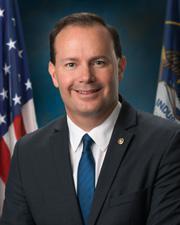
U.S. Senator for Utah
Republican
Senate term end not loaded yet
Missed 3.1% of roll calls. Chamber median 2.1%.
The full voting recordCounts roll calls where most Democrats and most Republicans voted differently, leaving out procedural votes.
How we countFrom FEC filings, Voteview roll calls and Congress.gov.
Republican. In Congress since 2011, 3 terms in total.
Following saves Lee to your list, which Chamber & Street keeps on its server, linked to a cookie on this browser and not to your name or email. Email alerts will come with constituent verification.
Bills and resolutions where Lee is the primary sponsor. Most bills never leave committee; that is normal for every member. Source: Congress.gov, last updated Oct 29, 2026.
14 of 139 have at least one cosponsor from the other party.
AMERICA Act
Introduced Mar 13, 2025. 7 cosponsors, 5 from the other party. S. 1060 on Congress.gov
Introduced
Advertising Middlemen Endangering Rigorous Internet Competition Accountability Act or the AMERICA Act
This bill limits certain large digital advertising companies from owning multiple types of advertising exchanges or brokerages and imposes certain duties with respect to the interests of the customers of such brokerages. Advertising exchanges and brokerages generally facilitate advertisers and publishers in buying and selling advertising inventory through an automated bidding process.
Specifically, companies with more than $20 billion in annual digital advertising revenue are prohibited from owning more than one type of service within the digital advertising marketplace. For example, a company, such as Google, may not own a digital advertising exchange and provide software that assists publishers of online advertisements in selling advertising space on their websites.
Additionally, companies with more than $5 billion in annual digital advertising revenue that provide brokerage services to buyers or sellers of digital advertisements must act in the best interest of their brokerage customers. The bill also establishes transparency and privacy requirements for such brokerages.
The bill provides for enforcement of these requirements by the Department of Justice, state attorneys general, and private right of action.
LIBERATE Act
Introduced Mar 12, 2025. 0 cosponsors. S. 973 on Congress.gov(opens in a new tab)
Introduced
Basin Fund Preservation Act
Introduced Mar 6, 2025. 1 cosponsor. S. 887 on Congress.gov(opens in a new tab)
Introduced
Basin Fund Preservation Act
This bill directs the Bureau of Reclamation and the Western Area Power Administration, in consultation with the Glen Canyon Dam Adaptive Management Work Group, to enter into a memorandum of understanding to explore and address the impact that the 2024 record of decision entitled Supplement to the 2016 Glen Canyon Dam Long-Term Experimental and Management Plan Record of Decision has on the Upper Colorado River Basin Fund. The memorandum of understanding must include a plan to (1) address the effects that the decision may have on the fund's obligations, (2) address the impact that the decision has on hydropower production at Glen Canyon Dam, and (3) identify impacts that the decision has had on species listed as threatened or endangered species.
By way of background, Reclamation published a Final Supplemental Environmental Impact Statement (SEIS) under the National Environmental Policy Act of 1969 for the Glen Canyon Dam Long-Term Experimental and Management Plan (LTEMP) in 2024. The SEIS revises the 2016 LTEMP Record of Decision to address two issues: (1) responding to the threat of the invasive smallmouth bass below Glen Canyon Dam, and (2) incorporating the latest sediment science to assess when high-flow experiments should be conducted in order to protect the endangered humpback chub.
Federal Reserve Board Abolition Act
Introduced Mar 5, 2025. 0 cosponsors. S. 869 on Congress.gov(opens in a new tab)
Introduced
Move the ICC Out of NYC Act of 2025
Introduced Mar 4, 2025. 0 cosponsors. S. 833 on Congress.gov(opens in a new tab)
Introduced
Government Spectrum Valuation Act
Introduced Feb 27, 2025. 0 cosponsors. S. 792 on Congress.gov(opens in a new tab)
Introduced
Government Spectrum Valuation Act
This bill requires the National Telecommunications and Information Administration (NTIA) to periodically estimate the value of specified electromagnetic spectrum that is allocated to federal agencies.
Each federal agency that is assigned or allocated a portion of that spectrum must include the most recent estimated value of its spectrum, as determined by NTIA, in its annual budget and financial statements.
A bill to require the Assistant Secretary of Commerce for Communications and Information to audit Federal spectrum.
Introduced Feb 27, 2025. 0 cosponsors. S. 794 on Congress.gov(opens in a new tab)
Introduced
This bill requires the National Telecommunications and Information Administration to audit and report to Congress on electromagnetic spectrum that is assigned or allocated to federal entities. The report must identify each spectrum band used by a federal entity and detail where, how, and to what extent each such band is being used.
Guarding Readiness Resources Act
Introduced Feb 27, 2025. 22 cosponsors, 9 from the other party. S. 807 on Congress.gov(opens in a new tab)
Introduced
Guarding Readiness Resources Act
This bill modifies the treatment of funds received by the National Guard Bureau as a reimbursement from a state or other U.S. territory (e.g., Guam) for the use of military property.
Specifically, the funds must be credited to (1) the appropriation, fund, or account used in incurring the obligation; or (2) an appropriation, fund, or account currently available for the purposes of which the expenditures were made. Further, the funds may only be used by the Department of Defense for the repair, maintenance, replacement, or other similar functions related directly to assets used by National Guard units while operating under state active duty status.
Higher Education Reform and Opportunity Act
Introduced Feb 27, 2025. 0 cosponsors. S. 801 on Congress.gov(opens in a new tab)
Introduced
Higher Education Reform and Opportunity Act
This bill revises requirements governing student loans and the accreditation of institutions of higher education (IHEs).
Specifically, the bill consolidates federal student loans into one student loan program and phases out loan forgiveness for borrowers.
Additionally, the bill makes postsecondary education courses and programs (e.g., apprenticeship programs) that provide credits toward a postsecondary certification, credential, or degree eligible for federal student aid funding if the courses and programs are accredited by a state that has an alternative accreditation agreement with the Department of Education (ED).
The bill requires IHEs to publish certain enrollment and financial aid information, including (1) the percentage of former financial aid recipients who are employed at various intervals following graduation, and (2) the average amount of total federal student loan debt accrued upon graduation. The Government Accountability Office must compile, study, and report on all such information published by IHEs. Further, the bill prohibits the disclosure of personally identifiable information and directs ED to establish penalties for violations.
Lastly, the bill requires an IHE to pay a default rate fine for a fiscal year in an amount that is equal to the applicable percentage of outstanding federal student loans (i.e., the total amount of loans issued to students for attendance at the IHE for which regular on-time payments are not being made). An IHE shall receive a $400 credit for each graduate of the IHE who received a Federal Pell Grant while enrolled at the IHE during the fiscal year.
Saving Privacy Act
Introduced Feb 27, 2025. 1 cosponsor. S. 809 on Congress.gov(opens in a new tab)
Introduced
Saving Privacy Act
This bill eliminates or restricts various financial reporting requirements and requires congressional approval for new and existing regulations issued by specified financial regulatory agencies.
Specifically, the bill eliminates provisions that require financial institutions to report certain financial information to federal agencies. Currently, financial institutions are required to report certain financial transactions (e.g., transfers of over $10,000) for the purpose of detecting illicit activity, such as money laundering or the financing of terrorism. Under the bill, such records are only obtainable through a search warrant. Further, the bill generally prohibits the federal government from accessing an individual’s financial records without a warrant based on probable cause and establishes criminal penalties for violations.
Additionally, the bill requires congressional approval for major rules issued by specified financial regulatory agencies, including rules currently in effect.
The bill also eliminates or reduces reporting requirements applicable to (1) the beneficial ownership of certain corporate entities; (2) third-party settlement organizations (e.g., certain online platforms, apps, and card payment processors); and (3) the Consolidated Audit Trail (i.e., data collected by national securities exchanges to track securities market activity).
The bill generally prohibits federal agencies from issuing or using a central bank digital currency.
The bill prohibits federal agencies from restricting a person's use of convertible virtual currency for their own purposes or to conduct transactions through a self-hosted wallet.
SCREEN Act
Introduced Feb 26, 2025. 4 cosponsors. S. 737 on Congress.gov(opens in a new tab)
Introduced
Shielding Children's Retinas from Egregious Exposure on the Net Act or the SCREEN Act
This bill establishes age-verification requirements for commercial interactive computer services (e.g., websites) that make available content that is harmful to minors (e.g., content that appeals to the prurient interest in nudity or sex, is obscene, or is child pornography).
Specifically, the bill requires such services to adopt and utilize technology verification measures to ensure that (1) users of the service are not minors, and (2) minors are prevented from accessing any content on the service that is harmful to minors.
Additionally, such services must (1) use the technology to verify a user's age; (2) publish the verification process that the service uses; and (3) subject users' Internet Protocol (IP) addresses, including known virtual proxy network (VPN) IP addresses, to the technology verification measures, unless the service determines a user is not located within the United States.
Covered services also must implement data security measures to protect information about individuals collected through the verification process.
The Federal Trade Commission must conduct regular audits of such services, issue guidance, and otherwise enforce the requirements of this bill.
Critical Mineral Consistency Act of 2025
Introduced Feb 25, 2025. 5 cosponsors, 2 from the other party. S. 714 on Congress.gov(opens in a new tab)
Passed committee
Critical Mineral Consistency Act of 2025
This bill modifies the Energy Act of 2020 to expand the definition of critical minerals used by the U.S. Geological Survey (USGS) to include critical materials designated by the Department of Energy (DOE). It also directs USGS to update its list within 45 days of DOE adding a mineral, element, substance, or material to its critical materials list. Thus, the bill requires the lists to be treated consistently and makes critical materials eligible for the same benefits (e.g., financing support or clean energy tax credits) provided to critical minerals.
By way of background, DOE's critical materials list contains certain materials that are essential for energy, including those on the critical minerals list of the USGS. The USGS's list, which contains certain minerals that are essential to the nation's economic or national security, is currently not required to include the materials on DOE's list.
DEFUND Act of 2025
Introduced Feb 20, 2025. 2 cosponsors. S. 669 on Congress.gov(opens in a new tab)
Introduced
Disengaging Entirely From the United Nations Debacle Act of 2025 or the DEFUND Act of 2025
This bill directs the President to terminate U.S. membership in the United Nations (U.N.) and all formally affiliated bodies. It also ends U.S. participation in all U.N. conventions and agreements.
Funds may be appropriated to facilitate U.S. withdrawal from the U.N. No funds may be made available for contributions or payments to any U.N. body.
The bill prohibits U.S. participation in any U.N. peacekeeping operation.
The bill also repeals diplomatic immunity for officers and employees of the U.N. and for officers and employees of foreign government missions to the U.N.
The bill repeals various acts related to the U.N., including the United Nations Participation Act of 1945, the United Nations Headquarters Agreement Act, and a joint resolution establishing U.S. membership in the World Health Organization.
The United States may not rejoin the U.N. or any formally affiliated body without the advice and consent of the Senate. Any agreement to rejoin the U.N. or a formally affiliated body must include the right of the United States to withdraw from the agreement.
Modernizing Retrospective Regulatory Review Act
Introduced Feb 20, 2025. 1 cosponsor. S. 644 on Congress.gov(opens in a new tab)
Introduced
Healthy SNAP Act of 2025
Introduced Feb 13, 2025. 6 cosponsors. S. 561 on Congress.gov(opens in a new tab)
Introduced
Healthy SNAP Act of 2025
This bill amends the Supplemental Nutrition Assistance Program (SNAP) to redefine the foods eligible for purchase with SNAP benefits.
Under the bill, SNAP benefits may not be used for soft drinks, candy, ice cream, or prepared desserts, such as cakes, pies, cookies, or similar products.
Further, the Department of Agriculture (USDA) must designate by regulation foods and food products to include in the SNAP definition of the term food. USDA must consider food and products that (1) based on nutrition research, contain nutrients lacking in the diets of people in the United States; and (2) promote the health of the population served by SNAP, based on relevant nutrition science, public health concerns, and cultural eating patterns. USDA must also, to the maximum extent practicable, ensure that the fat, sugar, and salt content of the food and food products are appropriate. At least every five years, USDA must review and amend the list.
In addition, prepared meals purchased with SNAP benefits must have nutritional values consistent with standards developed by USDA for the list of food and food products.
A state agency may substitute different foods for food USDA designated under this bill, with USDA approval, so long as the foods are nutritionally equivalent; this is permitted to allow for different cultural eating patterns.
Reorganizing Government Act of 2025
Introduced Feb 13, 2025. 2 cosponsors. S. 583 on Congress.gov(opens in a new tab)
Introduced
Reorganizing Government Act of 2025
This bill revives expedited congressional consideration of certain Presidential plans to reorganize the executive branch, expands permissible plan purposes, and changes the prohibitions on plan content.
The bill reauthorizes through 2026 a currently expired authority that requires expedited congressional consideration of certain executive branch reorganization plans submitted by the President.
The bill also expands the purposes for which such reorganization plans may be undertaken, to include
• reducing the number of federal employees;
• eliminating unnecessary and burdensome rules, regulations, and other requirements; and
• eliminating government operations that do not serve the public interest.
The bill removes the following prohibitions on the contents of such plans:
• creating new executive departments or renaming existing executive departments;
• abolishing or transferring executive departments or independent regulatory agencies or all of their functions; and
• consolidating executive departments or independent regulatory agencies or all of their functions.
The bill also adds a new prohibition on content, specifying that any such plan may not create a net increase in federal workers or expenditures.
A bill to repeal the Impoundment Control Act of 1974.
Introduced Feb 11, 2025. 1 cosponsor. S. 515 on Congress.gov(opens in a new tab)
Introduced
This bill repeals the Impoundment Control Act of 1974 (ICA). The ICA generally limits the authority of the President to impound (i.e., withhold from obligation or expenditure) funds that have been appropriated by Congress and establishes related procedures. It also establishes expedited legislative procedures that Congress may use to consider legislation to enact rescissions proposed by the President.
Defund Government-Sponsored Propaganda Act
Introduced Feb 11, 2025. 0 cosponsors. S. 518 on Congress.gov(opens in a new tab)
Introduced
Defund Government-Sponsored Propaganda Act
This bill prohibits federal funding of the Public Broadcasting Service (PBS), National Public Radio (NPR), and any successor organization to PBS or NPR. The prohibition extends to the payment of dues to or the purchase of programming from PBS or NPR by a public broadcast station using federal funds.
The bill also directs the Corporation for Public Broadcasting to transfer to the Department of the Treasury for the purpose of reducing the public debt an amount equal to certain funding that would have otherwise been provided to PBS or NPR in FY2025-FY2027.
An original resolution authorizing expenditures by the Committee on Energy and Natural Resources.
Introduced Feb 11, 2025. 0 cosponsors. S.Res. 70 on Congress.gov(opens in a new tab)
Introduced
BOWSER Act
Introduced Feb 6, 2025. 2 cosponsors. S. 440 on Congress.gov(opens in a new tab)
Introduced
Utah Wildfire Research Institute Act of 2025
Introduced Feb 6, 2025. 1 cosponsor. S. 457 on Congress.gov(opens in a new tab)
Introduced
Utah Wildfire Research Institute Act of 2025
This bill requires the establishment of a Southwest Ecological Restoration Institute in Utah. Such institutes currently exist in Arizona, New Mexico, and Colorado and promote the use of adaptive ecosystem management to reduce the risk of wildfires and restore the health of forest and woodland ecosystems.
No CBDC Act
Introduced Feb 6, 2025. 2 cosponsors. S. 464 on Congress.gov(opens in a new tab)
Introduced
No Central Bank Digital Currency Act or the No CBDC Act
This bill generally prohibits the Federal Reserve Board, Federal Reserve Banks, the Department of the Treasury, and other agencies from issuing or using a central bank digital currency.
PLCAA Federal Jurisdiction Act
Introduced Feb 6, 2025. 5 cosponsors. S. 484 on Congress.gov(opens in a new tab)
Introduced
Mandatory Removal Proceedings Act
Introduced Feb 6, 2025. 4 cosponsors. S. 486 on Congress.gov(opens in a new tab)
Introduced
Mandatory Removal Proceedings Act
This bill requires the immediate initiation of removal proceedings against a non-U.S. national (alien under federal law) whose visa is revoked on security and related grounds.
Ensuring Naval Readiness Act
Introduced Feb 5, 2025. 1 cosponsor. S. 406 on Congress.gov(opens in a new tab)
Introduced