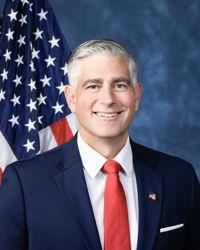
U.S. Representative for Washington’s 5th district
Republican
119th Congress, two-year term
Missed 2.4% of roll calls. Chamber median 1.9%.
The full voting recordCounts roll calls where most Democrats and most Republicans voted differently, leaving out procedural votes.
How we countFrom FEC filings, Voteview roll calls and Congress.gov.
Republican. In Congress since 2025, 1 term in total.
Following saves Baumgartner to your list, which Chamber & Street keeps on its server, linked to a cookie on this browser and not to your name or email. Email alerts will come with constituent verification.
Bills and resolutions Baumgartner signed on to as a cosponsor. An original cosponsor signed on the day the bill was introduced. Source: govinfo bill status files, last updated Nov 6, 2026.
National Right-to-Work Act
Sponsor Joe Wilson (R). Joined Feb 21, 2025. 129 cosponsors. H.R. 1232 on Congress.gov
Introduced
Death Tax Repeal Act
Sponsor Randy Feenstra (R). Original cosponsor. 182 cosponsors. H.R. 1301 on Congress.gov(opens in a new tab)
Introduced
Supporting the Local Radio Freedom Act.
Sponsor Steve Womack (R). Original cosponsor. 233 cosponsors. H.Con.Res. 12 on Congress.gov(opens in a new tab)
Introduced
This concurrent resolution declares that Congress should not impose any new performance fee, tax, royalty, or other charge relating to the public performance of sound recordings on a local radio station for broadcasting sound recordings over the air, or on any business for such public performance of sound recordings.
Medicare Patient Access and Practice Stabilization Act of 2025
Sponsor Gregory Murphy (R). Joined Feb 12, 2025. 198 cosponsors. H.R. 879 on Congress.gov(opens in a new tab)
Introduced
Medicare Patient Access and Practice Stabilization Act of 2025
This bill increases certain payment adjustments under the Medicare physician fee schedule for services furnished between April 1, 2025, and January 1, 2026.
Whole Milk for Healthy Kids Act of 2025
Sponsor Glenn Thompson (R). Joined Feb 10, 2025. 118 cosponsors. H.R. 649 on Congress.gov(opens in a new tab)
Introduced
Whole Milk for Healthy Kids Act of 2025
This bill revises requirements for milk provided by the National School Lunch Program of the Department of Agriculture (USDA).
Currently, schools participating in the program must provide milk that is consistent with the most recent Dietary Guidelines for Americans; USDA regulations require milk to be fat-free or low-fat and allow milk to be flavored or unflavored. The bill modifies these restrictions and instead permits schools to offer students whole, reduced-fat, low-fat, and fat-free flavored and unflavored milk. The milk that is offered may be organic or nonorganic. Further, USDA may not prohibit a participating school from offering students any of these milk choices.
Further, schools currently must provide a substitute for fluid milk, on receipt of a written statement from a licensed physician, for students whose disability restricts their diet. Under the bill, a parent or legal guardian may also provide the written statement.
In addition, schools currently participating in the program must provide meals that meet certain nutrition requirements; USDA regulations require that the average saturated fat content of the meals offered must be less than 10% of the total calories. Under the bill, fluid milk is excluded from the saturated fat content calculation; milk fat included in any fluid milk provided by the program must not be considered saturated fat for the purposes of measuring compliance with USDA regulations.
Finally, the bill prohibits schools participating in the program from purchasing or offering milk produced by Chinese state-owned enterprises.
No Censors on our Shores Act of 2025
Sponsor Darrell Issa (R). Original cosponsor. 5 cosponsors. H.R. 1071 on Congress.gov(opens in a new tab)
Introduced
No Censors on our Shores Act
This bill makes certain non-U.S. nationals (aliens under federal law) who were involved in conduct that would have been in violation of the First Amendment to the Constitution if it had occurred in the United States (1) inadmissible for entry into the United States, and (2) deportable.
Specifically, the bill applies to an individual who, while serving as a foreign government official, carried out or was responsible for activity against a U.S. citizen located in the United States that would have violated the First Amendment if committed by a U.S. government official in the United States.
Northwest Energy Security Act
Sponsor Dan Newhouse (R). Original cosponsor. 3 cosponsors. H.R. 626 on Congress.gov(opens in a new tab)
Introduced
Northwest Energy Security Act
This bill requires Federal Columbia River Power System (FCRPS) operations to be consistent with the preferred alternative in a 2020 environmental impact statement (EIS) decision that focuses on the operations, maintenance, and configuration of dams in the system rather than wild fish restoration. The system includes dams in the Columbia and Snake rivers in Oregon, Washington, Montana, and Idaho.
Specifically, the Bureau of Reclamation, the Bonneville Power Administration, and the U.S. Army Corps of Engineers must operate the FCRPS consistent with the Columbia River System Operations Environmental Impact Statement Record of Decision dated September 2020. Thus, Reclamation, the Bonneville Power Administration, and the Army Corps must follow the EIS rather than the 2023 Resilient Columbia Basin Initiative—and a supplemental EIS proposed in 2024—that focus on wild fish restoration in the Columbia Basin.
The EIS decision may be amended if each agency determines that (1) changes are necessary for public safety or electrical grid reliability, or (2) certain requirements in the decision are no longer necessary.
Further, the bill requires statutory authorization for any structural modification, action, study, or engineering plan that (1) restricts FCRPS hydroelectric dam generation; or (2) limits navigation on the Snake River in Washington, Oregon, or Idaho.
HALT Fentanyl Act
Sponsor H. Griffith (R). Joined Jan 22, 2025. 61 cosponsors. H.R. 27 on Congress.gov(opens in a new tab)
Passed the House
Halt All Lethal Trafficking of Fentanyl Act or the HALT Fentanyl Act
This bill permanently places fentanyl-related substances as a class into schedule I of the Controlled Substances Act. A schedule I controlled substance is a drug, substance, or chemical that has a high potential for abuse; has no currently accepted medical value; and is subject to regulatory controls and administrative, civil, and criminal penalties under the Controlled Substances Act.
Under the bill, offenses involving fentanyl-related substances are triggered by the same quantity thresholds and subject to the same penalties as offenses involving fentanyl analogues (e.g., offenses involving 100 grams or more trigger a 10-year mandatory minimum prison term).
Additionally, the bill establishes a new, alternative registration process for certain schedule I research.
The bill also makes several other changes to registration requirements for conducting research with controlled substances, including
• permitting a single registration for related research sites in certain circumstances,
• waiving the requirement for a new inspection in certain situations, and
• allowing a registered researcher to perform certain manufacturing activities with small quantities of a substance without obtaining a manufacturing registration.
Finally, the bill expresses the sense that Congress agrees with the interpretation of Controlled Substances Act in United States v. McCray, a 2018 case decided by the U.S. District Court for the Western District of New York. In that case, the court held that butyryl fentanyl, a controlled substance, can be considered an analogue of fentanyl even though, under the Controlled Substances Act, the term controlled substance analogue specifically excludes a controlled substance.
Equal Representation Act of 2025
Sponsor Chuck Edwards (R). Joined Jan 22, 2025. 66 cosponsors. H.R. 151 on Congress.gov(opens in a new tab)
Introduced
Equal Representation Act
This bill requires that the statement sent by the President to Congress after the decennial census indicating the number of persons in each state exclude noncitizens. (This statement is the basis for reapportionment of U.S. Representatives.)
The bill also requires any questionnaire used in the decennial census to include a checkbox or other similar option for respondents to indicate whether the respondent and each household member is (1) a U.S. citizen, (2) a U.S. national but not a citizen, (3) a non-U.S. national (alien under federal law) lawfully residing in the United States, or (4) a non-U.S. national unlawfully residing in the United States.
The Department of Commerce must make public the number of persons in each state, disaggregated by each of these four categories.
AMERICANS Act
Sponsor Pat Harrigan (R). Joined Jan 21, 2025. 29 cosponsors. H.R. 511 on Congress.gov(opens in a new tab)
Introduced
Allowing Military Exemptions, Recognizing Individual Concerns About New Shots Act of 2025 or the AMERICANS Act
This bill prohibits the Department of Defense (DOD) from issuing any COVID-19 vaccine mandate as a replacement for the rescinded vaccine mandate of August 24, 2021, unless the mandate is expressly authorized by Congress. The bill also provides that DOD must establish an application process for remedies for members of the Armed Forces who were discharged or subject to adverse action under the rescinded mandate.
Any administrative discharge of a member on the sole basis of a failure to receive a COVID-19 vaccine must be categorized as an honorable discharge, and DOD is prohibited from taking any adverse action against such a member for that reason.
DOD must try to retain unvaccinated members and provide such members with professional development, promotion and leadership opportunities, and consideration equal to that of their peers.
Additionally, DOD may only consider the COVID-19 vaccination status of members in making certain decisions (e.g., deployments in countries where it is the law) and must establish a process to provide exemptions to certain members for such decisions.
Members who were separated from the Armed Forces for refusing to receive a COVID-19 vaccine are not required to repay any bonuses and must be reimbursed if they repaid any portion of a bonus prior to this bill's enactment.
This bill applies to all members of the Armed Forces, regardless of whether they sought an accommodation to any DOD COVID-19 vaccination policy.
Constitutional Concealed Carry Reciprocity Act of 2025
Sponsor Richard Hudson (R). Joined Jan 21, 2025. 189 cosponsors. H.R. 38 on Congress.gov(opens in a new tab)
Introduced
Constitutional Concealed Carry Reciprocity Act
This bill establishes a federal statutory framework to regulate the carry or possession of concealed firearms across state lines.
Specifically, an individual who is eligible to carry a concealed firearm in one state may carry or possess a concealed handgun (other than a machine gun or destructive device) in another state that allows its residents to carry concealed firearms.
It sets forth requirements for lawful concealed carry across state lines. The bill preempts most state and local laws related to concealed carry and establishes a private right of action for a person adversely affected by interference with a concealed-carry right established by this bill.
REMAIN in Mexico Act of 2025
Sponsor Brandon Gill (R). Joined Jan 16, 2025. 110 cosponsors. H.R. 273 on Congress.gov(opens in a new tab)
Introduced
Return Excessive Migrants and Asylees to International Neighbors in Mexico Act of 2025 or the REMAIN in Mexico Act of 2025
This bill requires the Department of Homeland Security (DHS) to implement the Migrant Protection Protocols as outlined in the January 25, 2019, memo titled Policy Guidance for Implementation of the Migrant Protection Protocols.
(The protocols generally required aliens who are not clearly admissible, including those seeking asylum, arriving by land along the U.S.-Mexico border to be returned to Mexico while their immigration proceedings are pending, rather than remain in the United States. On January 21, 2021, DHS stopped applying the protocols to newly-arrived individuals.)
Proposing an amendment to the Constitution of the United States to limit the number of terms that a Member of Congress may serve.
Sponsor Ralph Norman (R). Joined Jan 13, 2025. 116 cosponsors. H.J.Res. 12 on Congress.gov(opens in a new tab)
Introduced
This joint resolution proposes an amendment to the Constitution establishing term limits for individuals serving in the Senate and the House of Representatives.
The proposed amendment makes an individual who has served two terms in the Senate ineligible for appointment or election to the Senate and an individual who has served three terms as a Member of the House of Representatives ineligible for election to the House of Representatives.
The joint resolution provides that the amendment shall be valid when ratified by the legislatures of three-fourths of the states within seven years after the date of its submission for ratification.
Under Article V of the Constitution, both chambers of Congress may propose an amendment by a vote of two-thirds of all Members present for such vote. A proposed amendment must be ratified by the states as prescribed in Article V and as specified by Congress.