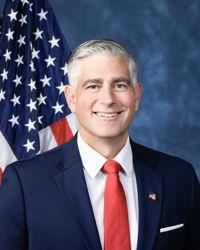
U.S. Representative for Washington’s 5th district
Republican
119th Congress, two-year term
Missed 2.4% of roll calls. Chamber median 1.9%.
The full voting recordCounts roll calls where most Democrats and most Republicans voted differently, leaving out procedural votes.
How we countFrom FEC filings, Voteview roll calls and Congress.gov.
Republican. In Congress since 2025, 1 term in total.
Following saves Baumgartner to your list, which Chamber & Street keeps on its server, linked to a cookie on this browser and not to your name or email. Email alerts will come with constituent verification.
Bills and resolutions Baumgartner signed on to as a cosponsor. An original cosponsor signed on the day the bill was introduced. Source: govinfo bill status files, last updated Nov 6, 2026.
Free Speech Fairness Act
Sponsor Mark Harris (R). Original cosponsor. 38 cosponsors. H.R. 2501 on Congress.gov
Introduced
REPAIR Act
Sponsor Neal Dunn (R). Joined Mar 31, 2025. 44 cosponsors. H.R. 1566 on Congress.gov(opens in a new tab)
Introduced
Miracle on Ice Congressional Gold Medal Act
Sponsor Pete Stauber (R). Joined Mar 27, 2025. 299 cosponsors. H.R. 452 on Congress.gov(opens in a new tab)
Became law
Miracle on Ice Congressional Gold Medal Act
This act provides for the award of Congressional Gold Medals to the members of the 1980 U.S. Olympic men's ice hockey team in recognition of the team's achievement at the 1980 Winter Olympic Games.
Rural Health Care Facility Technical Assistance Program Act
Sponsor Ronny Jackson (R). Joined Mar 27, 2025. 28 cosponsors. H.R. 1417 on Congress.gov(opens in a new tab)
Introduced
Secure Rural Schools Reauthorization Act of 2025
Joined Mar 27, 2025. 93 cosponsors. H.R. 1383 on Congress.gov(opens in a new tab)
Progress not on file
Secure Rural Schools Reauthorization Act of 2025
This bill extends and modifies the Secure Rural Schools and Community Self-Determination Act of 2000, including by
• extending payments made to states and counties containing federal land through FY2026,
• providing for payments for FY2024 and FY2025,
• extending the authority of counties to initiate projects using such funds through FY2028, and
• extending the authority to initiate projects proposed by resource advisory committees through FY2028.
Main Street Tax Certainty Act
Sponsor Lloyd Smucker (R). Joined Mar 26, 2025. 192 cosponsors. H.R. 703 on Congress.gov(opens in a new tab)
Introduced
Main Street Tax Certainty Act
This bill makes permanent the qualified business income (QBI) tax deduction.
Under current law, individuals, estates, and trusts may deduct the lower of (1) 20% of QBI from a qualified business, qualified real estate investment trust dividends, and qualified publicly traded partnership income; or (2) 20% of taxable income less net capital gain. (Some limitations apply.)
However, under current law, the QBI tax deduction expires after December 31, 2025.
Major Richard Star Act
Sponsor Gus Bilirakis (R). Original cosponsor. 340 cosponsors. H.R. 2102 on Congress.gov(opens in a new tab)
Introduced
Major Richard Star Act
This bill allows a veteran with a combat-related disability to receive retirement pay, without reduction, concurrently with their disability compensation. This includes veterans with a combat-related disability and fewer than 20 years of creditable service. (Currently, veterans who receive combat-related special compensation and retirement pay are subject to an offset in retirement pay for concurrent receipt of such benefits.)
POWER Act
Sponsor Dan Newhouse (R). Original cosponsor. 3 cosponsors. H.R. 2074 on Congress.gov(opens in a new tab)
Introduced
Defending our Dams Act
Sponsor Dan Newhouse (R). Original cosponsor. 3 cosponsors. H.R. 2073 on Congress.gov(opens in a new tab)
Introduced
To require the Federal Energy Regulatory Commission to extend the time period during which licensees are required to commence construction of certain hydropower projects.
Sponsor Dan Newhouse (R). Original cosponsor. 9 cosponsors. H.R. 2072 on Congress.gov(opens in a new tab)
Introduced
This bill authorizes the Federal Energy Regulatory Commission (FERC) to extend construction deadlines for hydropower projects that were issued a license before March 13, 2020. FERC is authorized, upon the request of the licensees, to extend the deadline for beginning construction on such projects an additional six years beyond the eight-year extension FERC is authorized to provide under current law. The extension must consist of no more than three consecutive two-year periods.
The bill also provides that FERC may reinstate certain expired licenses for projects with construction deadlines extended under this bill, effective as of the date they expire.
VOTE Act
Sponsor Abraham Hamadeh (R). Original cosponsor. 10 cosponsors. H.R. 2054 on Congress.gov(opens in a new tab)
Introduced
Voting Only Through English Act or the VOTE Act
This bill requires states to use English-only ballots to qualify for certain federal election funds. It also repeals a prohibition on English-only federal elections and eliminates language assistance provisions under the Voting Rights Act of 1965 (VRA). (The VRA requires some jurisdictions to provide materials such as ballots and registration information in English and in other covered languages for voters whose English proficiency is limited. The bill removes these requirements.)
Specifically, the bill prohibits a state from receiving federal election administration funds if the state provides ballots for a federal election that include text in any language other than English.
No American Land for Communist China Act
Sponsor Dan Newhouse (R). Joined Mar 11, 2025. 60 cosponsors. H.R. 1575 on Congress.gov(opens in a new tab)
Introduced
Protect Our Probationary Employees Act
Sponsor Sarah Elfreth (D). Original cosponsor. 72 cosponsors. H.R. 1989 on Congress.gov(opens in a new tab)
Introduced
Anti-CBDC Surveillance State Act
Sponsor Tom Emmer (R). Original cosponsor. 135 cosponsors. H.R. 1919 on Congress.gov(opens in a new tab)
Passed the House
Anti-CBDC Surveillance State Act
This bill prohibits a Federal Reserve bank from offering products or services directly to an individual, maintaining an account on behalf of an individual, or issuing a central bank digital currency (i.e., a digital dollar). Further, the Board of Governors of the Federal Reserve System is prohibited from using a central bank digital currency to implement monetary policy or from testing, studying, creating, or implementing a central bank digital currency, with exceptions as provided by the bill.
Censuring Representative Al Green of Texas.
Sponsor Dan Newhouse (R). Original cosponsor. 34 cosponsors. H.Res. 189 on Congress.gov(opens in a new tab)
Passed the House
This resolution censures Representative Al Green.
Nancy Gardner Sewell Medicare Multi-Cancer Early Detection Screening Coverage Act
Sponsor Jodey Arrington (R). Joined Mar 4, 2025. 338 cosponsors. H.R. 842 on Congress.gov(opens in a new tab)
Introduced
Nancy Gardner Sewell Medicare Multi-Cancer Early Detection Screening Coverage Act
This bill allows, beginning in 2028, for Medicare coverage and payment for multi-cancer early detection screening tests that are approved by the Food and Drug Administration and that are used to screen for cancer across many cancer types, if the Centers for Medicare & Medicaid Services determines such coverage is appropriate. Coverage is limited to those under a certain age (age 68 in 2028, increased by one year every year thereafter) and to one test every 11 months.
Protecting American Agriculture from Foreign Adversaries Act of 2025
Sponsor Dan Newhouse (R). Joined Mar 4, 2025. 60 cosponsors. H.R. 1576 on Congress.gov(opens in a new tab)
Introduced
Protecting American Agriculture from Foreign Adversaries Act of 2025
This bill makes changes to the Committee on Foreign Investment in the United States (CFIUS), including by requiring CFIUS to determine whether a national security review is necessary for reportable agricultural land transactions that are referred by the Department of Agriculture (USDA). (CFIUS oversees the national security risks of certain foreign investment in the United States. CFIUS has the authority to review covered transactions, which include mergers, acquisitions, and takeovers that could result in foreign control of a U.S. business; certain investments in businesses involved in critical technologies, critical infrastructure, or sensitive personal data; and certain real estate transactions.)
Specifically, the bill directs CFIUS to, after receiving notification from USDA, determine (1) whether a reportable agricultural land transaction is a covered transaction, and (2) whether CFIUS should initiate a national security review or take another action with respect to the transaction.
Reportable agricultural land transaction means a transaction (1) that USDA has reason to believe is a covered transaction; (2) that involves the acquisition of an interest in agricultural land by a foreign person of China, North Korea, Russia, or Iran; and (3) with respect to which a foreign person is required to submit a report to USDA regarding their agricultural land transactions.
The bill also expands the membership of CFIUS to include the Secretary of Agriculture for covered transactions that involve agricultural land, agricultural biotechnology, or the agriculture industry (e.g., agricultural transportation, storage, and processing).
Enhanced Iran Sanctions Act of 2025
Sponsor Michael Lawler (R). Joined Mar 4, 2025. 295 cosponsors. H.R. 1422 on Congress.gov(opens in a new tab)
Passed the House
Enhanced Iran Sanctions Act of 2025
This bill imposes sanctions on certain foreign persons (individuals and entities) that are involved in Iran's petroleum sector as well as certain associated persons. The bill also requires or authorizes actions to facilitate the enforcement of sanctions on Iran.
Specifically, the bill requires the President to impose visa- and property-blocking sanctions on any foreign person that, after the bill's enactment, knowingly engages in any transaction related to the processing, export, or sale of oil, condensates, gas, liquefied natural gas, or other petrochemical products in whole or in part from Iran. The President must also impose sanctions on certain foreign persons associated with a sanctioned individual or entity. For example, the President must sanction the subsidiaries and corporate officers of a sanctioned business.
The bill provides certain exceptions to these sanctions, including specifying that sanctions do not apply to the importation of goods or to conducting or facilitating transactions for humanitarian assistance.
The Department of State must establish an interagency working group that shall seek to establish a multilateral contact group to coordinate international efforts to enforce sanctions on Iran.
The bill expands the State Department rewards program to authorize a reward payment to any individual who furnishes information leading to the identification of a person (1) subject to sanctions under this bill, or (2) that has attempted or is attempting to evade sanctions under this bill.
Educational Choice for Children Act of 2025
Sponsor Adrian Smith (R). Joined Mar 3, 2025. 91 cosponsors. H.R. 833 on Congress.gov(opens in a new tab)
Introduced
To amend the Internal Revenue Code of 1986 to modify the railroad track maintenance credit.
Sponsor Mike Kelly (R). Joined Mar 3, 2025. 183 cosponsors. H.R. 516 on Congress.gov(opens in a new tab)
Introduced
This bill increases the annual limit on the tax credit for qualified railroad track maintenance expenses (also referred to as the short line railroad tax credit) and expands eligibility for claiming the credit.
Under current law, the tax credit is limited each tax year to $3,500 multiplied by the sum of the number of miles of railroad track owned or leased by the taxpayer (miles owned or leased) and the number of railroad track miles assigned to the taxpayer by a Class II or III railroad (miles assigned). This bill increases the annual limit to $6,100 multiplied by the sum of miles owned or leased and miles assigned. The $6,100 amount used in the calculation of the tax credit limit is adjusted for inflation for tax years beginning after 2025.
The bill also expands eligibility for the tax credit to include gross expenses for maintaining railroad tracks owned or leased as of January 1, 2024. Under current law, the tax credit is limited to gross expenses for maintaining railroad tracks owned or leased as of January 1, 2015.
CATCH Fentanyl Act
Sponsor Clay Higgins (R). Joined Mar 3, 2025. 21 cosponsors. H.R. 1569 on Congress.gov(opens in a new tab)
Introduced
Contraband Awareness Technology Catches Harmful Fentanyl Act or the CATCH Fentanyl Act
This bill establishes a pilot program for improving the inspection of conveyances or modes of transportation at land ports of entry along U.S. borders to detect contraband, illegal drugs, illegal weapons, human smuggling, and threats. Specifically, the U.S. Customs and Border Protection Innovation Team must test technology in at least one of the categories of artificial intelligence, machine learning, high-performance computing, quantum information sciences, or other emerging technologies. The team must also test and collect data regarding at least five types of enhancements to nonintrusive inspection technology (e.g., X-ray machines) able to be deployed at land ports of entry.
Forest Service Accountability Act
Sponsor Ryan Zinke (R). Original cosponsor. 11 cosponsors. H.R. 1762 on Congress.gov(opens in a new tab)
Introduced
Expressing support for the Iranian people's desires for a democratic, secular, and nonnuclear Republic of Iran, and condemning the Iranian regime's terrorism, regional proxy war, internal suppression, and for other purposes.
Sponsor Tom McClintock (R). Original cosponsor. 230 cosponsors. H.Res. 166 on Congress.gov(opens in a new tab)
Introduced
Economic Espionage Prevention Act
Sponsor Richard McCormick (R). Joined Feb 24, 2025. 3 cosponsors. H.R. 1486 on Congress.gov(opens in a new tab)
Passed the House
Economic Espionage Prevention Act
This bill authorizes the President to impose visa- and property-blocking sanctions on foreign adversary entities that knowingly engage in (1) economic and industrial espionage with respect to trade secrets and proprietary information owned by U.S. persons, (2) the provision of material support or services to a foreign adversaries' national security entities, or (3) the violation of U.S. export control laws. The bill cites regulations that define China, Russia, Iran, North Korea, Cuba, and the Maduro regime of Venezuela as foreign adversaries.
The bill also limits certain exemptions from the President's authority under the International Emergency Economic Powers Act (IEEPA). IEEPA provides the President broad authority to regulate a variety of economic transactions following a declaration of national emergency, but exempts from this authority activities such as (1) the import or export of information or informational materials; (2) transactions ordinarily incident to international travel, such as the importation of personal baggage; and (3) personal communications, such as postal or telephonic communications, that do not transfer anything of value. Under the bill, the first two of these exemptions are not applicable if the President determines such imports and exports would seriously impair the ability to deal with a declared national emergency. Additionally, the bill specifies that the first and third exemptions listed above do not apply to bulk sensitive personal data or source code used in a connected software application.
Purchased and Referred Care Improvement Act of 2025
Sponsor Dusty Johnson (R). Joined Feb 24, 2025. 7 cosponsors. H.R. 1418 on Congress.gov(opens in a new tab)
Introduced
Purchased and Referred Care Improvement Act of 2025
This bill specifies that the Indian Health Service (IHS) must reimburse patients for their out-of-pocket costs for authorized purchased/referred care services within 30 days. (The IHS provides medical and dental services directly to American Indian and Alaska Native patients whenever possible. However, when services are not available, IHS beneficiaries may be referred to private providers. This is called purchased/referred care.)
Specifically, the bill requires the Department of Health and Human Services (HHS) to establish and implement procedures to allow a patient who paid out of pocket for purchased/referred care services authorized by the IHS to be reimbursed by the IHS for that payment no later than 30 days after the patient submits required documentation.
Additionally, the bill requires HHS to update applicable provisions of and exhibits to the Indian Health Manual, contracts with providers, and other relevant documents and administrative authorities to incorporate the provisions of the bill.
The bill also replaces statutory references to contract health service with purchased/referred care.