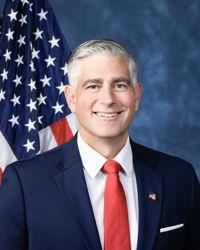
U.S. Representative for Washington’s 5th district
Republican
119th Congress, two-year term
Missed 2.4% of roll calls. Chamber median 1.9%.
The full voting recordCounts roll calls where most Democrats and most Republicans voted differently, leaving out procedural votes.
How we countFrom FEC filings, Voteview roll calls and Congress.gov.
Republican. In Congress since 2025, 1 term in total.
Following saves Baumgartner to your list, which Chamber & Street keeps on its server, linked to a cookie on this browser and not to your name or email. Email alerts will come with constituent verification.
Bills and resolutions Baumgartner signed on to as a cosponsor. An original cosponsor signed on the day the bill was introduced. Source: govinfo bill status files, last updated Nov 6, 2026.
Recognizing the 50th anniversary of Black April and the Fall of Saigon on April 30, 1975.
Sponsor Derek Tran (D). Original cosponsor. 45 cosponsors. H.Res. 366 on Congress.gov
Introduced
Veterans’ ACCESS Act of 2025
Sponsor Mike Bost (R). Joined Apr 30, 2025. 88 cosponsors. H.R. 740 on Congress.gov(opens in a new tab)
Passed committee
Veterans' Assuring Critical Care Expansions to Support Servicemembers Act of 2025 or the Veterans' ACCESS Act of 2025
This bill addresses the administration of the Veterans Community Care Program (VCCP) and other Department of Veterans Affairs (VA) health care matters.
Among other provisions regarding the VCCP, the bill
• establishes in statute access standards that determine when a veteran is eligible to receive non-VA care through the VCCP,
• requires the VA to notify veterans regarding their eligibility for care within two business days after the VA is aware the veteran is seeking care, and
• extends the deadline for the submittal of claims under the VCCP by health care entities and providers.
The VA must address its mental health treatment programs by
• establishing a standardized screening process to determine whether a veteran satisfies criteria for priority or routine admission to a mental health residential rehabilitation treatment program or a program for residential care for mental health and substance abuse disorders,
• tracking the performance of medical facilities and Veterans Integrated Service Networks in meeting the requirements for mental health treatment screenings and timely admission to treatment programs under such screenings, and
• establishing an appeal process for when a veteran is denied admission to a covered treatment program or is accepted into a program but not offered bed placement in a timely manner.
Additionally, the VA must establish an online self-service module for veterans to request and manage appointments, track referrals, and appeal and track decisions related to requests for care.
Telehealth Expansion Act of 2025
Sponsor Jodey Arrington (R). Joined Apr 30, 2025. 17 cosponsors. H.R. 1650 on Congress.gov(opens in a new tab)
Introduced
Remote Access Security Act
Sponsor Michael Lawler (R). Joined Apr 29, 2025. 17 cosponsors. H.R. 2683 on Congress.gov(opens in a new tab)
Passed the House
Remote Access Security Act
This bill broadens the scope of the U.S. export control system to include remote access of items. Remote access means (1) access to an item subject to the jurisdiction of the United States by a foreign person through a network connection, including the internet or a cloud computing service, from a location other than where the item is physically located; or (2) any other form of access specified in regulations promulgated by the Department of Commerce.
The Export Control Reform Act of 2018 (ECRA), which is implemented through the Export Administration Regulations, provides a permanent statutory basis for controlling the export of dual-use goods (e.g., items with both civilian and military uses) and certain military parts and components. This bill applies export controls under ECRA to remote access of items, thereby allowing Commerce's Bureau of Industry and Security to issue licenses and impose penalties related to remote access of controlled items.
No Tax Dollars for Terrorists Act
Sponsor Tim Burchett (R). Joined Apr 28, 2025. 27 cosponsors. H.R. 260 on Congress.gov(opens in a new tab)
Passed the House
No Tax Dollars for Terrorists Act
This bill requires the Department of State to develop and implement a strategy to discourage foreign countries and nongovernmental organizations from providing financial or material support to the Taliban, including by using U.S.-provided foreign assistance to discourage countries and organizations from providing such support to the Taliban.
The State Department must report to Congress on (1) foreign countries and nongovernmental organizations that have provided financial or material support to the Taliban and U.S. efforts to oppose such support; (2) the strategy to discourage such support and a plan for the strategy's implementation; (3) U.S.-funded direct cash assistance programs in Afghanistan; and (4) the Afghan Fund, including Taliban influence over Da Afghanistan Bank (the Afghan central bank).
To provide for the rescission of certain waivers and licenses relating to Iran, and for other purposes.
Sponsor August Pfluger (R). Joined Apr 28, 2025. 22 cosponsors. H.R. 2575 on Congress.gov(opens in a new tab)
Introduced
Revitalizing Downtowns and Main Streets Act
Sponsor Mike Carey (R). Joined Apr 28, 2025. 57 cosponsors. H.R. 2410 on Congress.gov(opens in a new tab)
Introduced
Donut Dollies Congressional Gold Medal Act
Joined Apr 28, 2025. 43 cosponsors. H.R. 2081 on Congress.gov(opens in a new tab)
Progress not on file
Providing congressional disapproval under chapter 8 of title 5, United States Code, of the rule submitted by the Environmental Protection Agency relating to "California State Motor Vehicle and Engine Pollution Control Standards; Heavy-Duty Vehicle and Engine Emission Warranty and Maintenance Provisions; Advanced Clean Trucks; Zero Emission Airport Shuttle; Zero-Emission Power Train Certification; Waiver of Preemption; Notice of Decision".
Sponsor John James (R). Joined Apr 28, 2025. 24 cosponsors. H.J.Res. 87 on Congress.gov(opens in a new tab)
Became law
This joint resolution revokes waivers granted to the California Air Resources Board regarding several of its regulations, including the Heavy-Duty Vehicle and Engine Emission Warranty Regulations and Maintenance Provisions. (Under the Clean Air Act, California may seek waivers of the preemption prohibiting states from enacting certain emission standards.)
Specifically, the joint resolution nullifies the Environmental Protection Agency notice titled California State Motor Vehicle and Engine Pollution Control Standards; Heavy-Duty Vehicle and Engine Emission Warranty and Maintenance Provisions; Advanced Clean Trucks; Zero Emission Airport Shuttle; Zero-Emission Power Train Certification; Waiver of Preemption; Notice of Decision.
Sanctioning Russia Act of 2025
Sponsor Brian Fitzpatrick (R). Joined Apr 24, 2025. 155 cosponsors. H.R. 2548 on Congress.gov(opens in a new tab)
Introduced
Sanctioning Russia Act of 2025
This bill imposes penalties on certain persons (individuals and entities) if the President determines that the Russian government or a person acting at Russia's direction is involved with (1) refusing to negotiate a peace agreement with Ukraine; (2) violating a negotiated peace agreement; (3) initiating another invasion of Ukraine; or (4) overthrowing, dismantling, or seeking to subvert the Ukrainian government.
If the President makes such a determination, the bill requires certain actions including
• the President must impose visa- and property-blocking sanctions on specified persons such as the Russian president, certain Russian military commanders, and any foreign person that knowingly provides defense items to the Russian armed forces;
• the President must increase the rate of duty on all goods and services imported from Russia into the United States to at least 500% relative to the value of such goods and services;
• the President must increase the rate of duty on all goods and services imported into the United States from countries that knowingly engage in the exchange of Russian-origin uranium and petroleum products to at least 500% relative to the value of such goods and services;
• the Department of the Treasury must impose property-blocking sanctions on any financial institution organized under Russian law and owned wholly or partly by Russia, and any financial institution that engages in transactions with those entities; and
• the Department of Commerce must prohibit the export, reexport, or in-country transfer to or in Russia of any U.S.-produced energy or energy product.
SHARE Act of 2026
Sponsor Tracey Mann (R). Joined Apr 24, 2025. 29 cosponsors. H.R. 2332 on Congress.gov(opens in a new tab)
Introduced
To modernize Federal firearms laws to account for advancements in technology and less-than-lethal weapons, and for other purposes.
Sponsor Scott Fitzgerald (R). Joined Apr 24, 2025. 95 cosponsors. H.R. 2189 on Congress.gov(opens in a new tab)
Passed the House
Law-Enforcement Innovate to De-Escalate Act
This bill removes less-than-lethal projectile devices (e.g., certain TASERs) from regulation under the Gun Control Act.
The term less-than-lethal projectile device means a device that (1) is not designed or intended to expel (and may not be readily converted to discharge) commonly used ammunition or projectiles exceeding a velocity of 500 feet per second; (2) is designed and intended to be used in a manner not likely to cause death or serious bodily injury; and (3) does not accept (and cannot be readily modified to accept) an ammunition feeding device.
The bill also requires the Bureau of Alcohol, Tobacco, Firearms and Explosives to determine whether a device satisfies the definition of a less-than-lethal projectile device within 90 days of a request.
Providing congressional disapproval under chapter 8 of title 5, United States Code, of the rule submitted by the Environmental Protection Agency relating to "California State Motor Vehicle and Engine Pollution Control Standards; Advanced Clean Cars II; Waiver of Preemption; Notice of Decision".
Sponsor John Joyce (R). Joined Apr 24, 2025. 41 cosponsors. H.J.Res. 88 on Congress.gov(opens in a new tab)
Became law
This joint resolution revokes the waiver granted to the California Air Resources Board regarding its Advanced Clean Cars II (ACC II) regulations, which include new requirements for low-emission vehicles and zero-emission vehicles. (Under the Clean Air Act, California may seek waivers of the preemption prohibiting states from enacting certain emission standards.)
Specifically, the joint resolution nullifies the Environmental Protection Agency notice titled California State Motor Vehicle and Engine Pollution Control Standards; Advanced Clean Cars II; Waiver of Preemption; Notice of Decision.
Credit for Caring Act of 2025
Sponsor Mike Carey (R). Joined Apr 17, 2025. 145 cosponsors. H.R. 2036 on Congress.gov(opens in a new tab)
Introduced
Tanning Tax Repeal Act of 2025
Sponsor Carol Miller (R). Joined Apr 17, 2025. 26 cosponsors. H.R. 1940 on Congress.gov(opens in a new tab)
Introduced
Tanning Tax Repeal Act of 2025
This bill repeals the 10% excise tax imposed on the amount paid for indoor tanning services.
Combating Organized Retail Crime Act of 2025
Sponsor David Joyce (R). Original cosponsor. 206 cosponsors. H.R. 2853 on Congress.gov(opens in a new tab)
Passed the House
Combating Organized Retail Crime Act of 2025
This bill expands federal enforcement of criminal offenses related to organized retail and supply chain crime. The term organized retail and supply chain crime includes criminal offenses involving the interstate transportation of stolen property, the sale or receipt of stolen goods, or theft from an interstate or foreign shipment that is committed by, in coordination with, or at the instruction of an organization.
First, with respect to criminal offenses involving the interstate transportation of stolen property or the sale or receipt of stolen goods, the bill broadens the scope of conduct that qualifies as offenses by allowing prosecutions to be based on the aggregate value of stolen items over a 12-month period. Additionally, the bill makes the offenses predicate offenses (i.e., underlying offenses) for prosecutions under the federal money laundering statute and authorizes the criminal forfeiture of any property obtained from the proceeds of an offense.
Second, with respect to criminal offenses involving theft from an interstate or foreign shipment, the bill also makes an offense an underlying offense for prosecution under the federal money laundering statute and authorizes the criminal forfeiture of any associated property.
Third, the bill expands the federal money laundering statute to include offenses involving general-use prepaid cards, gift certificates, or store gift cards.
Finally, the bill temporarily establishes a center within the Department of Homeland Security to coordinate federal law enforcement activities related to organized retail and supply chain crime.
Tipped Employee Protection Act
Sponsor Steve Womack (R). Joined Apr 9, 2025. 6 cosponsors. H.R. 2312 on Congress.gov(opens in a new tab)
Introduced
Tipped Employee Protection Act
This bill modifies the definition of a tipped employee under the Fair Labor Standards Act of 1938 (FLSA) to exclude consideration of an employee's duties when determining if the employee is a tipped employee.
Under current law, tipped employees may be paid less than the federal minimum wage (currently $7.25 an hour), but the total of their cash wage and tips must be at least equal to the federal minimum wage. Under the FLSA, a tipped employee is currently a worker who customarily and regularly receives more than $30 a month in tips.
The bill broadens the definition of tipped employee to include any worker who receives tips and other cash wages for a work period at a rate that is at least the federal minimum wage, without regard to the duties of the employee. Under the bill, the work period is a work period that is determined by the employer.
Calling on the United Kingdom, France, and Germany (E3) to initiate the snapback of sanctions on Iran under United Nations Security Council Resolution 2231 (2015).
Sponsor Claudia Tenney (R). Joined Apr 8, 2025. 8 cosponsors. H.Res. 139 on Congress.gov(opens in a new tab)
Introduced
The resolution urges the E3 (the United Kingdom, France, and Germany) to invoke the snapback of United Nations (UN) sanctions against Iran under UN Security Council Resolution 2231 before the option expires on October 18, 2025.
This resolution also (1) recognizes that Iran's possession of a nuclear weapon would threaten U.S. and global security, (2) condemns Iran's repeated violations of certain international commitments related to nuclear weapons, and (3) reaffirms that the United States maintains the right to prevent Iran from acquiring nuclear weapons.
Stop Corrupt Iranian Oligarchs and Entities Act
Sponsor David Kustoff (R). Joined Apr 8, 2025. 4 cosponsors. H.R. 348 on Congress.gov(opens in a new tab)
Introduced
Stop Corrupt Iranian Oligarchs and Entities Act
This bill directs the Department of the Treasury to report to Congress on certain individuals and entities in Iran that have close relationships with the Iranian government.
The report must include specified information, including (1) identifying senior foreign political figures and oligarchs in Iran, their known sources of income, and their non-Iranian business affiliations; (2) assessing the emergence of parastatal entities and their leadership structure; and (3) the potential effects of imposing sanctions or debt and equity restrictions on such oligarchs, parastatal entities, or Iranian state-owned enterprises.
For the purposes of this bill, an Iranian parastatal entity is one in which Iranian state ownership is at least 25% and that had revenues of at least $2 billion in 2016.
Crime Victims Fund Stabilization Act of 2025
Sponsor Ann Wagner (R). Joined Apr 7, 2025. 327 cosponsors. H.R. 909 on Congress.gov(opens in a new tab)
Passed the House
Crime Victims Fund Stabilization Act of 2025
This bill adds a new source of revenue for the Crime Victims Fund (CVF). Specifically, the bill requires certain civil monetary penalties collected from settlements and judgments in cases involving fraud and false claims against the federal government to be deposited into the CVF through FY2029.
The CVF supports federal, state, and local programs and activities to compensate and assist victims of crimes. Currently, the CVF is funded by deposits from a variety of sources, including federal criminal fines, penalties, and assessments; forfeited bail bonds; and certain other gifts, donations, and bequests.
Reliability for Ratepayers Act
Sponsor Marie Perez (D). Joined Apr 7, 2025. 7 cosponsors. H.R. 447 on Congress.gov(opens in a new tab)
Introduced
Reliability for Ratepayers Act
This bill modifies provisions concerning the hiring and compensation of employees of the Bonneville Power Administration (BPA), which is a nonprofit federal power marketing administration that sells hydropower in the Northwest.
Specifically, it directs BPA to develop and implement a plan that specifies and fixes the compensation for its employees, including members of the Senior Executive Service. Within a year, BPA must develop an initial compensation plan, which must be approved by the Department of Energy. BPA must implement the plan no later than one year after the plan is developed.
The compensation plan must be based on an annual survey of the prevailing compensation for similar positions in the public sectors of the electric industry, provide compensation that is competitive with similar positions among consumer-owned utilities in the Western Interconnection, be consistent with BPA's approved annual general and administrative budget, and meet other criteria as outlined in the bill.
BPA must (1) annually review the compensation plan and make any updates as appropriate, and (2) publish the plan and any updates made to the plan.
The bill exempts BPA from certain civil service laws when it is carrying out its hiring authority.
Finally, the bill subjects BPA's employees to certain merit system principles.
Mikaela Naylon Give Kids a Chance Act
Sponsor Michael McCaul (R). Joined Apr 7, 2025. 313 cosponsors. H.R. 1262 on Congress.gov(opens in a new tab)
Passed the House
Give Kids a Chance Act of 2025
This bill expands the Food and Drug Administration’s (FDA’s) authority with respect to research on rare pediatric diseases, including by permitting the FDA to take enforcement action against drug sponsors that fail to satisfy pediatric study requirements and by reauthorizing programs that support pediatric research.
Specifically, the bill
• modifies requirements relating to molecularly targeted pediatric cancer investigations to permit research on new drugs in combination with active ingredients that have already been approved, provided certain conditions are met;
• permits the FDA to take enforcement action against drug sponsors that fail to comply with pediatric study requirements, if such sponsors demonstrated a lack of due diligence in satisfying the requirement;
• renews the FDA’s authority to award priority review vouchers to sponsors of new products intended to treat rare pediatric diseases through September 30, 2029; and
• reauthorizes through FY2027 certain funding for the National Institutes of Health to support priority pediatric research.
The bill also provides statutory authority for the FDA’s interpretation of the orphan drug exclusivity period. The bill specifies, consistent with FDA regulations, that the seven-year market exclusivity period for drugs for rare diseases or conditions (i.e., orphan drugs) prohibits the approval of the same drug for the same approved use or indication with respect to the disease or condition. (In Catalyst Pharmaceuticals, Inc. v. Becerra, a court rejected the FDA’s interpretation and held that orphan drug exclusivity extends to all uses or indications for the disease or condition.)
To transfer the functions, duties, responsibilities, assets, liabilities, orders, determinations, rules, regulations, permits, grants, loans, contracts, agreements, certificates, licenses, and privileges of the United States Agency for International Development relating to implementing and administering the Food for Peace Act to the Department of Agriculture.
Sponsor Tracey Mann (R). Joined Apr 7, 2025. 44 cosponsors. H.R. 1207 on Congress.gov(opens in a new tab)
Introduced
Protecting Privacy in Purchases Act
Sponsor Riley Moore (R). Joined Apr 7, 2025. 132 cosponsors. H.R. 1181 on Congress.gov(opens in a new tab)
Passed the House
Protecting Privacy in Purchases Act
This bill prohibits payment card networks from using merchant codes that distinguish firearms retailers from general-merchandise retailers or sporting-goods retailers.
The Department of Justice must enforce this bill and report annually on the resulting investigations and cases.
Providing congressional disapproval under chapter 8 of title 5, United States Code, of the rule submitted by the Environmental Protection Agency relating to "California State Motor Vehicle and Engine and Nonroad Engine Pollution Control Standards; The 'Omnibus' Low NOX Regulation; Waiver of Preemption; Notice of Decision".
Sponsor Jay Obernolte (R). Joined Apr 7, 2025. 32 cosponsors. H.J.Res. 89 on Congress.gov(opens in a new tab)
Became law
This joint resolution revokes the waiver granted to the California Air Resources Board regarding new emissions standards for new 2024 and subsequent model year on-road heavy-duty vehicles and engines, off-road diesel engines, and off-road diesel-fueled auxiliary power units. (Under the Clean Air Act, California may seek waivers of the preemption prohibiting states from enacting certain emission standards.)
Specifically, the joint resolution nullifies the Environmental Protection Agency notice titled California State Motor Vehicle and Engine and Nonroad Engine Pollution Control Standards; The ‘Omnibus’ Low NOX Regulation; Waiver of Preemption; Notice of Decision.