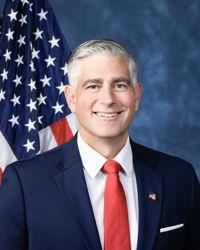
U.S. Representative for Washington’s 5th district
Republican
119th Congress, two-year term
Missed 2.4% of roll calls. Chamber median 1.9%.
The full voting recordCounts roll calls where most Democrats and most Republicans voted differently, leaving out procedural votes.
How we countFrom FEC filings, Voteview roll calls and Congress.gov.
Republican. In Congress since 2025, 1 term in total.
Following saves Baumgartner to your list, which Chamber & Street keeps on its server, linked to a cookie on this browser and not to your name or email. Email alerts will come with constituent verification.
Bills and resolutions Baumgartner signed on to as a cosponsor. An original cosponsor signed on the day the bill was introduced. Source: govinfo bill status files, last updated Nov 6, 2026.
Unlocking our Domestic LNG Potential Act of 2025
Sponsor August Pfluger (R). Joined Aug 15, 2025. 43 cosponsors. H.R. 1949 on Congress.gov
Passed the House
Unlocking our Domestic LNG Potential Act of 2025
This bill repeals certain restrictions on the import and export of natural gas under the Natural Gas Act, including requirements for Department of Energy (DOE) approval and related provisions that address free trade agreements.
In addition, the bill grants the Federal Energy Regulatory Commission (FERC) the exclusive authority to approve or deny applications to authorize the siting, construction, expansion, or operation of facilities (e.g., liquefied natural gas terminals) to export natural gas to foreign countries or import natural gas from foreign countries. (Currently, DOE authorizes the export or import of natural gas, and FERC authorizes related facilities.)
In determining whether to approve or deny an application, FERC must deem the exportation or importation of natural gas to be consistent with the public interest.
Afghan Adjustment Act
Sponsor Mariannette Miller-Meeks (R). Original cosponsor. 21 cosponsors. H.R. 4895 on Congress.gov(opens in a new tab)
Introduced
Modernize the Au Pair Program Act of 2025
Sponsor Guy Reschenthaler (R). Joined Aug 1, 2025. 9 cosponsors. H.R. 4199 on Congress.gov(opens in a new tab)
Introduced
Six Assurances to Taiwan Act
Sponsor Raja Krishnamoorthi (D). Joined Jul 29, 2025. 29 cosponsors. H.R. 3452 on Congress.gov(opens in a new tab)
Introduced
Taiwan Allies Fund Act
Sponsor Raja Krishnamoorthi (D). Joined Jul 29, 2025. 32 cosponsors. H.R. 2559 on Congress.gov(opens in a new tab)
Introduced
Modern Firearm Safety Act
Sponsor Darrell Issa (R). Joined Jul 25, 2025. 15 cosponsors. H.R. 4676 on Congress.gov(opens in a new tab)
Introduced
STUDENT Act
Sponsor Scott Fitzgerald (R). Joined Jul 25, 2025. 10 cosponsors. H.R. 4658 on Congress.gov(opens in a new tab)
Introduced
Stopping Teachers Unions from Damaging Education Needs Today Act or the STUDENT Act
This bill revises the federal charter for the National Education Association.
The bill specifies that the corporation and its state and local affiliates may only accept payment of membership dues or fees from a state or local government employee if the employee (1) has been notified of the employee's right under the First Amendment to refrain from membership and payment of associated dues or fees, (2) has clearly and affirmatively consented to membership and payment of associated dues or fees, and (3) has authorized the transmittal of membership dues or fees without the use of payroll deduction.
Further, the corporation and its state or local affiliates must process and honor cancellation requests for membership or payment of dues as soon as practicable following receipt of the request.
The bill also outlines requirements for the corporation, such as
• prohibiting the corporation or its directors or officers from contributing to, supporting, or participating in political activities;
• requiring each officer of the corporation to be a U.S. citizen;
• requiring the corporation to submit annual reports to Congress;
• prohibiting the corporation and its affiliates from requiring staff, officers, affiliates, or members to affirm, adopt, or adhere to certain principles related to race or sex; and
• prohibiting the corporation and its affiliates from calling or participating in a strike, work stoppage, or slowdown affecting a state or local government.
The bill repeals the corporation's exemption from District of Columbia property taxes.
EMS Counts Act
Sponsor Glenn Thompson (R). Joined Jul 25, 2025. 9 cosponsors. H.R. 3791 on Congress.gov(opens in a new tab)
Introduced
Justice for ALS Veterans Act of 2025
Sponsor Brian Fitzpatrick (R). Joined Jul 25, 2025. 32 cosponsors. H.R. 1685 on Congress.gov(opens in a new tab)
Introduced
Justice for ALS Veterans Act of 2025
This bill extends increased dependency and indemnity compensation to the surviving spouse of a veteran who dies from amyotrophic lateral sclerosis (ALS or Lou Gehrig's disease) regardless of how long the veteran had such disease prior to death. Under current law, such compensation is paid for a service-connected disability that was rated totally disabling for a continuous period of at least eight years immediately preceding death.
For purposes of compensation for a surviving spouse of a veteran who dies from ALS, the spouse must have been married to the veteran for a continuous period of eight years or longer prior to the death of the veteran.
Additionally, the Department of Veterans Affairs (VA) must report on service-connected disabilities the VA determines should be treated in the same manner as ALS for purposes of dependency and indemnity compensation.
Parity for Tribal Law Enforcement Act
Sponsor Dan Newhouse (R). Original cosponsor. 22 cosponsors. H.R. 4712 on Congress.gov(opens in a new tab)
Introduced
PRIME Act
Sponsor Thomas Massie (R). Original cosponsor. 48 cosponsors. H.R. 4700 on Congress.gov(opens in a new tab)
Introduced
Processing Revival and Intrastate Meat Exemption Act or the PRIME Act
This bill exempts from federal inspection requirements animals and meats that are slaughtered and prepared at custom animal slaughter facilities for distribution within the state. Under current law, a custom slaughter exemption applies if the meat is slaughtered exclusively for personal, household, guest, or employee uses.
Specifically, the bill expands the federal inspection exemption to include the slaughter of animals or the preparation of carcasses, meat, and meat food products that are
• slaughtered and prepared at a custom slaughter facility in accordance with the laws of the state where the facility is located; and
• prepared exclusively for distribution to household consumers in the state or restaurants, hotels, boarding houses, grocery stores, or other establishments in the state that either prepare meals served directly to consumers or offer meat and food products for sale directly to consumers in the state.
The bill does not preempt any state law concerning (1) the slaughter of animals or the preparation of carcasses, meat, and meat food products at a custom slaughter facility; or (2) the sale of meat or meat food products.
Sanctions Lists Harmonization Act
Sponsor Randy Fine (R). Joined Jul 17, 2025. 9 cosponsors. H.R. 4291 on Congress.gov(opens in a new tab)
Passed committee
ARMOR Act
Sponsor Young Kim (R). Joined Jul 16, 2025. 6 cosponsors. H.R. 4233 on Congress.gov(opens in a new tab)
Passed the House
AUKUS Reform for Military Optimization and Review Act or the ARMOR Act
This bill expedites review processes for the export of certain defense articles and services to Australia, the United Kingdom (UK), and Canada.
Specifically, the bill exempts from certain congressional notification requirements the export or transfer of defense articles or services subject to the defense trade partnership between Australia, the UK, and the United States (AUKUS). (Under current law, exports and transfers of defense articles and services to Australia and the UK are exempt from certain export controls pursuant to AUKUS. Separately, approvals of certain commercial agreements and the export of certain defense articles, services, and equipment are generally subject to congressional notification requirements and a waiting period.) Under the bill, exports and transfers that are exempt from export controls pursuant to AUKUS are also exempt from these congressional notification requirements.
Further, the bill requires the Department of State to periodically review the list of defense articles and services excluded from AUKUS to ensure it includes only items that (1) are required by statute to be included, or (2) require licensing review for national security reasons.
Finally, the bill explicitly states that the existing expedited review process for applications to export certain commercial, advanced-technology defense articles and services to Australia, the UK, and Canada is available to all exports and transfers, including reexports, retransfers, temporary imports, and brokering activity. Such exports and transfers must take place wholly within or between the territory of these countries or the United States.
Modern Worker Security Act
Sponsor Kevin Kiley (I). Joined Jul 16, 2025. 9 cosponsors. H.R. 1320 on Congress.gov(opens in a new tab)
Introduced
Abraham Accords Defense Against Terror Act
Sponsor Michael Lawler (R). Original cosponsor. 35 cosponsors. H.R. 4335 on Congress.gov(opens in a new tab)
Passed committee
Head Start for Our Future Act
Sponsor Joaquin Castro (D). Original cosponsor. 60 cosponsors. H.R. 4318 on Congress.gov(opens in a new tab)
Introduced
PROTECT Act of 2025
Sponsor Rick Larsen (D). Joined Jul 2, 2025. 19 cosponsors. H.R. 3773 on Congress.gov(opens in a new tab)
Introduced
Protection for Reservation Occupants against Trafficking and Evasive Communications Today Act of 2025 or the PROTECT Act of 2025
This bill expands special tribal criminal jurisdiction (STCJ) to include certain controlled substance-related offenses and firearms offenses. It also allows tribal courts to execute warrants for electronic material.
STCJ allows participating tribes to investigate, prosecute, convict, and sentence both Indian and non-Indian offenders who commit covered crimes in Indian country against Indian victims. Covered crimes currently include assault of tribal justice personnel, child violence, dating violence, domestic violence, obstruction of justice, sexual violence, sex trafficking, stalking, and a violation of a protection order.
The bill expands STCJ to allow participating tribes to prosecute individuals for controlled substance-related offenses (i.e., drug trafficking, unlawful drug possession, or unlawful possession of drug paraphernalia) and firearms offenses (i.e., use or possession of a firearm in furtherance of a covered crime or by a person who has been convicted of domestic violence).
Additionally, the bill allows participating tribes to exercise STCJ over a controlled substance-related offense or a firearms offense if neither the defendant nor the alleged victim is an Indian. (Currently, this exception only applies in cases of obstruction of justice or assault of tribal justice personnel.)
The bill allows offenders convicted pursuant to STCJ to be incarcerated through the Bureau of Prisons Tribal Prisoner Program.
The bill gives tribal courts the same authority as state courts to compel service providers to disclose stored electronic communication information through court-issued warrants, court orders, or administrative subpoenas.
SHORT Act
Sponsor Andrew Clyde (R). Joined Jul 2, 2025. 76 cosponsors. H.R. 2395 on Congress.gov(opens in a new tab)
Introduced
MODERN WIC Act of 2025
Sponsor Brian Fitzpatrick (R). Joined Jul 2, 2025. 80 cosponsors. H.R. 1464 on Congress.gov(opens in a new tab)
Introduced
More Options to Develop and Enhance Remote Nutrition in WIC Act of 2025 or the MODERN WIC Act of 2025
This bill permanently allows individuals to remotely certify their eligibility for, and receive benefits through, the Special Supplemental Nutrition Program for Women, Infants, and Children (WIC).
Specifically, the bill requires that a state agency allow an individual seeking a WIC certification, recertification, or a nutritional risk evaluation to do so by phone or through video teleconference, in addition to the in-person option.
A state agency has 90 days to collect data for a nutritional risk evaluation for a remotely certified individual. Further, a state agency may consider an applicant who meets the income eligibility standards to be temporarily eligible on an interim basis to participate in the program and may certify the individual for immediate participation without waiting for a nutritional risk evaluation.
The bill also allows states to provide benefits on WIC electronic benefit transfer cards through mail or remote issuance instead of requiring participants to pick up or reload benefits in person at a WIC office.
Further, the Department of Agriculture must report to Congress about the use of remote technologies and other digital tools in the WIC program.
Currently, individuals are generally required to be physically present to certify their WIC eligibility and receive benefits, with exceptions. The Food and Nutrition Service has temporarily waived these requirements and allowed remote certification and benefits using authorities that were provided by laws that were enacted to address COVID-19.
Smithsonian American Women’s History Museum Act
Sponsor Nicole Malliotakis (R). Joined Jul 2, 2025. 231 cosponsors. H.R. 1329 on Congress.gov(opens in a new tab)
Introduced
Smithsonian American Women’s History Museum Act
This bill authorizes the Smithsonian American Women's History Museum to be located on a particular site within the Reserve of the National Mall in Washington, DC.
Specifically, the bill designates the South Monument site as the location for the museum; however, the President may designate an alternative site within 180 days of the bill's enactment. (The site is the undeveloped land across the National Mall from the National Museum of African American History and Culture.) Administrative jurisdiction of the site must be transferred to the Smithsonian Institution.
The Board of Regents of the Smithsonian Institution must have the approval of specified federal entities (e.g., the Commission of Fine Arts) to plan, design, and construct a museum building. The bill (1) outlines the criteria for considering site and design proposals, and (2) requires the Smithsonian Institution to reimburse for costs resulting from the building approval process.
The bill directs the museum to be dedicated to preserving, researching, and presenting the history, achievements, and lived experiences of biological women in the United States. Under this bill, the museum may not identify, present, describe, or depict any biological male as a female.
In carrying out its duties, the museum's advisory council must (1) seek and utilize guidance from a broad array of knowledgeable and respected sources reflecting the diversity of the political viewpoints and authentic experiences held by women in the United States, and (2) seek guidance for the creation and substantial revision of exhibits and programs.
123 GO Act
Sponsor Keith Self (R). Original cosponsor. 4 cosponsors. H.R. 4263 on Congress.gov(opens in a new tab)
Introduced
Made-in-America Defense Act
Sponsor Sheri Biggs (R). Original cosponsor. 5 cosponsors. H.R. 4216 on Congress.gov(opens in a new tab)
Passed the House
FMS-Only List Review Act
This bill requires the Department of State to conduct an annual review to identify defense articles and services eligible to be sold only through Foreign Military Sales (FMS) (i.e., U.S. government to foreign government sales) that should also be eligible to be sold through Direct Commercial Sales (DCS) (i.e., U.S. company to foreign government sales).
For each article or service identified, the review must address (1) the length of time to complete a transfer of the article or service through the FMS program as compared to the DCS process; (2) the impact of a transfer of the article or service through the DCS process on the workload of the State Department and the Department of Defense; and (3) the benefits of the transfer of the article or service through the DCS process to U.S. national security and competitiveness.
Within 30 days of the completion of each annual review, the State Department must report to Congress on the results of the review.
Affirming the threats to world stability from a nuclear weapons-capable Islamic Republic of Iran.
Sponsor Jared Moskowitz (D). Joined Jun 26, 2025. 3 cosponsors. H.Res. 105 on Congress.gov(opens in a new tab)
Introduced
This resolution affirms that Iran's pursuit of nuclear weapons is a credible threat to the United States and an existential threat to Israel and other allies and partners in the Middle East.
The resolution also (1) demands that Iran cease engaging in activities such as enriching uranium and developing a nuclear warhead, and (2) asserts that all options should be considered to address the nuclear threat posed by Iran.
WILTR Act of 2025
Sponsor Darrell Issa (R). Original cosponsor. 8 cosponsors. H.R. 4181 on Congress.gov(opens in a new tab)
Introduced
Iran Sanctions Relief Review Act of 2025
Sponsor Keith Self (R). Joined Jun 25, 2025. 8 cosponsors. H.R. 2012 on Congress.gov(opens in a new tab)
Introduced
Iran Sanctions Relief Review Act of 2025
This bill restricts the President's authority to unilaterally undertake certain actions with respect to Iran and increases congressional oversight of those actions.
Specifically, the President must report to Congress before terminating or waiving sanctions related to Iran or taking a licensing action that significantly alters U.S. foreign policy with respect to Iran.
Each report must (1) describe the proposed action and its rationale, and (2) indicate whether or not the action is intended to significantly alter foreign policy concerning Iran. If the intention is to alter that policy, the report must provide additional information including the policy objectives for which the affected sanctions were initially imposed and the anticipated effects of the action on U.S. national security interests.
After the President submits a report, the bill provides Congress with a 30-day period to review it; this period is extended to 60 days for reports submitted between July 10 and September 7. During this period, Congress may enact a joint resolution approving or disapproving the action.
During the review period, the President may not take the action unless Congress passes a joint resolution of approval; if Congress enacts a joint resolution of disapproval, the bill prohibits the President from taking the action.
The bill also outlines procedures for the introduction and consideration of these types of joint resolutions.