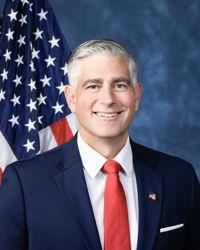
U.S. Representative for Washington’s 5th district
Republican
119th Congress, two-year term
Missed 2.4% of roll calls. Chamber median 1.9%.
The full voting recordCounts roll calls where most Democrats and most Republicans voted differently, leaving out procedural votes.
How we countFrom FEC filings, Voteview roll calls and Congress.gov.
Republican. In Congress since 2025, 1 term in total.
Following saves Baumgartner to your list, which Chamber & Street keeps on its server, linked to a cookie on this browser and not to your name or email. Email alerts will come with constituent verification.
Bills and resolutions Baumgartner signed on to as a cosponsor. An original cosponsor signed on the day the bill was introduced. Source: govinfo bill status files, last updated Nov 6, 2026.
STOP Nitazenes Act
Sponsor Robert Latta (R). Joined Mar 27, 2026. 10 cosponsors. H.R. 7970 on Congress.gov
Passed committee
To establish a National and Nuclear Risk Reduction Center within the Department of State, and for other purposes.
Sponsor William Keating (D). Original cosponsor. 1 cosponsor. H.R. 8086 on Congress.gov(opens in a new tab)
Introduced
DETECT Nitazenes Act of 2026
Sponsor August Pfluger (R). Original cosponsor. 2 cosponsors. H.R. 8022 on Congress.gov(opens in a new tab)
Introduced
No Shari’a Act
Sponsor Randy Fine (R). Joined Mar 18, 2026. 34 cosponsors. H.R. 5512 on Congress.gov(opens in a new tab)
Introduced
Condemning the Government of Iran's state-sponsored persecution of the Baha'i minority in Iran and the continued violation of the Universal Declaration of Human Rights and the International Covenant on Civil and Political Rights.
Sponsor Janice Schakowsky (D). Joined Feb 20, 2026. 49 cosponsors. H.Res. 925 on Congress.gov(opens in a new tab)
Introduced
This resolution condemns Iran's state-sponsored persecution of the Baha'i religious minority and Iran's continued violation of international human rights treaties. The resolution calls on Iran to (1) immediately release Baha'is and others imprisoned or detained solely on account of religion, (2) end its state-sponsored campaign of hate propaganda against the Baha'is, and (3) reverse certain policies that discriminate against Baha'is and other religious minorities. The resolution also urges the President and the Department of State to impose sanctions on Iranian officials and others who are responsible for serious human rights abuses, including abuses against Iran's Baha'i community.
SHIPS for America Act of 2025
Sponsor Trent Kelly (R). Joined Feb 12, 2026. 146 cosponsors. H.R. 3151 on Congress.gov(opens in a new tab)
Introduced
Congratulating the Seattle Seahawks for winning Super Bowl LX and the 12th Man for their unwavering support.
Sponsor Suzan DelBene (D). Original cosponsor. 9 cosponsors. H.Res. 1049 on Congress.gov(opens in a new tab)
Introduced
Dismantle DEI Act of 2025
Sponsor Michael Cloud (R). Joined Feb 4, 2026. 109 cosponsors. H.R. 925 on Congress.gov(opens in a new tab)
Introduced
Protecting TPLF From Abuse Act
Sponsor Darrell Issa (R). Original cosponsor. 3 cosponsors. H.R. 7015 on Congress.gov(opens in a new tab)
Introduced
Stop Insider Trading Act
Sponsor Bryan Steil (R). Original cosponsor. 93 cosponsors. H.R. 7008 on Congress.gov(opens in a new tab)
Passed the House
Stop Insider Trading Act
This bill generally prohibits Members of Congress and their spouses and dependent children from purchasing stocks and requires public notice before these individuals may sell stocks.
Specifically, Members of Congress and the spouses and dependent children of Members of Congress may not purchase covered investments. Between 7 and 14 days before a Member or a covered spouse or dependent sells a covered investment, the relevant Member must file public notice of the intent to sell with the Clerk of the House of Representatives or the Secretary of the Senate, as appropriate. The Clerk or Secretary must publish this notice online. If the individual decides not to sell the covered investment, the notice must be withdrawn.
Under the bill, a covered investment is a security issued by a publicly traded company or a comparable economic interest. Some investments are exempt, including interest in a widely held investment fund and certain investments held in a trust.
Violations of these provisions are subject to a fee and, in the case of a purchase, a requirement to sell the covered investment. The fee must equal (1) the greater of $2,000 or 10% of the transaction value, and (2) any net gain realized from the transaction during a specified period. The fee may not be paid using campaign donations or Members’ official allowances.
Certain transactions by covered spouses and dependents are exempt, including transactions made on behalf of another person or made as part of compensation from the individual’s employer.
Condemning the persecution of Christians in Nigeria and standing ready to support President Donald J. Trump in taking decisive action to end the existential threat that persecuted Christians face in Nigeria.
Sponsor Riley Moore (R). Joined Dec 18, 2025. 39 cosponsors. H.Res. 866 on Congress.gov(opens in a new tab)
Introduced
FIRE Act
Sponsor Tony Wied (R). Joined Dec 18, 2025. 10 cosponsors. H.R. 4546 on Congress.gov(opens in a new tab)
Introduced
Dismantle Foreign Scam Syndicates Act
Sponsor Jefferson Shreve (R). Joined Dec 12, 2025. 73 cosponsors. H.R. 5490 on Congress.gov(opens in a new tab)
Passed committee
Dismantle Foreign Scam Syndicates Act
This bill requires the President to (1) impose applicable sanctions on foreign persons (individuals or entities) responsible for online financial scams against U.S. nationals, and (2) establish an interagency task force to shut down the criminal syndicates perpetuating such scams.
Under the bill, the President must determine whether 43 specified foreign persons, and any other foreign persons the President determines are responsible for or complicit in online financial scams against U.S. nationals, are subject to sanctions under specified laws and Executive Order 13581. Upon such determination, the President must impose applicable sanctions (for example, blocking the sanctioned person's property transactions within the United States).
The President must also establish an interagency task force to shut down transnational criminal syndicates that use large scam centers and forced labor of trafficked persons to perpetuate mass online scams against Americans. The task force must (1) submit a comprehensive strategy to Congress to combat these scam centers and dismantle the criminal elements involved with them, and (2) coordinate and oversee implementation of the strategy. Within 360 days of submitting the strategy to Congress and annually thereafter for five years the task force must submit to Congress a report addressing various topics related to such scam centers including a list of all foreign persons sanctioned by the United States for their scam center involvement.
The Department of State is authorized to provide trauma-informed care, shelter, reintegration, and support services for victims of trafficking in persons within online scam centers.
Ukrainian Adjustment Act of 2025
Sponsor William Keating (D). Joined Nov 21, 2025. 39 cosponsors. H.R. 3104 on Congress.gov(opens in a new tab)
Introduced
Ukrainian Adjustment Act of 2025
This bill provides a streamlined process for certain Ukrainian nationals (including accompanying spouse and children) who are living in the United States to receive lawful permanent resident status.
Specifically, the bill permits Ukrainian nationals who have been paroled into the United States after February 20, 2014, to apply for and receive lawful permanent resident status. Additionally, the Department of Homeland Security (DHS) may waive grounds for inadmissibility (excluding certain crimes or security related grounds) for individuals who apply for status adjustment. DHS must establish vetting requirements (including an interview) for applicants that are equivalent to those under the United States Refugee Admissions Program.
The bill also preserves eligibility for the status adjustment of certain battered spouses whose eligibility for such status stemmed from a marriage that has terminated.
Finally, the bill requires DHS to issue guidance to implement these requirements and establishes a deadline for eligible individuals to apply for adjustment.
MIRACLE Act of 2025
Sponsor Dan Newhouse (R). Original cosponsor. 3 cosponsors. H.R. 6220 on Congress.gov(opens in a new tab)
Introduced
Heat Workforce Standards Act of 2025
Sponsor Mark Messmer (R). Original cosponsor. 74 cosponsors. H.R. 6213 on Congress.gov(opens in a new tab)
Passed committee
Heat Workforce Standards Act of 2025
This bill prohibits the Occupational Safety and Health Administration (OSHA) from finalizing, implementing, or enforcing a safety standard requiring certain employers to create a heat injury and illness prevention plan to evaluate and control heat hazards in their workplaces.
Specifically, OSHA is prohibited from finalizing the proposed rule titled Heat Injury and Illness Prevention in Outdoor and Indoor Work Settings, which was published on August 30, 2024, or any substantially similar standard. The proposed standard generally applies to employers conducting outdoor and indoor work in all general industry, construction, maritime, and agriculture sectors where OSHA has jurisdiction. Employers must develop plans in accordance with the specified standards to address employee exposures to heat indexes at or above 80 degrees (initial heat trigger) or 90 degrees (high heat trigger) Fahrenheit.
As background, the Occupational Safety and Health Act of 1970 generally requires employers to provide their employees with a place of employment that is free from recognized hazards that are causing or likely to cause death or serious harm to employees. OSHA conducts workplace inspections and cites employers that fail to satisfy these requirements. Currently, OSHA does not have specific heat exposure standards; however, OSHA has historically used its general authority to cite employers for violations involving excessive heat, including through a National Emphasis Program that focuses on indoor and outdoor heat exposure in industries that have the highest risks.
Censuring and condemning Delegate Stacey Plaskett and removing her from the House Permanent Select Committee on Intelligence for conduct that reflects discreditably on the House of Representatives for colluding with convicted felony sex offender Jeffrey Epstein during a congressional hearing.
Sponsor Ralph Norman (R). Original cosponsor. 21 cosponsors. H.Res. 888 on Congress.gov(opens in a new tab)
Introduced
Recognizing the strategic value of the historical partnership between the United States and India.
Sponsor Ami Bera (D). Original cosponsor. 25 cosponsors. H.Res. 880 on Congress.gov(opens in a new tab)
Introduced
CONNECT for Health Act of 2025
Sponsor Mike Thompson (D). Joined Nov 17, 2025. 248 cosponsors. H.R. 4206 on Congress.gov(opens in a new tab)
Introduced
Calling for the return of abducted Ukrainian children before finalizing any peace agreement to end the war against Ukraine.
Sponsor Michael McCaul (R). Joined Nov 7, 2025. 47 cosponsors. H.Res. 564 on Congress.gov(opens in a new tab)
Introduced
Protecting Our Courts from Foreign Manipulation Act
Sponsor Ben Cline (R). Joined Oct 31, 2025. 26 cosponsors. H.R. 2675 on Congress.gov(opens in a new tab)
Passed committee
Protecting Our Courts from Foreign Manipulation Act
This bill limits third-party financing of civil litigation by foreign entities in federal courts and establishes related disclosure requirements.
The bill makes it unlawful for a foreign state or sovereign wealth fund to provide any monetary support for a civil action in which it is not a named party. The bill also makes it unlawful for any party or counsel to receive monetary support for civil litigation from a foreign state or sovereign wealth fund that is not a party.
The bill also prohibits third-party litigation funding agreements involving money from a foreign state or sovereign wealth fund in which someone other than named parties or counsel of record receives a payment that is contingent on the outcome or proceeds from the civil action or from any matter within a portfolio that includes the civil action.
The bill requires any party or counsel in a civil action to disclose the name of any foreign person, state, or sovereign wealth fund that has agreed to provide monetary support for the civil action, has a right to receive a payment contingent upon the outcome of the civil action, or has the right to receive payment that is contingent on proceeds from any matter within a portfolio that includes the civil action.
The bill also requires parties to produce the agreement creating a contingent right to payment.
These requirements apply to claims that are pending on or commenced after this bill's date of enactment.
Generating Retirement Ownership through Long-Term Holding
Sponsor Beth Van Duyne (R). Joined Oct 31, 2025. 130 cosponsors. H.R. 2089 on Congress.gov(opens in a new tab)
Introduced
Litigation Transparency Act of 2025
Sponsor Darrell Issa (R). Joined Oct 24, 2025. 30 cosponsors. H.R. 1109 on Congress.gov(opens in a new tab)
Introduced
Litigation Transparency Act of 2025
This bill generally requires parties in a civil action to disclose to the court and other named parties the identity of any person (other than counsel) that has a right to receive a payment or thing of value contingent upon the outcome of the civil action. The bill also requires parties to produce the agreement creating the contingent right to payment or a thing of value.
These requirements apply to claims that are pending on or commenced after this bill's date of enactment.
Donald J. Trump Congressional Gold Medal Act
Sponsor Derrick Van Orden (R). Original cosponsor. 29 cosponsors. H.R. 5789 on Congress.gov(opens in a new tab)
Introduced
Retire through Ownership Act
Sponsor Rick Allen (R). Joined Oct 10, 2025. 4 cosponsors. H.R. 5169 on Congress.gov(opens in a new tab)
Introduced
Retire through Ownership Act
This bill allows the fiduciary of an Employee Stock Ownership Plan (ESOP) to rely on a valuation provided by an independent valuation or business appraiser in determining the fair market value of the plan's assets if the assets are not securities for which there is a generally recognized market and the expert or appraiser follows specified methodologies.
In general, ESOPs are defined contribution pension plans where employees accrue shares of their employers' stock in individual accounts as part of their compensation. After separating from employment or retiring, employees receive the cash value of their shares.
Under the bill, an independent appraiser or expert must adhere to the methodology established under the Internal Revenue Service Ruling 59-60, which prescribes the factors a professional business appraiser should consider in forming a valuation of the stock for a closely held business.