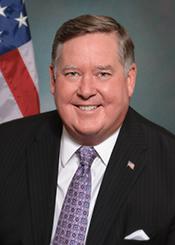
U.S. Representative for California’s 41st district
Republican
119th Congress, two-year term
Missed 0.3% of roll calls. Chamber median 1.9%.
The full voting recordCounts roll calls where most Democrats and most Republicans voted differently, leaving out procedural votes.
How we countFrom FEC filings, Voteview roll calls and Congress.gov.
Republican. In Congress since 1993, 17 terms in total.
Following saves Calvert to your list, which Chamber & Street keeps on its server, linked to a cookie on this browser and not to your name or email. Email alerts will come with constituent verification.
Bills and resolutions where Calvert is the primary sponsor. Most bills never leave committee; that is normal for every member. Source: Congress.gov, last updated Oct 29, 2026.
12 of 26 have at least one cosponsor from the other party.
National Security Interstate Pipeline Act
Introduced Jul 22, 2026. 8 cosponsors. H.R. 9838 on Congress.gov
Introduced
Department of Defense Appropriations Act, 2027
Introduced Jun 26, 2026. 0 cosponsors. H.R. 9495 on Congress.gov(opens in a new tab)
Introduced
Department of Defense Appropriations Act, 2027
This bill provides FY2027 appropriations to the Department of Defense (DOD) for military activities.
(The bill excludes military construction, military family housing, civil works projects of the Army Corps of Engineers, and nuclear warheads, which are all included in other appropriations bills.)
Within the DOD budget, the bill provides appropriations for
• Military Personnel;
• Operation and Maintenance;
• Procurement;
• Research, Development, Test and Evaluation; and
• Revolving and Management Funds.
The bill provides appropriations for other DOD programs, including
• the Combat and Operational Medicine Program,
• the Private Sector Care Program,
• Chemical Agents and Munitions Destruction,
• Drug Interdiction and Counter-Drug Activities, and
• the Office of the Inspector General.
In addition, the bill provides appropriations for related agencies, including (1) the Central Intelligence Agency Retirement and Disability System Fund, and (2) the Intelligence Community Management Account.
The bill also sets forth requirements and restrictions for using funds provided by this and other appropriations acts.
Zero Tolerance for Fraudsters Act of 2026
Introduced May 21, 2026. 3 cosponsors. H.R. 8951 on Congress.gov(opens in a new tab)
Introduced
Fireworks for Freedom Act
Introduced Apr 30, 2026. 0 cosponsors. H.R. 8593 on Congress.gov(opens in a new tab)
Introduced
Condemning State-level energy policies that restrict domestic oil production, increase gasoline prices, and undermine American energy security and national defense.
Introduced Apr 29, 2026. 0 cosponsors. H.Res. 1227 on Congress.gov(opens in a new tab)
Introduced
ACCESS Act of 2026.
Introduced Apr 21, 2026. 3 cosponsors, 1 from the other party. H.R. 8396 on Congress.gov(opens in a new tab)
Introduced
Stuck On Hold Act
Introduced Nov 10, 2025. 8 cosponsors, 3 from the other party. H.R. 5992 on Congress.gov(opens in a new tab)
Introduced
Stuck On Hold Act
This bill requires the Department of Veterans Affairs (VA) to implement automated systems for their customer phone lines that inform callers of the expected wait time and that offer callbacks for wait times of more than 10 minutes. The VA must also issue guidance to reduce the average wait time to no more than 10 minutes.
Agua Caliente Band of Cahuilla Indians Water Rights Settlement Act
Introduced Nov 7, 2025. 1 cosponsor, 1 from the other party. H.R. 5935 on Congress.gov(opens in a new tab)
Introduced
DOD Entrepreneurial Innovation Act
Introduced Oct 10, 2025. 0 cosponsors. H.R. 5726 on Congress.gov(opens in a new tab)
Introduced
To amend the Federal Water Pollution Control Act with respect to permitting terms, and for other purposes.
Introduced Mar 14, 2025. 2 cosponsors, 1 from the other party. H.R. 2093 on Congress.gov(opens in a new tab)
Introduced
Ending Major Borderland Environmental Ruin from Wildfires (EMBER) Act
Introduced Mar 11, 2025. 0 cosponsors. H.R. 2026 on Congress.gov(opens in a new tab)
Introduced
FISH Act of 2025
Introduced Mar 6, 2025. 7 cosponsors, 2 from the other party. H.R. 1894 on Congress.gov(opens in a new tab)
Introduced
HELD Act
Introduced Mar 4, 2025. 0 cosponsors. H.R. 1821 on Congress.gov(opens in a new tab)
Introduced
Help Ensure Legal Detainers Act or the HELD Act
This bill prohibits the use of federal funds by a state or local subdivision that has in effect a law, policy, or procedure that prevents or impedes
• a timely response to a request from U.S. Immigration and Customs Enforcement (ICE) for information about an alien in state or local custody, including the alien's estimated release date; or
• compliance with a request from ICE to hold an alien for up to 48 hours so that ICE may assume custody.
Recognizing the 80th anniversary of the amphibious landing on the Japanese island of Iwo Jima during World War II and the raisings of the flag of the United States on Mount Suribachi.
Introduced Feb 18, 2025. 3 cosponsors, 1 from the other party. H.Res. 142 on Congress.gov(opens in a new tab)
Introduced
This resolution recognizes the 80th anniversary of the amphibious landing of U.S. troops on the Japanese island of Iwo Jima in 1945 and commemorates the historic raising of the U.S. flag on Mount Suribachi that occurred on February 23, 1945.
HEARTS Act of 2025
Introduced Feb 13, 2025. 18 cosponsors, 15 from the other party. H.R. 1291 on Congress.gov(opens in a new tab)
Introduced
Humane and Existing Alternatives in Research and Testing Sciences Act of 2025 or the HEARTS Act of 2025
This bill establishes a center within the National Institutes of Health (NIH) and requires other activities to promote alternatives to using animals in research and testing.
The duties of the center include developing nonanimal research models (e.g., advanced cell cultures, advanced imaging systems) and training scientists about the methods.
Additionally, if an agency or other entity conducting federally funded research uses animals for research and testing, it must develop and update a plan for reducing such use and periodically report to the center the number and types of animals it uses.
The NIH must also provide incentives for the use of nonanimal research and generally ensure that nonanimal alternatives are considered when reviewing research proposals. Further, applications for NIH research grants must include an assurance that nonanimal methods for carrying out the research are unavailable.
Ensuring the Safety of Our Mail Act of 2025
Introduced Feb 13, 2025. 0 cosponsors. H.R. 1292 on Congress.gov(opens in a new tab)
Introduced
Ensuring the Safety of Our Mail Act of 2025
This bill increases from 5 to 10 years the maximum prison term for a defendant who commits mail theft.
To direct the United States Postal Service to designate a single, unique ZIP Code for Eastvale, California.
Introduced Feb 12, 2025. 1 cosponsor, 1 from the other party. H.R. 1225 on Congress.gov(opens in a new tab)
Introduced
This bill directs the U.S. Postal Service to designate a single, unique ZIP Code for Eastvale, California.
Space Infrastructure Act
Introduced Feb 10, 2025. 5 cosponsors, 4 from the other party. H.R. 1154 on Congress.gov(opens in a new tab)
Introduced
Space Infrastructure Act
This bill directs the Department of Homeland Security (DHS) to designate space systems, services, and technology as a critical infrastructure sector. Under current law, critical infrastructure means systems and assets, whether physical or virtual, so vital to the United States that the incapacity or destruction of such systems and assets would have a debilitating impact on security, national economic security, national public health or safety, or any combination of those matters.
DHS must issue guidance with respect to the designation, in which it must define the scope of the sector and name a federal agency to serve as the federal interface for the prioritization and coordination of activities specific to the sector, among other duties.
The bill also adds the space systems, services, and technology sector to a list of critical infrastructure sectors that DHS must consider in allocating certain national security grants.
Treatment and Homelessness Housing Integration Act of 2025
Introduced Jan 21, 2025. 1 cosponsor. H.R. 577 on Congress.gov(opens in a new tab)
Introduced
Legal Workforce Act
Introduced Jan 9, 2025. 45 cosponsors, 1 from the other party. H.R. 251 on Congress.gov(opens in a new tab)
Introduced
Legal Workforce Act
This bill directs the Department of Homeland Security (DHS) to create an electronic employment eligibility confirmation system modeled after and to replace the E-Verify system, which allows employers and recruiters to verify the immigration status of individuals. The bill also mandates the use of such a system, where currently only some employers, such as those with federal contracts, are required to use E-Verify.
The bill specifies documents that can establish an individual's identity and employment authorization. During the period starting when a job offer is made until three business days after hiring, the individual must attest to his or her employment authorization, and the employer or recruiter must attest that it has examined the individual's required documents.
Employers shall reverify certain types of employees who were not previously verified using E-Verify.
The Social Security Administration shall notify employees if their Social Security number has been used multiple times in an unusual manner. DHS shall establish programs for blocking and suspending misused numbers.
Employers that are required to use the verification system shall not be liable for any employment-related action based on a good-faith reliance on the system.
The bill establishes a phased-in participation deadline for different sizes and categories of employers, including agricultural employers.
The bill increases civil penalties related to hiring individuals without work authorization. It also preempts state laws relating to hiring and employment eligibility verification, but states may use their authority of business licensing to penalize employers for failing to comply with the bill's provisions.