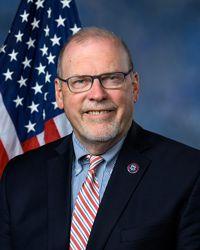
U.S. Representative for Virginia’s 9th district
Republican
119th Congress, two-year term
Missed 1.2% of roll calls. Chamber median 1.9%.
The full voting recordCounts roll calls where most Democrats and most Republicans voted differently, leaving out procedural votes.
How we countFrom FEC filings, Voteview roll calls and Congress.gov.
Republican. In Congress since 2011, 8 terms in total.
Following saves Griffith to your list, which Chamber & Street keeps on its server, linked to a cookie on this browser and not to your name or email. Email alerts will come with constituent verification.
Bills and resolutions where Griffith is the primary sponsor. Most bills never leave committee; that is normal for every member. Source: Congress.gov, last updated Oct 29, 2026.
10 of 38 have at least one cosponsor from the other party.
Risky Research Review Act
Introduced Mar 5, 2025. 0 cosponsors. H.R. 1864 on Congress.gov
Introduced
Risky Research Review Act
This bill establishes the Life Sciences Research Security Board to oversee the award of federal funding for high-risk life sciences research. High-risk life sciences research means the study of an organism, virus, or related product that could be misapplied to pose a significant threat to the public or could enhance the transmissibility or virulence of certain high-risk pathogens (e.g., Ebola).
Specifically, the bill establishes the board as an independent agency that must review proposed high-risk life sciences research, determine whether a federal agency may award funding for the research, and determine minimum required controls for funded research. Entities that are seeking federal funding must attest to whether their research is high-risk life sciences research. Agencies must certify the validity of these attestations and submit proposed high-risk life sciences research to the board. Agencies must also notify the board of intended awards for other life sciences research for potential review.
In making its determinations, the board must consider specified factors, including whether the benefits of the research outweigh the risks. The bill prohibits agencies from awarding federal funding for high-risk life sciences research without approval of the board or for life sciences research currently under board review. The board may also review awards that were made before the bill’s enactment.
Entities that fail to properly attest to the nature of their research may lose their eligibility for funding. Additionally, agency employees who fail to comply with the bill's requirements are subject to disciplinary action.
Providing for congressional disapproval under chapter 8 of title 5, United States Code, of the rule submitted by the Environmental Protection Agency relating to "National Emission Standards for Hazardous Air Pollutants: Rubber Tire Manufacturing".
Introduced Feb 25, 2025. 20 cosponsors. H.J.Res. 61 on Congress.gov(opens in a new tab)
Became law
This joint resolution removes emission regulations on hazardous air pollutants under the rubber tire manufacturing source category, specifically from the rubber processing subcategory. The joint resolution nullifies the Environmental Protection Agency (EPA) rule titled National Emission Standards for Hazardous Air Pollutants: Rubber Tire Manufacturing, which addresses the decision in Louisiana Environmental Action Network v. EPA (D.C. Cir. 2020) that requires the EPA to address unregulated emissions from a major source category when it conducts the 8-year technology review. The rule implemented emissions standards for the rubber processing subcategory.
Electing a Member to a certain standing committee of the House of Representatives.
Introduced Feb 5, 2025. 0 cosponsors. H.Res. 107 on Congress.gov(opens in a new tab)
Passed the House
This resolution elects Delegate James Moylan of Guam to the Committee on Education and Workforce and provides that he shall rank immediately after Representative Michael Rulli of Ohio.
Providing for consideration of the bill (H.R. 27) to amend the Controlled Substances Act with respect to the scheduling of fentanyl-related substances, and for other purposes.
Introduced Feb 4, 2025. 0 cosponsors. H.Res. 93 on Congress.gov(opens in a new tab)
Passed the House
This resolution provides for consideration of H.R. 27, the Halt All Lethal Trafficking of Fentanyl Act or the HALT Fentanyl Act. Specifically, it waives all points of order against consideration of the bill.
Under the resolution, the bill is to be considered as amended according to changes by the Rules Committee in its report accompanying the resolution.
Domestic SUPPLY Act of 2025
Introduced Jan 23, 2025. 0 cosponsors. H.R. 675 on Congress.gov(opens in a new tab)
Introduced
Domestic Security Using Production Partnerships and Lessons from Yesterday Act of 2025 or the Domestic SUPPLY Act of 2025
This bill establishes a program and sets out other requirements to promote domestic manufacturing of personal protective equipment (PPE) to address infectious diseases and other public health emergencies.
Specifically, the Department of Health and Human Services (HHS) must establish a program to enter into purchasing agreements with eligible domestic manufacturers for PPE to prepare for and respond to public health emergencies. To be eligible, manufacturers must be majority owned and operated by U.S. citizens and must manufacture a majority of their contracted products domestically, with 100% of products manufactured domestically by 2028. HHS must coordinate with the Department of Defense and the Department of Homeland Security on this program.
In addition, the federal government must only procure, subject to limited exceptions, clothing or equipment that is produced domestically to prevent the transmission of an infectious disease. If using federal funds, states or localities must also procure such items domestically.
Further, the bill requires HHS to submit to Congress a report about changes to federal requirements for PPE since the beginning of the COVID-19 pandemic and the impact of those changes on health care workers who cared for patients in 2020 and 2021.
____ Act
Introduced Jan 21, 2025. 0 cosponsors. H.R. 571 on Congress.gov(opens in a new tab)
Introduced
This bill implements a means test for certain elementary and secondary school students aged 18 or older to collect Social Security child’s benefits.
Specifically, a child beneficiary aged 18 years or older may not be eligible for Social Security child’s benefits based on their status as a full-time elementary or secondary school student if the individual on whose wages and income the benefit is based (e.g., the child’s parent or guardian) (1) is entitled to Social Security benefits, (2) is 67 years of age or older, and (3) has more than $125,000 of annual earnings for the taxable year.
To amend the Internal Revenue Code of 1986 to allow the child tax credit with respect to stillbirths.
Introduced Jan 21, 2025. 0 cosponsors. H.R. 570 on Congress.gov(opens in a new tab)
Introduced
This bill expands the definition of a qualifying child to include a stillborn child for purposes of the child tax credit. (Under current law, taxpayers may claim a tax credit of up $2,000 for each qualifying child.)
Under the bill, a stillborn child is an unborn child (1) carried in the womb for a gestational period of 20 weeks or more, and (2) delivered after the spontaneous intrauterine fetal demise of the child.
BROADBAND Leadership Act
Introduced Jan 9, 2025. 0 cosponsors. H.R. 278 on Congress.gov(opens in a new tab)
Introduced
Barriers and Regulatory Obstacles Avoids Deployment of Broadband Access and Needs Deregulatory Leadership Act or the BROADBAND Leadership Act
This bill limits the authority of a state or locality to regulate the placement, construction, or modification of telecommunications service facilities.
States and localities may not discriminate in such regulations among providers of telecommunications services, including based on the technology used to provide services. In addition, states and localities may not regulate in a manner that effectively prohibits the provision or improvement of interstate or intrastate telecommunications services.
However, states and localities may charge reasonable, cost-based fees (1) to review requests to place, construct, or modify telecommunications service facilities; or (2) for the use of property owned or managed by the state or locality for the placement, construction, or modification of those facilities.
States or localities must respond to requests to place, construct, or modify facilities and for other related actions by specified deadlines. Such deadlines may only be tolled by a mutual agreement between the applicant and the state or locality, or in the event that the application is incomplete and requires a supplemental submission. If a decision is not made by the deadline, the request is deemed to be approved. Further, denials of requests must be made in writing, supported by evidence, and promptly released to the public.
A person adversely affected by an alleged violation of these provisions may petition the courts for expedited review of the actions of the state or locality.
To direct the United States Postal Service to designate a single, unique ZIP Code for Fairlawn, Virginia, and for other purposes.
Introduced Jan 9, 2025. 0 cosponsors. H.R. 279 on Congress.gov(opens in a new tab)
Introduced
This bill requires the U.S. Postal Service to designate a single, unique ZIP Code applicable to Fairlawn, Virginia.
To amend the Internal Revenue Code of 1986 to increase and adjust for inflation the above-the-line deduction for teachers.
Introduced Jan 7, 2025. 0 cosponsors. H.R. 228 on Congress.gov(opens in a new tab)
Introduced
This bill increases the above-the-line tax deduction for unreimbursed expenses incurred by an eligible educator for classroom supplies and certain professional development courses. (Above-the-line deductions are subtracted from gross income to calculate adjusted gross income.)
Under current law, an eligible educator may deduct up to $300 in 2025 (adjusted annually for inflation) for unreimbursed expenses for classroom supplies and certain professional development courses. An eligible educator is defined as a kindergarten through grade 12 teacher, instructor, counselor, principal, or aide who works at least 900 hours during a school year in a school that provides elementary or secondary education.
Under the bill, an eligible educator may deduct up to $1,000 in 2025 for unreimbursed expenses for classroom supplies and certain professional development. For tax years after 2025, the $1,000 limit on the tax deduction is adjusted annually for inflation.
New Source Review Permitting Improvement Act
Introduced Jan 3, 2025. 21 cosponsors. H.R. 161 on Congress.gov(opens in a new tab)
Introduced
New Source Review Permitting Improvement Act
This bill modifies terminology for purposes of the New Source Review (NSR) permitting program of the Environmental Protection Agency (EPA).
In order for a change to a stationary source to be a modification (a change to a stationary source that increases the air pollutant emissions or results in new pollutants) for purposes of the NSR permitting program, the maximum hourly emission rate achievable by such source must be higher than the maximum hourly rate achievable by such source during any hour in the 10-year period preceding the change.
A change at a stationary source is not considered to be a modification under the bill if it is designed to (1) reduce the amount of any air pollutant emitted; or (2) restore, maintain, or improve the reliability of operations at, or safety of, the source. However, such changes are not excepted if the EPA determines the increase in the maximum achievable hourly emission rate from such change would cause an adverse effect on human health or the environment.
Construction, in connection with a major emitting facility (a type of stationary source), does not include a change at such a facility that does not result in a significant emissions increase or a significant net emissions increase.
In relation to major emitting facilities in nonattainment areas, the terms modifications and modified do not include changes at such facilities that do not result in a significant emissions increase or a significant net emissions increase.
Reclaiming Congress’s Constitutional Mandate in Trade Resolution
Introduced Jan 3, 2025. 0 cosponsors. H.Con.Res. 2 on Congress.gov(opens in a new tab)
Introduced
Reclaiming Congress’s Constitutional Mandate in Trade Resolution
This concurrent resolution establishes a process for transferring the functions and responsibilities of the Office of the Trade Representative (USTR) from the executive branch to the legislative branch. The concurrent resolution establishes the Joint Ad Hoc Committee on Trade Responsibilities and the Congressional Advisory Board on Trade Responsibilities to plan for and implement the transfer.
The Joint Ad Hoc Committee on Trade Responsibilities shall consist of 14 members of Congress appointed by majority and minority party leaders of the two chambers of Congress and meeting qualifications specified in the bill. The committee shall develop a plan under which the functions and responsibilities of the USTR shall be moved and provide its plan in a report to Congress within 16 months after the committee is appointed.
The bill also establishes a 21-member Congressional Advisory Board on Trade Responsibilities responsible for advising the committee in its development of the plan. Individuals meeting qualifications specified in the bill shall be appointed by the Trade Representative and majority and minority party leaders.
The concurrent resolution also provides that the USTR shall provide such information and assistance the committee and the advisory board may reasonably require to carry out their activities.
The transition of the USTR to the legislative branch occurs four years after the committee submits its report.
HALT Fentanyl Act
Introduced Jan 3, 2025. 61 cosponsors, 2 from the other party. H.R. 27 on Congress.gov(opens in a new tab)
Passed the House
Halt All Lethal Trafficking of Fentanyl Act or the HALT Fentanyl Act
This bill permanently places fentanyl-related substances as a class into schedule I of the Controlled Substances Act. A schedule I controlled substance is a drug, substance, or chemical that has a high potential for abuse; has no currently accepted medical value; and is subject to regulatory controls and administrative, civil, and criminal penalties under the Controlled Substances Act.
Under the bill, offenses involving fentanyl-related substances are triggered by the same quantity thresholds and subject to the same penalties as offenses involving fentanyl analogues (e.g., offenses involving 100 grams or more trigger a 10-year mandatory minimum prison term).
Additionally, the bill establishes a new, alternative registration process for certain schedule I research.
The bill also makes several other changes to registration requirements for conducting research with controlled substances, including
• permitting a single registration for related research sites in certain circumstances,
• waiving the requirement for a new inspection in certain situations, and
• allowing a registered researcher to perform certain manufacturing activities with small quantities of a substance without obtaining a manufacturing registration.
Finally, the bill expresses the sense that Congress agrees with the interpretation of Controlled Substances Act in United States v. McCray, a 2018 case decided by the U.S. District Court for the Western District of New York. In that case, the court held that butyryl fentanyl, a controlled substance, can be considered an analogue of fentanyl even though, under the Controlled Substances Act, the term controlled substance analogue specifically excludes a controlled substance.