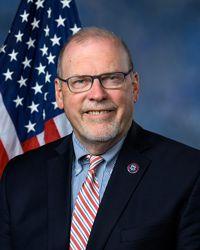
U.S. Representative for Virginia’s 9th district
Republican
119th Congress, two-year term
Missed 1.2% of roll calls. Chamber median 1.9%.
The full voting recordCounts roll calls where most Democrats and most Republicans voted differently, leaving out procedural votes.
How we countFrom FEC filings, Voteview roll calls and Congress.gov.
Republican. In Congress since 2011, 8 terms in total.
Following saves Griffith to your list, which Chamber & Street keeps on its server, linked to a cookie on this browser and not to your name or email. Email alerts will come with constituent verification.
Bills and resolutions Griffith signed on to as a cosponsor. An original cosponsor signed on the day the bill was introduced. Source: govinfo bill status files, last updated Nov 6, 2026.
To amend the Federal Food, Drug, and Cosmetic Act and Public Health Service Act to advance the next-generation of clinical development of novel treatments and cures, and for other purposes.
Sponsor Jake Auchincloss (D). Original cosponsor. 1 cosponsor. H.R. 10857 on Congress.gov
Introduced
Directing the Federal Trade Commission to investigate and report on anticompetitive practices and violations of the antitrust laws in the fire truck manufacturing industry.
Sponsor Becca Balint (D). Joined Oct 22, 2026. 9 cosponsors. H.J.Res. 203 on Congress.gov(opens in a new tab)
Introduced
SNAP Anti-Theft and Victim Compensation Act of 2025
Sponsor Zachary Nunn (R). Joined Sep 24, 2026. 1 cosponsor. H.R. 3887 on Congress.gov(opens in a new tab)
Introduced
Shenandoah VALOR Act
Sponsor Riley Moore (R). Original cosponsor. 12 cosponsors. H.R. 10581 on Congress.gov(opens in a new tab)
Introduced
North Platte Canteen Congressional Gold Medal Act
Sponsor Adrian Smith (R). Joined Sep 17, 2026. 270 cosponsors. H.R. 1502 on Congress.gov(opens in a new tab)
Introduced
North Platte Canteen Congressional Gold Medal Act
This bill provides for the award of a Congressional Gold Medal to recognize the individuals and communities that provided financial and other support for the North Platte Canteen in North Platte, Nebraska, during World War II.
Protect Domestic Oil and Gas Small Business Act of 2026
Sponsor August Pfluger (R). Joined Sep 16, 2026. 29 cosponsors. H.R. 8990 on Congress.gov(opens in a new tab)
Introduced
Fair Access to Banking Act
Sponsor Andy Barr (R). Joined Sep 15, 2026. 151 cosponsors. H.R. 987 on Congress.gov(opens in a new tab)
Introduced
Fair Access to Banking Act
This bill places restrictions on certain banks, credit unions, and payment card networks if they refuse to do business with a person who complies with the law. Restrictions include prohibiting the use of electronic funds transfer systems and lending programs, termination of an institution's depository insurance, and specified civil penalties.
Banks and other specified financial institutions are allowed to deny financial services to a person only if the denial is justified by a documented failure of that person to meet quantitative, impartial, risk-based standards established in advance by the institution. This justification may not be based upon reputational risks to the institution.
The bill establishes the right for a person to bring a civil action for a violation of this bill.
Stopping Harmful and Outrageous Torts Act
Sponsor Derek Schmidt (R). Joined Sep 15, 2026. 126 cosponsors. H.R. 9298 on Congress.gov(opens in a new tab)
Introduced
Firearm Access During Shutdowns Act
Sponsor Ben Cline (R). Joined Sep 15, 2026. 112 cosponsors. H.R. 5874 on Congress.gov(opens in a new tab)
Introduced
Firearm Access During Shutdowns Act
This bill requires various federal agencies to continue certain operations, functions, and services related to firearms during a government shutdown.
The bill applies to
• the Federal Bureau of Investigation's National Instant Criminal Background Check System, including the processing of background checks in support of the operations of the Directorate of Enforcement Programs and Services of the Bureau of Alcohol, Tobacco, Firearms and Explosives (ATF);
• the ATF's Directorate of Enforcement Programs and Services;
• the activities of the Department of Commerce's Bureau of Industry and Security relating to firearms and firearm-related products, including activities related to processing of applications for export licenses; and
• the activities of the Department of State's Directorate of Defense Trade Controls relating to firearms and firearm-related products, including activities related to processing of applications for export licenses.
Under the bill, (1) these operations, functions, and services are deemed to relate to an emergency involving the safety of human life or the protection of property; and (2) employees carrying out the operations, functions, and services are deemed to be excepted employees. (Under an exception in the Antideficiency Act, an employee whose duties involve the safety of human life or the protection of property may be required to work during a government shutdown. Employees who are required to work during a government shutdown because they fall under this or other exceptions are known as excepted employees.)
FIND Act
Sponsor Jack Bergman (R). Joined Sep 15, 2026. 154 cosponsors. H.R. 45 on Congress.gov(opens in a new tab)
Introduced
Firearm Industry Non-Discrimination Act or the FIND Act
This bill prohibits the federal government from entering into contracts with an entity that discriminates against firearm trade associations or businesses that deal in firearms, ammunition, or related products.
Specifically, the bill requires a federal agency to include in each contract for the procurement of goods or services awarded by the agency a clause requiring the prime contractor to certify that it (1) has no policy, practice, guidance, or directive that discriminates against a firearm entity or firearm trade association; and (2) will not adopt a policy, practice, guidance, or directive that discriminates against a firearm entity or firearm trade association during the term of the contract.
The bill establishes (1) a similar requirement with respect to subcontracts, and (2) penalties for violations.
The bill makes such prohibition inapplicable to a contract for the procurement of goods or services that is a sole-source contract.
Freedom from Unfair Gun Taxes Act of 2025
Sponsor Darrell Issa (R). Joined Sep 15, 2026. 105 cosponsors. H.R. 2442 on Congress.gov(opens in a new tab)
Introduced
Freedom from Unfair Gun Taxes Act of 2025
This bill prohibits a state or any political subdivision of a state from imposing or collecting an excise tax on the sale of a firearm, ammunition, or any part or component of a firearm or ammunition by a manufacture or dealer.
Federal Firearms Licensee Protection Act of 2025
Sponsor John Rutherford (R). Joined Sep 15, 2026. 145 cosponsors. H.R. 1773 on Congress.gov(opens in a new tab)
Introduced
Federal Firearms Licensee Protection Act of 2025
This bill modifies criminal penalties for an offense involving the theft of a firearm from a licensed importer, manufacturer, or dealer, or from their business premises.
Specifically, the bill does the following:
• increases from 10 to 20 years the maximum prison term, and
• creates a 3- or 5-year mandatory minimum prison term for an offense that occurs during the commission of a burglary or robbery.
An attempt to commit an offense is subject to the same penalties as a substantive offense.
American Franchise Act
Sponsor Kevin Hern (R). Joined Sep 3, 2026. 158 cosponsors. H.R. 5267 on Congress.gov(opens in a new tab)
Introduced
Protection Against Mass Surveillance Act
Sponsor Tim Burchett (R). Joined Sep 2, 2026. 8 cosponsors. H.R. 9800 on Congress.gov(opens in a new tab)
Introduced
SAVE Moms and Babies Act of 2025
Sponsor Robert Latta (R). Joined Sep 2, 2026. 85 cosponsors. H.R. 685 on Congress.gov(opens in a new tab)
Introduced
Support And Value Expectant Moms and Babies Act of 2025 or the SAVE Moms and Babies Act of 2025
This bill prohibits the Food and Drug Administration (FDA) from approving any new drug (either as a brand-name drug or a generic) intended to terminate a pregnancy and imposes additional restrictions on such drugs that are already approved.
Under the bill, an already-approved drug intended to terminate a pregnancy may be dispensed to a patient only with a prescription. Furthermore, the FDA may not approve any labeling change that would authorize (1) using the drug after 70 days of gestation, or (2) dispensing the drug by any means other than in-person administration by the prescribing health care practitioner.
The FDA must also impose additional restrictions on such already-approved drugs, including by (1) requiring the prescribing health care practitioner to receive a special certification, (2) prohibiting the practitioner from also acting as the dispensing pharmacist, and (3) requiring the practitioner to have the ability to provide surgical intervention to the patient.
The bill also rescinds any investigational use exemption already granted to such a drug if the bill would have prohibited the FDA from granting the exemption. (Currently, the FDA may grant an exemption to certain market approval requirements if a drug is intended solely for use in safety and effectiveness investigations.)
Forced Abortion Prevention and Accountability Act
Sponsor Mark Messmer (R). Joined Sep 2, 2026. 80 cosponsors. H.R. 6466 on Congress.gov(opens in a new tab)
Introduced
America’s Olympic and Paralympic Games Commemorative Coins Act
Sponsor Brad Sherman (D). Joined Sep 2, 2026. 313 cosponsors. H.R. 4382 on Congress.gov(opens in a new tab)
Introduced
Data BRIDGE Act
Sponsor Erin Houchin (R). Joined Sep 1, 2026. 15 cosponsors. H.R. 4950 on Congress.gov(opens in a new tab)
Passed committee
Data Broadband Reporting and Integration for Deployment in Geographically Essential Areas Act or the Data BRIDGE Act
This bill requires the Federal Communications Commission (FCC) to update the National Broadband Map to include data on the location of agricultural areas as a layer of the map and to maintain this data in the map moving forward. (The map depicts the availability of broadband internet service across the United States.)
In incorporating this data, the FCC must consult with (1) the Department of Agriculture, including with respect to existing data on the location of agricultural areas; and (2) with the National Telecommunications and Information Administration, states, and other relevant stakeholders.
Save Struggling Hospitals Act
Sponsor David Kustoff (R). Joined Aug 31, 2026. 6 cosponsors. H.R. 8109 on Congress.gov(opens in a new tab)
Introduced
Daughters of the American Revolution Membership Integrity Act.
Sponsor Ben Cline (R). Joined Aug 27, 2026. 48 cosponsors. H.R. 9701 on Congress.gov(opens in a new tab)
Introduced
Daughters of the American Revolution Membership Integrity Act
This bill limits membership eligibility for the National Society of the Daughters of the American Revolution (commonly known as the Daughters of the American Revolution, or DAR) to biological women. (Under the bill, biological women are human females who naturally have, had, will have, or would have—if not for a congenital anomaly or intentional or unintentional disruption—a female reproductive system.)
Members must also satisfy any genealogical and membership qualifications the organization establishes, as under current law.
As background, DAR's federal charter provides that its purposes include perpetuating the memory and spirit of the men and women who achieved American independence.
Ratepayer Protection Act
Sponsor Gabe Evans (R). Joined Jul 21, 2026. 42 cosponsors. H.R. 9340 on Congress.gov(opens in a new tab)
Passed the House
Ratepayer Protection Act
The bill requires state utility regulators and nonregulated utilities to consider implementing a standard to hold certain large-load customers responsible for the costs associated with any generation, transmission, or distribution upgrade of electric service necessary to serve such customers. A large-load customer means a non-residential electric consumer that enters, or requests to enter, an agreement concerning the sale of electric energy primarily to operate information technology infrastructure and related systems pertaining to data storage and computational applications and services (e.g., data centers) that have a peak electric demand of 100 megawatts or more at a single site or campus.
Specifically, the bill requires states to consider implementing a federal standard for large-load customers. The standard must require rates charged by electric utilities for providing electric service to a large-load customer to be designed to recover from the large-load customer the full, incremental cost of any generation, transmission, or distribution upgrade necessary to serve such customer. This rate must include the costs that would be incurred if the large-load customer terminates an agreement with the electric utility pertaining to the sale of electric energy or otherwise ceases the purchase of energy from the electric utility.
Under the standard, an electric utility must require the large-load customer to provide to the utility financial assurances or contributions to cover the cost of any generation, transmission, or distribution upgrade that is necessary to serve the load of a large-load customer before the utility makes any generation, transmission, or distribution upgrade.
Affordable Innovation for the Grid Act
Sponsor Diana Harshbarger (R). Joined Jul 21, 2026. 6 cosponsors. H.R. 9339 on Congress.gov(opens in a new tab)
Passed the House
Affordable Innovation for the Grid Act
This bill directs the Department of Energy to assess and report on the use of artificial intelligence and high-performance computing technologies to enhance the capacity, reliable operation, and operational efficiency of the bulk-power system.
Load Forecasting Enhancement Act
Sponsor Troy Balderson (R). Joined Jul 21, 2026. 6 cosponsors. H.R. 9332 on Congress.gov(opens in a new tab)
Passed the House
Load Forecasting Enhancement Act
This bill requires the Federal Energy Regulatory Commission (FERC) to establish regional boards to study and recommend best practices for electric load forecasting, which is the process of predicting the demand for electricity at a particular time. It also requires states to consider adopting the recommendations.
Specifically, the bill directs FERC to establish regional boards to study electric load forecasting, chair the boards, and run them jointly with each state public utility commission in the regions. The boards must (1) study issues relevant to identifying best practices for electric load forecasting that enhance the reliability and affordability of electric service to customers, and (2) identify such best practices. FERC must make recommendations to Congress for the consistent use across states of such best practices by electric utilities.
The bill also modifies provisions under the Public Utility Regulatory Policies Act to require state public utility commissions to consider adopting those recommendations.
It also modifies the Energy Policy and Conservation Act to make federal assistance for state energy conservation plans contingent upon the plan including procedures and programs to improve the accuracy, oversight, and transparency to stakeholders of the forecasting of electric loads by electric utilities.
Protecting Families from AI Data Center Energy Costs Act
Sponsor Greg Landsman (D). Joined Jul 20, 2026. 25 cosponsors. H.R. 6529 on Congress.gov(opens in a new tab)
Passed committee
DEF Act
Sponsor Julie Fedorchak (R). Joined Jul 14, 2026. 7 cosponsors. H.R. 9618 on Congress.gov(opens in a new tab)
Introduced