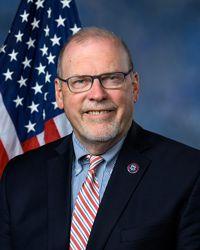
U.S. Representative for Virginia’s 9th district
Republican
119th Congress, two-year term
Missed 1.2% of roll calls. Chamber median 1.9%.
The full voting recordCounts roll calls where most Democrats and most Republicans voted differently, leaving out procedural votes.
How we countFrom FEC filings, Voteview roll calls and Congress.gov.
Republican. In Congress since 2011, 8 terms in total.
Following saves Griffith to your list, which Chamber & Street keeps on its server, linked to a cookie on this browser and not to your name or email. Email alerts will come with constituent verification.
Bills and resolutions Griffith signed on to as a cosponsor. An original cosponsor signed on the day the bill was introduced. Source: govinfo bill status files, last updated Nov 6, 2026.
Common Sense Air Regulations Act
Sponsor Earl Carter (R). Joined Mar 26, 2025. 5 cosponsors. H.R. 2288 on Congress.gov
Introduced
Common Sense Air Regulations Act
This bill nullifies the Environmental Protection Agency (EPA) final rule titled Reconsideration of the National Ambient Air Quality Standards for Particulate Matter (89 Fed. Reg. 16202) and published on March 6, 2024. Among other elements, the rule revised primary (health-based) National Ambient Air Quality Standards (NAAQS) for Particulate Matter under the Clean Air Act. NAAQS are air quality standards set and adjusted by the EPA to protect public health and the environment from certain pollutants.
Unlocking our Domestic LNG Potential Act of 2025
Sponsor August Pfluger (R). Joined Mar 25, 2025. 43 cosponsors. H.R. 1949 on Congress.gov(opens in a new tab)
Passed the House
Unlocking our Domestic LNG Potential Act of 2025
This bill repeals certain restrictions on the import and export of natural gas under the Natural Gas Act, including requirements for Department of Energy (DOE) approval and related provisions that address free trade agreements.
In addition, the bill grants the Federal Energy Regulatory Commission (FERC) the exclusive authority to approve or deny applications to authorize the siting, construction, expansion, or operation of facilities (e.g., liquefied natural gas terminals) to export natural gas to foreign countries or import natural gas from foreign countries. (Currently, DOE authorizes the export or import of natural gas, and FERC authorizes related facilities.)
In determining whether to approve or deny an application, FERC must deem the exportation or importation of natural gas to be consistent with the public interest.
Adams Memorial-Great American Heroes Act
Sponsor John Moolenaar (R). Original cosponsor. 8 cosponsors. H.R. 2306 on Congress.gov(opens in a new tab)
Passed the House
The Adams Memorial-Great American Heroes Act
This bill extends through 2032 the Adams Memorial Commission, whose purpose is to establish a permanent memorial in Washington, DC, to honor John Adams and his legacy.
The bill specifies that the Adams Memorial shall be located within the area specified by the Adams Memorial Commission in a February 25, 2025 map (i.e., south of the White House, adjacent to Ellipse Road and near Pennsylvania Avenue and 15th Street, Northwest).
If the Commission determines that this location is not suitable or feasible due to physical or security constraints, the bill requires that the memorial be located in the Reserve, an area which generally extends from the United States Capitol to the Lincoln Memorial, and from the White House to the Jefferson Memorial.
Medicare Patient Access and Practice Stabilization Act of 2025
Sponsor Gregory Murphy (R). Joined Mar 6, 2025. 198 cosponsors. H.R. 879 on Congress.gov(opens in a new tab)
Introduced
Medicare Patient Access and Practice Stabilization Act of 2025
This bill increases certain payment adjustments under the Medicare physician fee schedule for services furnished between April 1, 2025, and January 1, 2026.
SECURE Notarization Act of 2025
Sponsor Cliff Bentz (R). Joined Mar 4, 2025. 8 cosponsors. H.R. 1777 on Congress.gov(opens in a new tab)
Introduced
Securing and Enabling Commerce Using Remote and Electronic Notarization Act of 2025 or the SECURE Notarization Act of 2025
This bill allows a notary public commissioned under state law to remotely notarize electronic records and perform notarizations for remotely located individuals. The bill provides technical requirements for the notarizations, including the creation and retention of video and audio recordings and the use of communication technologies (i.e., video chat).
Additionally, the bill requires U.S. courts and states to recognize notarizations—including remote notarizations of electronic records and notarizations of remotely-located individuals—that occur in or affect interstate commerce and are performed by a notary public commissioned under the laws of other states.
The bill also allows a notary public to remotely notarize electronic records involving an individual located outside of the United States, subject to certain requirements.
To nullify the final rule issued by the Environmental Protection Agency relating to "New Source Performance Standards for Greenhouse Gas Emissions From New, Modified, and Reconstructed Fossil Fuel-Fired Electric Generating Units; Emission Guidelines for Greenhouse Gas Emissions From Existing Fossil Fuel-Fired Electric Generating Units; and Repeal of the Affordable Clean Energy Rule".
Sponsor Troy Balderson (R). Original cosponsor. 37 cosponsors. H.R. 1651 on Congress.gov(opens in a new tab)
Introduced
NIH Reform Act
Sponsor Chip Roy (R). Original cosponsor. 6 cosponsors. H.R. 1497 on Congress.gov(opens in a new tab)
Introduced
NIH Reform Act
This bill separates the National Institute of Allergy and Infectious Diseases (NIAID) into three separate institutes: the National Institute of Allergic Diseases, the National Institute of Infectious Diseases, and the National Institute of Immunologic Diseases.
The bill also requires that the President appoint the directors of the new institutes (under current law, the Director of NIAID is appointed by the Director of the National Institutes of Health). It further requires that the Senate confirm the appointment of the directors of the new institutes and the National Cancer Institute.
Lung Cancer Screening and Prevention Act of 2025
Sponsor Vern Buchanan (R). Original cosponsor. 9 cosponsors. H.R. 1406 on Congress.gov(opens in a new tab)
Introduced
Lung Cancer Screening and Prevention Act of 2025
This bill authorizes Medicare coverage of additional types of lung cancer screening tests that are approved by the Food and Drug Administration, regardless of whether they are recommended by the United States Preventive Services Task Force. The Centers for Medicare & Medicaid Services must set coverage and payment limits for such tests. (Currently, Medicare covers screening tests for the early detection of lung cancer if they are recommended by the task force.)
National Right-to-Work Act
Sponsor Joe Wilson (R). Joined Feb 14, 2025. 129 cosponsors. H.R. 1232 on Congress.gov(opens in a new tab)
Introduced
Organ Donation Referral Improvement Act
Sponsor Robert Wittman (R). Joined Feb 13, 2025. 15 cosponsors. H.R. 330 on Congress.gov(opens in a new tab)
Introduced
Organ Donation Referral Improvement Act
This bill requires the Office of the Assistant Secretary for Planning and Evaluation (ASPE) in the Department of Health and Human Services to conduct a study on hospitals’ use of electronic automated referrals for organ donations. The bill defines electronic automated referral as an electronic system that uses electronic health records to identify patients who are potential organ donors and automatically refers those patients to organ procurement organizations.
The ASPE must include specified components in the study, including identifying benefits, reviewing best practices, and developing recommendations for the use of electronic automated referrals for organ donations.
Death Tax Repeal Act
Sponsor Randy Feenstra (R). Original cosponsor. 182 cosponsors. H.R. 1301 on Congress.gov(opens in a new tab)
Introduced
Providing for congressional disapproval under chapter 8 of title 5, United States Code, of the rule submitted by the Environmental Protection Agency relating to "Waste Emissions Charge for Petroleum and Natural Gas Systems: Procedures for Facilitating Compliance, Including Netting and Exemptions".
Sponsor August Pfluger (R). Joined Feb 13, 2025. 19 cosponsors. H.J.Res. 35 on Congress.gov(opens in a new tab)
Became law
This joint resolution eliminates an annual waste emissions charge on oil or gas facilities under the Methane Emissions Reduction Program. Under the program, the Environmental Protection Agency (EPA) currently collects a waste emissions charge from specific types of oil or gas facilities, such as onshore or offshore facilities that produce oil or gas, for exceeding emission thresholds for greenhouse gas emissions and methane emissions.
Specifically, the joint resolution nullifies the rule titled Waste Emissions Charge for Petroleum and Natural Gas Systems: Procedures for Facilitating Compliance, Including Netting and Exemptions and published by the EPA on November 18, 2024.
Alpha-gal Allergen Inclusion Act
Sponsor Jefferson Van Drew (R). Original cosponsor. 46 cosponsors. H.R. 1178 on Congress.gov(opens in a new tab)
Introduced
Alpha-gal Allergen Inclusion Act
This bill expands the definition of major food allergen to include galactose-alpha-1,3-galactose (commonly known as alpha-gal). Under current law, food labels generally must identify each major food allergen found in labeled food products.
(Certain tick bites cause an allergic condition known as alpha-gal syndrome that can result in an allergy to the alpha-gal molecule, which is found in red meat and other products made from mammals.)
Credit Union Board Modernization Act
Sponsor Juan Vargas (D). Joined Feb 7, 2025. 22 cosponsors. H.R. 975 on Congress.gov(opens in a new tab)
Passed the House
Credit Union Board Modernization Act
This bill reduces the required frequency of meetings held by the board of directors of certain credit unions. Under the bill, new credit unions and credit unions with a low soundness rating must meet monthly, as required under current law. All other credit unions must hold at least six meetings annually, with at least one meeting held during each fiscal quarter.
Expressing the sense of the House of Representatives that the sermon given by the Right Reverend Mariann Edgar Budde at the National Prayer Service on January 21st, 2025, at the National Cathedral was a display of political activism and condemning its distorted message.
Sponsor Josh Brecheen (R). Original cosponsor. 22 cosponsors. H.Res. 59 on Congress.gov(opens in a new tab)
Introduced
This resolution expresses (1) the sense of the House of Representatives that the sermon given at the National Prayer Service on January 21st, 2025, at the National Cathedral was a display of political activism, and (2) that the House condemns the message of Right Reverend Mariann Edgar Budde.
Main Street Tax Certainty Act
Sponsor Lloyd Smucker (R). Original cosponsor. 192 cosponsors. H.R. 703 on Congress.gov(opens in a new tab)
Introduced
Main Street Tax Certainty Act
This bill makes permanent the qualified business income (QBI) tax deduction.
Under current law, individuals, estates, and trusts may deduct the lower of (1) 20% of QBI from a qualified business, qualified real estate investment trust dividends, and qualified publicly traded partnership income; or (2) 20% of taxable income less net capital gain. (Some limitations apply.)
However, under current law, the QBI tax deduction expires after December 31, 2025.
No Taxpayer Funding for Abortion and Abortion Insurance Full Disclosure Act of 2025
Sponsor Christopher Smith (R). Original cosponsor. 133 cosponsors. H.R. 7 on Congress.gov(opens in a new tab)
Introduced
No Taxpayer Funding for Abortion and Abortion Insurance Full Disclosure Act of 2025
This bill modifies provisions relating to federal funding for, and health insurance coverage of, abortions.
Specifically, the bill prohibits the use of federal funds for abortions or for health coverage that includes abortions. Such restrictions extend to the use of funds in the budget of the District of Columbia. Additionally, abortions may not be provided in a federal health care facility or by a federal employee.
Historically, language has been included in annual appropriations bills for the Department of Health and Human Services (HHS) that prohibits the use of federal funds for abortions—such language is commonly referred to as the Hyde Amendment. Similar language is also frequently included in appropriations bills for other federal agencies and the District of Columbia. The bill makes these restrictions permanent and extends the restrictions to all federal funds (rather than specific agencies).
The bill's restrictions regarding the use of federal funds do not apply in cases of rape, incest, or where a physical disorder, injury, or illness endangers a woman's life unless an abortion is performed. The Hyde Amendment provides the same exceptions.
The bill also prohibits qualified health plans from including coverage for abortions. Currently, qualified health plans may cover abortion, but the portion of the premium attributable to abortion coverage is not eligible for subsidies.
Miracle on Ice Congressional Gold Medal Act
Sponsor Pete Stauber (R). Original cosponsor. 299 cosponsors. H.R. 452 on Congress.gov(opens in a new tab)
Became law
Miracle on Ice Congressional Gold Medal Act
This act provides for the award of Congressional Gold Medals to the members of the 1980 U.S. Olympic men's ice hockey team in recognition of the team's achievement at the 1980 Winter Olympic Games.
Repealing Big Brother Overreach Act
Sponsor Warren Davidson (R). Original cosponsor. 193 cosponsors. H.R. 425 on Congress.gov(opens in a new tab)
Passed committee
Repealing Big Brother Overreach Act
This bill repeals the Corporate Transparency Act. The act requires existing companies and newly created companies to report beneficial ownership information to the Department of the Treasury’s Financial Crimes Enforcement Network for purposes of addressing the financing of terrorism and money laundering.
Hearing Protection Act
Sponsor Ben Cline (R). Original cosponsor. 151 cosponsors. H.R. 404 on Congress.gov(opens in a new tab)
Introduced
Preserving Choice in Vehicle Purchases Act
Sponsor John Joyce (R). Original cosponsor. 7 cosponsors. H.R. 346 on Congress.gov(opens in a new tab)
Introduced
Preserving Choice in Vehicle Purchases Act
This bill modifies the waiver process under the Clean Air Act related to state emission control standards for new motor vehicles (or new motor vehicle engines).
Under current law, states are preempted from adopting or enforcing emission control standards for new motor vehicles (or new motor vehicle engines) unless the Environmental Protection Agency (EPA) provides a waiver authorizing a state to adopt such standards if certain requirements are met.
The bill provides that state standards that directly or indirectly limit the sale or use of new motor vehicles with internal combustion engines are not eligible for waivers. The bill also prohibits the EPA from determining that any state standards amended after the bill's enactment are within the scope of an existing waiver.
Additionally, the bill requires the EPA to revoke waivers granted between January 1, 2022, and the date of enactment of this bill if the standards directly or indirectly limit the sale or use of new motor vehicles with internal combustion engines.
Protection of Women and Girls in Sports Act of 2025
Sponsor W. Steube (R). Joined Jan 13, 2025. 83 cosponsors. H.R. 28 on Congress.gov(opens in a new tab)
Passed the House
Protection of Women and Girls in Sports Act of 2025
This bill generally prohibits school athletic programs from allowing individuals whose biological sex at birth was male to participate in programs that are for women or girls.
Specifically, the bill provides that it is a violation of Title IX of the Education Amendments of 1972 for federally funded education programs or activities to operate, sponsor, or facilitate athletic programs or activities that allow individuals of the male sex to participate in programs or activities that are designated for women or girls. (Title IX prohibits discrimination on the basis of sex in federally funded education programs or activities, including in public elementary and secondary schools and in colleges and universities.) Under the bill, sex is based on an individual's reproductive biology and genetics at birth.
The bill does not prohibit male individuals from training or practicing with programs or activities for women or girls as long as such training or practice does not deprive any female of corresponding opportunities or benefits.
The Government Accountability Office must report on the benefits for women or girls in single-sex sports that would be lost as a result of male participation. In particular, the report must document the negative psychological, developmental, participatory, and sociological effects of male participation on girls.
Federal Reserve Transparency Act of 2025
Sponsor Thomas Massie (R). Original cosponsor. 46 cosponsors. H.R. 24 on Congress.gov(opens in a new tab)
Introduced
Federal Reserve Transparency Act of 2025
This bill directs the Government Accountability Office (GAO) to complete, within 12 months, an audit of the Federal Reserve Board and Federal Reserve banks. In addition, the bill allows the GAO to audit the Federal Reserve Board and Federal Reserve banks with respect to (1) international financial transactions; (2) deliberations, decisions, or actions on monetary policy matters; (3) transactions made under the direction of the Federal Open Market Committee; and (4) discussions or communications among Federal Reserve officers, board members, and employees regarding any of these matters.
Family and Small Business Taxpayer Protection Act
Sponsor Adrian Smith (R). Original cosponsor. 36 cosponsors. H.R. 196 on Congress.gov(opens in a new tab)
Introduced
Family and Small Business Taxpayer Protection Act
This bill rescinds unobligated funds that were provided by the Inflation Reduction Act of 2022 to the Internal Revenue Service (IRS) for enforcement activities related to the determination and collection of taxes, for operations support for taxpayer services and enforcement activities, and for a task force to research options for a free, direct electronic filing (e-filing) tax return system.
The bill also rescinds unobligated funds that were provided by the Inflation Reduction Act of 2022 for expenses of the
• Treasury Inspector General for Tax Administration,
• Office of Tax Policy,
• U.S. Tax Court, and
• offices within the Department of the Treasury that provide oversight and support for the IRS.
Regulations from the Executive in Need of Scrutiny Act of 2025
Sponsor Kat Cammack (R). Original cosponsor. 93 cosponsors. H.R. 142 on Congress.gov(opens in a new tab)
Introduced
Regulations from the Executive in Need of Scrutiny Act of 2025
This bill revises provisions relating to congressional review of agency rulemaking.
Specifically, the bill establishes a congressional approval process for a major rule. A major rule may only take effect if Congress approves of the rule. A major rule is a rule that has resulted in or is likely to result in (1) an annual effect on the economy of $100 million or more; (2) a major increase in costs or prices for consumers, individual industries, government agencies, or geographic regions; or (3) significant adverse effects on competition, employment, investment, productivity, innovation, or the ability of U.S.-based enterprises to compete with foreign-based enterprises.
The bill generally preserves the current congressional review process for a nonmajor rule.