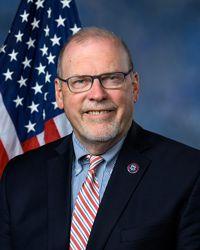
U.S. Representative for Virginia’s 9th district
Republican
119th Congress, two-year term
Missed 1.2% of roll calls. Chamber median 1.9%.
The full voting recordCounts roll calls where most Democrats and most Republicans voted differently, leaving out procedural votes.
How we countFrom FEC filings, Voteview roll calls and Congress.gov.
Republican. In Congress since 2011, 8 terms in total.
Following saves Griffith to your list, which Chamber & Street keeps on its server, linked to a cookie on this browser and not to your name or email. Email alerts will come with constituent verification.
Bills and resolutions Griffith signed on to as a cosponsor. An original cosponsor signed on the day the bill was introduced. Source: govinfo bill status files, last updated Nov 6, 2026.
Voter ID Act
Sponsor Bryan Steil (R). Original cosponsor. 7 cosponsors. H.R. 9368 on Congress.gov
Introduced
Voter ID Act
This bill establishes certain photo identification requirements for voting in federal elections.
Specifically, the bill prohibits a state or local election official from providing a ballot for a federal election to an individual who does not present valid physical photo identification.
Next, the bill outlines the availability of provisional ballots and the requirements for counting those ballots. An individual who does not present a valid photo identification must be permitted to cast a provisional ballot. However, an election official may not determine that the individual is eligible under state law to vote in the election unless, not later than three days after casting the provisional ballot, the individual presents (1) the identification required, or (2) an affidavit attesting that the individual does not possess the identification because of a religious objection to being photographed.
An election official may not allow for voting methods other than in-person voting unless the individual (1) submits the ballot with a copy of their photo identification or the last four digits of their Social Security number with an affidavit attesting that the individual is unable to obtain a copy of a valid photo identification after making reasonable efforts to obtain a copy, or (2) includes a notarization attesting that the individual has personally marked the ballot. This prohibition shall not apply to overseas military voters and certain disabled or elderly voters.
The Election Assistance Commission must make grants to states and tribal governments that provide eligible individuals with free valid photo identification.
Stop Lawmakers From Predicting Act
Sponsor Bryan Steil (R). Original cosponsor. 8 cosponsors. H.R. 9367 on Congress.gov(opens in a new tab)
Passed committee
Hydropower Licensing Affordability Act
Sponsor Cliff Bentz (R). Original cosponsor. 30 cosponsors. H.R. 9337 on Congress.gov(opens in a new tab)
Introduced
Foreign Robocall Elimination Act
Sponsor Addison McDowell (R). Joined Jun 18, 2026. 39 cosponsors. H.R. 6152 on Congress.gov(opens in a new tab)
Passed committee
Foreign Robocall Elimination Act
This bill modifies and expands certain Federal Communications Commission (FCC) programs targeting illegal robocalls and creates a task force to advise the federal government on foreign robocalls.
For example, the bill directs the FCC to issue rules under which certain voice service providers (i.e., phone companies) may be required to post a bond before filing required certifications in the Robocall Mitigation Database. (Under current law, providers must file annual certifications in this database regarding their compliance with illegal robocall mitigation requirements. Noncompliant providers are removed from the database and effectively blocked from the U.S. telephone network.) Providers that do not demonstrate legitimate operations, sufficient regulatory oversight, or the ability to pay fines may be subject to the bond requirement. The FCC must establish categorical exemptions for classes of legitimate providers that satisfy certain criteria.
Further, the bill makes changes related to the FCC’s traceback consortium, a group selected by the FCC to conduct private-led efforts to trace the origin of suspected illegal robocalls. Specifically, the bill protects the consortium from liability for receiving, sharing, or publishing information about suspected fraudulent, abusive, or illegal robocalls and other illegal calls. Additionally, the bill authorizes the consortium to publish a list of voice service providers based on information about providers’ transmission or origination of illegal robocalls or refusal to participate in traceback efforts. (Currently, only the FCC may publish this list.)
The bill also establishes an interagency task force on combating robocalls that originate outside the United States.
Patient Choice and Access Act of 2026
Sponsor Michael Rulli (R). Original cosponsor. 3 cosponsors. H.R. 9107 on Congress.gov(opens in a new tab)
Introduced
America 250 Commemorative Flag Act.
Sponsor Barry Loudermilk (R). Original cosponsor. 30 cosponsors. H.Res. 1314 on Congress.gov(opens in a new tab)
Introduced
To amend the Internal Revenue Code of 1986 to modify the railroad track maintenance credit.
Sponsor Mike Kelly (R). Joined May 20, 2026. 183 cosponsors. H.R. 516 on Congress.gov(opens in a new tab)
Introduced
This bill increases the annual limit on the tax credit for qualified railroad track maintenance expenses (also referred to as the short line railroad tax credit) and expands eligibility for claiming the credit.
Under current law, the tax credit is limited each tax year to $3,500 multiplied by the sum of the number of miles of railroad track owned or leased by the taxpayer (miles owned or leased) and the number of railroad track miles assigned to the taxpayer by a Class II or III railroad (miles assigned). This bill increases the annual limit to $6,100 multiplied by the sum of miles owned or leased and miles assigned. The $6,100 amount used in the calculation of the tax credit limit is adjusted for inflation for tax years beginning after 2025.
The bill also expands eligibility for the tax credit to include gross expenses for maintaining railroad tracks owned or leased as of January 1, 2024. Under current law, the tax credit is limited to gross expenses for maintaining railroad tracks owned or leased as of January 1, 2015.
Birthright Citizenship Act of 2025
Sponsor Brian Babin (R). Joined May 12, 2026. 95 cosponsors. H.R. 569 on Congress.gov(opens in a new tab)
Introduced
Birthright Citizenship Act of 2025
This bill limits birthright citizenship by redefining what it means to be subject to the jurisdiction of the United States.
Currently, a person born in the United States and subject to U.S. jurisdiction is entitled to citizenship. Under the bill, a person is subject to U.S. jurisdiction if he or she is born to a parent who is (1) a U.S. citizen or national, (2) a lawful permanent resident residing in the United States, or (3) a non-U.S. national (alien under federal law) with a lawful immigration status who is performing active service in the Armed Forces.
The bill does not affect the citizenship or nationality status of any person born before the bill's enactment date.
Resolution memorializing law enforcement officers killed in the line of duty.
Sponsor Michael Guest (R). Joined May 7, 2026. 126 cosponsors. H.Res. 1252 on Congress.gov(opens in a new tab)
Passed the House
This resolution expresses support for police officers and other law enforcement personnel.
The resolution further recognizes
• law enforcement officers across the United States in the pursuit of preserving safe and secure communities;
• the need to ensure that such officers have the equipment, training, and resources necessary to protect their health and safety while they are protecting the public; and
• the law enforcement community for acts of sacrifice and heroism.
The resolution expresses condolences and appreciation to the loved ones of each law enforcement officer who has made the ultimate sacrifice in the line of duty.
Protecting Life on College Campus Act of 2025
Sponsor Chip Roy (R). Joined Apr 29, 2026. 31 cosponsors. H.R. 632 on Congress.gov(opens in a new tab)
Introduced
Protecting Life on College Campus Act of 2025
This bill prohibits the award of federal funds to an institution of higher education (IHE) that hosts or is affiliated with a school-based service site that provides abortion drugs or abortions to its students or to employees of the IHE or the site. An IHE that hosts or is affiliated with a site must, in order to remain eligible for federal funds, annually certify that the site does not provide abortion drugs or abortions to students or employees.
MOMS Act
Sponsor Michelle Fischbach (R). Joined Apr 29, 2026. 27 cosponsors. H.R. 3235 on Congress.gov(opens in a new tab)
Introduced
More Opportunities for Moms to Succeed Act or the MOMS Act
This bill establishes requirements to enable the collection of certain child support during pregnancy, establishes grants for supportive services for women that promote alternatives to abortions, and requires the Department of Health and Human Services (HHS) to establish a website with pregnancy resources other than those about abortions.
Specifically, the bill requires states to apply child support obligations to the time period during pregnancy under the Child Support Enforcement program. (The program enables states to receive federal matching funds for expenses related to child support enforcement activities and related services.) Such child support applies at the request of the mother and may be applied retroactively.
Also, HHS must award grants to nonprofits to provide pregnant and postpartum women, and women parenting young children, with services or information on topics including health care (excluding abortions), child care, and employment assistance. It also requires HHS to provide grants to health care providers in rural or medically underserved areas, as well as tribal areas, to purchase equipment enabling telehealth visits for prenatal and postnatal care (e.g., monitoring devices).
Additionally, the bill requires HHS to establish a public website to inform pregnant and postpartum women, and women parenting young children, of nearby services and resources on topics including health care, material or legal support, and alternatives to abortion. States must, as a condition of receiving certain federal funds, provide lists of nonprofit child placement agencies for potential inclusion on the site.
Condemning the attempted assassination of President Donald J. Trump on April 25, 2026, condemning the multiple attempts against the President's life, and recognizing the critical mission of the Department of Homeland Security.
Sponsor Abraham Hamadeh (R). Original cosponsor. 30 cosponsors. H.Res. 1220 on Congress.gov(opens in a new tab)
Introduced
TRUMP Ballroom Act
Sponsor Lauren Boebert (R). Original cosponsor. 1 cosponsor. H.R. 8537 on Congress.gov(opens in a new tab)
Introduced
REMAIN in Mexico Act of 2025
Sponsor Brandon Gill (R). Joined Apr 28, 2026. 110 cosponsors. H.R. 273 on Congress.gov(opens in a new tab)
Introduced
Return Excessive Migrants and Asylees to International Neighbors in Mexico Act of 2025 or the REMAIN in Mexico Act of 2025
This bill requires the Department of Homeland Security (DHS) to implement the Migrant Protection Protocols as outlined in the January 25, 2019, memo titled Policy Guidance for Implementation of the Migrant Protection Protocols.
(The protocols generally required aliens who are not clearly admissible, including those seeking asylum, arriving by land along the U.S.-Mexico border to be returned to Mexico while their immigration proceedings are pending, rather than remain in the United States. On January 21, 2021, DHS stopped applying the protocols to newly-arrived individuals.)
Protecting Domestic Mining Act of 2025
Sponsor Jefferson Shreve (R). Joined Apr 28, 2026. 2 cosponsors. H.R. 1501 on Congress.gov(opens in a new tab)
Passed the House
Protecting Domestic Mining Act of 2025
This bill provides statutory authority for federal agencies to expedite the environmental review of certain mining infrastructure projects.
Specifically, the bill permanently makes certain mining infrastructure projects eligible for expedited environmental review under the Fixing America's Surface Transportation Act (FAST Act). This provides statutory authority for similar authorities that were included in the rule titled Adding Mining as a Sector of Projects Eligible for Coverage Under Title 41 of the Fixing America's Surface Transportation Act and issued by the Federal Permitting Improvement Steering Council (Permitting Council) on January 8, 2021.
The bill also prohibits the Permitting Council from finalizing its proposed rule titled Revising Scope of the Mining Sector of Projects That Are Eligible for Coverage Under Title 41 of the Fixing America’s Surface Transportation Act and issued on September 22, 2023. Among other modifications, the rule proposes to limit the types of mining projects that are eligible for the expedited environmental review process. Specifically, the proposed rule limits the expedited process to critical minerals mining projects.
To amend the Internal Revenue Code of 1986 to extend the credit period for the production of refined coal, and for other purposes.
Sponsor Carol Miller (R). Joined Apr 27, 2026. 2 cosponsors. H.R. 7070 on Congress.gov(opens in a new tab)
Introduced
Heat Workforce Standards Act of 2025
Sponsor Mark Messmer (R). Joined Apr 27, 2026. 74 cosponsors. H.R. 6213 on Congress.gov(opens in a new tab)
Passed committee
Heat Workforce Standards Act of 2025
This bill prohibits the Occupational Safety and Health Administration (OSHA) from finalizing, implementing, or enforcing a safety standard requiring certain employers to create a heat injury and illness prevention plan to evaluate and control heat hazards in their workplaces.
Specifically, OSHA is prohibited from finalizing the proposed rule titled Heat Injury and Illness Prevention in Outdoor and Indoor Work Settings, which was published on August 30, 2024, or any substantially similar standard. The proposed standard generally applies to employers conducting outdoor and indoor work in all general industry, construction, maritime, and agriculture sectors where OSHA has jurisdiction. Employers must develop plans in accordance with the specified standards to address employee exposures to heat indexes at or above 80 degrees (initial heat trigger) or 90 degrees (high heat trigger) Fahrenheit.
As background, the Occupational Safety and Health Act of 1970 generally requires employers to provide their employees with a place of employment that is free from recognized hazards that are causing or likely to cause death or serious harm to employees. OSHA conducts workplace inspections and cites employers that fail to satisfy these requirements. Currently, OSHA does not have specific heat exposure standards; however, OSHA has historically used its general authority to cite employers for violations involving excessive heat, including through a National Emphasis Program that focuses on indoor and outdoor heat exposure in industries that have the highest risks.
No Medicaid for Illegal Immigrants Act of 2025
Sponsor Kevin Kiley (I). Joined Apr 27, 2026. 10 cosponsors. H.R. 584 on Congress.gov(opens in a new tab)
Introduced
No Medicaid for Illegal Immigrants Act of 2025
This bill prohibits state Medicaid programs from covering individuals who are unlawfully present in the United States, except for certain emergency services for which federal payment is authorized under current law.
Sanctuary Penalty and Public Protection Act of 2025
Sponsor Chip Roy (R). Joined Apr 27, 2026. 29 cosponsors. H.R. 5005 on Congress.gov(opens in a new tab)
Introduced
Border Safety and Security Act of 2025
Sponsor Chip Roy (R). Joined Apr 27, 2026. 47 cosponsors. H.R. 318 on Congress.gov(opens in a new tab)
Introduced
Border Safety and Security Act of 2025
This bill requires the Department of Homeland Security (DHS) to suspend the entry of any non-U.S. nationals (aliens under federal law) without valid entry documents during any period when DHS cannot detain such an individual or return the individual to a foreign country contiguous to the United States. A state may sue DHS to enforce this requirement.
(Under current law, non-U.S. nationals who arrive at the border without entry documents are generally subject to expedited removal. However, if such an individual is found to have a credible fear of persecution, they are typically subject to detention while their asylum claim is being considered.)
The bill also authorizes DHS to suspend the entry of non-U.S. nationals without entry documents at the border if DHS determines that such a suspension is necessary to achieve operational control over such a border.
Nuclear Family Priority Act
Sponsor Elijah Crane (R). Joined Apr 27, 2026. 48 cosponsors. H.R. 2705 on Congress.gov(opens in a new tab)
Introduced
Nuclear Family Priority Act
This bill imposes limits on various types of family-sponsored immigration visas.
The non-U.S. national (alien under federal law) parents of U.S. citizens shall not qualify for visas for immediate relatives, which are not subject to any direct numerical limits. Currently, the spouses, unmarried children under 21, and parents of citizens are considered immediate relatives.
The bill also creates a nonimmigrant visa for such parents of citizens. Such non-U.S. nationals shall not be eligible for employment or any public benefits.
The bill also reduces the baseline annual cap for family-sponsored visas from 480,000 to 88,000, and revises the methods for calculating the cap. Currently, the 480,000 cap may be adjusted depending on various factors but shall not be less than 226,000.
The bill eliminates preference allocations (visa categories subject to various annual caps) for various family-sponsored visas, including those for the siblings and married children of citizens. The bill provides for a preference allocation for the unmarried children under 21 and spouses of permanent residents, subject to the 88,000 annual cap.
Fairness for High-Skilled Americans Act of 2025
Sponsor Paul Gosar (R). Joined Apr 27, 2026. 40 cosponsors. H.R. 2315 on Congress.gov(opens in a new tab)
Introduced
Fairness for High-Skilled Americans Act of 2025
This bill eliminates the Optional Practical Training Program or any successor program, unless Congress expressly authorizes such a program. (The program provides an F-1 student visa holder temporary employment authorization before or after completion of the student's studies, or both.)
Motorsports Fairness and Permanency Act of 2025
Sponsor Claudia Tenney (R). Joined Apr 27, 2026. 45 cosponsors. H.R. 2231 on Congress.gov(opens in a new tab)
Introduced
Safe Routes Act of 2025
Sponsor Tony Wied (R). Joined Apr 27, 2026. 19 cosponsors. H.R. 2166 on Congress.gov(opens in a new tab)
Introduced
Safe Routes Act of 2025
This bill directs the Department of Transportation to waive vehicle weight limits for covered logging vehicles, thus allowing logging vehicles to travel on interstate highways in certain circumstances.
The term covered logging vehicle means a vehicle that (1) is transporting raw or unfinished forest products, including logs, pulpwood, biomass, or wood chips; (2) is traveling a distance not greater than 150 air miles on interstate highways from origin to a storage or processing facility; and (3) meets state legal weight tolerances and vehicle configurations for transporting raw or unfinished forest products within the state boundaries in which the vehicle is operating.
Finish the Wall Act
Sponsor Clay Higgins (R). Joined Apr 27, 2026. 29 cosponsors. H.R. 163 on Congress.gov(opens in a new tab)
Introduced
Finish the Wall Act
This bill requires the Department of Homeland Security (DHS) to resume activities related to the construction of a barrier system along the U.S.-Mexico border and addresses other border-related issues.
DHS must resume all such construction activities that were planned or underway prior to January 20, 2021. DHS must also expend all funds appropriated or explicitly obligated since October 1, 2016, for construction of this barrier system. DHS may not cancel contracts for activities related to such construction entered into on or before January 20, 2021.
Furthermore, within 14 days of this bill's enactment, DHS must certify to Congress that U.S. Customs and Border Protection facilities that process adults taken into custody at the border are fully compliant with certain laws related to the collection of DNA. (Among other things, these laws allow for the collection of DNA samples from non-U.S. persons detained under U.S. authority.)