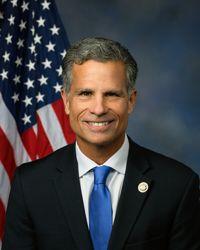
U.S. Representative for Pennsylvania’s 9th district
Republican
119th Congress, two-year term
Missed 5.2% of roll calls. Chamber median 1.9%.
The full voting recordCounts roll calls where most Democrats and most Republicans voted differently, leaving out procedural votes.
How we countFrom FEC filings, Voteview roll calls and Congress.gov.
Republican. In Congress since 2019, 4 terms in total.
Following saves Meuser to your list, which Chamber & Street keeps on its server, linked to a cookie on this browser and not to your name or email. Email alerts will come with constituent verification.
Bills and resolutions where Meuser is the primary sponsor. Most bills never leave committee; that is normal for every member. Source: Congress.gov, last updated Oct 29, 2026.
7 of 20 have at least one cosponsor from the other party.
Veterans Housing Opportunity Act
Introduced Aug 27, 2026. 3 cosponsors. H.R. 10168 on Congress.gov
Introduced
HUD Payment Integrity and Accountability Act of 2026
Introduced Apr 23, 2026. 0 cosponsors. H.R. 8489 on Congress.gov(opens in a new tab)
Introduced
Regulatory Review Improvement Act of 2026
Introduced Mar 30, 2026. 3 cosponsors. H.R. 8162 on Congress.gov(opens in a new tab)
Introduced
Endless Mountains National Heritage Area Act
Introduced Mar 26, 2026. 1 cosponsor. H.R. 8114 on Congress.gov(opens in a new tab)
Introduced
Growing Deposit Insurance for the Future Act
Introduced Mar 25, 2026. 0 cosponsors. H.R. 8088 on Congress.gov(opens in a new tab)
Introduced
Most Favored Patient Act of 2026
Introduced Mar 5, 2026. 0 cosponsors. H.R. 7837 on Congress.gov(opens in a new tab)
Introduced
SCAM Act
Introduced Feb 12, 2026. 57 cosponsors, 27 from the other party. H.R. 7548 on Congress.gov(opens in a new tab)
Introduced
Restoring the Secondary Trading Market Act
Introduced Jan 16, 2026. 0 cosponsors. H.R. 7127 on Congress.gov(opens in a new tab)
Introduced
Restoring the Secondary Trading Market Act
This bill prohibits states from banning, limiting, or imposing conditions upon off-exchange secondary trading of securities. This prohibition applies if the issuer of those securities provides public information on the issuer's financial status in accordance with federal regulations.
SAFE Guidance Act
Introduced Jul 16, 2025. 0 cosponsors. H.R. 4460 on Congress.gov(opens in a new tab)
Introduced
ACCESS Act of 2025
Introduced May 29, 2025. 4 cosponsors. H.R. 3645 on Congress.gov(opens in a new tab)
Introduced
Amendment for Crowdfunding Capital Enhancement and Small-business Support Act of 2025 or the ACCESS Act of 2025
This bill expands the exemption from certain disclosures applicable to crowdfunding issuers with specified target offering amounts. (Crowdfunding is used to raise capital through a large number of individuals investing potentially small amounts of money.) Under current law, crowdfunding issuers that have target offering amounts of $100,000 or less are not required to make available financial statements reviewed by an independent public accountant. The bill increases that amount to $250,000 and allows the Securities and Exchange Commission to increase this amount to no more than $400,000 upon recommendation of the Office of the Advocate for Small Business Capital Formation and the Office of the Investor Advocate.
CFPB–IG Reform Act of 2025
Introduced Mar 31, 2025. 6 cosponsors. H.R. 2513 on Congress.gov(opens in a new tab)
Introduced
Bureau of Consumer Financial Protection-Inspector General Reform Act of 2025 or the CFPB-IG Act of 2025
This bill establishes a separate Office of Inspector General for the Consumer Financial Protection Bureau (CFPB). Currently, such oversight of the CFPB is combined with the Office of Inspector General for the Board of Governors of the Federal Reserve System.
PIIA Reform Act
Introduced Feb 24, 2025. 0 cosponsors. H.R. 1533 on Congress.gov(opens in a new tab)
Introduced
PIIA Reform Act
This bill establishes a federal Overpayment Czar position, requires federal agencies to identify certain programs and activities as susceptible to improper payments (i.e., payments that should not have been made or were made in an incorrect amount), and imposes financial penalties on agencies for noncompliance with requirements related to reducing improper payments.
The bill establishes the position of Director of Improper Payment Mitigation, to be known as the Overpayment Czar, within the Office of Management and Budget (OMB). The duties of the Overpayment Czar include assisting federal agencies in preventing improper payments and fraud.
Under the bill, federal agencies must additionally identify as susceptible to significant improper payments any program or activity that is in the first four years of operation and has or is expected to have outlays exceeding $100 million in any of the first three fiscal years of operation unless, based upon a review of the program or activity, the agency makes a determination to the contrary.
The bill requires a reduction in certain appropriations accounts for agencies that do not comply with various requirements related to reducing improper payments (such as publishing improper payments estimates and programmatic corrective action plans).
States receiving funding for certain programs, such as Medicaid and unemployment compensation, must use payment integrity tools approved by OMB to reduce overpayments.
Each annual governmentwide five-year financial management plan produced by OMB must include a plan to decrease improper payments throughout executive agencies.
USA Batteries Act
Introduced Feb 12, 2025. 5 cosponsors. H.R. 1264 on Congress.gov(opens in a new tab)
Introduced
USA Batteries Act
This bill eliminates the Superfund chemical excise tax imposed on lead oxide ($8.28 per ton), antimony ($8.90 per ton), and sulfuric acid ($0.52 per ton).
Under current law, an excise tax is imposed through December 31, 2031, on taxable chemicals and taxable chemical substances that are (1) manufactured or produced in the United States, or (2) imported into the United States. The excise tax rate varies between $0.44 per ton to $9.74 per ton, depending on the chemical and certain other variables. (There are 42 listed taxable chemicals, including lead oxide, antimony, and sulfuric acid.)
Further, under current law, amounts collected from the excise tax on taxable chemicals are deposited into the Superfund, which finances the remediation of certain environmentally contaminated sites.
Recognizing Gold Shield Families and affirming that their sacrifices and difficulties should not be forgotten.
Introduced Jan 28, 2025. 20 cosponsors, 7 from the other party. H.Res. 76 on Congress.gov(opens in a new tab)
Introduced
This resolution recognizes and honors Gold Shield Families for their sacrifices and support of their loved ones in service to our nation. Gold Shield Families consist of the families of fallen police officers, firefighters, emergency medical technicians (EMTs), correction officers, emergency dispatch officers, and emergency service providers.