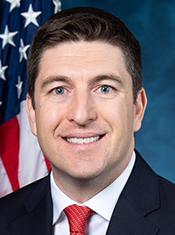
U.S. Representative for Wisconsin’s 1st district
Republican
119th Congress, two-year term
Missed 0.7% of roll calls. Chamber median 1.9%.
The full voting recordCounts roll calls where most Democrats and most Republicans voted differently, leaving out procedural votes.
How we countFrom FEC filings, Voteview roll calls and Congress.gov.
Republican. In Congress since 2019, 4 terms in total.
Following saves Steil to your list, which Chamber & Street keeps on its server, linked to a cookie on this browser and not to your name or email. Email alerts will come with constituent verification.
Bills and resolutions Steil signed on to as a cosponsor. An original cosponsor signed on the day the bill was introduced. Source: govinfo bill status files, last updated Nov 6, 2026.
Crime Victims Fund Stabilization Act of 2025
Sponsor Ann Wagner (R). Joined Feb 24, 2025. 327 cosponsors. H.R. 909 on Congress.gov
Passed the House
Crime Victims Fund Stabilization Act of 2025
This bill adds a new source of revenue for the Crime Victims Fund (CVF). Specifically, the bill requires certain civil monetary penalties collected from settlements and judgments in cases involving fraud and false claims against the federal government to be deposited into the CVF through FY2029.
The CVF supports federal, state, and local programs and activities to compensate and assist victims of crimes. Currently, the CVF is funded by deposits from a variety of sources, including federal criminal fines, penalties, and assessments; forfeited bail bonds; and certain other gifts, donations, and bequests.
Freedom to Invest in Tomorrow’s Workforce Act
Sponsor Robert Wittman (R). Joined Feb 14, 2025. 203 cosponsors. H.R. 1151 on Congress.gov(opens in a new tab)
Introduced
Freedom to Invest in Tomorrow’s Workforce Act
This bill expands the expenses eligible for tax-free withdrawals from a qualified tuition program (known as a 529 plan) to include tuition, fees (including test fees), books, supplies, equipment, and other expenses related to the enrollment or attendance in a recognized postsecondary credentialing program.
Under the bill, a recognized postsecondary credentialing program includes certain programs identified by a state as providing training services, a program listed in the Web Enabled Approval Management System (WEAMS) maintained by the Department of Veterans Affairs, certain examinations required to obtain or maintain a credential, and other reputable credentialing programs.
Further, under the bill, such programs must be designed for an individual to obtain
• an industry-recognized postsecondary employment credential (e.g., project management professional certificate, advanced emergency medical technician certificate, and welding supervisor certificate),
• a certificate of completion of a registered and certified apprenticeship,
• an occupational or professional license issued or recognized by a state or the federal government (and any certification required for obtaining such license), or
• an associate or baccalaureate degree.
Susan Muffley Act of 2025
Sponsor Michael Turner (R). Original cosponsor. 41 cosponsors. H.R. 1357 on Congress.gov(opens in a new tab)
Introduced
Susan Muffley Act of 2025
This bill restores the full vested monthly benefits for eligible participants of certain pension plans that were sponsored by Delphi Corporation and terminated as a result of General Motors' bankruptcy in 2009.
The Pension Benefit Guaranty Corporation (PBGC) must recalculate and adjust each plan participant's monthly benefits payment. The PBGC must also apply the recalculation to previously-made monthly payments and make a lump-sum payment for any additional benefits based on the recalculation.
The bill establishes and provides appropriations to a fund for the payment of these benefits and specifies how the lump-sum payments are treated for tax purposes.
SPEAR Act of 2025
Sponsor Tony Wied (R). Joined Feb 13, 2025. 5 cosponsors. H.R. 1150 on Congress.gov(opens in a new tab)
Introduced
TABS Act of 2025
Sponsor Andy Barr (R). Joined Feb 10, 2025. 16 cosponsors. H.R. 654 on Congress.gov(opens in a new tab)
Introduced
Taking Account of Bureaucrats' Spending Act of 2025 or the TABS Act of 2025
This bill restructures the Consumer Financial Protection Bureau and renames it as the Consumer Financial Empowerment Agency. The new agency is established as an independent agency outside of the Federal Reserve System.
The bill also changes the funding structure of the agency by prohibiting the transfer of funds to the agency from the Federal Reserve System and by authorizing congressional appropriations for FY2026-FY2027.
Prove It Act
Sponsor Brad Finstad (R). Original cosponsor. 30 cosponsors. H.R. 1163 on Congress.gov(opens in a new tab)
Introduced
Prove It Act of 2025
This bill expands the requirements for federal agency rulemaking with respect to small businesses, organizations, and governmental jurisdictions.
Specifically, when conducting an initial regulatory flexibility analysis, agencies must include, where feasible, any reasonably foreseeable indirect costs the proposed rule may impose on small entities.
Further, if an agency certifies that an initial regulatory flexibility analysis is not required because the rule will not have a significant economic impact on a substantial number of small entities, the agency must provide such certification within 10 days to the Office of Advocacy of the Small Business Administration. A small entity or group of small entities may petition the Office of Advocacy to review such certification. The petition must include specified information, such as the issues the petitioner believes should be addressed and a proposed solution to the issues raised.
If the Office of Advocacy ultimately determines, upon a full review of the petition, that the proposed rule would have a significant economic impact on a substantial number of small entities, the agency promulgating the rule must perform an initial and final regulatory flexibility analysis for the rule. Additionally, if the agency does not participate or assist in the full review process, the finalized rule shall not apply to small entities.
The bill also requires agencies to publish, and allow for comments on, all guidance documents with respect to any rule an agency determines is likely to have a significant economic impact on a substantial number of small entities.
Educational Choice for Children Act of 2025
Sponsor Adrian Smith (R). Joined Feb 7, 2025. 91 cosponsors. H.R. 833 on Congress.gov(opens in a new tab)
Introduced
Protect Small Businesses from Excessive Paperwork Act of 2025
Sponsor Zachary Nunn (R). Joined Feb 6, 2025. 12 cosponsors. H.R. 736 on Congress.gov(opens in a new tab)
Passed the House
Protect Small Businesses from Excessive Paperwork Act of 2025
This bill extends the deadline for certain companies that are required to file beneficial ownership information with the Financial Crimes Enforcement Network (FinCEN). Specifically, the bill requires companies formed or registered before January 1, 2024, to submit this information to FinCEN by January 1, 2026, instead of by January 1, 2025, as required under current regulations.
CARTEL Act of 2025
Sponsor Morgan Luttrell (R). Original cosponsor. 15 cosponsors. H.R. 1079 on Congress.gov(opens in a new tab)
Introduced
Cartel And Radical Terrorist Enforcement Log Act of 2025 or the CARTEL Act of 2025
This bill requires U.S. Customs and Border Protection to publish each month statistics related to encounters and arrests. The report must include, for example, the total number of individuals affiliated with transnational criminal organizations who have repeatedly attempted to cross unlawfully into the United States.
The Department of Homeland Security must report annually on foreign terrorist organizations and transnational criminal organizations attempting to move their members or affiliates into the United States through the southern, northern, or maritime border.
Supporting the goals and ideals of "Career and Technical Education Month".
Sponsor Glenn Thompson (R). Original cosponsor. 44 cosponsors. H.Res. 115 on Congress.gov(opens in a new tab)
Introduced
This resolution supports the designation of Career and Technical Education Month to celebrate career and technical education across the United States.
Expressing support for blockchain technology and digital assets.
Sponsor Dusty Johnson (R). Original cosponsor. 3 cosponsors. H.Res. 111 on Congress.gov(opens in a new tab)
Introduced
This resolution expresses the sense that the United States should strive to be a global leader in the development and adoption of digital assets and blockchain technology.
Pet and Livestock Protection Act
Sponsor Lauren Boebert (R). Original cosponsor. 37 cosponsors. H.R. 845 on Congress.gov(opens in a new tab)
Passed the House
Pet and Livestock Protection Act of 2025
This bill directs the Department of the Interior to remove protections for the gray wolf under the Endangered Species Act of 1973 (ESA). Specifically, the bill requires Interior to reissue the final rule titled Endangered and Threatened Wildlife and Plants; Removing the Gray Wolf (Canis lupus) From the List of Endangered and Threatened Wildlife and published on November 3, 2020.
The rule removed the gray wolf in the lower 48 United States, except for the Mexican wolf (C. l. baileyi) subspecies, from the endangered and threatened species list. However, the U.S. District Court for the Northern District of California vacated the rule on February 10, 2022. As a result, the gray wolf reattained the protection status it had prior to the rule's promulgation.
The bill also prohibits the reissuance of the rule from being subject to judicial review.
Supporting the contributions of Catholic schools in the United States and celebrating the 51st annual "National Catholic Schools Week".
Sponsor Darin LaHood (R). Original cosponsor. 12 cosponsors. H.Res. 74 on Congress.gov(opens in a new tab)
Introduced
This resolution supports the goals of National Catholic Schools Week, an event cosponsored by the National Catholic Educational Association and the U.S. Conference of Catholic Bishops and established to recognize the contributions of Catholic elementary and secondary schools in the United States.
Expressing the sense of Congress that tax-exempt fraternal benefit societies have historically provided and continue to provide critical benefits to the people and communities of the United States.
Sponsor Darin LaHood (R). Original cosponsor. 122 cosponsors. H.Con.Res. 4 on Congress.gov(opens in a new tab)
Introduced
This concurrent resolution expresses the sense of Congress that tax-exempt fraternal benefit societies serve as a private economic and social support system, providing benefits to their members is necessary to support the charitable and fraternal activities of the volunteer chapters, and their work should continue to be promoted.
Main Street Tax Certainty Act
Sponsor Lloyd Smucker (R). Original cosponsor. 192 cosponsors. H.R. 703 on Congress.gov(opens in a new tab)
Introduced
Main Street Tax Certainty Act
This bill makes permanent the qualified business income (QBI) tax deduction.
Under current law, individuals, estates, and trusts may deduct the lower of (1) 20% of QBI from a qualified business, qualified real estate investment trust dividends, and qualified publicly traded partnership income; or (2) 20% of taxable income less net capital gain. (Some limitations apply.)
However, under current law, the QBI tax deduction expires after December 31, 2025.
To establish new ZIP Codes for certain communities, and for other purposes.
Sponsor Mario Diaz-Balart (R). Original cosponsor. 13 cosponsors. H.R. 672 on Congress.gov(opens in a new tab)
Passed the House
This bill requires the U.S Postal Service to designate a single, unique ZIP Code for each of the following 14 communities:
• Eastvale, California
• Scotland, Connecticut
• Castle Pines, Colorado
• Silver Cliff, Colorado
• Hollywood, Florida
• Miami Lakes, Florida
• Ocoee, Florida
• Urbandale, Iowa
• Franklin, Wisconsin
• Greenfield, Wisconsin
• Village of Caledonia, Wisconsin
• Village of Mount Pleasant, Wisconsin
• Village of Somers, Wisconsin
• Mills, Wyoming
Whole Milk for Healthy Kids Act of 2025
Sponsor Glenn Thompson (R). Original cosponsor. 118 cosponsors. H.R. 649 on Congress.gov(opens in a new tab)
Introduced
Whole Milk for Healthy Kids Act of 2025
This bill revises requirements for milk provided by the National School Lunch Program of the Department of Agriculture (USDA).
Currently, schools participating in the program must provide milk that is consistent with the most recent Dietary Guidelines for Americans; USDA regulations require milk to be fat-free or low-fat and allow milk to be flavored or unflavored. The bill modifies these restrictions and instead permits schools to offer students whole, reduced-fat, low-fat, and fat-free flavored and unflavored milk. The milk that is offered may be organic or nonorganic. Further, USDA may not prohibit a participating school from offering students any of these milk choices.
Further, schools currently must provide a substitute for fluid milk, on receipt of a written statement from a licensed physician, for students whose disability restricts their diet. Under the bill, a parent or legal guardian may also provide the written statement.
In addition, schools currently participating in the program must provide meals that meet certain nutrition requirements; USDA regulations require that the average saturated fat content of the meals offered must be less than 10% of the total calories. Under the bill, fluid milk is excluded from the saturated fat content calculation; milk fat included in any fluid milk provided by the program must not be considered saturated fat for the purposes of measuring compliance with USDA regulations.
Finally, the bill prohibits schools participating in the program from purchasing or offering milk produced by Chinese state-owned enterprises.
Strengthening our Servicemembers with Milk Act
Sponsor Derrick Van Orden (R). Original cosponsor. 31 cosponsors. H.R. 648 on Congress.gov(opens in a new tab)
Introduced
Strengthening our Servicemembers with Milk Act
This bill requires the Department of Defense (DOD) to provide varieties of fluid or powdered milk (e.g., unflavored or organic) to members of the Armed Forces at dining facilities on military installations. Under the bill, DOD is prohibited from purchasing such milk from an entity owned or controlled by a foreign adversary.
Increased TSP Access Act of 2025
Sponsor James Baird (R). Original cosponsor. 27 cosponsors. H.R. 575 on Congress.gov(opens in a new tab)
Introduced
Increased TSP Access Act of 2025
This bill directs the Department of Agriculture (USDA) to modify the certification process for Technical Service Providers (TSPs) at the Natural Resources Conservation Service (NRCS) by establishing an approval process for nonfederal certifying entities and a streamlined certification process for TSPs that hold certain specialty certifications.
As background, TSPs are third-party service providers, such as private businesses, Indian tribes, and nonprofit organizations, that work on behalf of customers to offer planning, design, and implementation services that meet NRCS criteria.
The bill specifies that USDA must ensure, to the maximum extent practicable, third-party providers with expertise in the technical aspects of conservation practice design, implementation, and evaluation are eligible to become approved TSPs.
USDA must provide a streamlined certification process for TSPs who hold appropriate specialty certifications (e.g., certified crop advisors).
In determining the eligibility of a nonfederal certifying entity, USDA must consider the ability, experience, expertise, and history of the entity. USDA must decide whether to approve an application submitted by a nonfederal certifying entity to certify TSPs within a specified time period.
USDA must also review a TSP's certification by a nonfederal certifying entity within a specified time period. If the certification is satisfactory, USDA must include the TSP on a USDA-maintained registry of certified TSPs.
The bill also specifies that TSPs must be paid at rates equivalent to technical assistance provided by USDA.
Further, USDA must provide accessible public information on TSPs, including information on funding, certification results, and utilization rates.
Miracle on Ice Congressional Gold Medal Act
Sponsor Pete Stauber (R). Original cosponsor. 299 cosponsors. H.R. 452 on Congress.gov(opens in a new tab)
Became law
Miracle on Ice Congressional Gold Medal Act
This act provides for the award of Congressional Gold Medals to the members of the 1980 U.S. Olympic men's ice hockey team in recognition of the team's achievement at the 1980 Winter Olympic Games.
Interstate Commerce Simplification Act of 2025
Sponsor Scott Fitzgerald (R). Original cosponsor. 3 cosponsors. H.R. 427 on Congress.gov(opens in a new tab)
Introduced
Interstate Commerce Simplification Act of 2025
This bill expands the definition of solicitation of orders to include business activities that serve an independently valuable business function apart from the solicitation of orders for purposes of the limitation on a state’s authority to impose a net income tax on an out-of-state seller.
Under current law, a state is prohibited from imposing a net income tax on income derived from within the state from interstate commerce if the only business activity within the state is the solicitation of orders for the sale of tangible personal property, provided that the orders are approved (or rejected) and filled by shipment or delivery from outside of the state. Further, the Supreme Court has held that the term solicitation of orders includes (1) activities that are strictly essential to making requests for purchases, and (2) ancillary activities that serve no independent business function apart from their connection to requests for purchases.
Under the bill, the definition of solicitation of orders is expanded to include business activities that facilitate the solicitation of orders even if such business activities serve an independently valuable business function apart from the solicitation.
Constitutional Concealed Carry Reciprocity Act of 2025
Sponsor Richard Hudson (R). Joined Jan 14, 2025. 189 cosponsors. H.R. 38 on Congress.gov(opens in a new tab)
Introduced
Constitutional Concealed Carry Reciprocity Act
This bill establishes a federal statutory framework to regulate the carry or possession of concealed firearms across state lines.
Specifically, an individual who is eligible to carry a concealed firearm in one state may carry or possess a concealed handgun (other than a machine gun or destructive device) in another state that allows its residents to carry concealed firearms.
It sets forth requirements for lawful concealed carry across state lines. The bill preempts most state and local laws related to concealed carry and establishes a private right of action for a person adversely affected by interference with a concealed-carry right established by this bill.
GLRI Act of 2025
Sponsor David Joyce (R). Original cosponsor. 44 cosponsors. H.R. 284 on Congress.gov(opens in a new tab)
Introduced
Great Lakes Restoration Initiative Act of 2025 or the GLRI Act of 2025
This bill reauthorizes through FY2031 the Great Lakes Restoration Initiative, which carries out programs and projects to protect and restore the Great Lakes.