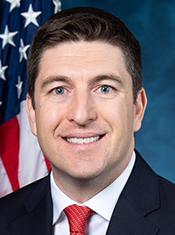
U.S. Representative for Wisconsin’s 1st district
Republican
119th Congress, two-year term
Missed 0.7% of roll calls. Chamber median 1.9%.
The full voting recordCounts roll calls where most Democrats and most Republicans voted differently, leaving out procedural votes.
How we countFrom FEC filings, Voteview roll calls and Congress.gov.
Republican. In Congress since 2019, 4 terms in total.
Following saves Steil to your list, which Chamber & Street keeps on its server, linked to a cookie on this browser and not to your name or email. Email alerts will come with constituent verification.
Bills and resolutions Steil signed on to as a cosponsor. An original cosponsor signed on the day the bill was introduced. Source: govinfo bill status files, last updated Nov 6, 2026.
Promoting Innovation in Blockchain Development Act
Sponsor Scott Fitzgerald (R). Joined Oct 29, 2026. 22 cosponsors. H.R. 7732 on Congress.gov
Introduced
Honoring the contributions of Indian Americans and supporting the designation of July as "Indian American Heritage Month".
Sponsor Raja Krishnamoorthi (D). Original cosponsor. 255 cosponsors. H.Res. 1641 on Congress.gov(opens in a new tab)
Introduced
Dismantle Foreign Scam Syndicates Act
Sponsor Jefferson Shreve (R). Joined Sep 28, 2026. 73 cosponsors. H.R. 5490 on Congress.gov(opens in a new tab)
Passed committee
Dismantle Foreign Scam Syndicates Act
This bill requires the President to (1) impose applicable sanctions on foreign persons (individuals or entities) responsible for online financial scams against U.S. nationals, and (2) establish an interagency task force to shut down the criminal syndicates perpetuating such scams.
Under the bill, the President must determine whether 43 specified foreign persons, and any other foreign persons the President determines are responsible for or complicit in online financial scams against U.S. nationals, are subject to sanctions under specified laws and Executive Order 13581. Upon such determination, the President must impose applicable sanctions (for example, blocking the sanctioned person's property transactions within the United States).
The President must also establish an interagency task force to shut down transnational criminal syndicates that use large scam centers and forced labor of trafficked persons to perpetuate mass online scams against Americans. The task force must (1) submit a comprehensive strategy to Congress to combat these scam centers and dismantle the criminal elements involved with them, and (2) coordinate and oversee implementation of the strategy. Within 360 days of submitting the strategy to Congress and annually thereafter for five years the task force must submit to Congress a report addressing various topics related to such scam centers including a list of all foreign persons sanctioned by the United States for their scam center involvement.
The Department of State is authorized to provide trauma-informed care, shelter, reintegration, and support services for victims of trafficking in persons within online scam centers.
Latonya Reeves Freedom Act of 2026
Sponsor Steve Cohen (D). Joined Sep 24, 2026. 84 cosponsors. H.R. 9401 on Congress.gov(opens in a new tab)
Introduced
Latonya Reeves Freedom Act of 2026
This bill prohibits government entities and insurance providers from denying community-based services to individuals with disabilities that require long-term service or support that would enable such individuals to live in the community and lead an independent life.
Specifically, these entities may not discriminate against such individuals in the provision of community-based services by such actions as imposing prohibited eligibility criteria, cost caps, or waiting lists or failing to provide a specific community-based service. Additionally, community-based services must be offered to individuals with such disabilities prior to institutionalization. Institutionalized individuals must be notified regularly of community-based alternatives.
The bill requires the Department of Justice to issue regulations requiring government entities and insurance providers to offer community-based long-term services to individuals with such disabilities who would otherwise qualify for institutional placement. Government entities must ensure sufficient availability of affordable, accessible, and integrated housing that is not a disability-specific residential setting or a setting where services are tied to tenancy.
Regulations shall also (1) require government entities and insurance providers to perform self-evaluation on current services, policies, and practices and concerning compliance with requirements of this bill; and (2) require government entities to submit a transition plan.
The bill allows civil actions by individuals subjected to, or about to be subjected to, a violation of its requirements.
Connected Vehicle Security Act of 2026
Sponsor John Moolenaar (R). Joined Sep 24, 2026. 146 cosponsors. H.R. 8730 on Congress.gov(opens in a new tab)
Introduced
Connected Vehicle Security Act of 2026
This bill prohibits the importation, manufacture, sale, resale, or introduction into U.S. interstate commerce of connected vehicles and related software and hardware components associated with China, Russia, Iran, or North Korea.
Connected vehicle means a vehicle that (1) integrates onboard networked hardware with automotive software systems to communicate with any other network or device using certain methods (e.g., wireless spectrum connectivity); or (2) is designed, manufactured, or originally equipped to communicate via such methods, regardless of whether such capability is enabled, disabled, or removed at the time the vehicle enters the United States.
Current regulations administered by the Department of Commerce's Bureau of Industry and Security (BIS) prohibit transactions involving vehicle connectivity system hardware and covered software designed, developed, manufactured, or supplied by persons owned by, controlled by, or subject to the jurisdiction or direction of China or Russia.
The bill expands the BIS regulatory framework, including by (1) expanding the countries covered by the prohibition to include China, Russia, Iran, and North Korea (Current BIS regulations apply only to China and Russia.); and (2) specifying that certain artificial intelligence components are covered by the prohibition.
By January 1, 2027, BIS must publish a list of items that are authorized for the importation, manufacture, sale, resale, or introduction into U.S. interstate commerce and would otherwise be subject to the bill's prohibition.
The bill also includes enforcement mechanisms, including that BIS must assess civil penalties for violations of the prohibition.
RESULTS Act
Sponsor Richard Hudson (R). Joined Sep 4, 2026. 129 cosponsors. H.R. 5269 on Congress.gov(opens in a new tab)
Introduced
Reforming and Enhancing Sustainable Updates to Laboratory Testing Services Act of 2025 or the RESULTS Act
This bill requires the use of particular data from the private sector to inform Medicare payment rates for certain widely available laboratory tests.
Specifically, the Centers for Medicare & Medicaid Services (CMS) must contract with an entity that maintains a database of claims data for clinical diagnostic laboratory tests that (1) are not advanced diagnostic tests, and (2) were furnished by more than 100 providers and suppliers of such services over a specified six-month period (i.e., widely available tests).
The database must meet specified requirements, such as having data that is representative of the entire country and from more than 50 private payors and claims administrators. The contracted entity must be a nonprofit entity that is not affiliated with any government agency, any insurance issuer or provider, or any other organization in the health care sector.
Beginning January 1, 2028, the CMS must use the information obtained from the database to inform Medicare payment rates for these widely available laboratory tests.
The bill additionally specifies processes for determining payment rates for laboratory tests that are not advanced diagnostic tests, are not widely available, and lack adequate claims data. The CMS must use certain existing processes to set appropriate rates.
The bill also delays scheduled payment reductions for laboratory tests until 2028 and allows for judicial and administrative review of payment rates.
North Platte Canteen Congressional Gold Medal Act
Sponsor Adrian Smith (R). Joined Sep 3, 2026. 270 cosponsors. H.R. 1502 on Congress.gov(opens in a new tab)
Introduced
North Platte Canteen Congressional Gold Medal Act
This bill provides for the award of a Congressional Gold Medal to recognize the individuals and communities that provided financial and other support for the North Platte Canteen in North Platte, Nebraska, during World War II.
To require the United States Postal Service to designate ZIP Codes for certain communities.
Sponsor Mario Diaz-Balart (R). Original cosponsor. 10 cosponsors. H.R. 10257 on Congress.gov(opens in a new tab)
Introduced
Consumer Financial Protection Accountability and Reform Act of 2026
Sponsor Andy Barr (R). Original cosponsor. 30 cosponsors. H.R. 10184 on Congress.gov(opens in a new tab)
Passed committee
Great American Outdoors Act 250
Sponsor Bruce Westerman (R). Joined Jul 18, 2026. 263 cosponsors. H.R. 9250 on Congress.gov(opens in a new tab)
Passed committee
Hmong Congressional Gold Medal Act
Sponsor Glenn Grothman (R). Original cosponsor. 10 cosponsors. H.R. 9627 on Congress.gov(opens in a new tab)
Introduced
REAL Butter Act
Sponsor Tony Wied (R). Joined Jun 24, 2026. 11 cosponsors. H.R. 9387 on Congress.gov(opens in a new tab)
Introduced
Accounting STEM Pursuit Act of 2025
Sponsor Young Kim (R). Joined Jun 8, 2026. 57 cosponsors. H.R. 2911 on Congress.gov(opens in a new tab)
Introduced
America’s Olympic and Paralympic Games Commemorative Coins Act
Sponsor Brad Sherman (D). Joined May 29, 2026. 313 cosponsors. H.R. 4382 on Congress.gov(opens in a new tab)
Introduced
State Veterans Homes Inspection Simplification Act
Sponsor Jack Bergman (R). Joined May 21, 2026. 20 cosponsors. H.R. 7747 on Congress.gov(opens in a new tab)
Introduced
Restoration of Employment Choice for Adults with Disabilities Act
Sponsor Glenn Grothman (R). Joined May 19, 2026. 5 cosponsors. H.R. 8736 on Congress.gov(opens in a new tab)
Passed committee
Restoration of Employment Choice for Adults with Disabilities Act
This bill relaxes requirements that allow entities with a special wage certificate to pay subminimum wages to individuals with disabilities.
Specifically, the bill eliminates a requirement that an individual with a disability who is age 24 or younger receive pre-employment transition services and meet specified vocational rehabilitation criteria before beginning subminimum wage work.
The bill also relaxes career counseling and service referral requirements that apply to an individual with a disability who is paid at a subminimum wage. Current law requires an entity to ensure that an individual employed at subminimum wage receives periodic career counseling, information, and referrals to other services from the designated state agency. Under the bill, this requirement is met if the employer makes a documented effort to contact the state agency for those resources on behalf of the employee, and the state agency subsequently fails to provide the counseling, information, and referrals.
PACK Act
Sponsor Randy Weber (R). Joined May 19, 2026. 19 cosponsors. H.R. 6832 on Congress.gov(opens in a new tab)
Passed committee
SCAM Act
Sponsor Daniel Meuser (R). Joined May 15, 2026. 57 cosponsors. H.R. 7548 on Congress.gov(opens in a new tab)
Introduced
FEC Administrative Improvements Act
Sponsor Joseph Morelle (D). Original cosponsor. 3 cosponsors. H.R. 8738 on Congress.gov(opens in a new tab)
Passed the House
FEC Administrative Improvements Act
This bill expands electronic filing requirements and allows political committees to make disbursements by methods other than check.
First, current law requires the Federal Election Commission (FEC) to make electronic filing mandatory for political committees and others required to file with the FEC who, in a calendar year, have, or have reason to expect to have, total contributions or expenditures exceeding a threshold amount set by the FEC (which is currently $50,000). Many independent expenditure reports are also subject to mandatory electronic filing. However, the current mandatory electronic filing provision does not apply to certain reports. This bill expands the types of reports that are required to be filed electronically to include electioneering communications (subject to the threshold amount).
Second, current law requires political committees to maintain at least one campaign depository account and make all disbursements (other than petty cash disbursements) by check drawn on such accounts. This bill removes the requirement that disbursements must be made by check drawn on campaign depository accounts. Therefore, the bill allows political committees to make disbursements in other forms (e.g., credit or debit cards).
DAIRY PRIDE Act
Sponsor John Joyce (R). Joined May 11, 2026. 15 cosponsors. H.R. 8414 on Congress.gov(opens in a new tab)
Introduced
Guidelines for Use, Access, and Responsible Disclosure of Financial Data Act
Sponsor Bill Huizenga (R). Original cosponsor. 6 cosponsors. H.R. 8398 on Congress.gov(opens in a new tab)
Introduced
Improving Seniors’ Timely Access to Care Act of 2025
Sponsor Mike Kelly (R). Joined Mar 27, 2026. 308 cosponsors. H.R. 3514 on Congress.gov(opens in a new tab)
Passed committee
Improving Seniors' Timely Access to Care Act of 2025
This bill establishes several requirements and standards relating to prior authorization processes under Medicare Advantage (MA) plans.
Specifically, MA plans must (1) establish an electronic prior authorization program that meets specified standards; (2) annually submit to the CMS for publication specified prior authorization information, including the percentage of requests approved and the average response time; and (3) meet other standards, as set by the Centers for Medicare & Medicaid Services (CMS), relating to the quality and timeliness of prior authorization determinations.
The CMS and the Office of the National Coordinator for Health Information Technology must publish on the CMS' website a report that analyzes the information received from MA plans, the feasibility of implementing real-time decision making with respect to prior authorization requests, and the impact of decisions that are made using artificial intelligence on patient access.
Native American Housing Assistance and Self-Determination Modernization Act of 2026
Sponsor Troy Downing (R). Original cosponsor. 50 cosponsors. H.R. 8092 on Congress.gov(opens in a new tab)
Introduced
Sikh American Anti-Discrimination Act of 2026
Sponsor Josh Gottheimer (D). Joined Mar 20, 2026. 65 cosponsors. H.R. 7100 on Congress.gov(opens in a new tab)
Introduced
Supporting Apprenticeship Colleges Act of 2025
Sponsor Angie Craig (D). Joined Mar 16, 2026. 35 cosponsors. H.R. 4588 on Congress.gov(opens in a new tab)
Introduced
Supporting Apprenticeship Colleges Act of 2025
This bill directs the Department of Education to award grants to institutions of higher education that sponsor construction and manufacturing-oriented registered apprenticeship programs for (1) expanding or supporting outreach to high schools, local businesses, local workforce development boards, and apprenticeship intermediaries; and (2) providing advising and support services to students who are enrolled in these apprenticeship programs.