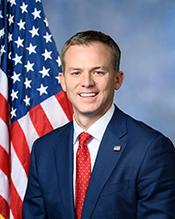
U.S. Representative for Utah’s 1st district
Republican
119th Congress, two-year term
Missed 0.3% of roll calls. Chamber median 1.9%.
The full voting recordCounts roll calls where most Democrats and most Republicans voted differently, leaving out procedural votes.
How we countFrom FEC filings, Voteview roll calls and Congress.gov.
Republican. In Congress since 2021, 3 terms in total.
Following saves Moore to your list, which Chamber & Street keeps on its server, linked to a cookie on this browser and not to your name or email. Email alerts will come with constituent verification.
Bills and resolutions Moore signed on to as a cosponsor. An original cosponsor signed on the day the bill was introduced. Source: govinfo bill status files, last updated Nov 6, 2026.
Moore also withdrew as a cosponsor from 1 bill, not listed here.
Supporting Pregnant and Parenting Women and Families Act
Sponsor Michelle Fischbach (R). Joined Jan 12, 2026. 15 cosponsors. H.R. 6945 on Congress.gov
Passed the House
Supporting Pregnant and Parenting Women and Families Act
This bill provides statutory authority for states to use Temporary Assistance for Needy Families (TANF) funds for pregnancy centers that (1) support protecting the life of the mother and the unborn child; and (2) offer resources and services to mothers, fathers, and families, including relationship counseling, prenatal and pregnancy education, pregnancy testing, diapers, baby clothes, and material supports.
To amend title 38, United States Code, to include eyeglass lens fittings in the category of medical services authorized to be furnished to veterans under the Veterans Community Care Program, and for other purposes.
Sponsor Celeste Maloy (R). Joined Jan 12, 2026. 7 cosponsors. H.R. 5593 on Congress.gov(opens in a new tab)
Introduced
Incentivize Savings Act
Sponsor Richard McCormick (R). Joined Jan 12, 2026. 69 cosponsors. H.R. 5438 on Congress.gov(opens in a new tab)
Passed committee
Incentivize Savings Act
This bill establishes requirements for allocating unexpended appropriations for federal agencies.
If appropriations are provided to a federal agency for a definite period and the agency does not spend the funds during the period of availability, the bill requires
• 49% of the funds to remain available for an additional fiscal year,
• 49% of the funds to be used for payments of principal and interest on the public debt, and
• 2% of the funds to be used for retention bonuses within the agency that do not exceed 10% of an employee's basic pay.
If an agency's unexpended appropriations are allocated under this bill, the agency's budget request for the fiscal year following the fiscal year in which the funds expired may not exceed the prior year's budget request with an adjustment for inflation.
Expressing the sense of the House of Representatives that the United States should reduce and maintain the Federal unified budget deficit at or below 3 percent of gross domestic product.
Sponsor Bill Huizenga (R). Original cosponsor. 20 cosponsors. H.Res. 981 on Congress.gov(opens in a new tab)
Introduced
This resolution expresses the sense of the House of Representatives that (1) Congress should adopt a fiscal target to reduce the federal budget deficit to 3% of gross domestic product or less as soon as possible and no later than the end of FY2030; and (2) after the target is achieved, Congress should continue to pursue further deficit reduction with the goal of achieving a balanced federal budget.
Geothermal Tax Parity Act
Sponsor Celeste Maloy (R). Original cosponsor. 5 cosponsors. H.R. 6873 on Congress.gov(opens in a new tab)
Introduced
CLEAR Act of 2025
Sponsor Celeste Maloy (R). Original cosponsor. 7 cosponsors. H.R. 6802 on Congress.gov(opens in a new tab)
Introduced
PAR Act
Sponsor Claudia Tenney (R). Joined Dec 10, 2025. 16 cosponsors. H.R. 1583 on Congress.gov(opens in a new tab)
Introduced
CONNECT for Health Act of 2025
Sponsor Mike Thompson (D). Joined Dec 3, 2025. 248 cosponsors. H.R. 4206 on Congress.gov(opens in a new tab)
Introduced
North Korean Human Rights Reauthorization Act of 2025
Sponsor Young Kim (R). Joined Dec 1, 2025. 11 cosponsors. H.R. 5959 on Congress.gov(opens in a new tab)
Introduced
Military Child and Youth Program Abuse and Neglect Notification Act
Sponsor Jill Tokuda (D). Original cosponsor. 15 cosponsors. H.R. 6313 on Congress.gov(opens in a new tab)
Introduced
Improve and Enhance the Work Opportunity Tax Credit Act
Sponsor Lloyd Smucker (R). Original cosponsor. 31 cosponsors. H.R. 6231 on Congress.gov(opens in a new tab)
Introduced
Human Trafficking Survivor Tax Relief Act
Sponsor Bradley Schneider (D). Original cosponsor. 3 cosponsors. H.R. 6227 on Congress.gov(opens in a new tab)
Introduced
Pay Our Troops Act of 2026
Sponsor Jennifer Kiggans (R). Joined Nov 17, 2025. 210 cosponsors. H.R. 5401 on Congress.gov(opens in a new tab)
Introduced
Pay Our Troops Act of 2026
This bill provides continuing appropriations for military pay for any period during which interim or full-year appropriations for FY2026 are not in effect (i.e., a government shutdown).
Specifically, the bill provides FY2026 continuing appropriations for the pay and allowances of (1) members of the Armed Forces, including reserve components, who perform active service during the period; and (2) civilian personnel and contractors of the Department of Defense (and the Department of Homeland Security in the case of the Coast Guard) who are providing support to such members of the Armed Forces.
If a government shutdown occurs, the bill provides the continuing appropriations until the earlier of (1) the enactment into law of specified appropriations legislation, or (2) January 1, 2027.
Accelerating Kids’ Access to Care Act of 2025
Sponsor Lori Trahan (D). Joined Nov 17, 2025. 104 cosponsors. H.R. 1509 on Congress.gov(opens in a new tab)
Introduced
Accelerating Kids’ Access to Care Act of 2025
This bill requires states to establish a process through which qualifying out-of-state providers may temporarily treat children under Medicaid and the Children's Health Insurance Program (CHIP) without undergoing additional screening requirements.
Specifically, states must establish a process through which qualifying out-of-state providers may enroll for five years as participating providers to treat individuals under the age of 21 without undergoing additional screening requirements.
A qualifying out-of-state provider (1) must not have been excluded or terminated from participating in a federal health care program or state Medicaid program; and (2) must have been successfully enrolled in Medicare or a state Medicaid program based on a determination that the provider posed a limited risk of fraud, waste, or abuse.
The bill’s changes take effect three years after enactment.
Preserving Patient Access to Home Infusion Act
Sponsor Vern Buchanan (R). Joined Nov 12, 2025. 30 cosponsors. H.R. 2172 on Congress.gov(opens in a new tab)
Introduced
Preserving Patient Access to Home Infusion Act
This bill specifically includes pharmacy services and home infusion drugs that are administered without a pump as part of covered home infusion therapy under Medicare. The bill also allows nurses and physician assistants to establish and review the plan of care for home infusion therapy, and it specifies that payment may be made regardless of whether a practitioner is physically present in the home at the time the drug is administered.
Calling for the return of abducted Ukrainian children before finalizing any peace agreement to end the war against Ukraine.
Sponsor Michael McCaul (R). Joined Nov 10, 2025. 47 cosponsors. H.Res. 564 on Congress.gov(opens in a new tab)
Introduced
REPO Implementation Act of 2025
Sponsor Joe Wilson (R). Joined Nov 7, 2025. 26 cosponsors. H.R. 5835 on Congress.gov(opens in a new tab)
Introduced
No Work, No Pay Act of 2025
Sponsor Mike Kennedy (R). Joined Nov 7, 2025. 1 cosponsor. H.R. 5637 on Congress.gov(opens in a new tab)
Introduced
No Work, No Pay Act of 2025
This bill prohibits Members of Congress from being paid during a government shutdown, beginning with the 120th Congress. Under the bill, a government shutdown is in effect when there is a lapse in appropriations for any federal agency or department as a result of a failure to enact a regular appropriations bill or a continuing resolution.
Make America's Youth Healthy Again Act of 2025
Sponsor Gregory Murphy (R). Joined Oct 31, 2025. 15 cosponsors. H.R. 5480 on Congress.gov(opens in a new tab)
Introduced
RESULTS Act
Sponsor Richard Hudson (R). Joined Oct 31, 2025. 129 cosponsors. H.R. 5269 on Congress.gov(opens in a new tab)
Introduced
Reforming and Enhancing Sustainable Updates to Laboratory Testing Services Act of 2025 or the RESULTS Act
This bill requires the use of particular data from the private sector to inform Medicare payment rates for certain widely available laboratory tests.
Specifically, the Centers for Medicare & Medicaid Services (CMS) must contract with an entity that maintains a database of claims data for clinical diagnostic laboratory tests that (1) are not advanced diagnostic tests, and (2) were furnished by more than 100 providers and suppliers of such services over a specified six-month period (i.e., widely available tests).
The database must meet specified requirements, such as having data that is representative of the entire country and from more than 50 private payors and claims administrators. The contracted entity must be a nonprofit entity that is not affiliated with any government agency, any insurance issuer or provider, or any other organization in the health care sector.
Beginning January 1, 2028, the CMS must use the information obtained from the database to inform Medicare payment rates for these widely available laboratory tests.
The bill additionally specifies processes for determining payment rates for laboratory tests that are not advanced diagnostic tests, are not widely available, and lack adequate claims data. The CMS must use certain existing processes to set appropriate rates.
The bill also delays scheduled payment reductions for laboratory tests until 2028 and allows for judicial and administrative review of payment rates.
Hospital Inpatient Services Modernization Act
Sponsor Vern Buchanan (R). Joined Oct 31, 2025. 8 cosponsors. H.R. 4313 on Congress.gov(opens in a new tab)
Passed the House
Hospital Inpatient Services Modernization Act
This bill extends the Acute Hospital Care at Home Program under Medicare and requires an additional study regarding the program. The program allows hospitals to treat certain patients from emergency departments or inpatient hospital beds at home.
Specifically, the bill extends the program through FY2030 and requires the Centers for Medicare & Medicaid Services to conduct a study of the program with respect to several metrics, including the quality of care, incurred costs, types of services, and demographics of patients under the program compared to inpatient settings.
Wildfire Coordination Act
Sponsor Joe Neguse (D). Joined Oct 31, 2025. 3 cosponsors. H.R. 3923 on Congress.gov(opens in a new tab)
Introduced
IRA Charitable Rollover Facilitation and Enhancement Act of 2025
Sponsor Adrian Smith (R). Joined Oct 31, 2025. 42 cosponsors. H.R. 2891 on Congress.gov(opens in a new tab)
Introduced
CREATE Act
Sponsor Judy Chu (D). Joined Oct 28, 2025. 16 cosponsors. H.R. 4840 on Congress.gov(opens in a new tab)
Introduced
Apples to Apples Comparison Act of 2025
Sponsor Aaron Bean (R). Joined Oct 28, 2025. 25 cosponsors. H.R. 4093 on Congress.gov(opens in a new tab)
Passed committee
Apples to Apples Comparison Act of 2025
This bill requires additional reporting and disclosures regarding Medicare enrollment and expenditures.
Specifically, the bill requires the Centers for Medicare & Medicaid Services to annually report on and publish information on its website regarding expenditures for Medicare hospital services and medical services, the Medicare prescription drug benefit, and Medicare Advantage (MA), including for those who are enrolled in one program but not others or have supplemental insurance. This information must be broken down by county and metropolitan statistical area for each month over the prior 10-year period and for each month over the next 5-year period.
In addition, the Medicare Payment Advisory Commission must annually analyze and report on expenditures for Medicare beneficiaries who have an MA plan compared to those who do not have an MA plan. The Boards of Trustees for Medicare must annually report on expenditures for (1) Medicare beneficiaries who have either hospital services or medical services but not both, and (2) Medicare beneficiaries who have both hospital and medical services but do not have an MA plan.