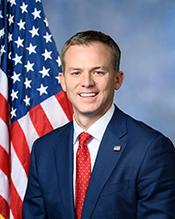
U.S. Representative for Utah’s 1st district
Republican
119th Congress, two-year term
Missed 0.3% of roll calls. Chamber median 1.9%.
The full voting recordCounts roll calls where most Democrats and most Republicans voted differently, leaving out procedural votes.
How we countFrom FEC filings, Voteview roll calls and Congress.gov.
Republican. In Congress since 2021, 3 terms in total.
Following saves Moore to your list, which Chamber & Street keeps on its server, linked to a cookie on this browser and not to your name or email. Email alerts will come with constituent verification.
Bills and resolutions Moore signed on to as a cosponsor. An original cosponsor signed on the day the bill was introduced. Source: govinfo bill status files, last updated Nov 6, 2026.
Moore also withdrew as a cosponsor from 1 bill, not listed here.
Ski Hill Resources for Economic Development Act
Sponsor Joe Neguse (D). Original cosponsor. 9 cosponsors. H.R. 1084 on Congress.gov
Introduced
Ski Hill Resources for Economic Development Act
This bill allows National Forest System (NFS) units to keep the majority of ski area permit rental fees that were generated within their boundaries and outlines how revenues from those fees may be used. Such fees are collected by the Department of Agriculture (USDA) from ski area operators on NFS land.
Within the NFS unit where the fees were generated, USDA must expend (1) 60%-48% of the collected fees for activities such as administration of the ski area permit program, visitor information, or reducing the likelihood of wildfire in or adjacent to a recreation site; and (2) 20% of the collected fees for activities such as repair of a Forest Service-owned facility, habitat restoration, or search and rescue activities.
The remainder of the collected fees must be expended by USDA at any NFS unit for any of the activities specified in this bill.
Utah Wildfire Research Institute Act of 2025
Sponsor Mike Kennedy (R). Original cosponsor. 3 cosponsors. H.R. 1045 on Congress.gov(opens in a new tab)
Passed the House
Utah Wildfire Research Institute Act of 2025
This bill requires the establishment of a Southwest Ecological Restoration Institute in Utah. Such institutes currently exist in Arizona, New Mexico, and Colorado and promote the use of adaptive ecosystem management to reduce the risk of wildfires and restore the health of forest and woodland ecosystems.
Providing for congressional disapproval under chapter 8 of title 5, United States Code, of the rule submitted by the Forest Service of the Department of Agriculture relating to "Law Enforcement; Criminal Prohibitions".
Sponsor Celeste Maloy (R). Original cosponsor. 6 cosponsors. H.J.Res. 36 on Congress.gov(opens in a new tab)
Introduced
Protect Our Clothes from PFAS Act
Sponsor Chellie Pingree (D). Original cosponsor. 4 cosponsors. H.R. 960 on Congress.gov(opens in a new tab)
Introduced
Protect Our Clothes from PFAS Act
This bill revises requirements for a garment to be considered water resistant under the Harmonized Tariff Schedule of the United States (HTS). The HTS sets out the tariff rates and statistical categories for all merchandise imported into the United States.
Currently, garments that are classified under specified subheadings under chapter 62 of the HTS (e.g., water resistant trousers) must have a water resistance such that, under a head pressure of 600 millimeters, not more than 1.0 gram of water penetrates after two minutes when tested in accordance with a specified test method. Further, the water resistance must be the result of a rubber or plastics application to the outer shell, lining, or inner lining. This bill removes the requirement that the water resistance must be the result of a rubber or plastics application to the outer shell, lining, or inner lining.
Educational Choice for Children Act of 2025
Sponsor Adrian Smith (R). Original cosponsor. 91 cosponsors. H.R. 833 on Congress.gov(opens in a new tab)
Introduced
To amend the Internal Revenue Code of 1986 to allow a credit against tax for charitable donations to nonprofit organizations providing education scholarships to qualified elementary and secondary students.
Sponsor Adrian Smith (R). Original cosponsor. 27 cosponsors. H.R. 817 on Congress.gov(opens in a new tab)
Introduced
Educational Choice for Children Act of 2025
This bill establishes a nonrefundable tax credit for contributions (cash or stock) made by an individual to a tax-exempt organization that provides scholarships for qualified elementary and secondary school expenses to eligible students (scholarship granting organization), subject to limitations.
Under the bill, the tax credit is limited to the greater of $5,000 or 10% of adjusted gross income.
Further, the bill establishes a $5 billion annual volume cap (for 2025-2028) for the tax credit (which may be increased under certain circumstances). The volume cap is allocated by the Department of the Treasury for the tax credit on a first-come, first-serve basis (based on the contribution date). However, under the bill, 10% of the volume cap must be divided evenly among states for allocation to individuals residing in those states.
The bill allows any portion of the tax credit that exceeds the individual’s tax liability (less certain other tax credits) to be carried forward for up to five tax years.
The bill also
• establishes specific requirements for a scholarship granting organization,
• requires a scholarship granting organization to distribute all contributions within a specific timeframe (exceptions apply), and
• excludes from gross income scholarships received by an individual from a scholarship granting organization.
Finally, the bill prohibits federal, state, and local government entities, officers, and employees from imposing requirements that prevent the use of scholarship funds for private or religious elementary or secondary education expenses or discouraging the use of scholarship funds at such education institutions.
Abundant American Resources Act of 2025
Sponsor Jodey Arrington (R). Original cosponsor. 6 cosponsors. H.R. 745 on Congress.gov(opens in a new tab)
Introduced
Expressing the sense of Congress that tax-exempt fraternal benefit societies have historically provided and continue to provide critical benefits to the people and communities of the United States.
Sponsor Darin LaHood (R). Original cosponsor. 122 cosponsors. H.Con.Res. 4 on Congress.gov(opens in a new tab)
Introduced
This concurrent resolution expresses the sense of Congress that tax-exempt fraternal benefit societies serve as a private economic and social support system, providing benefits to their members is necessary to support the charitable and fraternal activities of the volunteer chapters, and their work should continue to be promoted.
Main Street Tax Certainty Act
Sponsor Lloyd Smucker (R). Original cosponsor. 192 cosponsors. H.R. 703 on Congress.gov(opens in a new tab)
Introduced
Main Street Tax Certainty Act
This bill makes permanent the qualified business income (QBI) tax deduction.
Under current law, individuals, estates, and trusts may deduct the lower of (1) 20% of QBI from a qualified business, qualified real estate investment trust dividends, and qualified publicly traded partnership income; or (2) 20% of taxable income less net capital gain. (Some limitations apply.)
However, under current law, the QBI tax deduction expires after December 31, 2025.
FREE Act
Sponsor Celeste Maloy (R). Original cosponsor. 19 cosponsors. H.R. 689 on Congress.gov(opens in a new tab)
Introduced
ALIGN Act
Sponsor Jodey Arrington (R). Joined Jan 23, 2025. 34 cosponsors. H.R. 574 on Congress.gov(opens in a new tab)
Introduced
TCJA Permanency Act
Sponsor Vern Buchanan (R). Joined Jan 23, 2025. 53 cosponsors. H.R. 137 on Congress.gov(opens in a new tab)
Introduced
TCJA Permanency Act
This bill makes permanent multiple federal tax provisions enacted in 2017 by the Tax Cuts and Jobs Act.
The bill makes permanent the
• individual tax rates of 10%, 12%, 22%, 24%, 32%, 35%, and 37%;
• increased standard deduction;
• personal exemption allowance repeal;
• exclusion from income of student loans discharged due to death or disability;
• qualified business income tax deduction (199A tax deduction);
• allowance of ABLE account contributions in excess of the annual gift tax exclusion amount;
• base estate and gift tax exclusion amount of $10 million (adjusted annually); and
• alternative minimum tax exemption and phaseout amounts for noncorporate taxpayers.
The bill makes permanent the child tax credit amounts of $2,000 per child and $500 for dependents, the $200,000 phaseout threshold ($400,000 for joint filers), and the refundable portion of the tax credit.
The bill expands the expenses eligible for tax-free withdrawals from qualified tuition plans (529 plans) to include additional expenses associated with homeschool and elementary and secondary schools (e.g., instructional materials, tutoring, test and enrollment fees, and educational therapies).
The bill permanently eliminates certain miscellaneous itemized deductions and makes permanent the
• state and local tax deduction limit of $10,000 ($5,000 for married individuals filing separately),
• mortgage interest tax deduction limit of $750,000 ($375,000 for married individuals filing separately),
• limit on the deduction of cash charitable contributions to 60% of a taxpayer’s adjusted gross income, and
• certain limits on casualty loss tax deductions.
The bill also permanently eliminates the exclusion from income for employer-reimbursed bicycle commuting expenses.
Defending American Jobs and Investment Act
Sponsor Jason Smith (R). Original cosponsor. 25 cosponsors. H.R. 591 on Congress.gov(opens in a new tab)
Introduced
Defending American Jobs and Investment Act
This bill provides for the enforcement of remedies against foreign countries that have extraterritorial or discriminatory taxes.
Specifically, the bill requires the Department of the Treasury to periodically submit a report to Congress that lists each foreign country that has one or more extraterritorial or discriminatory taxes.
Treasury must commence enhanced bilateral engagement with each foreign country included in the report. This engagement must (1) express the concern of the United States with respect to the adverse trade and economic effects of tax policies that violate bilateral tax treaties and international tax norms, (2) urge the repeal of extraterritorial and discriminatory taxes that target U.S. persons, and (3) advise the foreign country of remedial actions (as outlined by this bill).
The bill increases income tax and withholding tax rates on certain foreign citizens, corporations, and partnerships of any foreign country listed in Treasury's report.
The bill provides the executive branch with additional tools to enforce against extraterritorial and discriminatory taxes. These tools include
• authorizing the President to prohibit government contracting for or procurement of goods or services from a foreign country listed in Treasury's report,
• directing Treasury to consider these taxes in assessing whether to enter into or update a bilateral tax treaty with the foreign country, and
• requiring the Office of the U.S. Trade Representative and the Department of Commerce to consider these taxes in assessing whether to enter into any free trade agreement or executive agreement with the foreign country.
Ending Presidential Overreach on Public Lands Act
Sponsor Celeste Maloy (R). Original cosponsor. 15 cosponsors. H.R. 521 on Congress.gov(opens in a new tab)
Introduced
Ending Presidential Overreach on Public Lands Act
This bill removes the president's authority to designate or expand national monuments and gives that authority to Congress instead.
Miracle on Ice Congressional Gold Medal Act
Sponsor Pete Stauber (R). Original cosponsor. 299 cosponsors. H.R. 452 on Congress.gov(opens in a new tab)
Became law
Miracle on Ice Congressional Gold Medal Act
This act provides for the award of Congressional Gold Medals to the members of the 1980 U.S. Olympic men's ice hockey team in recognition of the team's achievement at the 1980 Winter Olympic Games.
Historic Roadways Protection Act
Sponsor Mike Kennedy (R). Original cosponsor. 3 cosponsors. H.R. 376 on Congress.gov(opens in a new tab)
Introduced
Historic Roadways Protection Act
This bill prohibits the Bureau for Land Management (BLM) from closing historical roads on public lands in certain areas of Utah until the Federal District Court for Utah makes a decision on each of the R.S. 2477 cases, which are cases brought by Utah and counties to keep historical roads on BLM land in Utah open for public use.
By way of background, a provision of the Mining Law of 1866, commonly known as R.S. 2477, granted rights-of-way to states and counties across public lands for the construction of roads for public use in order to promote settlement of the American West. In 1976, Congress repealed R.S. 2477 when it enacted the Federal Land Policy and Management Act (FLPMA), but FLPMA preserved rights-of-way that had been established under R.S. 2477. After the BLM released travel management plans that closed some historical roads, Utah and 22 counties filed lawsuits about their rights-of-way across public lands for historical roads.
Until the BLM certifies that those cases have been decided, the bill prohibits the BLM from obligating or expending federal funds to (1) finalize or implement a new travel management plan for certain travel management areas in Utah; or (2) implement, with respect to land within the boundary of Utah, the Indian Creek (Canyon Rims) Travel Management Plan, the San Rafael Desert Travel Management Plan, the San Rafael Swell Travel Management Plan, or the Labyrinth/Gemini Bridges Travel Management Plan.
Water Rights Protection Act
Sponsor Celeste Maloy (R). Original cosponsor. 6 cosponsors. H.R. 302 on Congress.gov(opens in a new tab)
Introduced
Water Rights Protection Act of 2025
This bill limits the transfer of water rights from water users to the Department of the Interior or the Department of Agriculture (USDA).
First, the bill prohibits Interior and USDA from conditioning the issuance or renewal of land use or occupancy agreements (e.g., permits and leases) on the transfer of any water right to the United States. Next, it prohibits Interior and USDA from requiring water users, including Indian tribes, to acquire water rights in the name of the United States as a condition of the issuance or renewal of a land use or occupancy agreement. Finally, it prohibits Interior and USDA from conditioning or withholding the issuance or renewal of land use or occupancy agreements on (1) limiting the date, time, quantity, location of diversion or pumping, or place of use of a state water right beyond any applicable limitations under state water law; or (2) modifying the terms and conditions of groundwater withdrawal, guidance and reporting procedures, or conservation and source protection measures established by a state.
Interior and USDA must also ensure that federal action imposes no greater restriction or regulatory requirement than under applicable state water law.
Further, Interior and USDA must not take actions that adversely affect state authority in permitting water usage or in adjudicating water rights.
REMAIN in Mexico Act of 2025
Sponsor Brandon Gill (R). Original cosponsor. 110 cosponsors. H.R. 273 on Congress.gov(opens in a new tab)
Introduced
Return Excessive Migrants and Asylees to International Neighbors in Mexico Act of 2025 or the REMAIN in Mexico Act of 2025
This bill requires the Department of Homeland Security (DHS) to implement the Migrant Protection Protocols as outlined in the January 25, 2019, memo titled Policy Guidance for Implementation of the Migrant Protection Protocols.
(The protocols generally required aliens who are not clearly admissible, including those seeking asylum, arriving by land along the U.S.-Mexico border to be returned to Mexico while their immigration proceedings are pending, rather than remain in the United States. On January 21, 2021, DHS stopped applying the protocols to newly-arrived individuals.)
To amend the Internal Revenue Code of 1986 to provide special rules for the taxation of certain residents of Taiwan with income from sources within the United States.
Sponsor Jason Smith (R). Joined Jan 6, 2025. 46 cosponsors. H.R. 33 on Congress.gov(opens in a new tab)
Passed the House
Born-Alive Abortion Survivors Protection Act
Sponsor Ann Wagner (R). Joined Jan 6, 2025. 163 cosponsors. H.R. 21 on Congress.gov(opens in a new tab)
Passed the House
Born-Alive Abortion Survivors Protection Act
This bill establishes requirements for the degree of care a health care practitioner must provide in the case of a child born alive following an abortion or attempted abortion.
Specifically, a health care practitioner who is present must (1) exercise the same degree of care as would reasonably be provided to any other child born alive at the same gestational age, and (2) ensure the child is immediately admitted to a hospital. Additionally, a health care practitioner or other employee who has knowledge of a failure to comply with the degree-of-care requirements must immediately report such failure to law enforcement.
A health care practitioner who fails to provide the required degree of care, or a health care practitioner or other employee who fails to report such failure, is subject to criminal penalties—a fine, up to five years in prison, or both.
An individual who intentionally kills or attempts to kill a child born alive is subject to prosecution for murder.
The bill bars the criminal prosecution of a mother of a child born alive under this bill and allows her to bring a civil action against a health care practitioner or other employee for violations.
Proposing an amendment to the Constitution of the United States to limit the number of terms that a Member of Congress may serve.
Sponsor Ralph Norman (R). Original cosponsor. 116 cosponsors. H.J.Res. 12 on Congress.gov(opens in a new tab)
Introduced
This joint resolution proposes an amendment to the Constitution establishing term limits for individuals serving in the Senate and the House of Representatives.
The proposed amendment makes an individual who has served two terms in the Senate ineligible for appointment or election to the Senate and an individual who has served three terms as a Member of the House of Representatives ineligible for election to the House of Representatives.
The joint resolution provides that the amendment shall be valid when ratified by the legislatures of three-fourths of the states within seven years after the date of its submission for ratification.
Under Article V of the Constitution, both chambers of Congress may propose an amendment by a vote of two-thirds of all Members present for such vote. A proposed amendment must be ratified by the states as prescribed in Article V and as specified by Congress.
Constitutional Concealed Carry Reciprocity Act of 2025
Sponsor Richard Hudson (R). Original cosponsor. 189 cosponsors. H.R. 38 on Congress.gov(opens in a new tab)
Introduced
Constitutional Concealed Carry Reciprocity Act
This bill establishes a federal statutory framework to regulate the carry or possession of concealed firearms across state lines.
Specifically, an individual who is eligible to carry a concealed firearm in one state may carry or possess a concealed handgun (other than a machine gun or destructive device) in another state that allows its residents to carry concealed firearms.
It sets forth requirements for lawful concealed carry across state lines. The bill preempts most state and local laws related to concealed carry and establishes a private right of action for a person adversely affected by interference with a concealed-carry right established by this bill.
Regulations from the Executive in Need of Scrutiny Act of 2025
Sponsor Kat Cammack (R). Original cosponsor. 93 cosponsors. H.R. 142 on Congress.gov(opens in a new tab)
Introduced
Regulations from the Executive in Need of Scrutiny Act of 2025
This bill revises provisions relating to congressional review of agency rulemaking.
Specifically, the bill establishes a congressional approval process for a major rule. A major rule may only take effect if Congress approves of the rule. A major rule is a rule that has resulted in or is likely to result in (1) an annual effect on the economy of $100 million or more; (2) a major increase in costs or prices for consumers, individual industries, government agencies, or geographic regions; or (3) significant adverse effects on competition, employment, investment, productivity, innovation, or the ability of U.S.-based enterprises to compete with foreign-based enterprises.
The bill generally preserves the current congressional review process for a nonmajor rule.