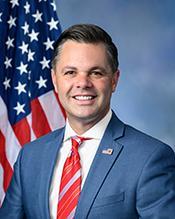
U.S. Representative for Iowa’s 3rd district
Republican
119th Congress, two-year term
Missed 4.6% of roll calls. Chamber median 1.9%.
The full voting recordCounts roll calls where most Democrats and most Republicans voted differently, leaving out procedural votes.
How we countFrom FEC filings, Voteview roll calls and Congress.gov.
Republican. In Congress since 2023, 2 terms in total.
Following saves Nunn to your list, which Chamber & Street keeps on its server, linked to a cookie on this browser and not to your name or email. Email alerts will come with constituent verification.
Bills and resolutions Nunn signed on to as a cosponsor. An original cosponsor signed on the day the bill was introduced. Source: govinfo bill status files, last updated Nov 6, 2026.
Fighting Budget Waste Act
Sponsor Chris Pappas (D). Original cosponsor. 9 cosponsors. H.R. 829 on Congress.gov
Introduced
Fighting Presidential Budget Waste Act
This bill requires the President and the Office of Management and Budget (OMB) to consider the Government Accountability Office's (GAO's) annual report on ways to improve the efficiency and effectiveness of the federal government when preparing the President's annual budget.
Specifically, the President and OMB must consider the information and recommendations contained in the most recent GAO report titled Additional Opportunities to Reduce Fragmentation, Overlap, and Duplication and Achieve Billions of Dollars in Financial Benefits.
Whole Milk for Healthy Kids Act of 2025
Sponsor Glenn Thompson (R). Joined Jan 31, 2025. 118 cosponsors. H.R. 649 on Congress.gov(opens in a new tab)
Introduced
Whole Milk for Healthy Kids Act of 2025
This bill revises requirements for milk provided by the National School Lunch Program of the Department of Agriculture (USDA).
Currently, schools participating in the program must provide milk that is consistent with the most recent Dietary Guidelines for Americans; USDA regulations require milk to be fat-free or low-fat and allow milk to be flavored or unflavored. The bill modifies these restrictions and instead permits schools to offer students whole, reduced-fat, low-fat, and fat-free flavored and unflavored milk. The milk that is offered may be organic or nonorganic. Further, USDA may not prohibit a participating school from offering students any of these milk choices.
Further, schools currently must provide a substitute for fluid milk, on receipt of a written statement from a licensed physician, for students whose disability restricts their diet. Under the bill, a parent or legal guardian may also provide the written statement.
In addition, schools currently participating in the program must provide meals that meet certain nutrition requirements; USDA regulations require that the average saturated fat content of the meals offered must be less than 10% of the total calories. Under the bill, fluid milk is excluded from the saturated fat content calculation; milk fat included in any fluid milk provided by the program must not be considered saturated fat for the purposes of measuring compliance with USDA regulations.
Finally, the bill prohibits schools participating in the program from purchasing or offering milk produced by Chinese state-owned enterprises.
Stop Chinese Fentanyl Act of 2025
Sponsor Andy Barr (R). Original cosponsor. 9 cosponsors. H.R. 747 on Congress.gov(opens in a new tab)
Passed the House
Stop Chinese Fentanyl Act of 2025
This bill subjects certain Chinese entities and government officials to potential sanctions related to opioid trafficking and requires the President to conduct certain preliminary analyses before regulating economic transactions in the event of a national emergency related to international drug trafficking.
Specifically, for the purposes of the Fentanyl Sanctions Act, the bill changes the definition of foreign opioid trafficker to specify that the term includes (1) Chinese entities involved in the production or sale of synthetic opioids or related pharmaceutical ingredients that fail to take steps to detect or prevent opioid trafficking; and (2) certain senior Chinese government officials that aid and abet opioid trafficking, including through intentional inaction. Under current law, the President must impose certain sanctions on individuals and entities identified as foreign opioid traffickers.
Further, the bill extends through 2029 an existing requirement that the President report to Congress annually on identified foreign opioid traffickers and any sanctions imposed on them. (This requirement expired in December 2024.)
The bill also requires the President to take additional steps in issuing regulations under the International Emergency Economic Powers Act (IEEPA) pursuant to a declared national emergency related to international drug trafficking. (IEEPA authorizes the President to regulate a variety of economic transactions following a declaration of national emergency.) Under the bill, the President must evaluate the costs and benefits of issuing economic regulations for the purpose of resolving the drug trafficking emergency and publish a discussion of such costs and benefits.
Main Street Tax Certainty Act
Sponsor Lloyd Smucker (R). Original cosponsor. 192 cosponsors. H.R. 703 on Congress.gov(opens in a new tab)
Introduced
Main Street Tax Certainty Act
This bill makes permanent the qualified business income (QBI) tax deduction.
Under current law, individuals, estates, and trusts may deduct the lower of (1) 20% of QBI from a qualified business, qualified real estate investment trust dividends, and qualified publicly traded partnership income; or (2) 20% of taxable income less net capital gain. (Some limitations apply.)
However, under current law, the QBI tax deduction expires after December 31, 2025.
TRUST in Congress Act
Sponsor Seth Magaziner (D). Joined Jan 22, 2025. 103 cosponsors. H.R. 396 on Congress.gov(opens in a new tab)
Introduced
Transparent Representation Upholding Service and Trust in Congress Act or the TRUST in Congress Act
This bill requires a Member of Congress, as well as any spouse or dependent child of a Member, to place specified investments into a qualified blind trust (i.e., an arrangement in which certain financial holdings are placed in someone else's control to avoid a possible conflict of interest) until 180 days after the end of their tenure as a Member of Congress.
Sarah’s Law
Sponsor Randy Feenstra (R). Original cosponsor. 53 cosponsors. H.R. 578 on Congress.gov(opens in a new tab)
Introduced
Sarah's Law
This bill requires the Department of Justice or the Department of Homeland Security (DHS) to detain a non-U.S. national (alien under federal law) who is unlawfully present in the United States and has been charged with, arrested for, convicted of, or admits to having committed acts that constitute the essential elements of a crime that resulted in the death or serious bodily injury of another person.
DHS must obtain information about the identity of any victims of the crimes for which the detained individual was charged or convicted. DHS shall provide the victim, or a relative or guardian of a deceased victim, with information about the detained individual, including name, date of birth, nationality, immigration status, criminal history, and a description of any related removal efforts.
BLUE Pacific Act
Sponsor Ed Case (D). Joined Jan 21, 2025. 14 cosponsors. H.R. 562 on Congress.gov(opens in a new tab)
Introduced
Boosting Long-term U.S. Engagement in the Pacific Act or the BLUE Pacific Act
This bill requires or authorizes activities to strengthen U.S. relations with Pacific Islands countries, which include the Cook Islands, Fiji, the Marshall Islands, Papua New Guinea, and Vanuatu.
The bill authorizes various activities in the Pacific Islands, including to
• assist in improving public health outcomes and build public health capacity;
• assist in promoting the dissemination of free and accurate information;
• promote educational and professional development for young adult leaders and professionals;
• provide assistance to promote sustainable and quality basic education;
• assist with workforce development;
• build the capacity of local civilian and national security institutions;
• expand trade and promote regional development;
• enhance preparedness for and resilience to natural disasters and other emergencies;
• support sustainable fisheries policies and marine biodiversity conservation;
• support expanded access to broadband and telecommunications infrastructure; and
• support cybersecurity, including by assisting with development and implementation of incident response plans.
The bill also requires (1) the Department of State to help Pacific Island countries access development support from international organizations, (2) the U.S. International Development Finance Corporation to prioritize efforts to enter into investment incentive agreements with Pacific Islands countries, and (3) the Department of Commerce to expand the presence of the U.S. Commercial Service and increase the number foreign commercial service officers in the Pacific Islands.
The President may extend certain diplomatic privileges, exemptions, and immunities to the Pacific Islands Forum, an international organization of 18 countries in the Pacific.
CHILD Act of 2025
Sponsor Stephanie Bice (R). Original cosponsor. 9 cosponsors. H.R. 413 on Congress.gov(opens in a new tab)
Introduced
Combating High Inflation Limiting Daycare Act of 2025 or the CHILD Act of 2025
This bill increases the maximum annual amount that may be contributed to a dependent care assistance program (generally known as a dependent care flexible spending account [FSA]).
Under the bill, the maximum annual amount that may be contributed to a dependent care FSA increases from $5,000 ($2,500 for married taxpayers who file separate federal tax returns) to $10,000 ($5,000 for married taxpayers who file separate federal tax returns) and is adjusted annually for inflation.
Goldie’s Act
Sponsor Nicole Malliotakis (R). Original cosponsor. 109 cosponsors. H.R. 349 on Congress.gov(opens in a new tab)
Introduced
Goldie's Act
This bill expands enforcement provisions under the Animal Welfare Act (AWA).
Specifically, the bill directs the Department of Agriculture (USDA) to document and record detailed descriptions of violations of the act observed during inspections and investigations. USDA must provide a copy of all records documenting violations to state, local, and municipal animal control or law enforcement officials within 24 hours of such inspections or investigations.
Inspections must be held at least once a year of each research facility, the premises of each animal dealer, and each exhibitor of animals. If violations are found during inspections, then USDA must conduct any necessary follow-up inspections until all the violations are corrected. Inspectors must confiscate or destroy in a humane manner animals found to be suffering physical or psychological harm as a result of failure to comply with the AWA.
Violators are subject to civil penalties as outlined in the bill.
To amend the Internal Revenue Code of 1986 to provide special rules for the taxation of certain residents of Taiwan with income from sources within the United States.
Sponsor Jason Smith (R). Joined Jan 13, 2025. 46 cosponsors. H.R. 33 on Congress.gov(opens in a new tab)
Passed the House
Protection of Women and Girls in Sports Act of 2025
Sponsor W. Steube (R). Joined Jan 13, 2025. 83 cosponsors. H.R. 28 on Congress.gov(opens in a new tab)
Passed the House
Protection of Women and Girls in Sports Act of 2025
This bill generally prohibits school athletic programs from allowing individuals whose biological sex at birth was male to participate in programs that are for women or girls.
Specifically, the bill provides that it is a violation of Title IX of the Education Amendments of 1972 for federally funded education programs or activities to operate, sponsor, or facilitate athletic programs or activities that allow individuals of the male sex to participate in programs or activities that are designated for women or girls. (Title IX prohibits discrimination on the basis of sex in federally funded education programs or activities, including in public elementary and secondary schools and in colleges and universities.) Under the bill, sex is based on an individual's reproductive biology and genetics at birth.
The bill does not prohibit male individuals from training or practicing with programs or activities for women or girls as long as such training or practice does not deprive any female of corresponding opportunities or benefits.
The Government Accountability Office must report on the benefits for women or girls in single-sex sports that would be lost as a result of male participation. In particular, the report must document the negative psychological, developmental, participatory, and sociological effects of male participation on girls.
Proposing an amendment to the Constitution of the United States to limit the number of terms that a Member of Congress may serve.
Sponsor Ralph Norman (R). Joined Jan 13, 2025. 116 cosponsors. H.J.Res. 12 on Congress.gov(opens in a new tab)
Introduced
This joint resolution proposes an amendment to the Constitution establishing term limits for individuals serving in the Senate and the House of Representatives.
The proposed amendment makes an individual who has served two terms in the Senate ineligible for appointment or election to the Senate and an individual who has served three terms as a Member of the House of Representatives ineligible for election to the House of Representatives.
The joint resolution provides that the amendment shall be valid when ratified by the legislatures of three-fourths of the states within seven years after the date of its submission for ratification.
Under Article V of the Constitution, both chambers of Congress may propose an amendment by a vote of two-thirds of all Members present for such vote. A proposed amendment must be ratified by the states as prescribed in Article V and as specified by Congress.
Family and Small Business Taxpayer Protection Act
Sponsor Adrian Smith (R). Joined Jan 9, 2025. 36 cosponsors. H.R. 196 on Congress.gov(opens in a new tab)
Introduced
Family and Small Business Taxpayer Protection Act
This bill rescinds unobligated funds that were provided by the Inflation Reduction Act of 2022 to the Internal Revenue Service (IRS) for enforcement activities related to the determination and collection of taxes, for operations support for taxpayer services and enforcement activities, and for a task force to research options for a free, direct electronic filing (e-filing) tax return system.
The bill also rescinds unobligated funds that were provided by the Inflation Reduction Act of 2022 for expenses of the
• Treasury Inspector General for Tax Administration,
• Office of Tax Policy,
• U.S. Tax Court, and
• offices within the Department of the Treasury that provide oversight and support for the IRS.
TCJA Permanency Act
Sponsor Vern Buchanan (R). Joined Jan 9, 2025. 53 cosponsors. H.R. 137 on Congress.gov(opens in a new tab)
Introduced
TCJA Permanency Act
This bill makes permanent multiple federal tax provisions enacted in 2017 by the Tax Cuts and Jobs Act.
The bill makes permanent the
• individual tax rates of 10%, 12%, 22%, 24%, 32%, 35%, and 37%;
• increased standard deduction;
• personal exemption allowance repeal;
• exclusion from income of student loans discharged due to death or disability;
• qualified business income tax deduction (199A tax deduction);
• allowance of ABLE account contributions in excess of the annual gift tax exclusion amount;
• base estate and gift tax exclusion amount of $10 million (adjusted annually); and
• alternative minimum tax exemption and phaseout amounts for noncorporate taxpayers.
The bill makes permanent the child tax credit amounts of $2,000 per child and $500 for dependents, the $200,000 phaseout threshold ($400,000 for joint filers), and the refundable portion of the tax credit.
The bill expands the expenses eligible for tax-free withdrawals from qualified tuition plans (529 plans) to include additional expenses associated with homeschool and elementary and secondary schools (e.g., instructional materials, tutoring, test and enrollment fees, and educational therapies).
The bill permanently eliminates certain miscellaneous itemized deductions and makes permanent the
• state and local tax deduction limit of $10,000 ($5,000 for married individuals filing separately),
• mortgage interest tax deduction limit of $750,000 ($375,000 for married individuals filing separately),
• limit on the deduction of cash charitable contributions to 60% of a taxpayer’s adjusted gross income, and
• certain limits on casualty loss tax deductions.
The bill also permanently eliminates the exclusion from income for employer-reimbursed bicycle commuting expenses.
Federal Employee Return to Work Act
Sponsor Dan Newhouse (R). Original cosponsor. 21 cosponsors. H.R. 236 on Congress.gov(opens in a new tab)
Introduced
Federal Employee Return to Work Act
This bill prohibits providing certain annual or locality-based pay increases to teleworking federal employees.
Currently, federal law mandates annual adjustments to General Schedule (GS) pay rates according to (1) a formula based on the annual percentage change in the Employment Cost Index (a measure of labor costs in the private sector); and (2) the difference between public and private sector pay rates in an employee's locality, if that difference exceeds 5%. For example, in 2025, the default annual rate of pay for a GS-7 (step 1) employee is $49,960; the adjusted annual rate of pay for a GS-7 (step 1) employee in the locality pay area that includes Washington, DC, is $57,164.
The bill makes executive agency employees who telework at least one day each week (or, in the case of an alternative work schedule, 20% or more each week) ineligible for these payments.
The bill is effective on the first day of the fiscal year beginning after the bill's enactment.
Sustainable Budget Act of 2025
Sponsor Ed Case (D). Original cosponsor. 7 cosponsors. H.R. 222 on Congress.gov(opens in a new tab)
Introduced
Sustainable Budget Act of 2025
This bill establishes the National Commission on Fiscal Responsibility and Reform within the legislative branch to identify policies to improve the fiscal situation in the medium term and achieve fiscal sustainability over the long term.
The commission must propose recommendations that (1) are designed to balance the budget, excluding interest payments on the debt, within 10 years; and (2) meaningfully improve the long-term fiscal outlook, including changes to address the growth of entitlement spending and the gap between projected federal revenues and expenditures.
Congress must consider the commission's recommendations using specified expedited legislative procedures.
Agent Raul Gonzalez Officer Safety Act
Sponsor Juan Ciscomani (R). Original cosponsor. 32 cosponsors. H.R. 35 on Congress.gov(opens in a new tab)
Passed the House
Agent Raul Gonzalez Officer Safety Act
This bill establishes new federal criminal offenses for operating a motor vehicle within 100 miles of the U.S. border while fleeing from a U.S. Border Patrol agent or a federal, state, or local law enforcement officer who is actively assisting or under the command of the U.S. Border Patrol.
The bill establishes criminal penalties for an offense, including a mandatory minimum prison term for an offense resulting in death or serious bodily injury. Additionally, a non-U.S. national who is convicted of or admits to committing an offense is inadmissible, deportable, and ineligible for immigration relief (including asylum).
No Bailout for Sanctuary Cities Act
Sponsor Nick LaLota (R). Original cosponsor. 21 cosponsors. H.R. 32 on Congress.gov(opens in a new tab)
Introduced
No Bailout for Sanctuary Cities Act
This bill makes a state or political subdivision of a state ineligible for any federal funds that the jurisdiction intends to use to benefit non-U.S. nationals (i.e., aliens under federal law) who are unlawfully present if the jurisdiction withholds information about citizenship or immigration status or does not cooperate with immigration detainers.
Specifically, such funds are denied to any jurisdiction that has a law, policy, or practice that prohibits or restricts any government entity from
• maintaining, sending, or receiving information regarding the citizenship or immigration status of any individual;
• exchanging information regarding an individual's citizenship or immigration status with a federal, state, or local government entity;
• complying with a valid immigration detainer from the Department of Homeland Security (DHS); or
• notifying DHS about an individual's release from custody.
The funding restriction does not apply to a law, policy, or practice that only applies to an individual who comes forward as a victim of or a witness to a criminal offense.
DHS must annually provide to specified congressional committees a list of jurisdictions that have failed to comply with a DHS detainer or have failed to notify DHS of an individual’s release.
The funding restriction begins 60 days after the bill's enactment or on the first day of the fiscal year following the bill's enactment, whichever is earlier.
POLICE Act of 2025
Sponsor Andrew Garbarino (R). Original cosponsor. 20 cosponsors. H.R. 31 on Congress.gov(opens in a new tab)
Introduced
Protect Our Law enforcement with Immigration Control and Enforcement Act of 2025 or the POLICE Act of 2025
This bill makes assaulting a law enforcement officer, firefighter, or other first responder a deportable offense.
Specifically, the bill makes deportable any non-U.S. national (alien under federal law) who has been convicted of (or admits to have committed) any act that constitutes the essential elements of any offense involving assault of a law enforcement officer, firefighter, or other first responder.
The Department of Homeland Security must publish annually on its website a report on the number of individuals deported in the previous year pursuant to this bill.
Preventing Violence Against Women by Illegal Aliens Act
Sponsor Nancy Mace (R). Original cosponsor. 60 cosponsors. H.R. 30 on Congress.gov(opens in a new tab)
Passed the House
Preventing Violence Against Women by Illegal Aliens Act
This bill establishes certain criminal grounds for making non-U.S. nationals (aliens under federal law) inadmissible and expands the crimes for which a non-U.S. national is deportable.
First, the bill establishes that a non-U.S. national is inadmissible if the individual has admitted to or is convicted of acts constituting the essential elements of stalking, child abuse, child neglect, child abandonment, a sex offense, conspiracy to commit a sex offense, a violation of certain protection orders, or domestic violence (including physical or sexual abuse or a pattern of coercive behavior when it occurs within certain close relationships).
Next, the bill establishes additional grounds for deportation. Under current law, a non-U.S. national is deportable for certain criminal convictions, including domestic violence, stalking, and child abuse. The bill makes any sex offense (including crimes against minors) or conspiracy to commit a sex offense a basis for deportation. The bill also expands the domestic violence crimes that make a non-U.S. national deportable to include physical or sexual abuse or a pattern of coercive behavior when it occurs within certain close relationships.
Laken Riley Act
Sponsor Mike Collins (R). Original cosponsor. 54 cosponsors. H.R. 29 on Congress.gov(opens in a new tab)
Passed the House
Laken Riley Act
This bill requires the Department of Homeland Security (DHS) to detain certain non-U.S. nationals (aliens under federal law) who have been arrested for burglary, theft, larceny, or shoplifting. The bill also authorizes states to sue the federal government for decisions or alleged failures related to immigration enforcement.
Under this bill, DHS must detain an individual who (1) is unlawfully present in the United States or did not possess the necessary documents when applying for admission; and (2) has been charged with, arrested for, convicted of, or admits to having committed acts that constitute the essential elements of burglary, theft, larceny, or shoplifting.
The bill also authorizes state governments to sue for injunctive relief over certain immigration-related decisions or alleged failures by the federal government if the decision or failure caused the state or its residents harm, including financial harm of more than $100. Specifically, the state government may sue the federal government over a
• decision to release a non-U.S. national from custody;
• failure to fulfill requirements relating to inspecting individuals seeking admission into the United States, including requirements related to asylum interviews;
• failure to fulfill a requirement to stop issuing visas to nationals of a country that unreasonably denies or delays acceptance of nationals of that country;
• violation of limitations on immigration parole, such as the requirement that parole be granted only on a case-by-case basis; or
• failure to detain an individual who has been ordered removed from the United States.
HALT Fentanyl Act
Sponsor H. Griffith (R). Original cosponsor. 61 cosponsors. H.R. 27 on Congress.gov(opens in a new tab)
Passed the House
Halt All Lethal Trafficking of Fentanyl Act or the HALT Fentanyl Act
This bill permanently places fentanyl-related substances as a class into schedule I of the Controlled Substances Act. A schedule I controlled substance is a drug, substance, or chemical that has a high potential for abuse; has no currently accepted medical value; and is subject to regulatory controls and administrative, civil, and criminal penalties under the Controlled Substances Act.
Under the bill, offenses involving fentanyl-related substances are triggered by the same quantity thresholds and subject to the same penalties as offenses involving fentanyl analogues (e.g., offenses involving 100 grams or more trigger a 10-year mandatory minimum prison term).
Additionally, the bill establishes a new, alternative registration process for certain schedule I research.
The bill also makes several other changes to registration requirements for conducting research with controlled substances, including
• permitting a single registration for related research sites in certain circumstances,
• waiving the requirement for a new inspection in certain situations, and
• allowing a registered researcher to perform certain manufacturing activities with small quantities of a substance without obtaining a manufacturing registration.
Finally, the bill expresses the sense that Congress agrees with the interpretation of Controlled Substances Act in United States v. McCray, a 2018 case decided by the U.S. District Court for the Western District of New York. In that case, the court held that butyryl fentanyl, a controlled substance, can be considered an analogue of fentanyl even though, under the Controlled Substances Act, the term controlled substance analogue specifically excludes a controlled substance.
Regulations from the Executive in Need of Scrutiny Act of 2025
Sponsor Kat Cammack (R). Original cosponsor. 93 cosponsors. H.R. 142 on Congress.gov(opens in a new tab)
Introduced
Regulations from the Executive in Need of Scrutiny Act of 2025
This bill revises provisions relating to congressional review of agency rulemaking.
Specifically, the bill establishes a congressional approval process for a major rule. A major rule may only take effect if Congress approves of the rule. A major rule is a rule that has resulted in or is likely to result in (1) an annual effect on the economy of $100 million or more; (2) a major increase in costs or prices for consumers, individual industries, government agencies, or geographic regions; or (3) significant adverse effects on competition, employment, investment, productivity, innovation, or the ability of U.S.-based enterprises to compete with foreign-based enterprises.
The bill generally preserves the current congressional review process for a nonmajor rule.