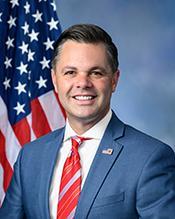
U.S. Representative for Iowa’s 3rd district
Republican
119th Congress, two-year term
Missed 4.6% of roll calls. Chamber median 1.9%.
The full voting recordCounts roll calls where most Democrats and most Republicans voted differently, leaving out procedural votes.
How we countFrom FEC filings, Voteview roll calls and Congress.gov.
Republican. In Congress since 2023, 2 terms in total.
Following saves Nunn to your list, which Chamber & Street keeps on its server, linked to a cookie on this browser and not to your name or email. Email alerts will come with constituent verification.
Bills and resolutions Nunn signed on to as a cosponsor. An original cosponsor signed on the day the bill was introduced. Source: govinfo bill status files, last updated Nov 6, 2026.
REPAIR Act
Sponsor Neal Dunn (R). Original cosponsor. 44 cosponsors. H.R. 1566 on Congress.gov
Introduced
Recognizing January 2025 as "National Mentoring Month".
Sponsor Mary Gay Scanlon (D). Original cosponsor. 32 cosponsors. H.Res. 160 on Congress.gov(opens in a new tab)
Introduced
This resolution recognizes National Mentoring Month.
Expressing condolences to the families, friends, and loved ones of the victims of the crash of American Eagle Flight 5342 and PAT 25, and for other purposes.
Sponsor Ron Estes (R). Original cosponsor. 93 cosponsors. H.Res. 153 on Congress.gov(opens in a new tab)
Passed the House
This resolution expresses condolences to the families, friends, and loved ones of the victims of the crash of American Eagle Flight 5342 and the U.S. Army helicopter flying under the call sign PAT 25 near Ronald Reagan Washington National Airport on January 29, 2025.
The resolution also commends the heroic actions of the first responders, emergency services personnel, and all those who aided in the recovery efforts.
Countering Online Radicalization and Terrorism Act
Sponsor August Pfluger (R). Joined Feb 24, 2025. 6 cosponsors. H.R. 1212 on Congress.gov(opens in a new tab)
Introduced
Providing for congressional disapproval under chapter 8 of title 5, United States Code, of the rule submitted by the Internal Revenue Service relating to "Gross Proceeds Reporting by Brokers That Regularly Provide Services Effectuating Digital Asset Sales".
Sponsor Mike Carey (R). Joined Feb 24, 2025. 9 cosponsors. H.J.Res. 25 on Congress.gov(opens in a new tab)
Became law
This joint resolution nullifies requirements for persons effectuating decentralized financial (DeFi) transactions to report certain information regarding digital asset sales to the Internal Revenue Service (IRS). Specifically, the joint resolution nullifies the requirements included in the rule titled Gross Proceeds Reporting by Brokers That Regularly Provide Services Effectuating Digital Asset Sales and issued by the IRS on December 30, 2024.
Decentralized finance refers to the suite of financial activities and services that are facilitated by cryptocurrency and intended to be conducted without any sort of reliance on traditional financial tools or intermediaries.
OFAC Licensure for Investigators Act
Sponsor Joyce Beatty (D). Original cosponsor. 1 cosponsor. H.R. 1450 on Congress.gov(opens in a new tab)
Passed the House
OFAC Licensure for Investigators Act
This bill requires the Office of Foreign Assets Control (OFAC) to establish a pilot program to license eligible private sector firms to conduct nominal financial transactions as part of the firm's sanctions-related investigations.
A firm that receives a license must submit monthly reports to OFAC on activities conducted under the license.
(OFAC, within the Department of the Treasury, is one of the primary agencies responsible for enforcing economic sanctions. OFAC requires firms to take various actions, such as ensuring that they are not engaging in transactions with entities subject to U.S. sanctions. A firm may also provide voluntary self-disclosures to OFAC with information from a firm's investigation of suspicious activities.)
United States-Israel Defense Partnership Act of 2025
Sponsor Joe Wilson (R). Joined Feb 21, 2025. 178 cosponsors. H.R. 1229 on Congress.gov(opens in a new tab)
Introduced
United States-Israel Defense Partnership Act of 2025
This bill requires or authorizes certain actions to increase defense-related cooperation between the United States and Israel.
Specifically, the bill requires the Department of Defense (DOD) to
• establish a cooperative program, with the concurrence of Israel's Ministry of Defense (MOD), to develop and deploy advanced technologies for countering unmanned systems that threaten the United States and Israel;
• establish in Israel an office of the Defense Innovation Unit (an organization that focuses on rapidly fielding and scaling commercial technology across the U.S. military); and
• seek to engage Israel's MOD on the ascension of Israel into the national technology and industrial base (currently defined in law as the persons and organizations engaged in research, development, production, integration, services, or information technology activities conducted within the United States, the United Kingdom, Australia, New Zealand, and Canada).
The bill authorizes DOD, upon request of Israel's MOD, to jointly conduct research, development, test, and evaluation (RDT&E) of emerging technologies such as artificial intelligence and robotics to meet defense challenges.
Additionally, the bill extends the authority for DOD to (1) carry out RDT&E on a joint basis with Israel to establish anti-tunnel and counter unmanned aerial systems capabilities through 2028, and (2) transfer defense articles intended for use as reserve stocks for Israel through January 1, 2029.
Protecting America’s Agricultural Land from Foreign Harm Act of 2025
Sponsor Dale Strong (R). Original cosponsor. 17 cosponsors. H.R. 1438 on Congress.gov(opens in a new tab)
Introduced
Protecting America's Agricultural Land from Foreign Harm Act of 2025
This bill prohibits persons associated with the governments of Iran, North Korea, China, or Russia from purchasing or leasing agricultural land in the United States.
Specifically, the President must prohibit any person (individual or entity) owned by, controlled by, or subject to the jurisdiction or direction of these foreign governments from purchasing or leasing (1) public agricultural land that is owned by the United States and administered by a federal department or agency, or (2) private agricultural land that is located in the United States.
A person that violates or attempts to violate this prohibition is subject to civil and criminal penalties. This prohibition does not require a person that owns or leases agricultural land as of the date of this bill's enactment to sell that land.
Further, the President must prohibit a person associated with these foreign governments and who leases, or who has full or partial ownership of, agricultural land in the United States from participating in Department of Agriculture (USDA) programs. Exceptions are included to allow for participation in USDA programs related to food safety, the health and labor safety of individuals, or certain reporting and disclosure requirements.
The bill excludes U.S. citizens or lawful permanent residents from these restrictions.
The bill also amends the Agricultural Foreign Investment Disclosure Act of 1978 (AFIDA) to require reporting on security interests and leases.
Finally, the Government Accountability Office must submit a report to Congress on AFIDA.
Expressing support for the designation of February 15 through February 22, 2025, as "National FFA Week", recognizing the important role of the National FFA Organization in developing the next generation of leaders who will change the world, and celebrating the 90th anniversary of New Farmers of America and the 75th anniversary of the Federal charter to Future Farmers of America.
Sponsor Tracey Mann (R). Original cosponsor. 67 cosponsors. H.Res. 133 on Congress.gov(opens in a new tab)
Introduced
This resolution supports the designation of National FFA (Future Farmers of America) Week.
It also celebrates the 90th anniversary of New Farmers of America (NFA), which served Black vocational agriculture students in segregated public schools until NFA and FFA became one organization in 1965.
The resolution also commemorates the 75th anniversary of the federal charter for the Future Farmers of America.
To amend the Clean Air Act with respect to the ethanol waiver for Reid Vapor Pressure under that Act, and for other purposes.
Sponsor Adrian Smith (R). Original cosponsor. 55 cosponsors. H.R. 1346 on Congress.gov(opens in a new tab)
Passed the House
Nationwide Consumer and Fuel Retailer Choice Act of 2025
This bill amends the Clean Air Act to address the limitations on Reid Vapor Pressure (a measure of gasoline's volatility) that are placed on gasoline during the summer ozone season. Specifically, the bill applies the waiver for Reid Vapor Pressure requirements that is applicable to gasoline blended with 10% ethanol (E10) to gasoline blended with up to 15% ethanol (E15). This change allows gasoline that is blended with 10% to 15% ethanol to be sold year-round.
Currently, states may be excluded from the waiver for Reid Vapor Pressure requirements by submitting documentation supporting that the waiver would increase air pollution. The bill nullifies existing state exclusions, but states may submit documentation after enactment of the bill to be excluded going forward.
The bill also modifies the Renewable Fuel Standard Program, which requires transportation fuel sold or introduced into commerce in the United States to contain minimum volumes of renewable fuel. Under the existing program, obligated parties, such as small refineries, must satisfy the volume obligations by either blending renewable fuels into their gasoline or diesel fuel products or by acquiring credits that represent the required renewable fuel volume. The bill directs the Environmental Protection Agency to return compliance credits to small refineries under certain circumstances.
Smithsonian National Museum of the American Latino Act
Sponsor Nicole Malliotakis (R). Original cosponsor. 130 cosponsors. H.R. 1330 on Congress.gov(opens in a new tab)
Introduced
Death Tax Repeal Act
Sponsor Randy Feenstra (R). Original cosponsor. 182 cosponsors. H.R. 1301 on Congress.gov(opens in a new tab)
Introduced
Veterans Jobs Opportunity Act
Sponsor Donald Davis (D). Original cosponsor. 1 cosponsor. H.R. 1298 on Congress.gov(opens in a new tab)
Introduced
Veterans Jobs Opportunity Act
This bill allows veteran-owned small businesses in underserved communities to claim a tax credit for qualified start-up expenses in the amount of 15% (up to $50,000) of such expenses. (Conditions and limitations apply.)
Under the bill, a business qualifies for the veteran small business start-up tax credit if it
• is owned and controlled by one or more veterans (or spouses of veterans);
• is located in a Historically Underutilized Business Zone (HUBZone) program area, empowerment zone or enterprise community, an area of low or moderate income, or county with persistent poverty; and
• has gross receipts for the prior tax year of $5 million or less (or employed 50 or fewer full-time employees in the prior tax year).
The bill generally defines qualified start-up expenses as amounts incurred or paid to
• investigate the creation or acquisition of the business,
• create the business,
• engage in activities for the production of income before the day the business opens, and
• purchase or lease real property (or purchase personal property) for use in the active conduct of a trade or business.
However, under the bill, the veteran small business start-up tax credit is allowed only in the first two tax years for which a business may claim a tax deduction for ordinary and necessary trade or business expenses.
Finally, the bill requires the Treasury Inspector General for Tax Administration to provide an evaluation of the veteran small business start-up tax credit to Congress every four years.
Small LENDER Act
Sponsor J. Hill (R). Joined Feb 12, 2025. 16 cosponsors. H.R. 941 on Congress.gov(opens in a new tab)
Passed committee
Small Lenders Exempt from New Data and Excessive Reporting Act or the Small LENDER Act
This bill modifies the requirements for financial institutions to report certain information about small business credit applications to the Consumer Financial Protection Bureau (CFPB) and extends the timeline for compliance with the CFPB rule with respect to such reporting (i.e., Section 1071 final rule). (For background about the CFPB rule and subsequent litigation see CRS Report R47788.)
Under the bill, the reporting requirements apply only to financial institutions that originate at least 500 credit transactions to small businesses in each of the preceding two years. The bill further defines small businesses as those with gross annual revenue of $1 million or less.
The rule currently establishes a phase-in period that ultimately requires institutions that originate over 100 credit transactions to small businesses to comply with the reporting requirements. The rule also defines small businesses as those with gross annual revenue of $5 million or less.
Further, beginning on the date the final CFPB rule was issued (May 31, 2023), the bill provides three years for applicable financial institutions to comply with the rule followed by a two-year safe harbor period during which such institutions are not subject to any penalties for failure to comply with the rule.
Expanding Access to Capital for Rural Job Creators Act
Sponsor Troy Downing (R). Original cosponsor. 5 cosponsors. H.R. 1190 on Congress.gov(opens in a new tab)
Passed the House
Expanding Access to Capital for Rural Job Creators Act
This bill requires the Office of the Advocate for Small Business Capital Formation within the Securities and Exchange Commission to report on issues encountered by rural-area small businesses.
Credit Union Board Modernization Act
Sponsor Juan Vargas (D). Joined Feb 10, 2025. 22 cosponsors. H.R. 975 on Congress.gov(opens in a new tab)
Passed the House
Credit Union Board Modernization Act
This bill reduces the required frequency of meetings held by the board of directors of certain credit unions. Under the bill, new credit unions and credit unions with a low soundness rating must meet monthly, as required under current law. All other credit unions must hold at least six meetings annually, with at least one meeting held during each fiscal quarter.
Repealing Big Brother Overreach Act
Sponsor Warren Davidson (R). Joined Feb 10, 2025. 193 cosponsors. H.R. 425 on Congress.gov(opens in a new tab)
Passed committee
Repealing Big Brother Overreach Act
This bill repeals the Corporate Transparency Act. The act requires existing companies and newly created companies to report beneficial ownership information to the Department of the Treasury’s Financial Crimes Enforcement Network for purposes of addressing the financing of terrorism and money laundering.
Prove It Act
Sponsor Brad Finstad (R). Original cosponsor. 30 cosponsors. H.R. 1163 on Congress.gov(opens in a new tab)
Introduced
Prove It Act of 2025
This bill expands the requirements for federal agency rulemaking with respect to small businesses, organizations, and governmental jurisdictions.
Specifically, when conducting an initial regulatory flexibility analysis, agencies must include, where feasible, any reasonably foreseeable indirect costs the proposed rule may impose on small entities.
Further, if an agency certifies that an initial regulatory flexibility analysis is not required because the rule will not have a significant economic impact on a substantial number of small entities, the agency must provide such certification within 10 days to the Office of Advocacy of the Small Business Administration. A small entity or group of small entities may petition the Office of Advocacy to review such certification. The petition must include specified information, such as the issues the petitioner believes should be addressed and a proposed solution to the issues raised.
If the Office of Advocacy ultimately determines, upon a full review of the petition, that the proposed rule would have a significant economic impact on a substantial number of small entities, the agency promulgating the rule must perform an initial and final regulatory flexibility analysis for the rule. Additionally, if the agency does not participate or assist in the full review process, the finalized rule shall not apply to small entities.
The bill also requires agencies to publish, and allow for comments on, all guidance documents with respect to any rule an agency determines is likely to have a significant economic impact on a substantial number of small entities.
Family Farm and Small Business Exemption Act
Sponsor Tracey Mann (R). Original cosponsor. 89 cosponsors. H.R. 1131 on Congress.gov(opens in a new tab)
Introduced
Family Farm and Small Business Exemption Act
This bill restores an exemption for certain family farms and small businesses on the Free Application for Federal Student Aid (FAFSA) form. The bill applies to the net worth of (1) a family farm on which the family resides, or (2) a small business with not more than 100 full-time or full-time equivalent employees that is owned and controlled by the family.
Prior to recent changes made to the FAFSA, the net worth of these family farms and small businesses were excluded as assets when calculating a student's financial need to determine federal student aid eligibility. Beginning with the 2024-2025 academic year, the net worth of these farms and businesses are treated as an asset and therefore included in the calculation. This bill restores the exemption to exclude such net worth from the calculation.
Responsible Budgeting Act
Sponsor Scott Peters (D). Original cosponsor. 3 cosponsors. H.R. 1092 on Congress.gov(opens in a new tab)
Introduced
Expressing the sense of Congress that the United States should resume normal diplomatic relations with Taiwan, negotiate a bilateral free trade agreement with Taiwan, and support Taiwans membership in international organizations.
Sponsor Thomas Tiffany (R). Original cosponsor. 38 cosponsors. H.Con.Res. 8 on Congress.gov(opens in a new tab)
Introduced
This concurrent resolution calls on the President to abandon the One China policy in favor of one that recognizes Taiwan as an independent country that is not a part of China. The resolution also urges the President to bolster diplomatic and economic relations between the United States and Taiwan through specified means.
Miracle on Ice Congressional Gold Medal Act
Sponsor Pete Stauber (R). Joined Feb 5, 2025. 299 cosponsors. H.R. 452 on Congress.gov(opens in a new tab)
Became law
Miracle on Ice Congressional Gold Medal Act
This act provides for the award of Congressional Gold Medals to the members of the 1980 U.S. Olympic men's ice hockey team in recognition of the team's achievement at the 1980 Winter Olympic Games.
Disabled Veterans Housing Support Act
Sponsor Monica De La Cruz (R). Joined Feb 5, 2025. 11 cosponsors. H.R. 224 on Congress.gov(opens in a new tab)
Became law
Disabled Veterans Housing Support Act
This act excludes compensation received for a military service-connected disability from a veteran's income when determining eligibility for assistance under the Community Development Block Grant (CDBG) program.
The CDBG program provides grants to urban communities for development activities focused on revitalizing neighborhoods, economic development, and providing improved community facilities and services.
Additionally, the Government Accountability Office must report on how service-connected disability compensation is treated when determining eligibility for all programs administered by the Department of Housing and Urban Development. This includes identifying instances where the treatment of such compensation is inconsistent with the requirement under this act.
1071 Repeal to Protect Small Business Lending Act
Sponsor Roger Williams (R). Original cosponsor. 52 cosponsors. H.R. 976 on Congress.gov(opens in a new tab)
Introduced
1071 Repeal to Protect Small Business Lending Act
This bill repeals the statute that requires financial institutions to collect data regarding applications for women-owned, minority-owned, or small business loans. Currently, financial institutions must collect and report to the Consumer Financial Protection Bureau information on (1) how many applications were received; (2) the disposition of each application; (3) the type of loan; (4) the amount applied for; (5) the amount approved; and (6) each applicant’s census tract, revenue, race, sex, and ethnicity.
Banning SPR Oil Exports to Foreign Adversaries Act
Sponsor Chrissy Houlahan (D). Original cosponsor. 37 cosponsors. H.R. 942 on Congress.gov(opens in a new tab)
Introduced