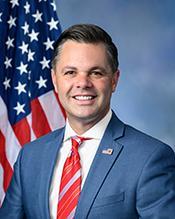
U.S. Representative for Iowa’s 3rd district
Republican
119th Congress, two-year term
Missed 4.6% of roll calls. Chamber median 1.9%.
The full voting recordCounts roll calls where most Democrats and most Republicans voted differently, leaving out procedural votes.
How we countFrom FEC filings, Voteview roll calls and Congress.gov.
Republican. In Congress since 2023, 2 terms in total.
Following saves Nunn to your list, which Chamber & Street keeps on its server, linked to a cookie on this browser and not to your name or email. Email alerts will come with constituent verification.
Bills and resolutions Nunn signed on to as a cosponsor. An original cosponsor signed on the day the bill was introduced. Source: govinfo bill status files, last updated Nov 6, 2026.
COST Act
Sponsor Randy Feenstra (R). Original cosponsor. 3 cosponsors. H.R. 2188 on Congress.gov
Introduced
Accelerating Kids’ Access to Care Act of 2025
Sponsor Lori Trahan (D). Joined Mar 18, 2025. 104 cosponsors. H.R. 1509 on Congress.gov(opens in a new tab)
Introduced
Accelerating Kids’ Access to Care Act of 2025
This bill requires states to establish a process through which qualifying out-of-state providers may temporarily treat children under Medicaid and the Children's Health Insurance Program (CHIP) without undergoing additional screening requirements.
Specifically, states must establish a process through which qualifying out-of-state providers may enroll for five years as participating providers to treat individuals under the age of 21 without undergoing additional screening requirements.
A qualifying out-of-state provider (1) must not have been excluded or terminated from participating in a federal health care program or state Medicaid program; and (2) must have been successfully enrolled in Medicare or a state Medicaid program based on a determination that the provider posed a limited risk of fraud, waste, or abuse.
The bill’s changes take effect three years after enactment.
To provide that members of the Armed Forces performing services in Kenya, Mali, Burkina Faso, and Chad shall be entitled to tax benefits in the same manner as if such services were performed in a combat zone.
Sponsor Jimmy Panetta (D). Original cosponsor. 17 cosponsors. H.R. 2157 on Congress.gov(opens in a new tab)
Introduced
This bill treats Kenya, Mali, Burkina Faso, and Chad as combat zones for purposes of determining eligibility for certain federal tax benefits available to members of the U.S. Armed Forces. (Conditions apply.)
Specifically, under the bill, a qualified hazardous duty area is treated as a combat zone for purposes of
• determining the filing status of an individual whose spouse is missing in action;
• excluding compensation received by a member of the Armed Forces serving in a combat zone from gross income and wages subject to withholding;
• forgiving the income tax liability of a member of the Armed Forces who dies in a combat zone;
• certain estate tax rules applicable to a member of the Armed Forces who dies in a combat zone or as a result of an injury, wound, or disease suffered while in a combat zone;
• the exemption from the federal excise tax imposed on certain telephone services for telephone calls originating from a combat zone by a member of the Armed Forces; and
• postponing certain federal tax deadlines (e.g., filing a tax return, paying taxes, and claiming a tax refund) for a member of the Armed Forces serving in a combat zone.
The bill defines a qualified hazardous duty area as Kenya, Mali, Burkina Faso, and Chad if any member of the U.S. Armed Forces is entitled to special pay (e.g., hostile fire pay and imminent danger pay) for services performed in such locations.
Social Security Overpayment Relief Act
Sponsor Kristen McDonald Rivet (D). Original cosponsor. 4 cosponsors. H.R. 2142 on Congress.gov(opens in a new tab)
Introduced
Social Security Overpayment Relief Act
This bill prohibits the Social Security Administration from collecting overpayments made in error to Social Security or Supplemental Security Income recipients 10 or more years prior to the discovery of the error by the administration. This prohibition extends to the collection of funds directly from overpaid recipients and to the adjustment of future payments to those recipients.
Expel Illegal Chinese Police Act of 2025
Sponsor Ashley Hinson (R). Original cosponsor. 8 cosponsors. H.R. 2127 on Congress.gov(opens in a new tab)
Introduced
Expel Illegal Chinese Police Act of 2025
This bill requires sanctions on certain foreign persons associated with the Chinese Communist Party (CCP) or Chinese law enforcement institutions, including those seeking to establish a Chinese police presence in the United States.
The bill requires the President to impose visa-blocking sanctions on certain non-U.S. nationals (aliens under federal law), including those who are (1) employees of Chinese law enforcement institutions or their immediate family members, or (2) directly associated with a Chinese police or United Front Work Department (UFWD) presence in the United States. (The CCP's UFWD seeks to win support for the CCP from non-CCP groups at home and abroad, with a focus on ethnic-Chinese diaspora communities.)
The President must also impose property-blocking sanctions on foreign individuals or entities that are (1) Chinese law enforcement institutions, their senior leaders, or those acting under the control of such institutions; (2) directly associated with establishing or maintaining a Chinese police presence in the United States; or (3) acting under the control of the UFWD with the intention of covertly monitoring or intimidating those living in the United States.
Additionally, the bill requires the President to prohibit federal agencies from participating in investigations into foreign persons subject to these sanctions unless the investigation is (1) initiated by the U.S. government; or (2) the President determines that such participation is vital to the health, safety, and well-being of U.S. citizens.
Cybersecurity for Rural Water Systems Act
Sponsor Donald Davis (D). Original cosponsor. 5 cosponsors. H.R. 2109 on Congress.gov(opens in a new tab)
Introduced
Cybersecurity for Rural Water Systems Act
This bill amends the Department of Agriculture (USDA) Circuit Rider Program to include cybersecurity technical assistance for rural water systems serving fewer than 10,000 people. Under the program, USDA provides technical assistance to rural water systems that are experiencing day-to-day operational, financial, or managerial issues.
Specifically, the program's cybersecurity technical assistance must (1) assess system efficacy in protecting against cyber threats; and (2) implement cybersecurity plans, procedures, and technologies to protect against cyber threats.
The bill also reauthorizes the Circuit Rider Program through FY2030.
Protect and Serve Act of 2025
Sponsor John Rutherford (R). Joined Mar 14, 2025. 120 cosponsors. H.R. 1551 on Congress.gov(opens in a new tab)
Introduced
Ensuring Continuity in Veterans Health Act
Sponsor Scott Franklin (R). Joined Mar 11, 2025. 12 cosponsors. H.R. 1248 on Congress.gov(opens in a new tab)
Introduced
Ensuring Continuity in Veterans Health Act
This bill requires the consideration of continuity of care when determining whether care through the Veterans Community Care Program is in the best medical interest of a veteran.
TAKE IT DOWN Act
Sponsor Maria Salazar (R). Joined Mar 10, 2025. 41 cosponsors. H.R. 633 on Congress.gov(opens in a new tab)
Introduced
Tools to Address Known Exploitation by Immobilizing Technological Deepfakes On Websites and Networks Act or the TAKE IT DOWN Act
This bill generally prohibits the nonconsensual online publication of intimate visual depictions of individuals, both authentic and computer-generated, and requires certain online platforms to promptly remove such depictions upon receiving notice of their existence.
Specifically, the bill prohibits the online publication of intimate visual depictions of
• an adult subject where publication is intended to cause or does cause harm to the subject, and where the depiction was published without the subject’s consent or, in the case of an authentic depiction, was created or obtained under circumstances where the adult had a reasonable expectation of privacy; or
• a minor subject where publication is intended to abuse or harass the minor or to arouse or gratify the sexual desire of any person.
Violators are subject to mandatory restitution and criminal penalties, including prison, a fine, or both. Threats to publish intimate visual depictions of a subject are similarly prohibited under the bill and subject to criminal penalties.
Separately, covered platforms must establish a process through which subjects of intimate visual depictions may notify the platform of the existence of, and request removal of, an intimate visual depiction including the subject that was published without the subject’s consent. Covered platforms must remove such depictions within 48 hours of notification. Under the bill, covered platforms are defined as public websites, online services, or applications that primarily provide a forum for user-generated content.
Anti-CBDC Surveillance State Act
Sponsor Tom Emmer (R). Original cosponsor. 135 cosponsors. H.R. 1919 on Congress.gov(opens in a new tab)
Passed the House
Anti-CBDC Surveillance State Act
This bill prohibits a Federal Reserve bank from offering products or services directly to an individual, maintaining an account on behalf of an individual, or issuing a central bank digital currency (i.e., a digital dollar). Further, the Board of Governors of the Federal Reserve System is prohibited from using a central bank digital currency to implement monetary policy or from testing, studying, creating, or implementing a central bank digital currency, with exceptions as provided by the bill.
Veteran Fraud Reimbursement Act of 2025
Original cosponsor. 7 cosponsors. H.R. 1912 on Congress.gov(opens in a new tab)
Progress not on file
Veteran Fraud Reimbursement Act of 2025
This act modifies the procedures by which the Department of Veterans Affairs (VA) reissues misused benefits to a beneficiary, including by requiring the VA to establish methods and timing with respect to determining whether an instance of misuse by a fiduciary is the result of negligence by the VA. The act also provides that if a beneficiary predeceases a reissuance, the VA must pay the amount to a surviving beneficiary in the same method as certain other VA benefits are paid upon the death of a beneficiary.
Under the act, the VA may not withhold the reissuing of a benefit payment by reason of a pending determination regarding the VA's negligence in relation to the instance of misuse by a fiduciary. Additionally, the VA is not required to make a determination regarding its negligence for each instance of misuse by a fiduciary of all or part of an individual's benefit paid to such fiduciary.
Honoring Our Fallen Heroes Act of 2025
Sponsor Mary Gay Scanlon (D). Joined Mar 6, 2025. 180 cosponsors. H.R. 1269 on Congress.gov(opens in a new tab)
Introduced
Honoring Our Fallen Heroes Act of 2025
This bill extends death and disability benefits under the Public Safety Officers' Benefits Program (PSOB) to certain public safety officers who suffer from exposure-related cancer while on duty and their survivors. The PSOB program provides death, disability, and education benefits to public safety officers who are killed or injured in the line of duty and their survivors.
The bill specifies that exposure to a carcinogen shall be presumed to constitute a personal injury in the line of duty if
• the exposure occurred while the officer was in the line of duty;
• the officer began serving as an officer not fewer than 5 years before the date of the diagnosis of an exposure-related cancer and the diagnosis occurred not more than 15 years after the last date of active service; and
• the exposure-related cancer directly and proximately resulted in the death or permanent and total disability of the officer.
The Department of Justice's Bureau of Justice Assistance must periodically review the definition of exposure-related cancer and update the definition if appropriate based on medical evidence and in accordance with the requirements of a petition process.
Protecting American Industry and Labor from International Trade Crimes Act of 2026
Sponsor Ashley Hinson (R). Original cosponsor. 44 cosponsors. H.R. 1869 on Congress.gov(opens in a new tab)
Passed the House
Protecting American Industry and Labor from International Trade Crimes Act of 2025
This bill requires the Department of Justice to establish a task force, program, or other similar structure within its Criminal Division to investigate and prosecute trade-related crimes.
Flooding Prevention, Assessment, and Restoration Act
Sponsor Donald Davis (D). Original cosponsor. 8 cosponsors. H.R. 1858 on Congress.gov(opens in a new tab)
Introduced
Flooding Prevention, Assessment, and Restoration Act
This bill expands Department of Agriculture (USDA) watershed programs.
Under the Emergency Watershed Protection (EWP) Program, the bill allows USDA to undertake certain measures that go beyond addressing the immediate impairment of the watershed. Specifically, USDA may undertake measures that increase the level of protection of the watershed if USDA determines that the restoration is (1) in the best interest of the long-term health and the protection of the watershed from repetitive impairments; and (2) cost-effective and appropriate, given risks to the environment.
As background, the EWP Program assists sponsors, landowners, and operators in implementing emergency recovery measures for runoff retardation and erosion prevention to relieve imminent hazards to life and property created by natural disasters.
In addition, for Watershed Rehabilitation Program projects, the bill increases the federal cost-share to 90%, from 65%, of the total rehabilitation costs. The Watershed Rehabilitation Program assists project sponsors in rehabilitating aging watershed dams that are reaching the end of their design life or no longer meet federal or state safety criteria or performance standards.
The bill also exempts rehabilitation projects under the Watershed Rehabilitation Program from a requirement that specifies that each project must contain benefits directly related to agriculture, including rural communities, that account for at least 20% of the total benefits of the project.
USDA must also submit a national agriculture flood vulnerability report to Congress that contains the results of a conservation effects assessment project that studies flood risk on agricultural lands.
Agricultural Risk Review Act of 2025
Sponsor Frank Lucas (R). Joined Mar 4, 2025. 20 cosponsors. H.R. 1713 on Congress.gov(opens in a new tab)
Passed the House
Agricultural Risk Review Act of 2025
This bill makes changes to the Committee on Foreign Investment in the United States (CFIUS), including by requiring CFIUS to determine whether a national security review is necessary for reportable agricultural land transactions that are referred by the Department of Agriculture (USDA). (CFIUS oversees the national security risks of certain foreign investment in the United States. CFIUS has the authority to review covered transactions, which include mergers, acquisitions, and takeovers that could result in foreign control of a U.S. business; certain investments in businesses involved in critical technologies, critical infrastructure, or sensitive personal data; and certain real estate transactions.)
Specifically, the bill directs CFIUS to, after receiving notification from USDA, determine (1) whether a reportable agricultural land transaction is a covered transaction, and (2) whether CFIUS should initiate a national security review or take another action with respect to the transaction.
Reportable agricultural land transaction means a transaction (1) that USDA has reason to believe is a covered transaction, based on information from or in cooperation with the intelligence community; (2) that involves the acquisition of an interest in agricultural land by a foreign person of China, North Korea, Russia, or Iran; and (3) with respect to which a foreign person is required to submit a report to USDA regarding their agricultural land transactions.
The bill also expands CFIUS to include the Secretary of Agriculture for covered transactions that involve agricultural land, agricultural biotechnology, or the agriculture industry (e.g., agricultural transportation, storage, and processing).
Providing for congressional disapproval under chapter 8 of title 5, United States Code, of the rule submitted by the Environmental Protection Agency relating to "National Emission Standards for Hazardous Air Pollutants: Rubber Tire Manufacturing".
Sponsor H. Griffith (R). Joined Mar 4, 2025. 20 cosponsors. H.J.Res. 61 on Congress.gov(opens in a new tab)
Became law
This joint resolution removes emission regulations on hazardous air pollutants under the rubber tire manufacturing source category, specifically from the rubber processing subcategory. The joint resolution nullifies the Environmental Protection Agency (EPA) rule titled National Emission Standards for Hazardous Air Pollutants: Rubber Tire Manufacturing, which addresses the decision in Louisiana Environmental Action Network v. EPA (D.C. Cir. 2020) that requires the EPA to address unregulated emissions from a major source category when it conducts the 8-year technology review. The rule implemented emissions standards for the rubber processing subcategory.
Expressing the sense of Congress that tax-exempt fraternal benefit societies have historically provided and continue to provide critical benefits to the people and communities of the United States.
Sponsor Darin LaHood (R). Joined Mar 4, 2025. 122 cosponsors. H.Con.Res. 4 on Congress.gov(opens in a new tab)
Introduced
This concurrent resolution expresses the sense of Congress that tax-exempt fraternal benefit societies serve as a private economic and social support system, providing benefits to their members is necessary to support the charitable and fraternal activities of the volunteer chapters, and their work should continue to be promoted.
Encouraging the EU to DESIGNATE Resolution
Sponsor Claudia Tenney (R). Joined Mar 3, 2025. 23 cosponsors. H.Res. 176 on Congress.gov(opens in a new tab)
Introduced
Recruiting Families Using Data Act of 2025
Sponsor Randy Feenstra (R). Joined Mar 3, 2025. 2 cosponsors. H.R. 579 on Congress.gov(opens in a new tab)
Passed the House
Recruiting Families Using Data Act of 2025
This bill requires state plans for child welfare services to provide for the development and implementation of a family partnership plan to improve foster care placement stability, increase rates of kinship placements, and align the composition of foster and adoptive families with the needs of children in or entering foster care.
The Children's Bureau of the Administration for Children and Families also must include in its annual report information from states about the number, demographics, and characteristics of foster and adoptive families as well as a summary of the challenges related to recruiting and being foster or adoptive parents.
Protecting Investors’ Personally Identifiable Information Act
Sponsor Barry Loudermilk (R). Joined Mar 3, 2025. 5 cosponsors. H.R. 1483 on Congress.gov(opens in a new tab)
Introduced
Protecting Investors' Personally Identifiable Information Act
This bill limits certain disclosures of personally identifiable information belonging to a participant in the securities market for purposes of tracking market activity.
Specifically, the bill prohibits the Securities and Exchange Commission (SEC) from requiring a national securities exchange, a national securities association, or a member of such an exchange or association to provide such information to satisfy the reporting requirements of the Consolidated Audit Trail (data used by regulators to track market activity).
Retirement Fairness for Charities and Educational Institutions Act of 2025
Sponsor Frank Lucas (R). Joined Mar 3, 2025. 24 cosponsors. H.R. 1013 on Congress.gov(opens in a new tab)
Introduced
Retirement Fairness for Charities and Educational Institutions Act of 2025
This bill allows 403(b) retirement plans (i.e., retirement plans designed for certain employees of public schools, charities, and churches) to invest in collective investment trusts, which are a group of pooled investment assets held by a bank or trust company, and in insurance company separate accounts.
Expressing support for the Iranian people's desires for a democratic, secular, and nonnuclear Republic of Iran, and condemning the Iranian regime's terrorism, regional proxy war, internal suppression, and for other purposes.
Sponsor Tom McClintock (R). Original cosponsor. 230 cosponsors. H.Res. 166 on Congress.gov(opens in a new tab)
Introduced
Stop Fentanyl Money Laundering Act of 2025
Sponsor Andrew Ogles (R). Original cosponsor. 9 cosponsors. H.R. 1577 on Congress.gov(opens in a new tab)
Introduced
Stop Fentanyl Money Laundering Act of 2025
This bill expands efforts to prevent money laundering related to international fentanyl and narcotics distribution.
The bill allows the Department of the Treasury to impose restrictions on an entity or activity determined to be of primary money-laundering concern in connection with illicit fentanyl and narcotics trafficking. Specifically, if Treasury determines that a foreign financial institution, class of transaction, or type of account is of such concern, Treasury may require domestic financial institutions and agencies to take special measures, such as reporting certain financial transactions involving that entity or activity.
The Financial Crimes Enforcement Network (FinCEN) must issue advisories to financial institutions about how to identify Chinese money laundering that facilitates the trafficking of fentanyl and other synthetic opioids. FinCEN must also issue guidance to financial institutions for filing suspicious transaction reports related to suspected narcotics trafficking by transnational criminal organizations.
Protecting American Agriculture from Foreign Adversaries Act of 2025
Sponsor Dan Newhouse (R). Original cosponsor. 60 cosponsors. H.R. 1576 on Congress.gov(opens in a new tab)
Introduced
Protecting American Agriculture from Foreign Adversaries Act of 2025
This bill makes changes to the Committee on Foreign Investment in the United States (CFIUS), including by requiring CFIUS to determine whether a national security review is necessary for reportable agricultural land transactions that are referred by the Department of Agriculture (USDA). (CFIUS oversees the national security risks of certain foreign investment in the United States. CFIUS has the authority to review covered transactions, which include mergers, acquisitions, and takeovers that could result in foreign control of a U.S. business; certain investments in businesses involved in critical technologies, critical infrastructure, or sensitive personal data; and certain real estate transactions.)
Specifically, the bill directs CFIUS to, after receiving notification from USDA, determine (1) whether a reportable agricultural land transaction is a covered transaction, and (2) whether CFIUS should initiate a national security review or take another action with respect to the transaction.
Reportable agricultural land transaction means a transaction (1) that USDA has reason to believe is a covered transaction; (2) that involves the acquisition of an interest in agricultural land by a foreign person of China, North Korea, Russia, or Iran; and (3) with respect to which a foreign person is required to submit a report to USDA regarding their agricultural land transactions.
The bill also expands the membership of CFIUS to include the Secretary of Agriculture for covered transactions that involve agricultural land, agricultural biotechnology, or the agriculture industry (e.g., agricultural transportation, storage, and processing).
No American Land for Communist China Act
Sponsor Dan Newhouse (R). Original cosponsor. 60 cosponsors. H.R. 1575 on Congress.gov(opens in a new tab)
Introduced