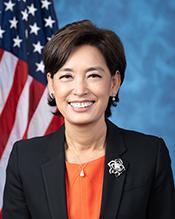
U.S. Representative for California’s 40th district
Republican
119th Congress, two-year term
Missed 0.7% of roll calls. Chamber median 1.9%.
The full voting recordCounts roll calls where most Democrats and most Republicans voted differently, leaving out procedural votes.
How we countFrom FEC filings, Voteview roll calls and Congress.gov.
Republican. In Congress since 2021, 3 terms in total.
Following saves Kim to your list, which Chamber & Street keeps on its server, linked to a cookie on this browser and not to your name or email. Email alerts will come with constituent verification.
Bills and resolutions where Kim is the primary sponsor. Most bills never leave committee; that is normal for every member. Source: Congress.gov, last updated Oct 29, 2026.
43 of 58 have at least one cosponsor from the other party.
Improving VA Training for Military Sexual Trauma Claims Act
Introduced Mar 18, 2025. 5 cosponsors, 3 from the other party. H.R. 2201 on Congress.gov
Passed the House
Improving VA Training for Military Sexual Trauma Claims Act
This bill expands training requirements and assistance provided by the Department of Veterans Affairs (VA) in relation to claims for covered mental health conditions (e.g., post-traumatic stress disorder) based on military sexual trauma.
Specifically, the bill requires VA employees who process claims for covered mental health conditions based on military sexual trauma to receive annual sensitivity training. Such training must be updated by the VA at least once a year.
The VA must annually report on (1) the training it provides, and (2) any plans to expand and update such training.
In providing assistance with such claims related to military sexual trauma, the VA must obtain the service medical record of the claimant and, if there is not credible supporting evidence of a military sexual trauma in the record, obtain the service personnel record of the claimant.
Additionally, the VA must report to Congress regarding (1) sensitivity training required for health care professionals (including schedulers) who are contracted under a VA pilot program to perform examinations of veterans who make claims related to military sexual trauma, and (2) the VA’s plan to improve such training and ensure veterans are not retraumatized during such an examination.
Recognizing Girl Scouts of the United States of America on its 113th birthday and celebrating its founder Juliette Gordon Low and the legacy of providing girls with a secure and inclusive space where they can explore their world, build meaningful relationships, and have access to experiences that prepare them for a life of leadership.
Introduced Mar 11, 2025. 8 cosponsors, 5 from the other party. H.Res. 217 on Congress.gov(opens in a new tab)
Introduced
This resolution recognizes Girl Scouts of the United States of America for 113 years of building girls of courage, confidence, and character who make the world a better place. The resolution also congratulates all Girl Scouts who earned the Gold Award in 2024.
Strengthening Exports Against China Act
Introduced Feb 26, 2025. 2 cosponsors, 1 from the other party. H.R. 1615 on Congress.gov(opens in a new tab)
Introduced
Strengthening Exports Against China Act
This bill allows the Export-Import Bank of the United States (EXIM) to exclude financing provided to certain U.S. exporters from its default rate cap calculations.
EXIM, the official export credit agency of the United States, provides financing for U.S. exports of goods and services. EXIM monitors credit and other transaction risks, reserves against losses, and submits quarterly reports to Congress on its default rate. If its default rate reaches 2%, EXIM faces an immediate lending cap freeze.
This bill exempts certain transactions from EXIM's default rate calculation, thereby allowing EXIM to provide financing to these U.S. exporters without the risk of reaching the default rate cap.
Specifically, the bill allows EXIM to exclude from the default rate cap any financing provided to U.S. exporters under the China and Transformational Exports Program. (This program allows EXIM to extend loans, guarantees, and insurance to advance the comparative leadership of the United States with respect to China in specified export areas, such as artificial intelligence, biotechnology, and wireless communications equipment.)
Additionally, the bill allows EXIM to exclude from the default rate cap any financing provided to U.S. exporters that are competing with products or services provided by (1) a foreign entity included on the Entity List maintained by the Department of Commerce's Bureau of Industry and Security (e.g., entities involved in activities contrary to U.S. national security or foreign policy interests), or (2) a foreign individual or entity sanctioned by the Department of the Treasury's Office of Foreign Assets Control.
Expressing the sense of the House of Representatives regarding United Nations General Assembly Resolution 2758 (XXVI) and the harmful conflation of China's "One China Principle" and the United States "One China Policy".
Introduced Feb 21, 2025. 29 cosponsors, 16 from the other party. H.Res. 148 on Congress.gov(opens in a new tab)
Introduced
Hotel Fees Transparency Act of 2025
Introduced Feb 21, 2025. 6 cosponsors, 4 from the other party. H.R. 1479 on Congress.gov(opens in a new tab)
Passed the House
Hotel Fees Transparency Act of 2025
This bill requires providers of short-term lodging (e.g., hotels, short-term rentals, and third-party online sellers) to include certain price information when displaying, advertising, or marketing reservations for lodging.
Specifically, such providers must (1) display the total services price, including the base price and any service fees, if a price is displayed in an advertisement. marketing material, or a price list; (2) disclose the total services price at the time the services are first displayed to an individual seeking to purchase such services and anytime thereafter during the purchasing process; and (3) disclose, prior to the final purchase, any tax, fee, or assessment imposed by any government entity (or quasi-government entity) on the sale of such services.
The bill provides for enforcement by the Federal Trade Commission and state attorneys general (or other authorized state officials).
Taiwan Non-Discrimination Act of 2025
Introduced Feb 4, 2025. 3 cosponsors, 2 from the other party. H.R. 910 on Congress.gov(opens in a new tab)
Passed the House
Taiwan Non-Discrimination Act of 2025
This bill requires actions to support Taiwan's participation in the International Monetary Fund (IMF).
The U.S. Governor of the IMF must advocate for (1) Taiwan's admission into the IMF as a member, to the extent Taiwan seeks to be a member; (2) Taiwan's participation in the IMF's regular surveillance activities relating to Taiwan's economic and financial policies; (3) employment opportunities at the IMF for Taiwan nationals; and (4) Taiwan's ability to receive IMF technical assistance and training.
To provide for a review of sanctions with respect to Hong Kong.
Introduced Jan 24, 2025. 7 cosponsors, 2 from the other party. H.R. 733 on Congress.gov(opens in a new tab)
Introduced
This bill requires the President to submit to Congress a determination, including a detailed justification, of whether specified Hong Kong officials meet the criteria for the imposition of sanctions under certain U.S. laws or executive orders, including the Global Magnitsky Human Rights Accountability Act.
Combat Veterans Pre-Enrollment Act of 2025
Introduced Jan 23, 2025. 12 cosponsors, 8 from the other party. H.R. 683 on Congress.gov(opens in a new tab)
Introduced
Combat Veterans Pre-Enrollment Act of 2025
This bill requires the Department of Veterans Affairs (VA) to establish a program to carry out all activities necessary to permit certain members of the Armed Forces to elect to enroll in the VA health care system on the date of separation of such members from active service. Specifically, the program is for those who served on active duty in a theater of combat operations during a period of war after the Persian Gulf War or in combat against a hostile force during a period of hostilities after November 11, 1998.
The VA must, in conjunction with the Department of Defense (DOD) and Department of Homeland Security, establish a mechanism to permit a member of the Armed Forces to elect to pre-enroll in the VA health care system during the 180-day period preceding the date of separation of the member from active service.
The VA-DOD Joint Executive Committee must brief Congress on the efforts to implement such a mechanism under the program.
The Government Accountability Office must report on the program and include recommendations with respect to methods to improve the program.