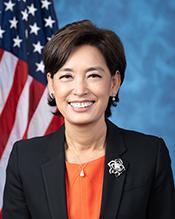
U.S. Representative for California’s 40th district
Republican
119th Congress, two-year term
Missed 0.7% of roll calls. Chamber median 1.9%.
The full voting recordCounts roll calls where most Democrats and most Republicans voted differently, leaving out procedural votes.
How we countFrom FEC filings, Voteview roll calls and Congress.gov.
Republican. In Congress since 2021, 3 terms in total.
Following saves Kim to your list, which Chamber & Street keeps on its server, linked to a cookie on this browser and not to your name or email. Email alerts will come with constituent verification.
Bills and resolutions Kim signed on to as a cosponsor. An original cosponsor signed on the day the bill was introduced. Source: govinfo bill status files, last updated Nov 6, 2026.
Fix Our Forests Act
Sponsor Bruce Westerman (R). Original cosponsor. 56 cosponsors. H.R. 471 on Congress.gov
Passed the House
Fix Our Forests Act
This bill establishes requirements for managing forests on federal land, including requirements concerning reducing wildfire threats, expediting the review of certain forest management projects, and implementing forest management projects and other activities.
Specifically, the bill (1) designates certain firesheds at high risk for wildfires as fireshed management areas; (2) directs the U.S. Forest Service and U.S. Geological Survey to jointly establish an interagency Fireshed Center that is responsible for duties related to assessing and predicting fire, including maintaining a fireshed registry on a publicly accessible website that provides interactive geospatial data on individual firesheds; and (3) makes other requirements related to reducing wildfire.
Next, the bill expedites the review of certain forest management projects under the National Environmental Policy Act (NEPA) of 1969 and exempts certain activities from NEPA review. It also establishes intra-agency strike teams to accelerate the review and any interagency consultation processes under NEPA, the Endangered Species Act of 1973, and the National Historic Preservation Act. It also limits consultation requirements concerning threatened and endangered species under the Forest and Rangeland Renewable Resources Planning Act of 1974 and the Federal Land Management and Policy Act of 1976. Finally, it limits litigation involving fireshed management projects and limits remedies that courts may provide.
Additionally, the bill supports reducing community wildfire risks, carrying out forest restoration and stewardship activities (including watershed protection and restoration), conducting biochar demonstration projects, advancing technologies to address forest wildfires, and assisting wildland firefighters and their families.
SALT Deductibility Act
Sponsor Andrew Garbarino (R). Original cosponsor. 25 cosponsors. H.R. 430 on Congress.gov(opens in a new tab)
Introduced
Securing Access to Lower Taxes by ensuring Deductibility Act or the SALT Deductibility Act
This bill repeals the limitation on the federal tax deduction for state and local taxes (commonly known as the SALT deduction cap).
Under current law, a SALT deduction cap of $10,000 ($5,000 for married individuals filing separate federal income tax returns) applies for tax years 2018 through 2025 and expires beginning in 2026.
Housing Survivors of Major Disasters Act
Sponsor Adriano Espaillat (D). Original cosponsor. 3 cosponsors. H.R. 426 on Congress.gov(opens in a new tab)
Introduced
Housing Survivors of Major Disasters Act
This bill expands eligibility for disaster housing assistance under the Federal Emergency Management Agency (FEMA) Individuals and Households Program (IHP) with respect to property damage, availability of housing resources, and constructive (i.e., implied) ownership.
Specifically, the bill lowers the level of damage required to be eligible for IHP housing assistance, so the residence must be damaged by a major disaster instead of rendered uninhabitable.
Also, under current law, FEMA is authorized to provide IHP assistance for permanent housing construction where (1) no alternative housing resources are available; and (2) other types of temporary housing assistance are unavailable, infeasible, or not cost-effective. The bill authorizes IHP permanent housing construction where FEMA determines such assistance is a cost-effective alternative to other housing solutions, such as providing for temporary housing costs.
Additionally, the bill requires FEMA to consider an individual's or household’s claim of constructive ownership, where evidence supports such ownership is more likely than not, when determining eligibility for IHP financial assistance for home repair or replacement for a residence without documented ownership rights. FEMA must consider all evidence provided (e.g., deeds, tax receipts, insurance documents) when determining whether constructive ownership more likely than not exists. If FEMA determines the evidence is insufficient, FEMA may require a signed declarative statement describing the constructive ownership.
TRUST in Congress Act
Sponsor Seth Magaziner (D). Original cosponsor. 103 cosponsors. H.R. 396 on Congress.gov(opens in a new tab)
Introduced
Transparent Representation Upholding Service and Trust in Congress Act or the TRUST in Congress Act
This bill requires a Member of Congress, as well as any spouse or dependent child of a Member, to place specified investments into a qualified blind trust (i.e., an arrangement in which certain financial holdings are placed in someone else's control to avoid a possible conflict of interest) until 180 days after the end of their tenure as a Member of Congress.
Supporting the goals and ideals of Korean American Day.
Sponsor Jimmy Gomez (D). Original cosponsor. 72 cosponsors. H.Res. 33 on Congress.gov(opens in a new tab)
Introduced
This resolution expresses support for the goals and ideals of Korean American Day and honors the 122nd anniversary of the arrival of the first Korean immigrants to the United States.
Proxy Voting for New Parents Resolution
Sponsor Brittany Pettersen (D). Original cosponsor. 175 cosponsors. H.Res. 23 on Congress.gov(opens in a new tab)
Introduced
Proxy Voting for New Parents Resolution
This resolution authorizes proxy voting in the House of Representatives for a Member who has given birth or whose spouse has given birth and pregnant Members who are unable to travel safely or have a serious medical condition.
Under the resolution, a qualifying Member may designate a proxy to cast a vote in a committee, the Committee of the Whole, or on the House floor; however, proxies will not be counted for purposes of establishing a quorum. The proxy designation is valid for up to 12 weeks.
To designate a proxy for House and Committee of the Whole votes, the Member must submit a signed and dated letter to the Clerk stating the Member’s qualifying circumstances and the name and state of the Member who has agreed to be designated as proxy. A Member who has designated a proxy according to these requirements may also designate a proxy for committee votes. To designate a proxy for committee votes, the Member must provide the committee chair and ranking minority member with a signed and dated letter specifying another member of the committee to cast a proxy vote.
The resolution further provides that a Member may revoke the proxy authorization by (1) casting the Member’s own vote; (2) recording the Member’s own presence in the House or in the Committee of the Whole; or (3) in a committee, by submitting a signed letter to the chair and ranking minority member.
ESCRA Act
Sponsor Sarah McBride (D). Original cosponsor. 7 cosponsors. H.R. 306 on Congress.gov(opens in a new tab)
Introduced
Ending Scam Credit Repair Act or the ESCRA Act
This bill revises the Credit Repair Organizations Act and creates additional requirements for credit repair organizations (CROs).
Under current law, it is illegal for a person (including a CRO) to make false or misleading statements regarding a consumer’s creditworthiness or standing to a consumer reporting agency or to a consumer credit provider. The bill additionally prohibits making such statements to the Consumer Financial Protection Bureau, the Federal Trade Commission, or law enforcement. To be subject to this prohibition, the bill also requires such statements to be made knowingly.
The bill also revises CRO obligations to consumers. A CRO is prohibited from charging a consumer for a service (e.g., getting inaccurate information removed from a credit report) until the CRO provides proof of success not less than six months after providing the service. The bill also requires additional disclosures to consumers, requires the retention of any recorded telephone calls, and increases the time records must be retained from two to five years. In addition, consumers must be given copies of all communications sent on their behalf.
Under the bill, all persons must be licensed by a state to act as a CRO. The bill also restricts a CRO’s ability to submit multiple credit disputes regarding the same information.
The bill also sets a minimum liability amount for damages of $500 for each violation of the Credit Repair Organizations Act.
Prevent Family Fire Act of 2025
Sponsor Mike Levin (D). Original cosponsor. 10 cosponsors. H.R. 169 on Congress.gov(opens in a new tab)
Introduced
Prevent Family Fire Act of 2025
This bill establishes a new business tax credit on the sale of a safe firearm storage device on or before December 31, 2032.
The amount of the tax credit is 10% of the retail sales price (up to a maximum price of $400 and excluding separately stated sales tax) of a safe firearm storage device. The tax credit is allowed only on the first retail sale of a safe firearm storage device for a use other than resale or long-term lease.
The bill defines safe firearm storage device as a device that is (1) designed and marketed to deny unauthorized access to a firearm or ammunition or render such items inoperable; and (2) is secured by a combination lock, key lock, or lock based on biometric information.