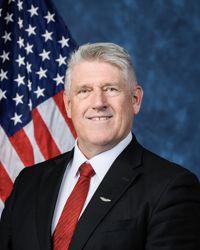
U.S. Representative for Montana’s 2nd district
Republican
119th Congress, two-year term
Missed 0.6% of roll calls. Chamber median 1.9%.
The full voting recordCounts roll calls where most Democrats and most Republicans voted differently, leaving out procedural votes.
How we countFrom FEC filings, Voteview roll calls and Congress.gov.
Republican. In Congress since 2025, 1 term in total.
Following saves Downing to your list, which Chamber & Street keeps on its server, linked to a cookie on this browser and not to your name or email. Email alerts will come with constituent verification.
Bills and resolutions Downing signed on to as a cosponsor. An original cosponsor signed on the day the bill was introduced. Source: govinfo bill status files, last updated Nov 6, 2026.
Protection of Women and Girls in Sports Act of 2025
Sponsor W. Steube (R). Joined Jan 13, 2025. 83 cosponsors. H.R. 28 on Congress.gov
Passed the House
Protection of Women and Girls in Sports Act of 2025
This bill generally prohibits school athletic programs from allowing individuals whose biological sex at birth was male to participate in programs that are for women or girls.
Specifically, the bill provides that it is a violation of Title IX of the Education Amendments of 1972 for federally funded education programs or activities to operate, sponsor, or facilitate athletic programs or activities that allow individuals of the male sex to participate in programs or activities that are designated for women or girls. (Title IX prohibits discrimination on the basis of sex in federally funded education programs or activities, including in public elementary and secondary schools and in colleges and universities.) Under the bill, sex is based on an individual's reproductive biology and genetics at birth.
The bill does not prohibit male individuals from training or practicing with programs or activities for women or girls as long as such training or practice does not deprive any female of corresponding opportunities or benefits.
The Government Accountability Office must report on the benefits for women or girls in single-sex sports that would be lost as a result of male participation. In particular, the report must document the negative psychological, developmental, participatory, and sociological effects of male participation on girls.
Constitutional Concealed Carry Reciprocity Act of 2025
Sponsor Richard Hudson (R). Joined Jan 9, 2025. 189 cosponsors. H.R. 38 on Congress.gov(opens in a new tab)
Introduced
Constitutional Concealed Carry Reciprocity Act
This bill establishes a federal statutory framework to regulate the carry or possession of concealed firearms across state lines.
Specifically, an individual who is eligible to carry a concealed firearm in one state may carry or possess a concealed handgun (other than a machine gun or destructive device) in another state that allows its residents to carry concealed firearms.
It sets forth requirements for lawful concealed carry across state lines. The bill preempts most state and local laws related to concealed carry and establishes a private right of action for a person adversely affected by interference with a concealed-carry right established by this bill.
Grizzly Bear State Management Act
Sponsor Harriet Hageman (R). Original cosponsor. 4 cosponsors. H.R. 281 on Congress.gov(opens in a new tab)
Introduced
Grizzly Bear State Management Act of 2025
This bill requires the U.S. Fish and Wildlife Service to reissue the final rule titled Endangered and Threatened Wildlife and Plants; Removing the Greater Yellowstone Ecosystem Population of Grizzly Bears From the Federal List of Endangered and Threatened Wildlife and published on June 30, 2017.
In addition, the bill exempts the rule from judicial review.
REMAIN in Mexico Act of 2025
Sponsor Brandon Gill (R). Original cosponsor. 110 cosponsors. H.R. 273 on Congress.gov(opens in a new tab)
Introduced
Return Excessive Migrants and Asylees to International Neighbors in Mexico Act of 2025 or the REMAIN in Mexico Act of 2025
This bill requires the Department of Homeland Security (DHS) to implement the Migrant Protection Protocols as outlined in the January 25, 2019, memo titled Policy Guidance for Implementation of the Migrant Protection Protocols.
(The protocols generally required aliens who are not clearly admissible, including those seeking asylum, arriving by land along the U.S.-Mexico border to be returned to Mexico while their immigration proceedings are pending, rather than remain in the United States. On January 21, 2021, DHS stopped applying the protocols to newly-arrived individuals.)
Born-Alive Abortion Survivors Protection Act
Sponsor Ann Wagner (R). Joined Jan 9, 2025. 163 cosponsors. H.R. 21 on Congress.gov(opens in a new tab)
Passed the House
Born-Alive Abortion Survivors Protection Act
This bill establishes requirements for the degree of care a health care practitioner must provide in the case of a child born alive following an abortion or attempted abortion.
Specifically, a health care practitioner who is present must (1) exercise the same degree of care as would reasonably be provided to any other child born alive at the same gestational age, and (2) ensure the child is immediately admitted to a hospital. Additionally, a health care practitioner or other employee who has knowledge of a failure to comply with the degree-of-care requirements must immediately report such failure to law enforcement.
A health care practitioner who fails to provide the required degree of care, or a health care practitioner or other employee who fails to report such failure, is subject to criminal penalties—a fine, up to five years in prison, or both.
An individual who intentionally kills or attempts to kill a child born alive is subject to prosecution for murder.
The bill bars the criminal prosecution of a mother of a child born alive under this bill and allows her to bring a civil action against a health care practitioner or other employee for violations.
Laken Riley Act
Sponsor Mike Collins (R). Joined Jan 7, 2025. 54 cosponsors. H.R. 29 on Congress.gov(opens in a new tab)
Passed the House
Laken Riley Act
This bill requires the Department of Homeland Security (DHS) to detain certain non-U.S. nationals (aliens under federal law) who have been arrested for burglary, theft, larceny, or shoplifting. The bill also authorizes states to sue the federal government for decisions or alleged failures related to immigration enforcement.
Under this bill, DHS must detain an individual who (1) is unlawfully present in the United States or did not possess the necessary documents when applying for admission; and (2) has been charged with, arrested for, convicted of, or admits to having committed acts that constitute the essential elements of burglary, theft, larceny, or shoplifting.
The bill also authorizes state governments to sue for injunctive relief over certain immigration-related decisions or alleged failures by the federal government if the decision or failure caused the state or its residents harm, including financial harm of more than $100. Specifically, the state government may sue the federal government over a
• decision to release a non-U.S. national from custody;
• failure to fulfill requirements relating to inspecting individuals seeking admission into the United States, including requirements related to asylum interviews;
• failure to fulfill a requirement to stop issuing visas to nationals of a country that unreasonably denies or delays acceptance of nationals of that country;
• violation of limitations on immigration parole, such as the requirement that parole be granted only on a case-by-case basis; or
• failure to detain an individual who has been ordered removed from the United States.