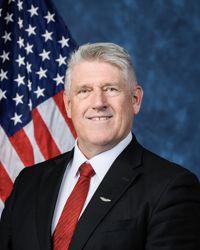
U.S. Representative for Montana’s 2nd district
Republican
119th Congress, two-year term
Missed 0.6% of roll calls. Chamber median 1.9%.
The full voting recordCounts roll calls where most Democrats and most Republicans voted differently, leaving out procedural votes.
How we countFrom FEC filings, Voteview roll calls and Congress.gov.
Republican. In Congress since 2025, 1 term in total.
Following saves Downing to your list, which Chamber & Street keeps on its server, linked to a cookie on this browser and not to your name or email. Email alerts will come with constituent verification.
Bills and resolutions Downing signed on to as a cosponsor. An original cosponsor signed on the day the bill was introduced. Source: govinfo bill status files, last updated Nov 6, 2026.
PATROL Act
Sponsor Michael Cloud (R). Original cosponsor. 19 cosponsors. H.R. 992 on Congress.gov
Introduced
Preventing Aliens Through Rivers or Land Act or the PATROL Act
This bill prohibits the Department of Justice (DOJ) from bringing certain civil actions against a state for building a physical structure impacting navigable waters along the U.S. border for security purposes. Specifically, the DOJ is prohibited from bringing an action for (1) the construction of a bridge, causeway, dam, dike, or other structure over or in a port, harbor, or other navigable water of the United States without federal approval; or (2) the creation of any obstruction to the navigable capacity of waters of the United States without federal approval.
Old Glory Only Act
Sponsor William Timmons (R). Joined Feb 5, 2025. 34 cosponsors. H.R. 465 on Congress.gov(opens in a new tab)
Introduced
Old Glory Only Act
This bill prohibits the flying of any flag other than the U.S. flag over U.S. diplomatic and consular posts.
Protection of Women in Olympic and Amateur Sports Act of 2026
Sponsor W. Steube (R). Original cosponsor. 73 cosponsors. H.R. 1028 on Congress.gov(opens in a new tab)
Introduced
Protection of Women in Olympic and Amateur Sports Act
This bill requires certified national governing bodies (NGBs) of amateur sports (e.g., USA Gymnastics) to prohibit a person whose sex is male from participating in an amateur athletic competition that is designated for females, women, or girls.
Under the bill, male means an individual who has, had, will have—or would have, but for a developmental or genetic anomaly or historical accident—the reproductive system that at some point produces, transports, and utilizes sperm for fertilization.
1071 Repeal to Protect Small Business Lending Act
Sponsor Roger Williams (R). Original cosponsor. 52 cosponsors. H.R. 976 on Congress.gov(opens in a new tab)
Introduced
1071 Repeal to Protect Small Business Lending Act
This bill repeals the statute that requires financial institutions to collect data regarding applications for women-owned, minority-owned, or small business loans. Currently, financial institutions must collect and report to the Consumer Financial Protection Bureau information on (1) how many applications were received; (2) the disposition of each application; (3) the type of loan; (4) the amount applied for; (5) the amount approved; and (6) each applicant’s census tract, revenue, race, sex, and ethnicity.
No User Fees for Gun Owners Act
Sponsor Ronny Jackson (R). Original cosponsor. 51 cosponsors. H.R. 943 on Congress.gov(opens in a new tab)
Introduced
No User Fees for Gun Owners Act
This bill prohibits a state or local government from imposing any insurance requirement, tax, user fee, or similar charge on the manufacture, import, acquisition, transfer, or continued ownership of a firearm or ammunition. The bill includes an exception for a generally applicable sales tax that is assessed against firearms or ammunition in the same proportion to which the tax applies to other goods or services.
Birthright Citizenship Act of 2025
Sponsor Brian Babin (R). Joined Feb 4, 2025. 95 cosponsors. H.R. 569 on Congress.gov(opens in a new tab)
Introduced
Birthright Citizenship Act of 2025
This bill limits birthright citizenship by redefining what it means to be subject to the jurisdiction of the United States.
Currently, a person born in the United States and subject to U.S. jurisdiction is entitled to citizenship. Under the bill, a person is subject to U.S. jurisdiction if he or she is born to a parent who is (1) a U.S. citizen or national, (2) a lawful permanent resident residing in the United States, or (3) a non-U.S. national (alien under federal law) with a lawful immigration status who is performing active service in the Armed Forces.
The bill does not affect the citizenship or nationality status of any person born before the bill's enactment date.
Northern Montana Water Security Act of 2025
Sponsor Ryan Zinke (R). Original cosponsor. 2 cosponsors. H.R. 907 on Congress.gov(opens in a new tab)
Introduced
Northern Montana Water Security Act of 2025
This bill modifies and ratifies a specified water rights settlement agreement entered into by the United States, Montana, and the Fort Belknap Indian Community of the Fort Belknap Reservation of Montana (i.e., the Gros Ventre and Assiniboine Tribes). The bill also authorizes wastewater infrastructure on the Blackfeet Indian Reservation in Montana.
The bill requires the community's water rights to be held in trust for the benefit of the community and its allottees. The community must enact a tribal water code to regulate its water rights.
Additionally, the bill authorizes the Department of the Interior and the Department of Agriculture (as applicable) to enter negotiations with Montana to exchange certain state lands for federal lands to be held in trust for the benefit of the community. The bill prohibits gaming on the land taken into trust.
The bill also
• establishes the Aaniiih Nakoda Settlement Trust Fund (and specified accounts) for purposes of carrying out this bill,
• establishes the Fort Belknap Indian Community Water Settlement Implementation Fund (and specified accounts) for purposes of carrying out this bill, and
• provides funding for specified accounts established by the bill.
The bill also authorizes Interior to plan, design, construct, operate, maintain, and replace community water distribution and wastewater treatment facilities for the Blackfeet Tribe of the Blackfeet Indian Reservation of Montana.
Jeremy and Angel Seay and Sergeant Brandon Mendoza Protect Our Communities from DUIs Act of 2025
Sponsor Barry Moore (R). Original cosponsor. 23 cosponsors. H.R. 875 on Congress.gov(opens in a new tab)
Passed the House
Jeremy and Angel Seay and Sergeant Brandon Mendoza Protect Our Communities from DUIs Act of 2025
This bill makes driving while intoxicated or impaired a ground for (1) barring a non-U.S. national (alien under federal law) from admission into the United States, or (2) deporting the individual.
The bar to admission shall apply to an individual who has been convicted of the offense or has admitted to having committed the acts which constitute the elements of the offense. As a ground for deportability, the individual must have been convicted of the offense.
Pet and Livestock Protection Act
Sponsor Lauren Boebert (R). Original cosponsor. 37 cosponsors. H.R. 845 on Congress.gov(opens in a new tab)
Passed the House
Pet and Livestock Protection Act of 2025
This bill directs the Department of the Interior to remove protections for the gray wolf under the Endangered Species Act of 1973 (ESA). Specifically, the bill requires Interior to reissue the final rule titled Endangered and Threatened Wildlife and Plants; Removing the Gray Wolf (Canis lupus) From the List of Endangered and Threatened Wildlife and published on November 3, 2020.
The rule removed the gray wolf in the lower 48 United States, except for the Mexican wolf (C. l. baileyi) subspecies, from the endangered and threatened species list. However, the U.S. District Court for the Northern District of California vacated the rule on February 10, 2022. As a result, the gray wolf reattained the protection status it had prior to the rule's promulgation.
The bill also prohibits the reissuance of the rule from being subject to judicial review.
Rural Small Business Resilience Act
Sponsor Kelly Morrison (D). Original cosponsor. 4 cosponsors. H.R. 804 on Congress.gov(opens in a new tab)
Passed the House
Rural Small Business Resilience Act
This bill requires the Small Business Administration's Office of Disaster Recovery and Resilience to take necessary actions to ensure that individuals located in rural areas where a disaster has been declared have full access to disaster assistance. Such actions include providing targeted outreach and marketing materials to such individuals.
Main Street Tax Certainty Act
Sponsor Lloyd Smucker (R). Original cosponsor. 192 cosponsors. H.R. 703 on Congress.gov(opens in a new tab)
Introduced
Main Street Tax Certainty Act
This bill makes permanent the qualified business income (QBI) tax deduction.
Under current law, individuals, estates, and trusts may deduct the lower of (1) 20% of QBI from a qualified business, qualified real estate investment trust dividends, and qualified publicly traded partnership income; or (2) 20% of taxable income less net capital gain. (Some limitations apply.)
However, under current law, the QBI tax deduction expires after December 31, 2025.
Strengthening our Servicemembers with Milk Act
Sponsor Derrick Van Orden (R). Original cosponsor. 31 cosponsors. H.R. 648 on Congress.gov(opens in a new tab)
Introduced
Strengthening our Servicemembers with Milk Act
This bill requires the Department of Defense (DOD) to provide varieties of fluid or powdered milk (e.g., unflavored or organic) to members of the Armed Forces at dining facilities on military installations. Under the bill, DOD is prohibited from purchasing such milk from an entity owned or controlled by a foreign adversary.
Protecting Life on College Campus Act of 2025
Sponsor Chip Roy (R). Original cosponsor. 31 cosponsors. H.R. 632 on Congress.gov(opens in a new tab)
Introduced
Protecting Life on College Campus Act of 2025
This bill prohibits the award of federal funds to an institution of higher education (IHE) that hosts or is affiliated with a school-based service site that provides abortion drugs or abortions to its students or to employees of the IHE or the site. An IHE that hosts or is affiliated with a site must, in order to remain eligible for federal funds, annually certify that the site does not provide abortion drugs or abortions to students or employees.
RIFLE Act of 2025
Sponsor Tracey Mann (R). Original cosponsor. 34 cosponsors. H.R. 624 on Congress.gov(opens in a new tab)
Introduced
Reining In Federal Licensing Enforcement Act of 2025 or the RIFLE Act of 2025
This bill revises the federal statutory framework governing the licensing, inspection, and enforcement of federally licensed dealers, importers, and manufacturers of firearms (i.e., federal firearms licensees, or FFLs) by the Bureau of Alcohol, Tobacco, Firearms and Explosives (ATF).
With respect to an application for a license, this bill requires the ATF to make a preliminary determination, provide notice of a proposed denial, and allow the applicant to request a hearing.
With respect to inspections, this bill requires the ATF to establish standards for how it inspects, examines, or investigates FFLs for possible violations.
With respect to the enforcement of violations, this bill establishes a new framework. The new framework establishes a presumption that a violation by an FFL is not willful and requires the ATF to provide notice of and work with an FFL to rectify a violation.
In the case of a violation that is willful, the ATF has the burden of proving by clear and convincing evidence that the violation was committed willfully. The term willfully means that the person had actual knowledge of a legal duty, understood the obligation imposed by the legal duty, and deliberately disregarded the legal duty. The ATF may pursue revocation of an FFL’s license, but only after (1) providing notice and an opportunity to comply; and (2) finding that a lesser administrative action (e.g., warning, warning letter, or warning conference) is not likely to lead to future compliance.
Promoting New Bank Formation Act
Sponsor Andy Barr (R). Joined Jan 22, 2025. 24 cosponsors. H.R. 478 on Congress.gov(opens in a new tab)
Introduced
Promoting New Bank Formation Act
This bill eliminates and reduces certain requirements applicable to new depository institutions, certain rural community depository institutions, and federal savings associations.
Federal banking agencies must issue rules allowing a new depository institution or depository institution holding company three years to meet capital requirements. During this period, a depository institution or its depository institution holding company may request to deviate from an approved business plan, and the appropriate agency has 30 days to approve or deny the request.
In addition, the community bank leverage ratio—a way of evaluating debt levels—is reduced for new rural community depository institutions. Specifically, new rural community depository institutions must have a ratio of 8%, with a three-year phase-in of the rate. After this period, the ratio rises to its current level of 9%.
Finally, the bill removes certain restrictions to allow federal savings associations to invest in, sell, or otherwise deal in agricultural loans.
SAVE Act
Sponsor Chip Roy (R). Joined Jan 22, 2025. 110 cosponsors. H.R. 22 on Congress.gov(opens in a new tab)
Passed the House
Safeguard American Voter Eligibility Act or the SAVE Act
This bill requires individuals to provide documentary proof of U.S. citizenship when registering to vote in federal elections.
Specifically, the bill prohibits states from accepting and processing an application to register to vote in a federal election unless the applicant presents documentary proof of U.S. citizenship. The bill specifies what documents are considered acceptable proof of U.S. citizenship, such as identification that complies with the REAL ID Act of 2005 that indicates U.S. citizenship.
Further, the bill (1) prohibits states from registering an individual to vote in a federal election unless, at the time the individual applies to register to vote, the individual provides documentary proof of U.S. citizenship; and (2) requires states to establish an alternative process under which an applicant may submit other evidence to demonstrate U.S. citizenship.
Each state must take affirmative steps on an ongoing basis to ensure that only U.S. citizens are registered to vote, which shall include establishing a program to identify individuals who are not U.S. citizens using information supplied by certain sources.
Additionally, states must remove noncitizens from their official lists of eligible voters.
The bill allows for a private right of action against an election official who registers an applicant to vote in a federal election who fails to present documentary proof of U.S. citizenship.
The bill establishes criminal penalties for certain offenses, including registering an applicant to vote in a federal election who fails to present documentary proof of U.S. citizenship.
TCJA Permanency Act
Sponsor Vern Buchanan (R). Joined Jan 22, 2025. 53 cosponsors. H.R. 137 on Congress.gov(opens in a new tab)
Introduced
TCJA Permanency Act
This bill makes permanent multiple federal tax provisions enacted in 2017 by the Tax Cuts and Jobs Act.
The bill makes permanent the
• individual tax rates of 10%, 12%, 22%, 24%, 32%, 35%, and 37%;
• increased standard deduction;
• personal exemption allowance repeal;
• exclusion from income of student loans discharged due to death or disability;
• qualified business income tax deduction (199A tax deduction);
• allowance of ABLE account contributions in excess of the annual gift tax exclusion amount;
• base estate and gift tax exclusion amount of $10 million (adjusted annually); and
• alternative minimum tax exemption and phaseout amounts for noncorporate taxpayers.
The bill makes permanent the child tax credit amounts of $2,000 per child and $500 for dependents, the $200,000 phaseout threshold ($400,000 for joint filers), and the refundable portion of the tax credit.
The bill expands the expenses eligible for tax-free withdrawals from qualified tuition plans (529 plans) to include additional expenses associated with homeschool and elementary and secondary schools (e.g., instructional materials, tutoring, test and enrollment fees, and educational therapies).
The bill permanently eliminates certain miscellaneous itemized deductions and makes permanent the
• state and local tax deduction limit of $10,000 ($5,000 for married individuals filing separately),
• mortgage interest tax deduction limit of $750,000 ($375,000 for married individuals filing separately),
• limit on the deduction of cash charitable contributions to 60% of a taxpayer’s adjusted gross income, and
• certain limits on casualty loss tax deductions.
The bill also permanently eliminates the exclusion from income for employer-reimbursed bicycle commuting expenses.
FACE Act Repeal Act of 2025
Sponsor Chip Roy (R). Original cosponsor. 44 cosponsors. H.R. 589 on Congress.gov(opens in a new tab)
Passed committee
FACE Act Repeal Act of 2025
This bill repeals provisions of federal criminal law that prohibit conduct intended to injure, intimidate, or interfere with persons who are seeking to (1) obtain or provide reproductive health services, or (2) exercise their right of religious freedom at a place of religious worship.
Sarah’s Law
Sponsor Randy Feenstra (R). Original cosponsor. 53 cosponsors. H.R. 578 on Congress.gov(opens in a new tab)
Introduced
Sarah's Law
This bill requires the Department of Justice or the Department of Homeland Security (DHS) to detain a non-U.S. national (alien under federal law) who is unlawfully present in the United States and has been charged with, arrested for, convicted of, or admits to having committed acts that constitute the essential elements of a crime that resulted in the death or serious bodily injury of another person.
DHS must obtain information about the identity of any victims of the crimes for which the detained individual was charged or convicted. DHS shall provide the victim, or a relative or guardian of a deceased victim, with information about the detained individual, including name, date of birth, nationality, immigration status, criminal history, and a description of any related removal efforts.
AMERICANS Act
Sponsor Pat Harrigan (R). Original cosponsor. 29 cosponsors. H.R. 511 on Congress.gov(opens in a new tab)
Introduced
Allowing Military Exemptions, Recognizing Individual Concerns About New Shots Act of 2025 or the AMERICANS Act
This bill prohibits the Department of Defense (DOD) from issuing any COVID-19 vaccine mandate as a replacement for the rescinded vaccine mandate of August 24, 2021, unless the mandate is expressly authorized by Congress. The bill also provides that DOD must establish an application process for remedies for members of the Armed Forces who were discharged or subject to adverse action under the rescinded mandate.
Any administrative discharge of a member on the sole basis of a failure to receive a COVID-19 vaccine must be categorized as an honorable discharge, and DOD is prohibited from taking any adverse action against such a member for that reason.
DOD must try to retain unvaccinated members and provide such members with professional development, promotion and leadership opportunities, and consideration equal to that of their peers.
Additionally, DOD may only consider the COVID-19 vaccination status of members in making certain decisions (e.g., deployments in countries where it is the law) and must establish a process to provide exemptions to certain members for such decisions.
Members who were separated from the Armed Forces for refusing to receive a COVID-19 vaccine are not required to repay any bonuses and must be reimbursed if they repaid any portion of a bonus prior to this bill's enactment.
This bill applies to all members of the Armed Forces, regardless of whether they sought an accommodation to any DOD COVID-19 vaccination policy.
Miracle on Ice Congressional Gold Medal Act
Sponsor Pete Stauber (R). Original cosponsor. 299 cosponsors. H.R. 452 on Congress.gov(opens in a new tab)
Became law
Miracle on Ice Congressional Gold Medal Act
This act provides for the award of Congressional Gold Medals to the members of the 1980 U.S. Olympic men's ice hockey team in recognition of the team's achievement at the 1980 Winter Olympic Games.
Repealing Big Brother Overreach Act
Sponsor Warren Davidson (R). Original cosponsor. 193 cosponsors. H.R. 425 on Congress.gov(opens in a new tab)
Passed committee
Repealing Big Brother Overreach Act
This bill repeals the Corporate Transparency Act. The act requires existing companies and newly created companies to report beneficial ownership information to the Department of the Treasury’s Financial Crimes Enforcement Network for purposes of addressing the financing of terrorism and money laundering.
Equal Representation Act of 2025
Sponsor Chuck Edwards (R). Joined Jan 15, 2025. 66 cosponsors. H.R. 151 on Congress.gov(opens in a new tab)
Introduced
Equal Representation Act
This bill requires that the statement sent by the President to Congress after the decennial census indicating the number of persons in each state exclude noncitizens. (This statement is the basis for reapportionment of U.S. Representatives.)
The bill also requires any questionnaire used in the decennial census to include a checkbox or other similar option for respondents to indicate whether the respondent and each household member is (1) a U.S. citizen, (2) a U.S. national but not a citizen, (3) a non-U.S. national (alien under federal law) lawfully residing in the United States, or (4) a non-U.S. national unlawfully residing in the United States.
The Department of Commerce must make public the number of persons in each state, disaggregated by each of these four categories.
Repeal the NFA Act
Sponsor Eric Burlison (R). Joined Jan 14, 2025. 25 cosponsors. H.R. 335 on Congress.gov(opens in a new tab)
Introduced
Preventing Violence Against Women by Illegal Aliens Act
Sponsor Nancy Mace (R). Joined Jan 13, 2025. 60 cosponsors. H.R. 30 on Congress.gov(opens in a new tab)
Passed the House
Preventing Violence Against Women by Illegal Aliens Act
This bill establishes certain criminal grounds for making non-U.S. nationals (aliens under federal law) inadmissible and expands the crimes for which a non-U.S. national is deportable.
First, the bill establishes that a non-U.S. national is inadmissible if the individual has admitted to or is convicted of acts constituting the essential elements of stalking, child abuse, child neglect, child abandonment, a sex offense, conspiracy to commit a sex offense, a violation of certain protection orders, or domestic violence (including physical or sexual abuse or a pattern of coercive behavior when it occurs within certain close relationships).
Next, the bill establishes additional grounds for deportation. Under current law, a non-U.S. national is deportable for certain criminal convictions, including domestic violence, stalking, and child abuse. The bill makes any sex offense (including crimes against minors) or conspiracy to commit a sex offense a basis for deportation. The bill also expands the domestic violence crimes that make a non-U.S. national deportable to include physical or sexual abuse or a pattern of coercive behavior when it occurs within certain close relationships.