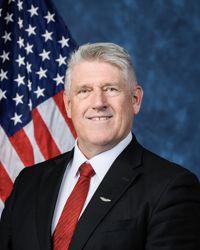
U.S. Representative for Montana’s 2nd district
Republican
119th Congress, two-year term
Missed 0.6% of roll calls. Chamber median 1.9%.
The full voting recordCounts roll calls where most Democrats and most Republicans voted differently, leaving out procedural votes.
How we countFrom FEC filings, Voteview roll calls and Congress.gov.
Republican. In Congress since 2025, 1 term in total.
Following saves Downing to your list, which Chamber & Street keeps on its server, linked to a cookie on this browser and not to your name or email. Email alerts will come with constituent verification.
Bills and resolutions Downing signed on to as a cosponsor. An original cosponsor signed on the day the bill was introduced. Source: govinfo bill status files, last updated Nov 6, 2026.
Protecting Investors’ Personally Identifiable Information Act
Sponsor Barry Loudermilk (R). Joined Mar 27, 2025. 5 cosponsors. H.R. 1483 on Congress.gov
Introduced
Protecting Investors' Personally Identifiable Information Act
This bill limits certain disclosures of personally identifiable information belonging to a participant in the securities market for purposes of tracking market activity.
Specifically, the bill prohibits the Securities and Exchange Commission (SEC) from requiring a national securities exchange, a national securities association, or a member of such an exchange or association to provide such information to satisfy the reporting requirements of the Consolidated Audit Trail (data used by regulators to track market activity).
STABLE Act of 2025
Sponsor Bryan Steil (R). Original cosponsor. 17 cosponsors. H.R. 2392 on Congress.gov(opens in a new tab)
Introduced
Stablecoin Transparency and Accountability for a Better Ledger Economy Act of 2025 or the STABLE Act of 2025
This bill establishes a regulatory framework for payment stablecoins (digital assets which an issuer must redeem for a fixed value).
Under the bill, only permitted issuers may issue a payment stablecoin in the United States, subject to certain exceptions. Permitted issuers must be a subsidiary of an insured depository institution, a federal-qualified nonbank payment stablecoin issuer, or a state-qualified payment stablecoin issuer. Permitted issuers must be regulated by the appropriate federal or state regulator. A state regulator must certify that the state regulatory regime meets or exceeds federal requirements as established by the bill.
Permitted issuers must maintain reserves backing the stablecoin on a one-to-one basis using U.S. currency or other similarly liquid assets, as specified. Permitted issuers must also publicly disclose their redemption policy and publish monthly the details of their reserves.
The bill specifies requirements for (1) reusing reserves; (2) providing safekeeping services for stablecoins; and (3) supervisory, examination, and enforcement authority over federal-qualified issuers.
The bill places a two-year moratorium on new endogenously collateralized stablecoins (i.e., stablecoins that rely on the value of another digital asset created or maintained by the same originator to maintain the fixed price).
Under the bill, permitted payment stablecoins are not considered securities under securities law. However, permitted issuers are subject to the Bank Secrecy Act for anti-money laundering and related purposes.
Whole Milk for Healthy Kids Act of 2025
Sponsor Glenn Thompson (R). Joined Mar 24, 2025. 118 cosponsors. H.R. 649 on Congress.gov(opens in a new tab)
Introduced
Whole Milk for Healthy Kids Act of 2025
This bill revises requirements for milk provided by the National School Lunch Program of the Department of Agriculture (USDA).
Currently, schools participating in the program must provide milk that is consistent with the most recent Dietary Guidelines for Americans; USDA regulations require milk to be fat-free or low-fat and allow milk to be flavored or unflavored. The bill modifies these restrictions and instead permits schools to offer students whole, reduced-fat, low-fat, and fat-free flavored and unflavored milk. The milk that is offered may be organic or nonorganic. Further, USDA may not prohibit a participating school from offering students any of these milk choices.
Further, schools currently must provide a substitute for fluid milk, on receipt of a written statement from a licensed physician, for students whose disability restricts their diet. Under the bill, a parent or legal guardian may also provide the written statement.
In addition, schools currently participating in the program must provide meals that meet certain nutrition requirements; USDA regulations require that the average saturated fat content of the meals offered must be less than 10% of the total calories. Under the bill, fluid milk is excluded from the saturated fat content calculation; milk fat included in any fluid milk provided by the program must not be considered saturated fat for the purposes of measuring compliance with USDA regulations.
Finally, the bill prohibits schools participating in the program from purchasing or offering milk produced by Chinese state-owned enterprises.
Enhanced Iran Sanctions Act of 2025
Sponsor Michael Lawler (R). Joined Mar 18, 2025. 295 cosponsors. H.R. 1422 on Congress.gov(opens in a new tab)
Passed the House
Enhanced Iran Sanctions Act of 2025
This bill imposes sanctions on certain foreign persons (individuals and entities) that are involved in Iran's petroleum sector as well as certain associated persons. The bill also requires or authorizes actions to facilitate the enforcement of sanctions on Iran.
Specifically, the bill requires the President to impose visa- and property-blocking sanctions on any foreign person that, after the bill's enactment, knowingly engages in any transaction related to the processing, export, or sale of oil, condensates, gas, liquefied natural gas, or other petrochemical products in whole or in part from Iran. The President must also impose sanctions on certain foreign persons associated with a sanctioned individual or entity. For example, the President must sanction the subsidiaries and corporate officers of a sanctioned business.
The bill provides certain exceptions to these sanctions, including specifying that sanctions do not apply to the importation of goods or to conducting or facilitating transactions for humanitarian assistance.
The Department of State must establish an interagency working group that shall seek to establish a multilateral contact group to coordinate international efforts to enforce sanctions on Iran.
The bill expands the State Department rewards program to authorize a reward payment to any individual who furnishes information leading to the identification of a person (1) subject to sanctions under this bill, or (2) that has attempted or is attempting to evade sanctions under this bill.
Proposing an amendment to the Constitution of the United States to limit the number of terms that a Member of Congress may serve.
Sponsor Ralph Norman (R). Joined Mar 18, 2025. 116 cosponsors. H.J.Res. 12 on Congress.gov(opens in a new tab)
Introduced
This joint resolution proposes an amendment to the Constitution establishing term limits for individuals serving in the Senate and the House of Representatives.
The proposed amendment makes an individual who has served two terms in the Senate ineligible for appointment or election to the Senate and an individual who has served three terms as a Member of the House of Representatives ineligible for election to the House of Representatives.
The joint resolution provides that the amendment shall be valid when ratified by the legislatures of three-fourths of the states within seven years after the date of its submission for ratification.
Under Article V of the Constitution, both chambers of Congress may propose an amendment by a vote of two-thirds of all Members present for such vote. A proposed amendment must be ratified by the states as prescribed in Article V and as specified by Congress.
Productive Public Lands Act
Sponsor Jeff Hurd (R). Original cosponsor. 6 cosponsors. H.R. 1997 on Congress.gov(opens in a new tab)
Introduced
To require the Secretary of Agriculture to carry out activities to suppress wildfires, and for other purposes.
Sponsor Tom McClintock (R). Joined Mar 10, 2025. 9 cosponsors. H.R. 178 on Congress.gov(opens in a new tab)
Introduced
This bill sets out requirements for wildfire suppression and management activities carried out by the Forest Service.
These requirements apply to Forest Service land that (1) has a severe, extreme, or exceptional drought intensity rating; (2) has a National Wildland Fire Preparedness level of 5 (i.e., the highest level of wildland fire activity); or (3) is located in a fireshed ranked in the top 10% of wildfire exposure.
Within 24 hours of detecting a wildfire on such Forest Service land, the service must use all available resources to extinguish the wildfire. Additionally, the service may not inhibit the firefighting activities of state and local agencies that are authorized to respond to wildfires on the Forest Service land.
Further, the service may only initiate a backfire or burnout as part of a fire suppression strategy if it is ordered by the responsible incident commander or is necessary to protect the health and safety of firefighting personnel. The service must use all available resources to control any initiated fire until it is extinguished.
The bill also limits the service's use of prescribed fires (i.e., the controlled application of fire by a team of experts under specified weather conditions to restore health to ecosystems that depend on fire). When using prescribed fires as a fire resource management tool, the service must comply with applicable laws and regulations and immediately suppress any prescribed fire that exceeds its prescription.
Grazing for Wildfire Risk Reduction Act
Joined Mar 10, 2025. 10 cosponsors. H.R. 1110 on Congress.gov(opens in a new tab)
Progress not on file
Veterans 2nd Amendment Protection Act
Sponsor Mike Bost (R). Joined Mar 10, 2025. 70 cosponsors. H.R. 1041 on Congress.gov(opens in a new tab)
Passed the House
Veterans 2nd Amendment Protection Act
This bill prohibits the Department of Veterans Affairs (VA) from transmitting certain information to the National Instant Criminal Background Check System (NICS) utilized by licensed importers or dealers of firearms.
Specifically, the bill prohibits the VA from transmitting personally identifying information of a veteran or a beneficiary to the NICS solely on the basis that such veteran or beneficiary has an appointed fiduciary to manage their benefits, unless there is an order or finding of a judicial authority that such veteran or beneficiary is a danger to themselves or others.
AM Radio for Every Vehicle Act of 2025
Sponsor Gus Bilirakis (R). Joined Mar 6, 2025. 317 cosponsors. H.R. 979 on Congress.gov(opens in a new tab)
Passed the House
AM Radio for Every Vehicle Act of 2025
This bill requires the Department of Transportation (DOT) to issue a rule requiring AM radio capabilities to be standard in all new passenger vehicles. (AM radio is often used to deliver emergency alerts and news and entertainment programming; some newer vehicles do not include AM equipment.)
Specifically, this bill applies to passenger vehicles (1) manufactured in the United States for sale in the United States, imported into the United States, or shipped in interstate commerce; and (2) manufactured after the rule's effective date. The rule must require all such vehicles to have devices that can receive signals and play content transmitted by AM stations or digital audio AM stations installed as standard equipment and made easily accessible to drivers.
Prior to the rule's effective date, manufacturers that do not include devices that can access AM radio as standard equipment (1) must inform purchasers of this fact through clear and conspicuous labeling, and (2) may not charge an additional or separate fee for AM radio access.
DOT may assess civil penalties for any violation of the rule. The Department of Justice may also bring a civil action to enjoin a violation.
The rule, including DOT’s authority to enforce it, must expire 10 years after the bill’s enactment.
Further, the Government Accountability Office must study and report on the dissemination of emergency alerts to the public, including by conducting an assessment of AM radio relative to other Integrated Public Alert and Warning System communication technologies.
Anti-CBDC Surveillance State Act
Sponsor Tom Emmer (R). Original cosponsor. 135 cosponsors. H.R. 1919 on Congress.gov(opens in a new tab)
Passed the House
Anti-CBDC Surveillance State Act
This bill prohibits a Federal Reserve bank from offering products or services directly to an individual, maintaining an account on behalf of an individual, or issuing a central bank digital currency (i.e., a digital dollar). Further, the Board of Governors of the Federal Reserve System is prohibited from using a central bank digital currency to implement monetary policy or from testing, studying, creating, or implementing a central bank digital currency, with exceptions as provided by the bill.
Disapproving the rule submitted by the Bureau of Consumer Financial Protection relating to "Prohibition on Creditors and Consumer Reporting Agencies Concerning Medical Information (Regulation V)".
Sponsor Ralph Norman (R). Original cosponsor. 13 cosponsors. H.J.Res. 74 on Congress.gov(opens in a new tab)
Introduced
This joint resolution nullifies the final rule issued by the Consumer Financial Protection Bureau titled Prohibition on Creditors and Consumer Reporting Agencies Concerning Medical Information (Regulation V) and published on January 14, 2025. This rule prohibits the inclusion of medical debt on credit reports and prohibits creditors from considering medical debt when making credit eligibility determinations.
Secure Rural Schools Reauthorization Act of 2025
Joined Mar 4, 2025. 93 cosponsors. H.R. 1383 on Congress.gov(opens in a new tab)
Progress not on file
Secure Rural Schools Reauthorization Act of 2025
This bill extends and modifies the Secure Rural Schools and Community Self-Determination Act of 2000, including by
• extending payments made to states and counties containing federal land through FY2026,
• providing for payments for FY2024 and FY2025,
• extending the authority of counties to initiate projects using such funds through FY2028, and
• extending the authority to initiate projects proposed by resource advisory committees through FY2028.
Financial Reporting Threshold Modernization Act
Sponsor Barry Loudermilk (R). Original cosponsor. 20 cosponsors. H.R. 1799 on Congress.gov(opens in a new tab)
Introduced
Financial Reporting Threshold Modernization Act
This bill increases the threshold amounts for certain reporting by financial institutions, adjusts these amounts periodically for inflation, and requires a review of specified financial forms and reporting requirements.
The bill increases the threshold dollar amounts above which financial institutions are required to file currency-transaction and suspicious-activity reports with the Financial Crimes Enforcement Network (FinCEN). The bill also increases the transaction threshold above which an entity must register with FinCEN as a money services business. Further, these amounts must be updated every five years to reflect the change in the consumer price index.
Treasury must review and report on the effectiveness and efficiency of the forms and requirements regarding domestic coin and currency transactions, foreign currency transactions, and anti-money laundering and combating the financing of terrorism measures, among other matters. Treasury must also make appropriate updates to such forms.
The bill also extends through 2031 the requirement that the director of FinCEN must be made annually available for testimony before congressional committees regarding certain FinCEN issues, including resources needed to implement beneficial ownership reporting requirements.
Disapproving the rule submitted by the Bureau of Consumer Financial Protection relating to "Defining Larger Participants of a Market for General-Use Digital Consumer Payment Applications".
Sponsor Mike Flood (R). Original cosponsor. 7 cosponsors. H.J.Res. 64 on Congress.gov(opens in a new tab)
Introduced
This joint resolution nullifies the final rule issued by the Consumer Financial Protection Bureau (CFPB) titled Defining Larger Participants of a Market for General-Use Digital Consumer Payment Applications and published on December 10, 2024. The rule defines larger participants in the general-use digital consumer payment application market (i.e., payment apps) that are subject to CFPB supervisory authority. The rule defines larger participants in this market as nonbanks (1) with an annual volume of at least 50 million transactions, and (2) that are not small business concerns.
Providing for congressional disapproval under chapter 8 of title 5, United States Code, of the rule submitted by the Internal Revenue Service relating to "Gross Proceeds Reporting by Brokers That Regularly Provide Services Effectuating Digital Asset Sales".
Sponsor Mike Carey (R). Joined Feb 27, 2025. 9 cosponsors. H.J.Res. 25 on Congress.gov(opens in a new tab)
Became law
This joint resolution nullifies requirements for persons effectuating decentralized financial (DeFi) transactions to report certain information regarding digital asset sales to the Internal Revenue Service (IRS). Specifically, the joint resolution nullifies the requirements included in the rule titled Gross Proceeds Reporting by Brokers That Regularly Provide Services Effectuating Digital Asset Sales and issued by the IRS on December 30, 2024.
Decentralized finance refers to the suite of financial activities and services that are facilitated by cryptocurrency and intended to be conducted without any sort of reliance on traditional financial tools or intermediaries.
Protecting Life from Chemical Abortions Act
Sponsor Kevin Hern (R). Original cosponsor. 25 cosponsors. H.R. 1525 on Congress.gov(opens in a new tab)
Introduced
Protecting Life from Chemical Abortions Act
This bill nullifies certain changes made by the Food and Drug Administration (FDA) to dispensing requirements for mifepristone. (Mifepristone is a drug that is approved to end pregnancies through 10 weeks gestation when used in conjunction with the drug misoprostol. The procedure is often referred to as medication abortion or the abortion pill.)
The FDA regulates mifepristone through the Mifepristone Risk Evaluation and Mitigation Strategy (REMS) program. The program requires health care providers to comply with certain requirements in order to prescribe or dispense mifepristone to end a pregnancy; the program previously included an in-person dispensing requirement that required mifepristone to be directly dispensed to patients in clinics, medical offices, or hospitals. During the COVID-19 public health emergency, the FDA stopped enforcing the in-person dispensing requirement, which allowed mail-order pharmacies to fill and dispense mifepristone prescriptions.
In January 2023, the FDA modified program requirements so as to (1) remove the in-person dispensing requirement, and (2) require pharmacies to be program-certified in order to dispense mifepristone. The modifications allow certified retail pharmacies to dispense mifepristone pursuant to prescriptions that are written by certified prescribers.
The bill nullifies the January 2023 changes and prohibits the FDA from (1) exercising any enforcement discretion with respect to program requirements, or (2) reducing program protections until every state submits certain data regarding abortions to the Centers for Disease Control and Prevention.
The bill also generally prohibits the declaration of a public health emergency with respect to abortions.
Promoting American Patriotism In Our Schools Act
Sponsor Dale Strong (R). Original cosponsor. 19 cosponsors. H.R. 1351 on Congress.gov(opens in a new tab)
Introduced
Promoting American Patriotism In Our Schools Act
This bill requires local educational agencies (LEAs) to establish, maintain, and enforce policies that require federally funded public elementary and secondary schools to display the U.S. flag, educate students about the U.S. flag, and direct students and staff to recite the Pledge of Allegiance on a daily basis.
Specifically, LEAs, as a condition of receiving federal elementary and secondary education funds, must require the following activities at each school:
• for all students, teachers, and staff to recite the Pledge of Allegiance at the beginning of each school day (with an exception for religious or personal reasons);
• for the U.S. flag to be prominently displayed in each classroom and gymnasium; and
• for educational materials on the history, significance, and proper display of the U.S. flag to be incorporated into the civics or history curriculum of each grade level.
The bill includes annual certification requirements. Further, the bill authorizes and directs the Department of Education to issue and secure compliance with rules or orders with respect to an LEA that fails to certify (or certifies in bad faith) compliance with the bill's requirements.
Protect America’s Lands Act
Original cosponsor. 22 cosponsors. H.R. 1309 on Congress.gov(opens in a new tab)
Progress not on file
Protect America’s Lands Act
This bill prohibits national securities exchanges from allowing the trade of securities issued by natural asset companies. Natural asset companies are companies that oversee land for conservation, restoration, or for the sustainable management of the natural resources and ecosystem services on that land.
Death Tax Repeal Act
Sponsor Randy Feenstra (R). Original cosponsor. 182 cosponsors. H.R. 1301 on Congress.gov(opens in a new tab)
Introduced
Disapproving the rule submitted by the Bureau of Consumer Financial Protection relating to "Overdraft Lending: Very Large Financial Institutions".
Sponsor J. Hill (R). Original cosponsor. 17 cosponsors. H.J.Res. 59 on Congress.gov(opens in a new tab)
Introduced
This joint resolution nullifies the final rule issued by the Consumer Financial Protection Bureau titled Overdraft Lending: Very Large Financial Institutions and published on December 30, 2024. The rule revises provisions regarding charges for insufficient funds in a customer’s bank account (i.e., overdrafts) at very large financial institutions. Under the rule, these institutions must (1) cap overdraft charges at $5; (2) with justification, cap charges at a higher amount; or (3) handle overdrafts as credit and comply with applicable Truth in Lending Act disclosure requirements.
Fair Access to Banking Act
Sponsor Andy Barr (R). Joined Feb 12, 2025. 151 cosponsors. H.R. 987 on Congress.gov(opens in a new tab)
Introduced
Fair Access to Banking Act
This bill places restrictions on certain banks, credit unions, and payment card networks if they refuse to do business with a person who complies with the law. Restrictions include prohibiting the use of electronic funds transfer systems and lending programs, termination of an institution's depository insurance, and specified civil penalties.
Banks and other specified financial institutions are allowed to deny financial services to a person only if the denial is justified by a documented failure of that person to meet quantitative, impartial, risk-based standards established in advance by the institution. This justification may not be based upon reputational risks to the institution.
The bill establishes the right for a person to bring a civil action for a violation of this bill.
TABS Act of 2025
Sponsor Andy Barr (R). Joined Feb 12, 2025. 16 cosponsors. H.R. 654 on Congress.gov(opens in a new tab)
Introduced
Taking Account of Bureaucrats' Spending Act of 2025 or the TABS Act of 2025
This bill restructures the Consumer Financial Protection Bureau and renames it as the Consumer Financial Empowerment Agency. The new agency is established as an independent agency outside of the Federal Reserve System.
The bill also changes the funding structure of the agency by prohibiting the transfer of funds to the agency from the Federal Reserve System and by authorizing congressional appropriations for FY2026-FY2027.
Protect Small Businesses from Excessive Paperwork Act of 2025
Sponsor Zachary Nunn (R). Joined Feb 7, 2025. 12 cosponsors. H.R. 736 on Congress.gov(opens in a new tab)
Passed the House
Protect Small Businesses from Excessive Paperwork Act of 2025
This bill extends the deadline for certain companies that are required to file beneficial ownership information with the Financial Crimes Enforcement Network (FinCEN). Specifically, the bill requires companies formed or registered before January 1, 2024, to submit this information to FinCEN by January 1, 2026, instead of by January 1, 2025, as required under current regulations.
Family Farm and Small Business Exemption Act
Sponsor Tracey Mann (R). Original cosponsor. 89 cosponsors. H.R. 1131 on Congress.gov(opens in a new tab)
Introduced
Family Farm and Small Business Exemption Act
This bill restores an exemption for certain family farms and small businesses on the Free Application for Federal Student Aid (FAFSA) form. The bill applies to the net worth of (1) a family farm on which the family resides, or (2) a small business with not more than 100 full-time or full-time equivalent employees that is owned and controlled by the family.
Prior to recent changes made to the FAFSA, the net worth of these family farms and small businesses were excluded as assets when calculating a student's financial need to determine federal student aid eligibility. Beginning with the 2024-2025 academic year, the net worth of these farms and businesses are treated as an asset and therefore included in the calculation. This bill restores the exemption to exclude such net worth from the calculation.