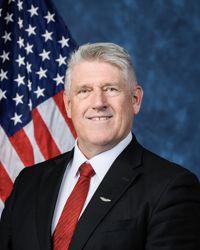
U.S. Representative for Montana’s 2nd district
Republican
119th Congress, two-year term
Missed 0.6% of roll calls. Chamber median 1.9%.
The full voting recordCounts roll calls where most Democrats and most Republicans voted differently, leaving out procedural votes.
How we countFrom FEC filings, Voteview roll calls and Congress.gov.
Republican. In Congress since 2025, 1 term in total.
Following saves Downing to your list, which Chamber & Street keeps on its server, linked to a cookie on this browser and not to your name or email. Email alerts will come with constituent verification.
Bills and resolutions Downing signed on to as a cosponsor. An original cosponsor signed on the day the bill was introduced. Source: govinfo bill status files, last updated Nov 6, 2026.
Tackling Predatory Litigation Funding Act
Sponsor Kevin Hern (R). Joined Jun 24, 2026. 39 cosponsors. H.R. 3512 on Congress.gov
Introduced
SAVE Moms and Babies Act of 2025
Sponsor Robert Latta (R). Joined Jun 23, 2026. 85 cosponsors. H.R. 685 on Congress.gov(opens in a new tab)
Introduced
Support And Value Expectant Moms and Babies Act of 2025 or the SAVE Moms and Babies Act of 2025
This bill prohibits the Food and Drug Administration (FDA) from approving any new drug (either as a brand-name drug or a generic) intended to terminate a pregnancy and imposes additional restrictions on such drugs that are already approved.
Under the bill, an already-approved drug intended to terminate a pregnancy may be dispensed to a patient only with a prescription. Furthermore, the FDA may not approve any labeling change that would authorize (1) using the drug after 70 days of gestation, or (2) dispensing the drug by any means other than in-person administration by the prescribing health care practitioner.
The FDA must also impose additional restrictions on such already-approved drugs, including by (1) requiring the prescribing health care practitioner to receive a special certification, (2) prohibiting the practitioner from also acting as the dispensing pharmacist, and (3) requiring the practitioner to have the ability to provide surgical intervention to the patient.
The bill also rescinds any investigational use exemption already granted to such a drug if the bill would have prohibited the FDA from granting the exemption. (Currently, the FDA may grant an exemption to certain market approval requirements if a drug is intended solely for use in safety and effectiveness investigations.)
Forced Abortion Prevention and Accountability Act
Sponsor Mark Messmer (R). Joined Jun 23, 2026. 80 cosponsors. H.R. 6466 on Congress.gov(opens in a new tab)
Introduced
Generating Retirement Ownership through Long-Term Holding
Sponsor Beth Van Duyne (R). Joined Jun 23, 2026. 130 cosponsors. H.R. 2089 on Congress.gov(opens in a new tab)
Introduced
Hydropower Licensing Affordability Act
Sponsor Cliff Bentz (R). Original cosponsor. 30 cosponsors. H.R. 9337 on Congress.gov(opens in a new tab)
Introduced
SEC Reform and Restructuring Act
Sponsor Ann Wagner (R). Original cosponsor. 4 cosponsors. H.R. 9329 on Congress.gov(opens in a new tab)
Introduced
No Taxpayer Funding for Abortion and Abortion Insurance Full Disclosure Act of 2025
Sponsor Christopher Smith (R). Joined Jun 18, 2026. 133 cosponsors. H.R. 7 on Congress.gov(opens in a new tab)
Introduced
No Taxpayer Funding for Abortion and Abortion Insurance Full Disclosure Act of 2025
This bill modifies provisions relating to federal funding for, and health insurance coverage of, abortions.
Specifically, the bill prohibits the use of federal funds for abortions or for health coverage that includes abortions. Such restrictions extend to the use of funds in the budget of the District of Columbia. Additionally, abortions may not be provided in a federal health care facility or by a federal employee.
Historically, language has been included in annual appropriations bills for the Department of Health and Human Services (HHS) that prohibits the use of federal funds for abortions—such language is commonly referred to as the Hyde Amendment. Similar language is also frequently included in appropriations bills for other federal agencies and the District of Columbia. The bill makes these restrictions permanent and extends the restrictions to all federal funds (rather than specific agencies).
The bill's restrictions regarding the use of federal funds do not apply in cases of rape, incest, or where a physical disorder, injury, or illness endangers a woman's life unless an abortion is performed. The Hyde Amendment provides the same exceptions.
The bill also prohibits qualified health plans from including coverage for abortions. Currently, qualified health plans may cover abortion, but the portion of the premium attributable to abortion coverage is not eligible for subsidies.
Great American Outdoors Act 250
Sponsor Bruce Westerman (R). Original cosponsor. 263 cosponsors. H.R. 9250 on Congress.gov(opens in a new tab)
Passed committee
Local Data for Better Conservation Act
Sponsor Lauren Boebert (R). Original cosponsor. 6 cosponsors. H.R. 9184 on Congress.gov(opens in a new tab)
Introduced
Title IX Clarification Act of 2026
Sponsor Jodey Arrington (R). Original cosponsor. 44 cosponsors. H.R. 8781 on Congress.gov(opens in a new tab)
Introduced
Title IX Clarification Act of 2026
This bill defines the terms sex, female, and male for purposes of Title IX of the Education Amendments of 1972. Title IX prohibits discrimination on the basis of sex in education programs that receive federal financial assistance.
Specifically, the bill defines sex as an individual’s biologically determined sex, as either male or female. Therefore, Title IX's prohibition on sex discrimination only applies to biological sex under the bill.
The bill defines female, when used with respect to a natural person, as an individual who naturally has, had, will have, or would have, but for a congenital anomaly, historical accident, or intentional or unintentional disruption, the reproductive system that at some point produces, transports, and utilizes the large gamete (ova) for fertilization.
The bill defines male, when used with respect to a natural person, as an individual who naturally has, had, will have, or would have, but for a congenital anomaly, historical accident, or intentional or unintentional disruption, the reproductive system that at some point produces, transports, and utilizes the small gamete (sperm) for fertilization.
(A January 20, 2025, executive order stated that it is the policy of the United States to recognize two sexes—male and female—which are not changeable. On February 4, 2025, the Department of Education announced its intent to enforce its Title IX regulations consistent with this executive order. For more information on the status of these regulations, see LBS11279.)
GUARD Veterans’ Health Care Act
Sponsor Lloyd Doggett (D). Joined May 13, 2026. 7 cosponsors. H.R. 4077 on Congress.gov(opens in a new tab)
Introduced
Nuclear Family Priority Act
Sponsor Elijah Crane (R). Joined May 12, 2026. 48 cosponsors. H.R. 2705 on Congress.gov(opens in a new tab)
Introduced
Nuclear Family Priority Act
This bill imposes limits on various types of family-sponsored immigration visas.
The non-U.S. national (alien under federal law) parents of U.S. citizens shall not qualify for visas for immediate relatives, which are not subject to any direct numerical limits. Currently, the spouses, unmarried children under 21, and parents of citizens are considered immediate relatives.
The bill also creates a nonimmigrant visa for such parents of citizens. Such non-U.S. nationals shall not be eligible for employment or any public benefits.
The bill also reduces the baseline annual cap for family-sponsored visas from 480,000 to 88,000, and revises the methods for calculating the cap. Currently, the 480,000 cap may be adjusted depending on various factors but shall not be less than 226,000.
The bill eliminates preference allocations (visa categories subject to various annual caps) for various family-sponsored visas, including those for the siblings and married children of citizens. The bill provides for a preference allocation for the unmarried children under 21 and spouses of permanent residents, subject to the 88,000 annual cap.
Legal Workforce Act
Sponsor Ken Calvert (R). Joined May 12, 2026. 45 cosponsors. H.R. 251 on Congress.gov(opens in a new tab)
Introduced
Legal Workforce Act
This bill directs the Department of Homeland Security (DHS) to create an electronic employment eligibility confirmation system modeled after and to replace the E-Verify system, which allows employers and recruiters to verify the immigration status of individuals. The bill also mandates the use of such a system, where currently only some employers, such as those with federal contracts, are required to use E-Verify.
The bill specifies documents that can establish an individual's identity and employment authorization. During the period starting when a job offer is made until three business days after hiring, the individual must attest to his or her employment authorization, and the employer or recruiter must attest that it has examined the individual's required documents.
Employers shall reverify certain types of employees who were not previously verified using E-Verify.
The Social Security Administration shall notify employees if their Social Security number has been used multiple times in an unusual manner. DHS shall establish programs for blocking and suspending misused numbers.
Employers that are required to use the verification system shall not be liable for any employment-related action based on a good-faith reliance on the system.
The bill establishes a phased-in participation deadline for different sizes and categories of employers, including agricultural employers.
The bill increases civil penalties related to hiring individuals without work authorization. It also preempts state laws relating to hiring and employment eligibility verification, but states may use their authority of business licensing to penalize employers for failing to comply with the bill's provisions.
Stopping Border Surges Act
Sponsor Andy Biggs (R). Joined May 12, 2026. 41 cosponsors. H.R. 116 on Congress.gov(opens in a new tab)
Introduced
Stopping Border Surges Act
This bill modifies immigration law provisions relating to unaccompanied alien minors and to asylum seekers.
The bill requires the Department of Homeland Security (DHS) to repatriate certain unaccompanied, inadmissible alien children, generally those not at risk of being trafficking victims nor having a fear of persecution. Currently, only inadmissible unaccompanied aliens from neighboring countries are subject to repatriation, and DHS has discretion whether to repatriate.
When the Department of Health and Human Services releases an unaccompanied child to an individual, it shall provide DHS with certain information about that individual, including Social Security number and immigration status.
The bill requires a stricter standard to find a credible fear of persecution and imposes additional rules on credible fear interviews.
If an alien is granted asylum because of fear of persecution in a country, the alien shall be deemed to have renounced asylum status by returning to that country, if there has been no change in the country's conditions.
The bill also (1) expands the definition of what constitutes a frivolous asylum application, (2) imposes additional limitations on eligibility for asylum, (3) shortens the deadline for applying for asylum, and (4) extends the time period an alien seeking asylum must wait before receiving employment authorization.
Any individual who knowingly and willfully makes materially false statements or uses fraudulent documents in asylum-related proceedings shall be fined or imprisoned up to 10 years, or both.
25th Anniversary of 9/11 Commemorative Coin Act
Sponsor Daniel Goldman (D). Joined May 7, 2026. 302 cosponsors. H.R. 1993 on Congress.gov(opens in a new tab)
Passed the House
25th Anniversary of 9/11 Commemorative Coin Act
This bill directs the Department of the Treasury to mint and issue coins to commemorate the 25th anniversary of the September 11, 2001, terrorist attacks on the United States and the establishment of the National September 11 Memorial and Museum at the World Trade Center.
The sale of all coins issued under this bill must include a surcharge to be paid to the National September 11 Memorial and Museum at the World Trade Center to support operations and maintenance. However, if the issuance of this commemorative coin exceeds certain annual limits, no surcharge may be included.
Condemning the attempted assassination of President Donald J. Trump on April 25, 2026, condemning the multiple attempts against the President's life, and recognizing the critical mission of the Department of Homeland Security.
Sponsor Abraham Hamadeh (R). Original cosponsor. 30 cosponsors. H.Res. 1220 on Congress.gov(opens in a new tab)
Introduced
Kayleigh’s Law Act of 2026
Sponsor Abraham Hamadeh (R). Original cosponsor. 21 cosponsors. H.R. 8481 on Congress.gov(opens in a new tab)
Passed the House
Kayleigh’s Law Act of 2026
This bill establishes a federal statutory framework to require federal courts to issue an order prohibiting contact with a victim (i.e., a no-contact order) in the case of a defendant who is convicted of certain violent crimes or sex crimes.
Specifically, in the case of a defendant convicted of a felony offense that is a crime of violence or that involves a sexual act or sexual conduct, on a motion by the victim or federal government, the court must issue a no-contact order.
Under the framework, the no-contact order must be imposed at sentencing and be in effect for the lifetime of the defendant unless it is terminated or suspended in accordance with specified procedures. Additionally, no fee may be assessed or collected from a victim in connection with the issuance of a no-contact order.
Chloe Cole Act of 2026
Sponsor Robert Onder (R). Joined Mar 2, 2026. 95 cosponsors. H.R. 7651 on Congress.gov(opens in a new tab)
Passed committee
To provide that the final rule titled "Special Areas; Roadless Area Conservation" and issued on January 12, 2001 (66 Fed. Reg. 3244) shall have no force or effect and require the Secretary of Agriculture to construct certain roads on National Forest System lands, and for other purposes.
Sponsor Harriet Hageman (R). Original cosponsor. 4 cosponsors. H.R. 7695 on Congress.gov(opens in a new tab)
Introduced
Gun Owner Registration Information Protection Act
Sponsor Paul Gosar (R). Original cosponsor. 97 cosponsors. H.R. 7678 on Congress.gov(opens in a new tab)
Introduced
Gun Owner Registration Information Protection Act
This bill prohibits federal funding of, or support for, state databases that list (1) firearms lawfully owned or possessed by individuals, or (2) individuals who lawfully own or possess firearms.
Stop the Sexualization of Children Act
Sponsor Mary Miller (R). Original cosponsor. 22 cosponsors. H.R. 7661 on Congress.gov(opens in a new tab)
Passed committee
Stop the Sexualization of Children Act
This bill prohibits the use of federal elementary and secondary education funds for sexually oriented material. Sexually oriented material is material that (1) includes any depiction, description, or simulation of sexually explicit conduct; or (2) involves gender dysphoria or transgenderism.
Specifically, the bill prohibits the use of these funds to develop, implement, facilitate, host, or promote any program or activity for, or to provide or promote literature or other materials to, children under the age of 18 that includes sexually oriented material. This includes any program, activity, literature, or material that exposes children to nude adults, individuals who are stripping, or lewd or lascivious dancing.
The bill does not prohibit the use of funds for the teaching of standard science coursework (e.g., biology, genetics, human health, and human anatomy), the texts of major world religions, classic works of literature or art (as defined by the bill), or security measures designed to help students recognize and safely respond to methods and attempts to sexually traffic children or groom children for sexual trafficking.
Expressing support for the designation of February 21 through February 28, 2026, as "National FFA Week", recognizing the important role of the National Future Farmers of America (FFA) Organization in developing the next generation of globally conscious leaders who will change the world, and celebrating the 50th anniversary of the chartering of the State of Alaska as a State FFA Association.
Sponsor Tracey Mann (R). Original cosponsor. 69 cosponsors. H.Res. 1073 on Congress.gov(opens in a new tab)
Introduced
This resolution supports the designation of National FFA (Future Farmers of America) Week.
It also celebrates the 50th anniversary of the chartering of Alaska as a State FFA Association of the National FFA Organization.
GUARD Act
Sponsor Zachary Nunn (R). Joined Feb 23, 2026. 54 cosponsors. H.R. 2978 on Congress.gov(opens in a new tab)
Passed the House
Guarding Unprotected Aging Retirees from Deception Act of 2026 or the GUARD Act of 2026
This bill allows state, local, and tribal law enforcement agencies and grantees that receive funds from certain law enforcement grant programs to use the funds to investigate general financial fraud, elder financial fraud, and pig butchering. Pig butchering refers to a confidence and investment fraud in which a victim is gradually lured into transferring increasing amounts of money, generally in the form of cryptocurrency, into a fake virtual investment.
The bill allows federal law enforcement agencies to assist state, local, and tribal law enforcement agencies and fusion centers in the use of tracing tools for blockchain and related technology tools.
Finally, the bill requires the Financial Crimes Enforcement Network (FinCEN) to report on efforts to combat general financial fraud, elder financial fraud, pig butchering, and scams, including an evaluation of any legislative recommendations to improve the efforts. The bill also requires FinCEN to report on the state of general financial fraud, elder financial fraud, pig butchering, and scams in the United States, including trends in the crimes.
Dismantle Foreign Scam Syndicates Act
Sponsor Jefferson Shreve (R). Joined Feb 20, 2026. 73 cosponsors. H.R. 5490 on Congress.gov(opens in a new tab)
Passed committee
Dismantle Foreign Scam Syndicates Act
This bill requires the President to (1) impose applicable sanctions on foreign persons (individuals or entities) responsible for online financial scams against U.S. nationals, and (2) establish an interagency task force to shut down the criminal syndicates perpetuating such scams.
Under the bill, the President must determine whether 43 specified foreign persons, and any other foreign persons the President determines are responsible for or complicit in online financial scams against U.S. nationals, are subject to sanctions under specified laws and Executive Order 13581. Upon such determination, the President must impose applicable sanctions (for example, blocking the sanctioned person's property transactions within the United States).
The President must also establish an interagency task force to shut down transnational criminal syndicates that use large scam centers and forced labor of trafficked persons to perpetuate mass online scams against Americans. The task force must (1) submit a comprehensive strategy to Congress to combat these scam centers and dismantle the criminal elements involved with them, and (2) coordinate and oversee implementation of the strategy. Within 360 days of submitting the strategy to Congress and annually thereafter for five years the task force must submit to Congress a report addressing various topics related to such scam centers including a list of all foreign persons sanctioned by the United States for their scam center involvement.
The Department of State is authorized to provide trauma-informed care, shelter, reintegration, and support services for victims of trafficking in persons within online scam centers.
Respect State Housing Laws Act
Sponsor Barry Loudermilk (R). Joined Feb 20, 2026. 58 cosponsors. H.R. 1078 on Congress.gov(opens in a new tab)
Introduced
Respect State Housing Laws Act
This bill eliminates a provision that requires a 30-day notice period before a landlord may begin eviction proceedings against a tenant in federally assisted or federally backed housing.