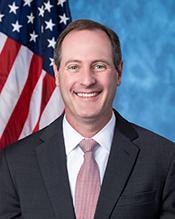
U.S. Representative for Kansas’s 1st district
Republican
119th Congress, two-year term
Missed 0.3% of roll calls. Chamber median 1.9%.
The full voting recordCounts roll calls where most Democrats and most Republicans voted differently, leaving out procedural votes.
How we countFrom FEC filings, Voteview roll calls and Congress.gov.
Republican. In Congress since 2021, 3 terms in total.
Following saves Mann to your list, which Chamber & Street keeps on its server, linked to a cookie on this browser and not to your name or email. Email alerts will come with constituent verification.
Bills and resolutions where Mann is the primary sponsor. Most bills never leave committee; that is normal for every member. Source: Congress.gov, last updated Oct 29, 2026.
20 of 29 have at least one cosponsor from the other party.
To prohibit the use of Federal funds to implement Salmonella framework for raw poultry products.
Introduced Jan 23, 2025. 2 cosponsors. H.R. 690 on Congress.gov
Introduced
This bill prohibits using federal funds to finalize, implement, administer, or enforce the proposed determination and proposed rule on Salmonella in raw poultry products. The Food Safety and Inspection Service (FSIS) proposed the rule and the determination in the proposed Salmonella Framework for Raw Poultry Products that was published on August 7, 2024.
The FSIS's proposed determination declares raw chicken carcasses, chicken parts, ground chicken, and ground turkey products that contain certain types and levels of Salmonella as adulterated, thus prohibiting these products from entering commerce.
The FSIS's proposed rule would revise the current regulations on how poultry slaughter establishments monitor and document microbial contamination throughout the slaughter and dressing operation. This includes new requirements for microbial monitoring programs, increased sampling and testing, and additional recordkeeping.
RIFLE Act of 2025
Introduced Jan 22, 2025. 34 cosponsors. H.R. 624 on Congress.gov(opens in a new tab)
Introduced
Reining In Federal Licensing Enforcement Act of 2025 or the RIFLE Act of 2025
This bill revises the federal statutory framework governing the licensing, inspection, and enforcement of federally licensed dealers, importers, and manufacturers of firearms (i.e., federal firearms licensees, or FFLs) by the Bureau of Alcohol, Tobacco, Firearms and Explosives (ATF).
With respect to an application for a license, this bill requires the ATF to make a preliminary determination, provide notice of a proposed denial, and allow the applicant to request a hearing.
With respect to inspections, this bill requires the ATF to establish standards for how it inspects, examines, or investigates FFLs for possible violations.
With respect to the enforcement of violations, this bill establishes a new framework. The new framework establishes a presumption that a violation by an FFL is not willful and requires the ATF to provide notice of and work with an FFL to rectify a violation.
In the case of a violation that is willful, the ATF has the burden of proving by clear and convincing evidence that the violation was committed willfully. The term willfully means that the person had actual knowledge of a legal duty, understood the obligation imposed by the legal duty, and deliberately disregarded the legal duty. The ATF may pursue revocation of an FFL’s license, but only after (1) providing notice and an opportunity to comply; and (2) finding that a lesser administrative action (e.g., warning, warning letter, or warning conference) is not likely to lead to future compliance.
To remove the lesser prairie-chicken from the lists of threatened species and endangered species published pursuant to the Endangered Species Act of 1973 and to amend that Act to exclude the lesser prairie-chicken from the authority of that Act.
Introduced Jan 21, 2025. 17 cosponsors. H.R. 587 on Congress.gov(opens in a new tab)
Introduced
This bill removes the lesser prairie-chicken (Tympanuchus pallidicinctus), including each of its distinct population segments, from the threatened and endangered species lists that are published under the Endangered Species Act of 1973. Further, the bill prohibits the U.S. Fish and Wildlife Service from designating such species as threatened or endangered, and thus, protecting such species under such act.
FAITH in Small Business Act
Introduced Jan 16, 2025. 4 cosponsors. H.R. 522 on Congress.gov(opens in a new tab)
Introduced
Fair Assistance and Impartial Treatment of Help In Small Business Act
This bill implements a proposed rule by the Small Business Administration (SBA) that allows certain faith-based organizations to access business loan and disaster assistance programs.
The programs include the Intermediary Lending Program (ILP), Business Loan programs (7(a), microloan, and 504 programs), Economic Injury Disaster Loan (EIDL) program, Military Reservist Economic Injury Disaster Loan (MREIDL) program, and Immediate Disaster Assistance Program (IDAP).
Current SBA regulations generally prohibit access to these programs if an organization is principally engaged in teaching, instructing, counseling, or indoctrinating religion or religious beliefs.
Recent Supreme Court opinions have found it unconstitutional to deny an otherwise qualified recipient access to a public benefit based solely on the organization's religious character (e.g., Trinity Lutheran Church of Columbia, Inc. v. Comer, 582 U.S. 449 (2017)).