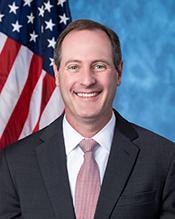
U.S. Representative for Kansas’s 1st district
Republican
119th Congress, two-year term
Missed 0.3% of roll calls. Chamber median 1.9%.
The full voting recordCounts roll calls where most Democrats and most Republicans voted differently, leaving out procedural votes.
How we countFrom FEC filings, Voteview roll calls and Congress.gov.
Republican. In Congress since 2021, 3 terms in total.
Following saves Mann to your list, which Chamber & Street keeps on its server, linked to a cookie on this browser and not to your name or email. Email alerts will come with constituent verification.
Bills and resolutions Mann signed on to as a cosponsor. An original cosponsor signed on the day the bill was introduced. Source: govinfo bill status files, last updated Nov 6, 2026.
Proposing an amendment to the Constitution of the United States to require that the Supreme Court of the United States be composed of nine justices.
Sponsor Dusty Johnson (R). Original cosponsor. 108 cosponsors. H.J.Res. 28 on Congress.gov
Introduced
This joint resolution proposes a constitutional amendment requiring the Supreme Court to consist of nine Justices.
Declaration of Energy Independence Act
Sponsor Andrew Ogles (R). Joined Jan 21, 2025. 8 cosponsors. H.R. 526 on Congress.gov(opens in a new tab)
Introduced
Declaration of Energy Independence Act
This bill reduces certain royalty rates, minimum bids, rental rates, and fees for onshore oil and gas leases on federal lands and modifies related leasing procedures.
Specifically, the bill (1) decreases the royalty rate from 16 2/3% to 12 1/2% for developing oil and gas on federal lands, (2) lowers the minimum bid amount from $10.00 to $2.00 per acre for oil and gas leases on federal lands, and (3) decreases the rental rates from a maximum of $15.00 per acre to $1.50 per acre for the first five years and $2.00 per acre thereafter. The bill also eliminates the fee for expressing interest in a lease.
It also modifies leasing procedures to provide for noncompetitive leasing under certain circumstances.
In addition, the bill modifies the conditions for the reinstatement of leases that have been cancelled or terminated, including by reducing the applicable royalty and rental rates.
REMAIN in Mexico Act of 2025
Sponsor Brandon Gill (R). Joined Jan 21, 2025. 110 cosponsors. H.R. 273 on Congress.gov(opens in a new tab)
Introduced
Return Excessive Migrants and Asylees to International Neighbors in Mexico Act of 2025 or the REMAIN in Mexico Act of 2025
This bill requires the Department of Homeland Security (DHS) to implement the Migrant Protection Protocols as outlined in the January 25, 2019, memo titled Policy Guidance for Implementation of the Migrant Protection Protocols.
(The protocols generally required aliens who are not clearly admissible, including those seeking asylum, arriving by land along the U.S.-Mexico border to be returned to Mexico while their immigration proceedings are pending, rather than remain in the United States. On January 21, 2021, DHS stopped applying the protocols to newly-arrived individuals.)
No Retaining Every Gun In a System That Restricts Your Rights Act
Sponsor Michael Cloud (R). Original cosponsor. 74 cosponsors. H.R. 563 on Congress.gov(opens in a new tab)
Introduced
No Retaining Every Gun In a System That Restricts Your Rights Act
This bill modifies the retention requirements for firearm transaction records of federal firearms licensees (FFLs) that go out of business.
Current law generally requires FFLs that go out of business to deliver their firearm transaction records to the Bureau of Alcohol, Tobacco, Firearms and Explosives (ATF).
This bill removes the requirement for FFLs that go out of business to deliver their firearm transaction records to the ATF. Further, the bill requires the ATF to destroy all out-of-business records it has collected from FFLs.
Protecting Infrastructure Investments for Rural America Act
Sponsor Brad Finstad (R). Original cosponsor. 8 cosponsors. H.R. 502 on Congress.gov(opens in a new tab)
Introduced
Protecting Infrastructure Investments for Rural America Act
This bill modifies the definition of rural area that is used for the Rural Surface Transportation Grant Program and adds provisions for small communities.
As background, the grant program supports projects that improve and expand the surface transportation infrastructure in rural areas. Eligible applicants for the grant program include states, regional transportation planning organizations, local governments, and tribal governments.
For purposes of the program, the bill defines rural area as an area outside an urbanized area that has a population of 30,000 or less. Current law requires a rural area to be outside of an urbanized area with a population of over 200,000.
The bill includes provisions for small communities (i.e., an area outside an urbanized area and that has a population of 5,000 or less). The bill sets the maximum federal cost-share at 90% for project grants carried out in a small community. The Department of Transportation (DOT) must use at least 5% of the program's annual funds to provide grants for projects in small communities. The bill also removes the prohibition against DOT using more than 10% of program funds for grants that are under $25 million.
Further, program grants may be used for highway, road, bridge, or tunnel projects that would benefit the economic development or quality of life for citizens of the local community.
The bill also specifies that the program's goals include the generation of economic growth and development in rural areas.
Miracle on Ice Congressional Gold Medal Act
Sponsor Pete Stauber (R). Original cosponsor. 299 cosponsors. H.R. 452 on Congress.gov(opens in a new tab)
Became law
Miracle on Ice Congressional Gold Medal Act
This act provides for the award of Congressional Gold Medals to the members of the 1980 U.S. Olympic men's ice hockey team in recognition of the team's achievement at the 1980 Winter Olympic Games.
Pony Up Act
Sponsor Sam Graves (R). Original cosponsor. 10 cosponsors. H.R. 431 on Congress.gov(opens in a new tab)
Introduced
Pony Up Act
This bill requires the U.S. Postal Service (USPS) to pay a citizen for late payment fees or penalties incurred due to late delivery of mail by USPS.
Late delivery of mail means that (1) USPS received a bill or notice of bill at least 12 days prior to the payment due date and delivered such bill or notice of bill less than 6 days prior to the payment due date; or (2) USPS received a payment at least 5 days prior to the payment due date and delivered such payment after the due date.
USPS is not required to pay a citizen for late payment fees or penalties when a bill, notice of bill, or payment is delayed for reasons outside of USPS control (for example, if a major disaster or emergency declared by the President caused the delay).
FIND Act
Sponsor Jack Bergman (R). Joined Jan 14, 2025. 154 cosponsors. H.R. 45 on Congress.gov(opens in a new tab)
Introduced
Firearm Industry Non-Discrimination Act or the FIND Act
This bill prohibits the federal government from entering into contracts with an entity that discriminates against firearm trade associations or businesses that deal in firearms, ammunition, or related products.
Specifically, the bill requires a federal agency to include in each contract for the procurement of goods or services awarded by the agency a clause requiring the prime contractor to certify that it (1) has no policy, practice, guidance, or directive that discriminates against a firearm entity or firearm trade association; and (2) will not adopt a policy, practice, guidance, or directive that discriminates against a firearm entity or firearm trade association during the term of the contract.
The bill establishes (1) a similar requirement with respect to subcontracts, and (2) penalties for violations.
The bill makes such prohibition inapplicable to a contract for the procurement of goods or services that is a sole-source contract.
No Immigration Benefits for Hamas Terrorists Act of 2025
Sponsor Tom McClintock (R). Joined Jan 14, 2025. 19 cosponsors. H.R. 176 on Congress.gov(opens in a new tab)
Passed the House
No Immigration Benefits for Hamas Terrorists Act
This bill imposes immigration-related penalties on certain non-U.S. nationals (aliens under federal law) who are involved with terrorism or attacks against Israel.
Under this bill, members of Palestinian Islamic Jihad or Hamas or individuals who participated in or otherwise facilitated the October 7, 2023, attacks on Israel may not be admitted into the United States.
The bill also expands an existing admissions bar against officers, representatives, and spokespersons of the Palestinian Liberation Organization (PLO). Under this bill, all PLO members are barred from admission into the United States.
The bill also prohibits any non-U.S. national who participated in or otherwise facilitated the October 7, 2023, attacks from seeking any immigration-related relief or protections, including (1) protection from being deported to a country where the individual's life or freedom would be threatened, or (2) asylum in the United States.
The Department of Homeland Security must annually report to Congress the number of individuals found to be inadmissible or deportable due to their participation in or facilitation of the attacks.
Finish the Wall Act
Sponsor Clay Higgins (R). Joined Jan 14, 2025. 29 cosponsors. H.R. 163 on Congress.gov(opens in a new tab)
Introduced
Finish the Wall Act
This bill requires the Department of Homeland Security (DHS) to resume activities related to the construction of a barrier system along the U.S.-Mexico border and addresses other border-related issues.
DHS must resume all such construction activities that were planned or underway prior to January 20, 2021. DHS must also expend all funds appropriated or explicitly obligated since October 1, 2016, for construction of this barrier system. DHS may not cancel contracts for activities related to such construction entered into on or before January 20, 2021.
Furthermore, within 14 days of this bill's enactment, DHS must certify to Congress that U.S. Customs and Border Protection facilities that process adults taken into custody at the border are fully compliant with certain laws related to the collection of DNA. (Among other things, these laws allow for the collection of DNA samples from non-U.S. persons detained under U.S. authority.)
Proposing an amendment to the Constitution of the United States to limit the number of terms that a Member of Congress may serve.
Sponsor Ralph Norman (R). Joined Jan 14, 2025. 116 cosponsors. H.J.Res. 12 on Congress.gov(opens in a new tab)
Introduced
This joint resolution proposes an amendment to the Constitution establishing term limits for individuals serving in the Senate and the House of Representatives.
The proposed amendment makes an individual who has served two terms in the Senate ineligible for appointment or election to the Senate and an individual who has served three terms as a Member of the House of Representatives ineligible for election to the House of Representatives.
The joint resolution provides that the amendment shall be valid when ratified by the legislatures of three-fourths of the states within seven years after the date of its submission for ratification.
Under Article V of the Constitution, both chambers of Congress may propose an amendment by a vote of two-thirds of all Members present for such vote. A proposed amendment must be ratified by the states as prescribed in Article V and as specified by Congress.
Title X Abortion Provider Prohibition Act
Sponsor Virginia Foxx (R). Original cosponsor. 32 cosponsors. H.R. 343 on Congress.gov(opens in a new tab)
Introduced
Title X Abortion Provider Prohibition Act
This bill prohibits the Department of Health and Human Services (HHS) from awarding family planning grants to entities that perform abortions or provide funding to other entities that perform abortions. To receive a grant, an entity must certify it will refrain from those activities during the grant period.
The bill provides exceptions for abortions (1) in cases of rape or incest; or (2) when the life of the woman is in danger due to a physical disorder, injury, or illness. It also exempts hospitals unless they provide funds to non-hospital entities that provide abortions.
HHS must submit a report to Congress annually on this prohibition.
Expressing support for the Geneva Consensus Declaration on Promoting Women's Health and Strengthening the Family and urging that the United States rejoin this historic declaration.
Sponsor Ronny Jackson (R). Original cosponsor. 22 cosponsors. H.Con.Res. 3 on Congress.gov(opens in a new tab)
Introduced
This concurrent resolution affirms the commitments in the Geneva Consensus Declaration on Promoting Women's Health and Strengthening the Family and applauds the signatory countries for their dedication to advancing women's health, protecting life at every stage while affirming that there is no international right to abortion, and upholding the importance of the family as foundational to society.
The resolution also states that Congress will work with the executive branch to ensure that the United States does not conduct or fund abortions, abortion lobbying, or coercive family planning in foreign countries.
Protecting Life and Taxpayers Act of 2025
Sponsor Michelle Fischbach (R). Original cosponsor. 45 cosponsors. H.R. 272 on Congress.gov(opens in a new tab)
Introduced
Protecting Life and Taxpayers Act of 2025
This bill requires entities receiving federal funds to certify that they will not, subject to certain exceptions, perform abortions or provide funding to other entities that perform abortions.
The bill provides exceptions for abortions performed in cases of rape or incest or when necessary to resolve a physical condition that endangers a woman's life.
Defund Planned Parenthood Act of 2025
Sponsor Michelle Fischbach (R). Original cosponsor. 60 cosponsors. H.R. 271 on Congress.gov(opens in a new tab)
Introduced
Defund Planned Parenthood Act of 2025
This bill restricts federal funding for Planned Parenthood Federation of America, Inc. or any of its affiliates or clinics for one year.
Specifically, it prohibits providing federal funding to those entities unless they certify that the affiliates and clinics will not perform, and will not provide funds to entities that perform, abortions during that year. If the certification requirement is not met, the Department of Health and Human Services and the Department of Agriculture must recoup any federal assistance received by those entities.
However, the bill's funding restriction does not apply to abortions performed in cases of rape or incest or when necessary to resolve a physical condition that endangers a woman's life.
The bill also provides additional funding for community health centers for the one-year period. These funds are subject to the same abortion-related restrictions and exceptions.
SAVE Act
Sponsor Stephanie Bice (R). Original cosponsor. 7 cosponsors. H.R. 256 on Congress.gov(opens in a new tab)
Introduced
Save America’s Valuable Energy Act or the SAVE Act
This bill directs the Department of Energy to prohibit the sale of petroleum products (e.g., crude oil) from the Strategic Petroleum Reserve to entities headquartered in Russia, Belarus, Burma, China, Cuba, Iran, North Korea, Syria, or Venezuela.
Adoption Information Act
Sponsor Robert Wittman (R). Joined Jan 9, 2025. 4 cosponsors. H.R. 215 on Congress.gov(opens in a new tab)
Introduced
Adoption Information Act
This bill requires federally funded family planning programs to provide each person who inquires about medical or abortion services with specified information about adoption centers in their region. The Department of Health and Human Services must provide the programs with pamphlets containing the required information.
Born-Alive Abortion Survivors Protection Act
Sponsor Ann Wagner (R). Joined Jan 9, 2025. 163 cosponsors. H.R. 21 on Congress.gov(opens in a new tab)
Passed the House
Born-Alive Abortion Survivors Protection Act
This bill establishes requirements for the degree of care a health care practitioner must provide in the case of a child born alive following an abortion or attempted abortion.
Specifically, a health care practitioner who is present must (1) exercise the same degree of care as would reasonably be provided to any other child born alive at the same gestational age, and (2) ensure the child is immediately admitted to a hospital. Additionally, a health care practitioner or other employee who has knowledge of a failure to comply with the degree-of-care requirements must immediately report such failure to law enforcement.
A health care practitioner who fails to provide the required degree of care, or a health care practitioner or other employee who fails to report such failure, is subject to criminal penalties—a fine, up to five years in prison, or both.
An individual who intentionally kills or attempts to kill a child born alive is subject to prosecution for murder.
The bill bars the criminal prosecution of a mother of a child born alive under this bill and allows her to bring a civil action against a health care practitioner or other employee for violations.
Constitutional Concealed Carry Reciprocity Act of 2025
Sponsor Richard Hudson (R). Original cosponsor. 189 cosponsors. H.R. 38 on Congress.gov(opens in a new tab)
Introduced
Constitutional Concealed Carry Reciprocity Act
This bill establishes a federal statutory framework to regulate the carry or possession of concealed firearms across state lines.
Specifically, an individual who is eligible to carry a concealed firearm in one state may carry or possess a concealed handgun (other than a machine gun or destructive device) in another state that allows its residents to carry concealed firearms.
It sets forth requirements for lawful concealed carry across state lines. The bill preempts most state and local laws related to concealed carry and establishes a private right of action for a person adversely affected by interference with a concealed-carry right established by this bill.
Regulations from the Executive in Need of Scrutiny Act of 2025
Sponsor Kat Cammack (R). Original cosponsor. 93 cosponsors. H.R. 142 on Congress.gov(opens in a new tab)
Introduced
Regulations from the Executive in Need of Scrutiny Act of 2025
This bill revises provisions relating to congressional review of agency rulemaking.
Specifically, the bill establishes a congressional approval process for a major rule. A major rule may only take effect if Congress approves of the rule. A major rule is a rule that has resulted in or is likely to result in (1) an annual effect on the economy of $100 million or more; (2) a major increase in costs or prices for consumers, individual industries, government agencies, or geographic regions; or (3) significant adverse effects on competition, employment, investment, productivity, innovation, or the ability of U.S.-based enterprises to compete with foreign-based enterprises.
The bill generally preserves the current congressional review process for a nonmajor rule.
Proposing a balanced budget amendment to the Constitution of the United States.
Sponsor Zachary Nunn (R). Original cosponsor. 15 cosponsors. H.J.Res. 10 on Congress.gov(opens in a new tab)
Introduced
This joint resolution proposes a constitutional amendment prohibiting total outlays for a fiscal year from exceeding total receipts for that fiscal year unless Congress authorizes the excess by a three-fifths roll call vote of each chamber. The prohibition excludes outlays for repayment of debt principal and receipts derived from borrowing.
The amendment requires a three-fifths roll call vote of each chamber to increase the public debt limit. It prohibits a bill to increase revenue from becoming law unless it has been approved by a majority roll call vote of each chamber.
The amendment also requires the President to submit an annual budget in which total outlays do not exceed total receipts.
Congress may waive these requirements due to a declaration of war or a military conflict that causes an imminent and serious military threat to national security.