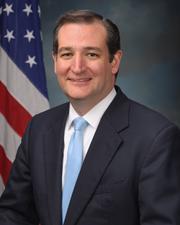
U.S. Senator for Texas
Republican
Senate term end not loaded yet
Missed 5.1% of roll calls. Chamber median 2.1%.
The full voting recordCounts roll calls where most Democrats and most Republicans voted differently, leaving out procedural votes.
How we countFrom FEC filings, Voteview roll calls and Congress.gov.
Republican. In Congress since 2013, 3 terms in total.
Following saves Cruz to your list, which Chamber & Street keeps on its server, linked to a cookie on this browser and not to your name or email. Email alerts will come with constituent verification.
Bills and resolutions where Cruz is the primary sponsor. Most bills never leave committee; that is normal for every member. Source: Congress.gov, last updated Oct 29, 2026.
50 of 133 have at least one cosponsor from the other party.
Chemical Tax Repeal Act
Introduced Feb 18, 2025. 7 cosponsors. S. 615 on Congress.gov(opens in a new tab)
Introduced
Chemical Tax Repeal Act
This bill repeals the Hazardous Substance Superfund excise tax imposed on certain chemicals and chemical substances.
Under current law, an excise tax is imposed through December 31, 2031, on taxable chemicals and taxable chemical substances that are (1) manufactured or produced in the United States, or (2) imported into the United States. The excise tax rate varies between 44 cents per ton to $9.74 per ton, depending on the chemical and certain other variables. (There are 42 listed taxable chemicals and 151 listed taxable chemical substances.)
Further, under current law, amounts collected from the excise tax on taxable chemicals and taxable chemical substances are deposited into the Hazardous Substance Superfund, which finances the remediation of certain environmentally contaminated sites.
Astronaut Ground Travel Support Act
Introduced Feb 13, 2025. 1 cosponsor, 1 from the other party. S. 582 on Congress.gov(opens in a new tab)
Introduced
Astronaut Ground Travel Support Act
This bill permits the National Aeronautics and Space Administration (NASA) to use government-owned passenger vehicles to transport astronauts and other space flight participants to and from post-mission medical research and treatment activities. (After returning to earth, astronauts generally undergo a post-mission medical recovery program and may be prohibited from driving motor vehicles for varying periods of time.)
Under the bill, transportation may be provided to necessary post-mission activities including medical research and the monitoring, diagnosis, and treatment of an astronaut or space flight participant before they receive post-mission clearance to operate a motor vehicle. Only astronauts employed by the U.S. government, certain international partner astronauts, and other individuals carried in launch or reentry vehicles are eligible for transportation.
The bill also permits NASA to maintain, operate, and repair one or more passenger vehicles, including motor vehicles, aircraft, and other means of transportation, for the purpose of providing such post-mission transportation.
The cost of transporting international partner astronauts and space flight participants not employed by the U.S. government must be reimbursed to the Department of the Treasury.
Officer John Barnes Act
Introduced Feb 13, 2025. 4 cosponsors. S. 571 on Congress.gov(opens in a new tab)
Introduced
Agent Raul Gonzalez Officer Safety Act
Introduced Feb 11, 2025. 9 cosponsors. S. 512 on Congress.gov(opens in a new tab)
Introduced
Agent Raul Gonzalez Officer Safety Act
This bill establishes new federal criminal offenses for operating a motor vehicle within 100 miles of the U.S. border while fleeing from a U.S. Border Patrol agent or a federal, state, or local law enforcement officer who is actively assisting or under the command of the U.S. Border Patrol.
The bill establishes criminal penalties for an offense, including a mandatory minimum prison term for an offense resulting in death or serious bodily injury. Additionally, a non-U.S. national who is convicted of or admits to committing an offense is inadmissible, deportable, and ineligible for immigration relief (including asylum).
Wildfire Victim Tax Relief and Recovery Act
Introduced Feb 10, 2025. 0 cosponsors. S. 496 on Congress.gov(opens in a new tab)
Introduced
Wildfire Victim Tax Relief and Recovery Act
This bill allows farmers to defer taxes on gain from the sale or exchange of livestock because of a fire. (Conditions apply.) The bill also allows individuals to exclude from gross income (for tax purposes) certain disaster relief payments received in connection with specific Texas wildfires.
Currently, farmers may defer gain on the sale or exchange of livestock (other than poultry) held for draft, breeding, or dairy purposes due to drought, flood, or other weather-related conditions for two years (four years if attributable to a federally-declared disaster). Otherwise, under current law, gain on the sale of livestock (including poultry) due to such weather-related conditions attributable to a federally-declared disaster may be deferred for one year. (Conditions apply.)
The bill adds fire to the list of circumstances for which the gain on the sale or exchange of livestock may be deferred, thus allowing farmers to defer such gains for up to four years (depending on the type of livestock and whether the sale is attributable to a federally-declared disaster).
The bill also allows individuals to exclude from gross income payments received from federal, state, or local government agencies or Xcel Energy (or any subsidiary, insurer, or agent of Xcel Energy) as compensation for unreimbursed losses, damages, and certain expenses attributable to the
• Smokehouse Creek, 687 Reamer, and Roughneck Fires (Hutchinson County, Texas, February and March 2024);
• Windy Deuce Fire (Moore County, Texas, February 2024); and
• Grape Vine Creek Fire (Gray County, Texas, February 2024).
A joint resolution proposing an amendment to the Constitution of the United States to require that the Supreme Court of the United States be composed of nine justices.
Introduced Feb 6, 2025. 22 cosponsors. S.J.Res. 16 on Congress.gov(opens in a new tab)
Introduced
This joint resolution proposes a constitutional amendment requiring the Supreme Court to consist of nine Justices.
AIM HIGH Act
Introduced Feb 6, 2025. 1 cosponsor. S. 442 on Congress.gov(opens in a new tab)
Introduced
Advancing Innovation and Maintenance through Headquarters for Instruction, Growth, and High-tech training Act or the AIM HIGH Act
This bill requires the Department of the Air Force to operate a Technical Training Center of Excellence. Among other duties, the center must (1) facilitate collaboration among all Air Force technical training installations; and (2) identify and promulgate best practices, standards, and benchmarks.
TICKET Act
Introduced Feb 5, 2025. 0 cosponsors. S. 430 on Congress.gov(opens in a new tab)
Introduced
Education Freedom Scholarships and Opportunity Act
Introduced Feb 3, 2025. 1 cosponsor. S. 370 on Congress.gov(opens in a new tab)
Introduced
Defund the CFPB Act
Introduced Jan 29, 2025. 6 cosponsors. S. 303 on Congress.gov(opens in a new tab)
Introduced
Defund the CFPB Act
This bill caps funding of the Consumer Financial Protection Bureau at $0.
Personalized Care Act of 2025
Introduced Jan 28, 2025. 2 cosponsors. S. 276 on Congress.gov(opens in a new tab)
Introduced
Personalized Care Act of 2025
This bill expands health saving account (HSA) eligibility, increases HSA contribution limits, and makes other HSA-related changes. The bill also expands the definition of medical care for purposes of the itemized tax deduction for unreimbursed medical expenses.
The bill eliminates the requirement that an individual must be covered by a high-deductible health plan to establish and contribute to an HSA. Under the bill, an eligible individual is defined as (1) a health care sharing ministry participant, or (2) individual covered under
• a group or individual health plan;
• health insurance (including a short-term limited duration and medical indemnity plan); or
• a government plan (including Medicare Part A and B, Medicaid, the Children’s Health Insurance Program, certain military and government employee health benefit programs, and the Indian Health Service and tribal organization programs).
The bill increases annual HSA contribution limits to $10,800 (from $4,300 in 2025) for self-only coverage and $29,500 (from $8,550 in 2025) for family coverage, adjusted annually for inflation.
The bill expands the qualified medical expenses that may be paid for with HSA distributions to include health insurance payments (e.g., premiums), direct care fees, and certain amounts paid by health care sharing ministry participants.
The bill decreases the penalty to 10% (from 20%) for nonqualified HSA distributions.
Finally, under the bill, direct care fees and fees paid for membership in a health care sharing ministry qualify as medical care for purposes of the itemized tax deduction for unreimbursed medical expenses.
Stop Illegal Reentry Act
Introduced Jan 28, 2025. 9 cosponsors. S. 271 on Congress.gov(opens in a new tab)
Introduced
Stop Illegal Reentry Act
This bill increases criminal penalties for certain non-U.S. nationals (aliens under federal law) who illegally reenter the United States after removal or exclusion.
Generally, an individual who had been denied entry into or removed from the United States and who later enters or attempts to enter the United States without prior approval from the Department of Homeland Security shall be fined, imprisoned for up to five years, or both. Current law requires a fine, imprisonment for up to two years, or both, for such an individual.
An individual who had been denied entry or removed three or more times and who later enters or attempts to enter the United States shall be fined, imprisoned for up to 10 years, or both.
An individual who was convicted of an aggravated felony or convicted at least two times before removal or departure and who subsequently enters or tries to enter the United States shall be imprisoned at least 5 years and for up to 20 years and may also be fined. Currently, there is no minimum term of imprisonment for an individual who reenters after a conviction for an aggravated felony, and there are no criminal penalties for a reentering individual who had been convicted at least two times (other than the penalties for illegal reentry generally).
MEDAL Act of 2025
Introduced Jan 23, 2025. 7 cosponsors, 2 from the other party. S. 214 on Congress.gov(opens in a new tab)
Introduced
Monetary Enhancement for Distinguished Active Legends Act of 2025 or the MEDAL Act of 2025
This bill increases the monthly special pension for living Medal of Honor recipients from $1,406.73 to $8,333.33 and establishes a rate of $1,406.73 for the monthly special pension for surviving spouses of Medal of Honor recipients. Both amounts must be adjusted annually for inflation.
Maintaining Academy Culture and Assuring Retention of Tradition, Honor, and Unity of the Republic Act (MACARTHUR) Act
Introduced Jan 23, 2025. 4 cosponsors. S. 215 on Congress.gov(opens in a new tab)
Introduced
Maintaining Academy Culture and Assuring Retention of Tradition, Honor, and Unity of the Republic Act (MACARTHUR) Act
This bill requires the Department of the Army to amend the mission statement of the United States Military Academy to include the phrase “Duty, Honor, Country.”
A bill to designate the area between the intersections of 16th Street, Northwest and Fuller Street, Northwest and 16th Street, Northwest and Euclid Street, Northwest in Washington, District of Columbia, as "Oswaldo Paya Way".
Introduced Jan 23, 2025. 3 cosponsors, 1 from the other party. S. 218 on Congress.gov(opens in a new tab)
Introduced
This bill designates the area in front of the Cuban embassy in the District of Columbia as Oswaldo Payá Way. (Oswaldo Payá was a pro-democracy activist in Cuba.)
Protecting Military Installations and Ranges Act of 2025
Introduced Jan 22, 2025. 8 cosponsors. S. 197 on Congress.gov(opens in a new tab)
Introduced
Protecting Military Installations and Ranges Act of 2025
This bill places restrictions on the purchase of certain property by a foreign person (e.g., an individual or entity) who is owned or controlled by, is acting for or on behalf of, or receives subsidies from Russia, China, Iran, or North Korea.
Specifically, the Committee on Foreign Investment in the United States (CFIUS) must review a purchase or lease by, or a concession to, any such foreign person of private or public real estate in the United States that is within (1) 100 miles of a military installation; or (2) 50 miles of a military training route, special use airspace, a controlled firing area, or a military operations area.
Further, the Department of Defense and the Department of Transportation may not issue final determinations regarding specified projects (e.g., energy projects) that involve a transaction under review by CFIUS until CFIUS concludes its action.
Student Empowerment Act
Introduced Jan 20, 2025. 8 cosponsors. S. 152 on Congress.gov(opens in a new tab)
Introduced
Student Empowerment Act
This bill expands the education-related expenses that may be paid for with tax-free distributions from a qualified tuition program (also known as a 529 plan) to include certain expenses related to elementary, secondary, and homeschool education.
Under current law, distributions from a 529 plan are excluded from gross income if they are used to pay for qualified higher education expenses, which includes up to $10,000 (per year and per beneficiary) for tuition at an elementary or secondary public, private, or religious school.
The bill expands the education-related expenses that may be paid for with tax-free distributions from a 529 plan to include tuition related to homeschooling and the following expenses related to elementary, secondary, and homeschool education:
• curriculum and curricular materials,
• books or other instructional materials,
• online educational materials,
• tutoring or educational classes outside the home,
• testing fees,
• fees for dual enrollment in an institution of higher education, and
• educational therapies for students with disabilities.
AMERICANS Act
Introduced Jan 16, 2025. 14 cosponsors. S. 117 on Congress.gov(opens in a new tab)
Introduced
Allowing Military Exemptions, Recognizing Individual Concerns About New Shots Act of 2025 or the AMERICANS Act
This bill prohibits the Department of Defense (DOD) from issuing any COVID-19 vaccine mandate as a replacement for the rescinded vaccine mandate of August 24, 2021, unless the mandate is expressly authorized by Congress. The bill also provides that DOD must establish an application process for remedies for members of the Armed Forces who were discharged or subject to adverse action under the rescinded mandate.
Any administrative discharge of a member on the sole basis of a failure to receive a COVID-19 vaccine must be categorized as an honorable discharge, and DOD is prohibited from taking any adverse action against such a member for that reason.
DOD must try to retain unvaccinated members and provide such members with professional development, promotion and leadership opportunities, and consideration equal to that of their peers.
Additionally, DOD may only consider the COVID-19 vaccination status of members in making certain decisions (e.g., deployments in countries where it is the law) and must establish a process to provide exemptions to certain members for such decisions.
Members who were separated from the Armed Forces for refusing to receive a COVID-19 vaccine are not required to repay any bonuses and must be reimbursed if they repaid any portion of a bonus prior to this bill's enactment.
This bill applies to all members of the Armed Forces, regardless of whether they sought an accommodation to any DOD COVID-19 vaccination policy.
GATE CRASHERS Act
Introduced Jan 16, 2025. 6 cosponsors. S. 115 on Congress.gov(opens in a new tab)
Introduced
Guarding and Administering Trespass Enforcement, Controlling Restricted Areas, and Stopping High-risk Encroachment Recidivism and Sabotage Act or the GATE CRASHERS Act
This bill establishes a new federal criminal offense for going onto Department of Defense property that is closed or restricted without authorization.
Natural Gas Tax Repeal Act
Introduced Jan 16, 2025. 17 cosponsors. S. 143 on Congress.gov(opens in a new tab)
Introduced
Natural Gas Tax Repeal Act
This bill eliminates a program administered by the Environmental Protection Agency that provides support for reducing methane emissions from the oil and gas sector. It also repeals a charge on methane emissions from facilities that contain petroleum and natural gas systems and emit 25,000 metric tons or more of greenhouse gases per year.
Overturn Biden’s Offshore Energy Ban Act
Introduced Jan 15, 2025. 0 cosponsors. S. 104 on Congress.gov(opens in a new tab)
Introduced
Overturn Biden’s Offshore Energy Ban Act
This bill nullifies two presidential memoranda that were published on January 6, 2025, including (1) the Memorandum on the Withdrawal of Certain Areas of the United States Outer Continental Shelf from Oil or Natural Gas Leasing, relating to the Gulf of Mexico, Atlantic, and Pacific areas of the Outer Continental Shelf (OCS); and (2) the Memorandum on the Withdrawal of Certain Areas of the United States Outer Continental Shelf from Oil or Natural Gas Leasing, relating to the Bering Sea areas of the OCS. The memoranda prohibited the Bureau of Ocean Energy Management (BOEM) from issuing offshore leases for the exploration, development, or production (i.e., offshore drilling) of oil or natural gas in those areas.
This bill reverses the withdrawal to allow BOEM to issue leases in those areas.
Thin Blue Line Act
Introduced Jan 14, 2025. 16 cosponsors. S. 83 on Congress.gov(opens in a new tab)
Introduced
Thin Blue Line Act
This bill expands the list of statutory aggravating factors in death penalty determinations to also include killing or targeting a law enforcement officer, firefighter, or other first responder.
A bill to require the imposition of sanctions with respect to Ansarallah and its officials, agents, or affiliates for acts of international terrorism.
Introduced Jan 13, 2025. 7 cosponsors. S. 70 on Congress.gov(opens in a new tab)
Introduced
This bill requires the President to designate Ansarallah, the Iran-backed movement in Yemen also known as the Houthis, as a foreign terrorist organization. The President must also report to Congress a determination as to whether specified foreign persons are officials, agents, or affiliates of Ansarallah.
Justice for Jocelyn Act
Introduced Jan 13, 2025. 6 cosponsors. S. 72 on Congress.gov(opens in a new tab)
Introduced
Justice for Jocelyn Act
This bill limits Immigration and Customs Enforcement’s (ICE’s) Alternatives to Detention program, which supervises non-U.S. nationals (aliens under federal law) subject to removal who are released from the custody of the Department of Homeland Security (DHS). Specifically, releases under this program are prohibited unless all detention beds are filled and DHS found no alternatives after exercising and exhausting all reasonable options.
The bill requires all individuals on ICE’s nondetained docket to be enrolled in the program and be subject to continuous GPS monitoring and curfew.
Further, the bill requires a non-U.S. national who was arrested and released to be removed in absentia if an immigration officer submits an affidavit to an immigration judge stating that the individual failed to comply with a condition of release.
A joint resolution proposing an amendment to the Constitution of the United States relative to limiting the number of terms that a Member of Congress may serve.
Introduced Jan 7, 2025. 19 cosponsors. S.J.Res. 1 on Congress.gov(opens in a new tab)
Introduced
This joint resolution proposes an amendment to the Constitution establishing term limits for individuals serving in the Senate and the House of Representatives.
The proposed amendment makes an individual who has served two terms in the Senate ineligible for appointment or election to the Senate and an individual who has served three terms as a Member of the House of Representatives ineligible for election to the House of Representatives.
The joint resolution provides that the amendment shall be valid when ratified by the legislatures of three-fourths of the states within seven years after the date of its submission for ratification.
Under Article V of the Constitution, both chambers of Congress may propose an amendment by a vote of two-thirds of all Members present for such vote. A proposed amendment must be ratified by the states as prescribed in Article V and as specified by Congress.