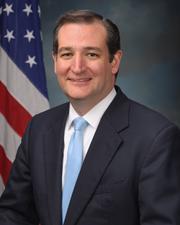
U.S. Senator for Texas
Republican
Senate term end not loaded yet
Missed 5.1% of roll calls. Chamber median 2.1%.
The full voting recordCounts roll calls where most Democrats and most Republicans voted differently, leaving out procedural votes.
How we countFrom FEC filings, Voteview roll calls and Congress.gov.
Republican. In Congress since 2013, 3 terms in total.
Following saves Cruz to your list, which Chamber & Street keeps on its server, linked to a cookie on this browser and not to your name or email. Email alerts will come with constituent verification.
Bills and resolutions Cruz signed on to as a cosponsor. An original cosponsor signed on the day the bill was introduced. Source: govinfo bill status files, last updated Nov 6, 2026.
Honoring Our Fallen Heroes Act of 2025
Sponsor Amy Klobuchar (D). Original cosponsor. 59 cosponsors. S. 237 on Congress.gov
Passed committee
Honoring Our Fallen Heroes Act of 2025
This bill extends death and disability benefits under the Public Safety Officers' Benefits Program (PSOB) to certain public safety officers who suffer from exposure-related cancer while on duty and their survivors. The PSOB program provides death, disability, and education benefits to public safety officers who are killed or injured in the line of duty and their survivors.
The bill specifies that exposure to a carcinogen shall be presumed to constitute a personal injury in the line of duty if
• the exposure occurred while the officer was in the line of duty;
• the officer began serving as an officer not fewer than 5 years before the date of the diagnosis of an exposure-related cancer and the diagnosis occurred not more than 15 years after the last date of active service; and
• the exposure-related cancer directly and proximately resulted in the death or permanent and total disability of the officer.
The Department of Justice's Bureau of Justice Assistance must periodically review the definition of exposure-related cancer and update the definition if appropriate based on medical evidence and in accordance with the requirements of a petition process.
Prosecutors Need to Prosecute Act of 2025
Sponsor John Kennedy (R). Original cosponsor. 1 cosponsor. S. 234 on Congress.gov(opens in a new tab)
Introduced
Prosecutors Need to Prosecute Act of 2025
This bill requires certain state and local prosecutors to report data on criminal referrals and outcomes of cases involving murder or non-negligent manslaughter, forcible rape, robbery, aggravated assault, burglary, larceny, motor vehicle theft, arson, or any offense involving the illegal use or possession of a firearm.
The reporting requirement applies to state and local prosecutors in a jurisdiction that has 360,000 or more persons and receives funding under the Edward Byrne Memorial Justice Assistance Grant (JAG) program. The report must contain data on
• cases referred for prosecution,
• cases the prosecutor declined to prosecute or refer for diversion,
• cases for which the prosecutor declined to reach a plea agreement,
• cases that resulted in a plea agreement or referral for diversion, and
• offenses the prosecutor did not prosecute due to an internal policy.
If a state or local prosecutor complies with these requirements, the bill requires (1) the Department of Justice to give priority in disbursing Byrne JAG program funds to the local government served by the prosecutor, and (2) the local government to ensure that the prosecutor receives a portion of the funds.
Additionally, the bill prohibits states and local governments from receiving funds under the Byrne JAG program if they have in effect a policy that prohibits the use of cash bail for a defendant in a case involving the illegal use or illegal possession of a firearm.
Promoting Domestic Energy Production Act
Sponsor James Lankford (R). Original cosponsor. 18 cosponsors. S. 224 on Congress.gov(opens in a new tab)
Introduced
Promoting Domestic Energy Production Act
This bill allows corporations to reduce their adjusted financial statement income to account for certain intangible costs related to oil, gas, or geothermal well drilling and development for purposes of calculating the corporate alternative minimum tax.
Under current law, a 15% corporate alternative minimum tax is imposed on a corporation with adjusted financial statement income exceeding an average of $1 billion for a consecutive three-year period (or an average of $100 million for a U.S. corporation that is part of a foreign parent multinational group if the adjusted financial statement income of such group exceeds an average of $1 billion for a consecutive three-year period). Adjusted financial statement income generally is the net income or loss reported on the corporation’s applicable financial statement for a tax year, with adjustments for specific items.
This bill expands the reductions that may be made to a corporation’s adjusted financial statement income to include (1) intangible drilling and development costs incurred by an operator of a domestic oil, gas, or geothermal well that are allowed as a deduction in the current tax year when computing regular taxable income; and (2) any depletion expenses related to the intangible oil, gas, or geothermal well drilling and development costs.
Veterans Health Care Freedom Act
Sponsor Marsha Blackburn (R). Original cosponsor. 8 cosponsors. S. 219 on Congress.gov(opens in a new tab)
Introduced
Veterans Health Care Freedom Act
This bill requires the Center for Innovation for Care and Payment within the Department of Veterans Affairs (VA) to implement a three-year pilot program to provide veterans who are enrolled in the VA health care system with the ability to choose health care providers through the covered care system. Under the bill, the covered care system includes VA medical facilities, health care providers participating in the Veterans Community Care Program (VCCP), and eligible entities or providers that have entered into a Veterans Care Agreement.
A veteran participating in the program may elect to receive care at any provider in the covered care system.
The pilot program removes certain requirements (e.g., location of the veteran) to access care at VA and non-VA facilities. After four years, the bill permanently phases out the requirements for accessing care under the VCCP and Veterans Care Agreements and requires the VA to provide such care under the same conditions of the pilot program. Additionally, after four years, veterans may receive care at a VA medical facility regardless of whether the facility is in the same Veterans Integrated Service Network as the veteran.
Main Street Tax Certainty Act
Sponsor Steve Daines (R). Original cosponsor. 45 cosponsors. S. 213 on Congress.gov(opens in a new tab)
Introduced
Main Street Tax Certainty Act
This bill makes permanent the qualified business income (QBI) tax deduction.
Under current law, individuals, estates, and trusts may deduct the lower of (1) 20% of QBI from a qualified business, qualified real estate investment trust dividends, and qualified publicly traded partnership income; or (2) 20% of taxable income less net capital gain. (Some limitations apply.)
However, under current law, the QBI tax deduction expires after December 31, 2025.
POLICE Act of 2025
Sponsor Ted Budd (R). Original cosponsor. 14 cosponsors. S. 212 on Congress.gov(opens in a new tab)
Introduced
Protect Our Law enforcement with Immigration Control and Enforcement Act of 2025 or the POLICE Act of 2025
This bill makes assaulting a law enforcement officer, firefighter, or other first responder a deportable offense.
Specifically, the bill makes deportable any non-U.S. national (alien under federal law) who has been convicted of (or admits to have committed) any act that constitutes the essential elements of any offense involving assault of a law enforcement officer, firefighter, or other first responder.
The Department of Homeland Security must publish annually on its website a report on the number of individuals deported in the previous fiscal year pursuant to this bill.
Defund Planned Parenthood Act
Sponsor Rand Paul (R). Original cosponsor. 11 cosponsors. S. 203 on Congress.gov(opens in a new tab)
Introduced
Defund Planned Parenthood Act
This bill prohibits providing federal funding to Planned Parenthood Federation of America or its affiliates.
PLO and PA Terror Payments Accountability Act of 2025
Sponsor Tom Cotton (R). Original cosponsor. 11 cosponsors. S. 198 on Congress.gov(opens in a new tab)
Introduced
PLO and PA Terror Payments Accountability Act of 2025
This bill requires the President to impose sanctions on foreign persons (individuals and entities) that are involved with the Palestinian Liberation Organization (PLO) or Palestinian Authority (PA) system of compensation supporting acts of terrorism. The bill defines this system of compensation as payments to an individual who (1) has been imprisoned for terrorist acts against Israeli or U.S. citizens after being fairly tried, (2) died while committing such terrorist acts, or (3) is a family member of such individuals. The definition also includes compensation for individuals imprisoned for terrorism where the level of compensation is based on the length of incarceration.
Specifically, the President must impose visa- and property-blocking sanctions on any foreign person that has facilitated this compensation system, including PLO and PA officials as well as entities such as the Institute for the Care of the Families of the Martyrs and the Wounded. The President must also impose visa- and property-blocking sanctions on foreign persons who knowingly provide significant support to, or engage in significant transactions with, any of the aforementioned persons.
The President must sanction foreign financial institutions that facilitate payments or benefits related to this compensation system by (1) prohibiting them from opening correspondent or payable-through accounts in the United States, and (2) prohibiting or imposing strict conditions on the maintenance of such accounts.
The provisions of this bill shall terminate if the Department of State certifies that such compensation system has ceased.
No Taxpayer Funding for Abortion and Abortion Insurance Full Disclosure Act of 2025
Sponsor Roger Wicker (R). Original cosponsor. 50 cosponsors. S. 186 on Congress.gov(opens in a new tab)
Introduced
No Taxpayer Funding for Abortion and Abortion Insurance Full Disclosure Act of 2025
This bill modifies provisions relating to federal funding for, and health insurance coverage of, abortions.
Specifically, the bill prohibits the use of federal funds for abortions or for health coverage that includes abortions. Such restrictions extend to the use of funds in the budget of the District of Columbia. Additionally, abortions may not be provided in a federal health care facility or by a federal employee.
Historically, language has been included in annual appropriations bills for the Department of Health and Human Services (HHS) that prohibits the use of federal funds for abortions—such language is commonly referred to as the Hyde Amendment. Similar language is also frequently included in appropriations bills for other federal agencies and the District of Columbia. The bill makes these restrictions permanent and extends the restrictions to all federal funds (rather than specific agencies).
The bill's restrictions regarding the use of federal funds do not apply in cases of rape, incest, or where a physical disorder, injury, or illness endangers a woman's life unless an abortion is performed. The Hyde Amendment provides the same exceptions.
The bill also prohibits qualified health plans from including coverage for abortions. Currently, qualified health plans may cover abortion, but the portion of the premium attributable to abortion coverage is not eligible for subsidies.
Justice for Victims of Sanctuary Cities Act of 2025
Sponsor Thomas Tillis (R). Original cosponsor. 11 cosponsors. S. 185 on Congress.gov(opens in a new tab)
Introduced
Justice for Victims of Sanctuary Cities Act of 2025
This bill provides a private right of action against state and local jurisdictions with certain policies that limit cooperation with federal immigration enforcement efforts, and contains additional provisions related to such jurisdictions. Currently, such cooperation is generally not required.
An individual (or certain relatives of such an individual) who is the victim of any felony for which an alien has been arrested, convicted, or sentenced to a prison term of at least one year may sue a state or local jurisdiction if the jurisdiction failed to comply with (1) certain Department of Homeland Security (DHS) requests related to arresting and detaining aliens, and (2) a DHS request to detain the alien in question or provide a notification about the release of the alien. A jurisdiction that accepts certain federal grants may not assert immunity in such a civil action.
A jurisdiction (or employee of a jurisdiction) that complies with certain DHS detainer requests shall be deemed to be acting as an agent of DHS. A complying jurisdiction or employee of the jurisdiction shall not be liable in any lawsuit relating to compliance with such requests. In a lawsuit against an employee of the jurisdiction, the United States shall be substituted in as the defendant, and remedies shall be limited to provisions for bringing tort claims against the federal government.
A bill to require agencies submit zero-based budgets.
Sponsor James Risch (R). Original cosponsor. 7 cosponsors. S. 181 on Congress.gov(opens in a new tab)
Introduced
This bill requires federal agencies to submit zero-based budgets to the Office of Management and Budget and the congressional budget committees. Under the bill, a zero-based budget is a systematic budget analysis in which managers (1) examine current objectives, operations, and costs; (2) consider alternative ways of carrying out programs or activities; and (3) rank different programs or activities by order of importance.
The bill also requires federal agencies to submit recommendations to reduce spending by at least 2% from the previous year's levels. The Department of Defense and the National Nuclear Security Administration are exempt from this requirement.
Stopping Overdoses of Fentanyl Analogues Act
Sponsor Ron Johnson (R). Original cosponsor. 7 cosponsors. S. 165 on Congress.gov(opens in a new tab)
Introduced
Stopping Overdoses of Fentanyl Analogues Act
This bill permanently places fentanyl-related substances as a class into schedule I of the Controlled Substances Act. A schedule I controlled substance is a drug, substance, or chemical that has a high potential for abuse; has no currently accepted medical value; and is subject to regulatory controls and administrative, civil, and criminal penalties under the Controlled Substances Act.
Fentanyl-related substances are currently regulated under schedule I through a temporary order issued by the Drug Enforcement Administration. The temporary order expires on March 31, 2025.
CONTAINER Act
Sponsor Marsha Blackburn (R). Original cosponsor. 10 cosponsors. S. 157 on Congress.gov(opens in a new tab)
Introduced
Creating Obstructions Necessary to Address Illegal and Nefarious Entry Rapidly Act or CONTAINER Act
This bill requires the Department of the Interior and the Forest Service to allow border states to place temporary, movable structures on federal lands adjacent to the U.S.-Canada and U.S.-Mexico borders without a special use authorization.
Border states may place these structures on such lands for the purpose of securing the northern or southern border for a period of not more than one year. Interior and the Forest Service must approve extension requests in 90-day increments if U.S. Customs and Border Protection determines that operational control of the border area has not been achieved.
VA Home Loan Awareness Act of 2025
Sponsor Tim Sheehy (R). Original cosponsor. 26 cosponsors. S. 138 on Congress.gov(opens in a new tab)
Introduced
VA Home Loan Awareness Act of 2025
This bill requires mortgage lenders to include on the Uniform Residential Loan Application (i.e., Fannie Mae Form 1003 or Freddie Mac Form 65) a notification that applicants with military service may qualify for a Department of Veterans Affairs Home Loan.
Not later than 18 months after the enactment of the bill, the Government Accountability Office must study and report on whether at least 80% of lenders using the loan application form have met this requirement.
SAVE Act
Sponsor Mike Lee (R). Original cosponsor. 49 cosponsors. S. 128 on Congress.gov(opens in a new tab)
Introduced
Safeguard American Voter Eligibility Act or the SAVE Act
This bill requires individuals to provide documentary proof of U.S. citizenship when registering to vote in federal elections.
Specifically, the bill prohibits states from accepting and processing an application to register to vote in a federal election unless the applicant presents documentary proof of U.S. citizenship. The bill specifies what documents are considered acceptable proof of U.S. citizenship, such as identification that complies with the REAL ID Act of 2005 that indicates U.S. citizenship.
Further, the bill (1) prohibits states from registering an individual to vote in a federal election unless, at the time the individual applies to register to vote, the individual provides documentary proof of U.S. citizenship; and (2) requires states to establish an alternative process under which an applicant may submit other evidence to demonstrate U.S. citizenship.
Each state must take affirmative steps on an ongoing basis to ensure that only U.S. citizens are registered to vote, which shall include establishing a program to identify individuals who are not U.S. citizens using information supplied by certain sources.
Additionally, states must remove noncitizens from their official lists of eligible voters.
The bill allows for a private right of action against an election official who registers an applicant to vote in a federal election who fails to present documentary proof of U.S. citizenship.
The bill establishes criminal penalties for certain offenses, including registering an applicant to vote in a federal election who fails to present documentary proof of U.S. citizenship.
A bill to rename the medical center of the Department of Veterans Affairs in Dallas, Texas, as the "Eddie Bernice Johnson VA Medical Center".
Sponsor John Cornyn (R). Original cosponsor. 1 cosponsor. S. 116 on Congress.gov(opens in a new tab)
Introduced
This bill designates the medical center of the Department of Veterans Affairs in Dallas, Texas, as the Eddie Bernice Johnson Department of Veterans Affairs Medical Center or the Eddie Bernice Johnson VA Medical Center.
A resolution concerning the National Collegiate Athletic Association policy for eligibility in women's sports.
Sponsor Marsha Blackburn (R). Joined Jan 15, 2025. 13 cosponsors. S.Res. 22 on Congress.gov(opens in a new tab)
Introduced
This resolution calls on the National Collegiate Athletic Association (NCAA) to revoke its transgender student-athlete eligibility policy and urges the NCAA to require its member conferences to conform to a biological sex-based policy across all sports and all divisions.
Born-Alive Abortion Survivors Protection Act
Sponsor James Lankford (R). Original cosponsor. 50 cosponsors. S. 6 on Congress.gov(opens in a new tab)
Introduced
Born-Alive Abortion Survivors Protection Act
This bill establishes requirements for the degree of care a health care practitioner must provide in the case of a child born alive following an abortion or attempted abortion.
Specifically, a health care practitioner who is present must (1) exercise the same degree of care as would reasonably be provided to any other child born alive at the same gestational age, and (2) ensure the child is immediately admitted to a hospital. Additionally, a health care practitioner or other employee who has knowledge of a failure to comply with the degree-of-care requirements must immediately report such failure to law enforcement.
A health care practitioner who fails to provide the required degree of care, or a health care practitioner or other employee who fails to report such failure, is subject to criminal penalties—a fine, up to five years in prison, or both.
An individual who intentionally kills or attempts to kill a child born alive is subject to prosecution for murder.
The bill bars the criminal prosecution of a mother of a child born alive under this bill and allows her to bring a civil action against a health care practitioner or other employee for violations.
Repealing Big Brother Overreach Act
Sponsor Tommy Tuberville (R). Original cosponsor. 34 cosponsors. S. 100 on Congress.gov(opens in a new tab)
Introduced
Repealing Big Brother Overreach Act
This bill repeals the Corporate Transparency Act. The act requires existing companies and newly created companies to report beneficial ownership information to the Department of the Treasury’s Financial Crimes Enforcement Network for purposes of addressing the financing of terrorism and money laundering.
Defending American Sovereignty in Global Pandemics Act
Sponsor John Barrasso (R). Original cosponsor. 15 cosponsors. S. 92 on Congress.gov(opens in a new tab)
Introduced
Defending American Sovereignty in Global Pandemics Act
This bill prohibits the United States from becoming a party to a World Health Organization (WHO) agreement related to strengthening pandemic prevention, preparedness, and response except pursuant to a treaty made under Article II, Section 2, clause 2 of the U.S. Constitution (which requires that two-thirds of Senators present concur with the treaty).
The bill also prohibits federal funding for WHO beginning on the effective date of such an agreement and ending on the date when the Senate ratifies the agreement.
No Budget, No Pay Act
Sponsor Rick Scott (R). Original cosponsor. 13 cosponsors. S. 88 on Congress.gov(opens in a new tab)
Introduced
No Budget, No Pay Act
This bill prohibits Members of Congress from being paid in a fiscal year until both chambers approve the budget resolution and pass all regular appropriations bills for that fiscal year. Retroactive pay is prohibited for such a period.
This bill takes effect on September 29, 2027.
Sarah's Law
Sponsor Joni Ernst (R). Original cosponsor. 34 cosponsors. S. 84 on Congress.gov(opens in a new tab)
Introduced
Sarah's Law
This bill requires U.S. Immigration and Customs Enforcement (ICE) to detain a non-U.S. national (alien under federal law) who is unlawfully present in the United States and has been charged with a crime that resulted in the death or serious bodily injury of another person.
ICE must make reasonable efforts to obtain information about the identity of any victims of the crimes for which the detained individual was charged or convicted. ICE shall provide the victim, or a relative or guardian of a deceased victim, with information about the detained individual, including name, date of birth, nationality, immigration status, criminal history, and a description of any related removal efforts.
A resolution designating October 10, 2025, as "American Girls in Sports Day".
Sponsor Marsha Blackburn (R). Original cosponsor. 31 cosponsors. S.Res. 21 on Congress.gov(opens in a new tab)
Introduced
This resolution recognizes October 10, 2025, as American Girls in Sports Day. The resolution also calls on sports-governing bodies in the United States and abroad to protect biological women and girls in sports.
A resolution honoring the life and legacy of President Jimmy Carter and commending President Jimmy Carter for his life-long career of public service, humanitarian leadership, diplomacy, and courageous advocacy.
Sponsor Raphael Warnock (D). Original cosponsor. 98 cosponsors. S.Res. 19 on Congress.gov(opens in a new tab)
Passed the Senate
This resolution (1) mourns the passing of former President Jimmy Carter and extends sympathy to his family; and (2) honors his life, legacy, and contributions to the United States.
Constitutional Concealed Carry Reciprocity Act of 2025
Sponsor John Cornyn (R). Original cosponsor. 49 cosponsors. S. 65 on Congress.gov(opens in a new tab)
Introduced
Constitutional Concealed Carry Reciprocity Act of 2025
This bill allows a qualified individual to carry a concealed handgun into or possess a concealed handgun in another state that allows its residents to carry concealed firearms.
A qualified individual must (1) be eligible to possess, transport, or receive a firearm under federal law; (2) carry a valid photo identification document; and (3) carry a valid state-issued concealed carry permit, or be eligible to carry a concealed firearm in his or her state of residence.