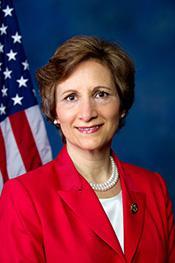
U.S. Representative for Oregon’s 1st district
Democrat
119th Congress, two-year term
Missed 1.2% of roll calls. Chamber median 1.9%.
The full voting recordCounts roll calls where most Democrats and most Republicans voted differently, leaving out procedural votes.
How we countFrom FEC filings, Voteview roll calls and Congress.gov.
Democrat. In Congress since 2012, 8 terms in total.
Following saves Bonamici to your list, which Chamber & Street keeps on its server, linked to a cookie on this browser and not to your name or email. Email alerts will come with constituent verification.
Bills and resolutions where Bonamici is the primary sponsor. Most bills never leave committee; that is normal for every member. Source: Congress.gov, last updated Oct 29, 2026.
39 of 70 have at least one cosponsor from the other party.
Recognizing World Oceans Day and the need to protect, conserve, maintain, and rebuild the ocean and its resources.
Introduced Jun 6, 2025. 3 cosponsors, 2 from the other party. H.Res. 482 on Congress.gov
Introduced
MEALS Act of 2025
Introduced Jun 4, 2025. 1 cosponsor. H.R. 3700 on Congress.gov(opens in a new tab)
Introduced
Mitigating Electronic Access Losses for Students Act of 2025 or the MEALS Act of 2025
This bill requires the Food and Nutrition Service (FNS) to prescribe fraud prevention measures for the Summer Electronic Benefits Transfer (or Summer EBT) program and provide for the replacement of the full amount of a student's stolen benefits. Summer EBT provides electronic benefits that can be redeemed for groceries to households with eligible children over the summer months.
Specifically, using funds provided by FNS, a participating state agency must provide a household with replacement Summer EBT benefits if the state agency determines that the benefits were stolen, and the agency meets certain requirements. The benefits must be equal to the amount of benefits stolen through card skimming, card cloning, or similar fraudulent methods.
Further, for state agencies and Indian tribal organizations that administer the Summer EBT program, FNS must
• issue guidance on security measures that are effective in detecting and preventing the theft of benefits (e.g., through card skimming or card cloning), and
• promulgate regulations to require them to take the appropriate security measures and implement procedures for the replacement of benefits.
In addition, FNS must coordinate with the Department of Justice and the Department of Health and Human Services to establish (1) measures to prevent Summer EBT benefits from being stolen, and (2) standard reporting methods.
Finally, the Government Accountability Office must submit a report to Congress that examines the risks related to Summer EBT benefit payment system security.
Supporting the goals and ideals of "National Honor Our LGBT Elders Day".
Introduced May 17, 2025. 6 cosponsors. H.Res. 424 on Congress.gov(opens in a new tab)
Introduced
Protecting our Students in Schools Act of 2025
Introduced May 8, 2025. 21 cosponsors. H.R. 3265 on Congress.gov(opens in a new tab)
Introduced
FACTS Act
Introduced May 1, 2025. 9 cosponsors, 5 from the other party. H.R. 3130 on Congress.gov(opens in a new tab)
Introduced
Fentanyl Awareness for Children and Teens in Schools Act or the FACTS Act
This bill establishes grant programs and requires strategies and studies to address the misuse of synthetic opioids (i.e., laboratory-derived substances such as fentanyl and its derivatives) among youth.
The bill requires the Department of Health and Human Services (HHS) to award grants to partnerships between educational and health organizations for prevention, treatment, and recovery efforts related to the use of synthetic opioids by middle and high school-aged children. It also allows school-based health centers to use existing HHS grants to purchase naloxone to reverse the effects of opioid overdoses and to establish programs to address misuse of synthetic opioids.
Also, the bill authorizes state educational agencies to use certain Department of Education (ED) grant funds to provide training to school personnel on addressing students’ misuse of synthetic opioids. State and local educational agencies must also address such misuse in their educational plans in order to qualify for certain ED grants.
Finally, the bill (1) establishes an interagency taskforce to coordinate federal efforts to address synthetic opioid misuse among youth, (2) requires an evaluation of the State Unintentional Drug Overdose Reporting System’s effectiveness in identifying the specific synthetic opioids causing youth overdoses, (3) expands the data reported by the National Center for Education Statistics to include information about the use of synthetic opioids in schools, and (4) requires two recurring HHS surveys to include questions on youth exposure to synthetic opioids.
Of inquiry requesting the President, and directing the Secretary of Health and Human Services, to transmit respectively, to the House of Representatives certain documents relating to the elimination of the Administration for Community Living-.
Introduced Apr 24, 2025. 10 cosponsors. H.Res. 344 on Congress.gov(opens in a new tab)
Introduced
Early Childhood Nutrition Improvement Act
Introduced Apr 10, 2025. 20 cosponsors, 4 from the other party. H.R. 2818 on Congress.gov(opens in a new tab)
Introduced
Save Our Seas 2.0 Amendments Act
Introduced Apr 3, 2025. 2 cosponsors, 2 from the other party. H.R. 2620 on Congress.gov(opens in a new tab)
Introduced
Arts Education for All Act
Introduced Mar 31, 2025. 43 cosponsors, 2 from the other party. H.R. 2485 on Congress.gov(opens in a new tab)
Introduced
Arts Education for All Act
This bill expands arts education and programming for children in early education, K-12 students, and juveniles and adults in the criminal justice system.
Specifically, the bill allows Child Care and Development Block Grant funding to be used for additional activities, including arts programming.
Additionally, the bill addresses arts programming in elementary and secondary schools by
• directing each state educational agency to include information on arts programming in its state plan, including how it will integrate arts education instruction into the curriculum and increase the number of arts teachers in schools;
• requiring state report cards to include information on arts courses;
• requiring local educational agency (LEA) plans to describe how the LEA will encourage the use of arts education to improve student achievement; and
• allowing certain funds to be used for professional development for arts teachers.
The bill directs the National Center for Education Research to carry out research on the use of arts and arts education in elementary and secondary schools, including in low-performing schools. Further, the National Center for Education Statistics must compile data on arts education.
The National Assessment of Educational Progress must include a specified arts assessment.
The bill requires a state's juvenile justice and delinquency plan to describe how the state will coordinate services and activities for juvenile justice and delinquency prevention with arts agencies and arts organizations. Additionally, grants for adult offender reentry demonstration projects may be used for facilitating arts education.
Expressing support for the designation of the third week of March 2025 as "National CACFP Week".
Introduced Mar 18, 2025. 4 cosponsors. H.Res. 228 on Congress.gov(opens in a new tab)
Introduced
This resolution recognizes the role of the Child and Adult Care Food Program (commonly referred to as CACFP) in improving the health of the country's most vulnerable children and adults in Head Start programs, child care programs, family day care homes, emergency shelters, adult day care homes, and after-school care by providing nutritious meals and snacks.
It also supports the designation of National CACFP Week.
Recognizing the essential work of the League of Oregon Cities.
Introduced Mar 11, 2025. 4 cosponsors. H.Con.Res. 19 on Congress.gov(opens in a new tab)
Introduced
SAFE Lending Act of 2025
Introduced Feb 27, 2025. 3 cosponsors. H.R. 1658 on Congress.gov(opens in a new tab)
Introduced
Stopping Abuse and Fraud in Electronic Lending Act of 2025 or the SAFE Lending Act of 2025
This bill creates additional consumer protections applicable to certain credit and banking transactions, including matters concerning remotely created checks, electronic fund transfers, registration of small-dollar lenders, overdraft fees, and the collection of personal information.
Under the bill, remotely created checks may only be issued by a person specifically designated in writing by a consumer. The consumer must provide the designation to the consumer's depository institution. (A remotely created check is a check not issued by the bank and not signed by the account owner.)
A voluntary agreement to repay a small-dollar consumer credit transaction by an electronic fund transfer is subject to certain protections, including the right of the consumer to stop payment.
Small-dollar consumer credit providers must register with the Consumer Financial Protection Bureau. Any small-dollar consumer credit transaction is subject to the laws of the state in which the consumer resides.
The bill also prohibits overdraft fees on prepaid accounts.
START Housing Act of 2025
Introduced Feb 12, 2025. 9 cosponsors, 2 from the other party. H.R. 1231 on Congress.gov(opens in a new tab)
Introduced
Project Turnkey Act
Introduced Feb 6, 2025. 16 cosponsors. H.R. 1042 on Congress.gov(opens in a new tab)
Introduced
Expressing support for the Nation's local public K-12 schools and condemning any actions that would defund public education or weaken or dismantle the Department of Education.
Introduced Feb 4, 2025. 99 cosponsors. H.Res. 94 on Congress.gov(opens in a new tab)
Introduced
This resolution supports federal investment in public K-12 schools, affirms that the Department of Education (ED) plays a vital role in the public education system, and states that public education funding should not be diverted (e.g., through the use of vouchers) to privately run K-12 schools.
The resolution also rejects any claim that the executive branch has the legal authority to (1) dismantle or relocate ED or any of its major offices; or (2) reduce federal funding for public education, block federal grants for education, or transfer funding burdens for education to state and local governments.
SAD Act
Introduced Jan 31, 2025. 86 cosponsors. H.R. 846 on Congress.gov(opens in a new tab)
Introduced
Stop Antiabortion Disinformation Act or the SAD Act
This bill prohibits deceptive advertising for reproductive health services.
Specifically, the bill makes it unlawful for a person (i.e., individual, partnership, corporation, association, or organization) to deceptively advertise the reproductive health services they offer, including by misrepresenting that the person (1) offers or provides contraception or abortion services (or referrals for such contraception or abortion services), or (2) employs or offers access to licensed medical personnel.
The bill provides for enforcement by the Federal Trade Commission.
In addition to any other penalty, violations are subject to a civil penalty that may not exceed the greater of $100,000 (adjusted annually for inflation) or 50% of the revenue earned during the preceding 12-month period by the ultimate parent entity of the person who violated the bill.
Harmful Algal Bloom and Hypoxia Research and Control Amendments Act of 2025
Introduced Jan 23, 2025. 6 cosponsors, 1 from the other party. H.R. 644 on Congress.gov(opens in a new tab)
Introduced
Harmful Algal Bloom and Hypoxia Research and Control Amendments Act of 2025
This bill extends through FY2030 and modifies the Harmful Algal Bloom and Hypoxia Research and Control Act to address algal blooms and hypoxia (deficiency of oxygen) in U.S. marine, estuarine, and freshwater systems. Harmful algal blooms are high concentrations of algae that may create nuisance or toxic conditions that are harmful to humans, animals, aquatic ecosystems, and the economy.
The bill directs the Inter-Agency Task Force on Harmful Algal Blooms and Hypoxia to submit to Congress an action strategy for harmful algal blooms at least once every five years. The bill also expands the task force's membership to include the Department of Energy.
The bill also expands the duties of the National Oceanic and Atmospheric Administration (NOAA) under the National Harmful Algal Bloom and Hypoxia program. NOAA must also carry out a variety of activities related to monitoring, predicting, preventing, mitigating, and responding to marine, coastal, and Great Lakes harmful algal bloom and hypoxia events. For example, NOAA must establish (1) a national network of observing systems for monitoring, detecting, and forecasting harmful algal blooms; and (2) a national-level incubator program to increase the number of strategies, technologies, and measures available to prevent, mitigate, and control harmful algal blooms.
Additionally, the Environmental Protection Agency must develop and enhance operational freshwater harmful algal bloom monitoring, observing, and forecasting programs in lakes, rivers, and reservoirs and carry out other activities related to researching freshwater harmful algal blooms and hypoxia events.
Build Housing with Care Act of 2025
Introduced Jan 23, 2025. 35 cosponsors. H.R. 646 on Congress.gov(opens in a new tab)
Introduced
Build Housing with Care Act of 2025
This bill establishes a competitive grant program to support co-located childcare and housing facilities. It also requires the Government Accountability Office to study the availability and affordability of childcare for residents of public housing.
Specifically, the Department of Housing and Urban Development must award the grants to eligible entities, which include community development financial institutions, public housing authorities, licensed childcare providers, government entities, housing developers, and consortia of such entities. Entities must use the grants for designing, planning, constructing, acquiring, renovating, or otherwise supporting new or existing housing facilities with childcare providers on the same premises or nearby.