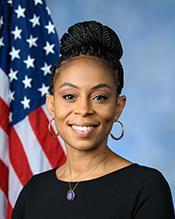
U.S. Representative for Ohio’s 11th district
Democrat
119th Congress, two-year term
Missed 0.0% of roll calls. Chamber median 1.9%.
The full voting recordCounts roll calls where most Democrats and most Republicans voted differently, leaving out procedural votes.
How we countFrom FEC filings, Voteview roll calls and Congress.gov.
Democrat. In Congress since 2021, 3 terms in total.
Following saves Brown to your list, which Chamber & Street keeps on its server, linked to a cookie on this browser and not to your name or email. Email alerts will come with constituent verification.
Bills and resolutions Brown signed on to as a cosponsor. An original cosponsor signed on the day the bill was introduced. Source: govinfo bill status files, last updated Nov 6, 2026.
Election Mail Act
Sponsor Nikema Williams (D). Original cosponsor. 54 cosponsors. H.R. 4915 on Congress.gov
Introduced
Election Mail Act
This bill addresses the delivery and processing of election mail for federal elections, including by establishing certain standards for mail-in ballots.
Specifically, the bill requires the U.S. Postal Service (USPS) to
• ensure (to the maximum extent practicable) same-day processing of mail-in ballots,
• postmark each ballot,
• carry election mail (e.g., voter registration applications and mail-in ballots) as first-class mail that is free of postage,
• appoint an election mail coordinator at each area office and district office, and
• consult annually with Indian tribes regarding barriers to voting for eligible voters living on Indian lands.
The bill prohibits the USPS, within 120 days of a federal election, from making any operational change that would restrict the prompt and reliable delivery of election mail.
Each state and jurisdiction must provide with each mail-in ballot a return envelope with an intelligent mail barcode. This requirement does not apply to a state or jurisdiction that uses an alternative system that enables voters to track the ballot through the mail.
The bill requires election officials to count mail-in ballots that are postmarked by election day and arrive within seven days after the election.
Unhoused Voter Opportunity Through Elections Act
Sponsor Nikema Williams (D). Original cosponsor. 51 cosponsors. H.R. 4914 on Congress.gov(opens in a new tab)
Introduced
Unhoused Voter Opportunity Through Elections Act or the Unhoused VOTE Act
This bill expands voter registration and voting access for unhoused individuals.
The bill specifies that no state or political subdivision may deny or abridge the right of any U.S. citizen to vote because the citizen resides at or in a nontraditional abode.
Additionally, the bill requires jurisdictions that allow for ballot drop boxes to ensure that these drop boxes are available for in-person use and are accessible and clearly labeled.
If a state requires individuals to show proof of residence in order to vote in a federal election, then the state must accept the individual’s written attestation of residence. A state may not prohibit an individual who is residing in a homeless shelter from using the shelter as the individual’s residence for purposes of voting in a federal election.
The bill requires chief state election officials to conduct outreach to unhoused individuals.
The bill directs the Election Assistance Commission to (1) develop best practices for election officials regarding voter registration and voting access for unhoused individuals, and (2) make grants to eligible states and local governments for programs and activities to support access to voting for unhoused individuals.
The bill also revises the National Voter Registration Act of 1993, including by (1) treating emergency shelters as voter registration agencies, and (2) allowing an unhoused individual to use an unsheltered street location as the individual's place of residence for purposes of a voter registration application.
CHALLENGES Act
Sponsor Nikema Williams (D). Original cosponsor. 33 cosponsors. H.R. 4913 on Congress.gov(opens in a new tab)
Introduced
Help America Run Act
Sponsor Nikema Williams (D). Original cosponsor. 34 cosponsors. H.R. 4912 on Congress.gov(opens in a new tab)
Introduced
POLL Act
Sponsor Nikema Williams (D). Original cosponsor. 39 cosponsors. H.R. 4911 on Congress.gov(opens in a new tab)
Introduced
People Over Long Lines Act or the POLL Act
This bill sets forth provisions related to voting and the administration of federal elections.
Specifically, the bill requires states to ensure that voters wait no more than 30 minutes at any polling place to cast their vote in a federal election, establishes a private right of action for voters who experience longer waiting times, and directs the Election Assistance Commission to make payments to eligible states to prevent unreasonable waiting times.
Next, the bill requires each state to provide for the minimum required number of voting systems, poll workers, and other election resources for each polling location on the day of any federal election and each day of early voting. The Department of Justice's Civil Rights Division must issue uniform standards regarding the minimum number and distribution of such systems, workers, and other resources.
The bill also prohibits a chief state election administration official from taking an active part in political management or in a political campaign with respect to any federal election over which the official has supervisory authority, with certain exceptions.
Sustaining Our Democracy Act
Sponsor Nikema Williams (D). Original cosponsor. 57 cosponsors. H.R. 4910 on Congress.gov(opens in a new tab)
Introduced
Sustaining Our Democracy Act
This bill establishes and provides funds through FY2035 for the State Election Assistance and Innovation Trust Fund for purposes of promoting election activities.
Specifically, the bill establishes the Democracy Advancement and Innovation Program, through which the Office of Democracy Advancement and Innovation (also established by this bill) shall make allocations to states for carrying out democracy promotion activities. These activities include improving the administration of federal elections, recruiting and training nonpartisan election officials and poll workers, and increasing voting access.
The bill requires each state, in order to receive allocated funds, to (1) submit a plan for approval that describes how the state will distribute resources and carry out democracy promotion activities, and (2) establish uniform and nondiscriminatory state-based administrative complaint procedures.
The bill prohibits states from using funds for certain activities, including any activity that diminishes the ability of any eligible voter to participate in the electoral process.
Voters on the Move Registration Act of 2025
Sponsor Nikema Williams (D). Original cosponsor. 52 cosponsors. H.R. 4909 on Congress.gov(opens in a new tab)
Introduced
Time Off to Vote Act
Sponsor Nikema Williams (D). Original cosponsor. 54 cosponsors. H.R. 4908 on Congress.gov(opens in a new tab)
Introduced
Time Off to Vote Act
This bill requires an employer, upon the request of an employee, to provide the employee with a minimum of two consecutive hours of paid leave while polls or sites that facilitate voting-related activity are open on the day of a federal election. This allotted time may be used to vote, return a mail-in ballot, or perform other voting-related activities.
The employer may determine the two-hour period, excluding any lunch break or other break.
Taking such leave shall not result in the employee losing accrued employment benefits.
The bill makes it unlawful for an employer to interfere with the right to take such leave or for an employer to discriminate against an employee for taking such leave. Further, the bill makes it unlawful for any employer to retaliate against an employee for (1) opposing any practice made unlawful by this bill; (2) filing a charge, or instituting or causing to be instituted any proceeding, under or related to this bill; or (3) testifying or preparing to testify in an inquiry or proceeding relating to such leave.
The bill specifies penalties for employers who violate these provisions.
Deceptive Practices and Voter Intimidation Prevention Act of 2025
Sponsor Jennifer McClellan (D). Original cosponsor. 34 cosponsors. H.R. 4894 on Congress.gov(opens in a new tab)
Introduced
Deceptive Practices and Voter Intimidation Prevention Act of 2025
This bill generally prohibits deceptive communications and voter interference regarding federal elections.
Specifically, the bill prohibits any person, within 60 days before a federal election, from communicating, causing to be communicated, or producing for communication certain information on voting, if the person (1) knows such information to be materially false, and (2) has the intent to impede or prevent another person from voting in an election.
Additionally, the bill prohibits any person, within 60 days before a federal election, from using an artificial intelligence system to produce certain information on voting, if the person has the intent to use the system to (1) produce false information, and (2) impede or prevent another person from voting in an election.
The bill also prohibits hindering, interfering with, or preventing voting or registering to vote.
A private right of action for preventive relief is established for persons aggrieved by violations of these prohibitions.
Criminal penalties are also established for violations.
If the Department of Justice (DOJ) receives a credible report that materially false information has been or is being communicated in violation of the prohibitions on deceptive communications, and state and local election officials have not adequately communicated corrected information, then DOJ must communicate to the public accurate information designed to correct the materially false information.
The bill extends the prohibition on certain types of intimidation in federal elections to also prohibit intimidation for processing ballots or tabulating, canvassing, or certifying votes.
Global Fragility Reauthorization Act
Sponsor Sara Jacobs (D). Joined Aug 1, 2025. 6 cosponsors. H.R. 3005 on Congress.gov(opens in a new tab)
Introduced
Gun Violence Prevention Research Act of 2025
Sponsor Marilyn Strickland (D). Original cosponsor. 54 cosponsors. H.R. 4821 on Congress.gov(opens in a new tab)
Introduced
Gun Violence Prevention Research Act of 2025
This bill authorizes the Centers for Disease Control and Prevention to conduct or support research on firearms safety or gun violence prevention.
Empowering and Enforcing Environmental Justice Act of 2025
Sponsor Nanette Barragán (D). Joined Jul 29, 2025. 18 cosponsors. H.R. 1553 on Congress.gov(opens in a new tab)
Introduced
Empowering and Enforcing Environmental Justice Act of 2025
This bill establishes the Office of Environmental Justice within the Department of Justice (DOJ). It also establishes grants to improve the capacity of state, local, and tribal governments to enforce environmental laws involving environmental justice matters. (On February 5, 2025, DOJ issued a directive to close its Office of Environmental Justice by March 15, 2025.)
Fix Our Flooded Basements Act of 2025
Sponsor Rashida Tlaib (D). Original cosponsor. 22 cosponsors. H.R. 4774 on Congress.gov(opens in a new tab)
Introduced
Fix Our Flooded Basements Act of 2025
This bill expands the disaster assistance provided to individuals and households for repairs to and property in flood-damaged basements. It also expands eligibility and coverage for certain group flood insurance.
Under current law, the Individual Assistance (IA) program of the Federal Emergency Management Agency (FEMA) limits home repair assistance for flood-damaged basements to damage affecting the safety, sanitation, or functionality of the home (e.g., structural damage, hazardous conditions). The bill allows home repair assistance for disaster-caused mold, mildew, and moisture damage in basements regardless of whether the damage affects safety, sanitation, or functionality. Additionally, flood-damaged basements are eligible for home repair assistance even when the basement is not required for occupying the dwelling.
Also, currently, IA assistance for flood-damaged personal property in basements is limited to washers, dryers, and property essential for occupying the dwelling. The bill expands IA personal property assistance to more broadly cover property damaged by disaster-caused flooding in basements. The scope of such assistance must at least equal the coverage for such damage by a standard policy under the National Flood Insurance Program (e.g., covering air conditioning units and freezers in basements).
Additionally, FEMA must expand the eligibility and coverage of the group flood insurance it provides to IA recipients, including increasing the maximum coverage and expanding coverage for basements.
The bill also excludes from the maximum for IA housing assistance expenses for (1) hazard mitigation measures in flood-damaged basements, and (2) premiums for group flood insurance policies.
Civil Rights Cold Case Records Collection Reauthorization Act
Sponsor Bonnie Watson Coleman (D). Joined Jul 25, 2025. 21 cosponsors. H.R. 3087 on Congress.gov(opens in a new tab)
Passed committee
Freedom to Move Act
Sponsor Ayanna Pressley (D). Original cosponsor. 26 cosponsors. H.R. 4719 on Congress.gov(opens in a new tab)
Introduced
Freedom to Move Act
This bill directs the Department of Transportation to award competitive five-year grants (i.e., Freedom to Move Grants) to states, local governments, transit agencies, and nonprofit organizations in both rural and urban areas to cover the lost fare revenue for fare-free public transportation and improve public transportation.
Grants must be used to support (1) implementing a fare-free transit program; and (2) efforts to improve public transportation, particularly in underserved communities, such as costs associated with efforts to provide more safe, frequent, and reliable bus service, including bus stop safety and accessibility improvements, and pedestrian and bike shelters.
Unearth America’s Future Act
Sponsor Haley Stevens (D). Joined Jul 23, 2025. 3 cosponsors. H.R. 4350 on Congress.gov(opens in a new tab)
Introduced
EACH Act of 2025
Sponsor Ayanna Pressley (D). Original cosponsor. 202 cosponsors. H.R. 4611 on Congress.gov(opens in a new tab)
Introduced
Proposing an amendment to the Constitution of the United States providing that there is no immunity from criminal prosecution for an act on the grounds that such act was within the constitutional authority or official duties of an individual, and providing that the President may not grant a pardon to himself or herself.
Sponsor Joseph Morelle (D). Original cosponsor. 187 cosponsors. H.J.Res. 108 on Congress.gov(opens in a new tab)
Introduced
Expressing the sense of the House of Representatives on Nelson Mandela International Day.
Sponsor Henry Johnson (D). Original cosponsor. 19 cosponsors. H.Res. 592 on Congress.gov(opens in a new tab)
Introduced
Black Farmers and Socially Disadvantaged Farmers Increased Market Share Act
Original cosponsor. 22 cosponsors. H.R. 4529 on Congress.gov(opens in a new tab)
Progress not on file
Equity in Government Act
Sponsor Ayanna Pressley (D). Original cosponsor. 42 cosponsors. H.R. 4524 on Congress.gov(opens in a new tab)
Introduced
Ethan's Law
Sponsor Rosa DeLauro (D). Joined Jul 16, 2025. 202 cosponsors. H.R. 1564 on Congress.gov(opens in a new tab)
Introduced
Ethan's Law
This bill establishes a framework to regulate the storage of firearms on residential premises at the federal, state, and tribal levels.
At the federal level, the bill establishes statutory requirements for firearms on residential premises to be safely stored if a minor is likely to gain access without permission or if a resident is ineligible to possess a firearm.
An individual who violates the requirements is subject to criminal penalties. A firearm stored in violation of the requirements is subject to seizure and forfeiture.
At the state and tribal levels, the bill requires the Department of Justice to award grants to implement functionally identical requirements for the safe storage of firearms.
Child Care for Working Families Act
Sponsor Robert Scott (D). Original cosponsor. 107 cosponsors. H.R. 4418 on Congress.gov(opens in a new tab)
Introduced
Uterine Cancer Study Act of 2025
Sponsor Yvette Clarke (D). Original cosponsor. 38 cosponsors. H.R. 4396 on Congress.gov(opens in a new tab)
Introduced
Stephanie Tubbs Jones Uterine Fibroid Research and Education Act of 2025
Sponsor Yvette Clarke (D). Original cosponsor. 77 cosponsors. H.R. 4395 on Congress.gov(opens in a new tab)
Introduced
Stephanie Tubbs Jones Uterine Fibroid Research and Education Act of 2025
This bill directs the Department of Health and Human Services (HHS) to expand research on, and take other actions to address, uterine fibroids. These are muscular tumors that grow in the wall of the uterus and may cause pain, heavy menstrual bleeding, and reproductive issues.
In coordination with the National Institutes of Health and appropriate federal agencies, HHS must undertake research activities on uterine fibroids.
In addition, HHS must establish a database of services furnished to individuals diagnosed with uterine fibroids under Medicaid or the Children's Health Insurance Program and must develop a report on federal and state expenditures for such services.
Additionally, HHS must disseminate information on uterine fibroids to the public and to health care providers, including information on the elevated risk for minority women and available treatments.