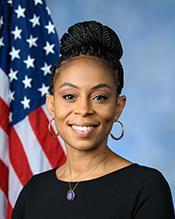
U.S. Representative for Ohio’s 11th district
Democrat
119th Congress, two-year term
Missed 0.0% of roll calls. Chamber median 1.9%.
The full voting recordCounts roll calls where most Democrats and most Republicans voted differently, leaving out procedural votes.
How we countFrom FEC filings, Voteview roll calls and Congress.gov.
Democrat. In Congress since 2021, 3 terms in total.
Following saves Brown to your list, which Chamber & Street keeps on its server, linked to a cookie on this browser and not to your name or email. Email alerts will come with constituent verification.
Bills and resolutions Brown signed on to as a cosponsor. An original cosponsor signed on the day the bill was introduced. Source: govinfo bill status files, last updated Nov 6, 2026.
Recognizing suicide as a serious public health problem, expressing support for the designation of September 8, 2025, as ''988 Day'' and the role of 988 Suicide and Crisis Lifeline, and for other purposes.
Sponsor Wesley Bell (D). Joined Sep 16, 2025. 36 cosponsors. H.Res. 680 on Congress.gov
Introduced
FAMILY Act
Sponsor Rosa DeLauro (D). Original cosponsor. 208 cosponsors. H.R. 5390 on Congress.gov(opens in a new tab)
Introduced
George Floyd Justice in Policing Act of 2025
Sponsor Glenn Ivey (D). Original cosponsor. 136 cosponsors. H.R. 5361 on Congress.gov(opens in a new tab)
Introduced
George Floyd Justice in Policing Act of 2025
This bill addresses a wide range of policies and issues regarding policing practices and law enforcement accountability. It increases accountability for law enforcement misconduct, restricts the use of certain policing practices, enhances transparency and data collection, and establishes best practices and training requirements.
The bill enhances existing enforcement mechanisms to remedy violations by law enforcement. Among other things, it does the following:
• lowers the criminal intent standard—from willful to knowing or reckless—to convict a law enforcement officer for misconduct in a federal prosecution,
• limits qualified immunity as a defense to liability in a private civil action against a law enforcement officer, and
• grants administrative subpoena power to the Department of Justice (DOJ) in pattern-or-practice investigations.
It establishes a framework to prevent and remedy racial profiling by law enforcement at the federal, state, and local levels. It also limits the unnecessary use of force and restricts the use of no-knock warrants, chokeholds, and carotid holds.
The bill creates a national registry—the National Police Misconduct Registry—to compile data on complaints and records of police misconduct. It also establishes new reporting requirements, including on the use of force, officer misconduct, and routine policing practices (e.g., stops and searches).
Finally, it directs DOJ to create uniform accreditation standards for law enforcement agencies and requires law enforcement officers to complete training on racial profiling, implicit bias, and the duty to intervene when another officer uses excessive force.
MORE Act
Sponsor Jerrold Nadler (D). Joined Sep 15, 2025. 74 cosponsors. H.R. 5068 on Congress.gov(opens in a new tab)
Introduced
Marijuana Opportunity Reinvestment and Expungement Act or the MORE Act
This bill decriminalizes marijuana.
Specifically, it removes marijuana from the list of scheduled substances under the Controlled Substances Act and eliminates criminal penalties for an individual who manufactures, distributes, or possesses marijuana.
The bill replaces statutory references to marijuana and marihuana with cannabis.
The bill also makes changes related to the economic impact of decriminalization, including the following:
• requires the Bureau of Labor Statistics to regularly publish demographic data on cannabis business owners and employees,
• establishes a trust fund to support various programs and services for individuals and businesses in communities impacted by the war on drugs,
• imposes an excise tax on cannabis products produced in or imported into the United States and an occupational tax on cannabis production facilities and export warehouses, and
• makes Small Business Administration loans and services available to entities that are cannabis-related legitimate businesses or service providers.
The bill also makes changes to other federal programs and legal processes to account for decriminalization, including the following:
• prohibits the denial of federal public benefits to a person on the basis of certain cannabis-related conduct or convictions,
• prohibits the denial of benefits and protections under immigration laws on the basis of an event (e.g., conduct or conviction) relating to possession or use of cannabis that is no longer prohibited under the bill, and
• establishes a process to expunge convictions and conduct sentencing review hearings related to federal cannabis offenses.
Protect Our Letter Carriers Act of 2025
Sponsor Brian Fitzpatrick (R). Joined Sep 15, 2025. 231 cosponsors. H.R. 1065 on Congress.gov(opens in a new tab)
Introduced
Protect Our Letter Carriers Act of 2025
This bill requires or authorizes certain actions related to the U.S. Postal Service (USPS).
The bill requires the Department of Justice to appoint an assistant U.S. attorney in each judicial district to coordinate and supervise the investigation and prosecution of various crimes related to postal services (for example, assault on a postal service employee, breaking into a post office, or obstruction of mails).
The bill also requires the U.S. Sentencing Commission to amend sentencing guidelines to provide that the assault or robbery of a postal employee shall be treated the same as the assault of a law enforcement officer.
Additionally, the bill authorizes appropriations for the USPS to install high security collection boxes and replace older versions of the universal mailbox key with electronic versions.
Congressional Tribute to Constance Baker Motley Act of 2025
Sponsor Rosa DeLauro (D). Original cosponsor. 209 cosponsors. H.R. 5309 on Congress.gov(opens in a new tab)
Introduced
Recognizing suicide as a serious public health problem and expressing support for the designation of September as "National Suicide Prevention Month" as well as September 10, 2025, as "World Suicide Prevention Day".
Sponsor Shri Thanedar (D). Original cosponsor. 54 cosponsors. H.Res. 697 on Congress.gov(opens in a new tab)
Introduced
This resolution expresses support for the designation of National Suicide Prevention Month and World Suicide Prevention Day.
Endometrial Cancer Research and Education Act of 2025
Original cosponsor. 8 cosponsors. H.R. 5239 on Congress.gov(opens in a new tab)
Progress not on file
SUN Act
Sponsor Sam Liccardo (D). Joined Sep 3, 2025. 56 cosponsors. H.R. 4998 on Congress.gov(opens in a new tab)
Introduced
Assault Weapons Ban of 2025
Sponsor Lucy McBath (D). Joined Sep 2, 2025. 194 cosponsors. H.R. 3115 on Congress.gov(opens in a new tab)
Introduced
Assault Weapons Ban of 2025
This bill makes it a crime to knowingly import, sell, manufacture, transfer, or possess a semiautomatic assault weapon (SAW) or large capacity ammunition feeding device (LCAFD).
The prohibition does not apply to a firearm that is (1) manually operated by bolt, pump, lever, or slide action, except for certain shotguns; (2) permanently inoperable; (3) an antique; (4) only capable of firing rimfire ammunition; or (5) a rifle or shotgun specifically identified by make and model.
The bill also exempts from the prohibition the following, with respect to a SAW or LCAFD:
• importation, sale, manufacture, transfer, or possession related to certain law enforcement efforts, or authorized tests or experiments;
• importation, sale, transfer, or possession related to securing nuclear materials; and
• possession by a retired law enforcement officer.
The bill permits continued possession, sale, or transfer of a grandfathered SAW, which must be securely stored. A licensed gun dealer must conduct a background check prior to the sale or transfer of a grandfathered SAW between private parties.
The bill permits continued possession of, but prohibits sale or transfer of, a grandfathered LCAFD.
Newly manufactured LCAFDs must display serial number identification. Newly manufactured SAWs and LCAFDs must display the date of manufacture.
The bill also allows a state or local government to use Edward Byrne Memorial Justice Assistance Grant Program funds to compensate individuals who surrender a SAW or LCAFD under a buy-back program.
Health Care Affordability Act of 2025
Sponsor Lauren Underwood (D). Joined Sep 2, 2025. 165 cosponsors. H.R. 247 on Congress.gov(opens in a new tab)
Introduced
Health Care Affordability Act of 2025
This bill makes permanent temporary changes enacted by the American Rescue Plan Act of 2021 (ARPA) and the Inflation Reduction Act of 2022 (IRA) that generally expand eligibility for and increase the amount of the premium tax credit.
Currently, eligible taxpayers may be able to claim the premium tax credit, which applies toward the cost of obtaining health insurance through health insurance exchanges. To be eligible for the premium tax credit, a taxpayer’s household income must meet or exceed 100% of the federal poverty level (FPL) and, after 2025, may not exceed 400% of the FPL (maximum income limit). For 2021-2025, the ARPA and IRA eliminated the maximum income limit, which generally expands eligibility for the premium tax credit.
Further, under current law, the amount of the premium tax credit is (1) generally the plan premium (conditions apply), minus (2) the taxpayer’s household income multiplied by the applicable percentage. The applicable percentage is a specific percentage that varies depending on which of six income ranges (adjusted for inflation after 2025) the taxpayer’s household income falls within. For 2021-2025, the ARPA and IRA lowered the applicable percentages and eliminated the adjustment of the applicable percentages for inflation, which generally increases the amount of the premium tax credit.
The bill makes permanent the elimination of the 400% maximum income limit, the lower applicable percentages, and the elimination of the inflation adjustment for the applicable percentages.
Increasing Nutrition Access for Seniors Act of 2025
Sponsor Josh Riley (D). Original cosponsor. 15 cosponsors. H.R. 5055 on Congress.gov(opens in a new tab)
Introduced
Terminating the emergency determined by the President on August 11, 2025, in the Executive Order titled "Declaring a crime emergency in the District of Columbia".
Sponsor Jamie Raskin (D). Joined Aug 22, 2025. 103 cosponsors. H.J.Res. 115 on Congress.gov(opens in a new tab)
Introduced
Cybersecurity Hiring Modernization Act
Sponsor Nancy Mace (R). Original cosponsor. 2 cosponsors. H.R. 5000 on Congress.gov(opens in a new tab)
Passed committee
Crime Victims Fund Stabilization Act of 2025
Sponsor Ann Wagner (R). Joined Aug 15, 2025. 327 cosponsors. H.R. 909 on Congress.gov(opens in a new tab)
Passed the House
Crime Victims Fund Stabilization Act of 2025
This bill adds a new source of revenue for the Crime Victims Fund (CVF). Specifically, the bill requires certain civil monetary penalties collected from settlements and judgments in cases involving fraud and false claims against the federal government to be deposited into the CVF through FY2029.
The CVF supports federal, state, and local programs and activities to compensate and assist victims of crimes. Currently, the CVF is funded by deposits from a variety of sources, including federal criminal fines, penalties, and assessments; forfeited bail bonds; and certain other gifts, donations, and bequests.
To amend the Clean Air Act with respect to the ethanol waiver for Reid Vapor Pressure under that Act, and for other purposes.
Sponsor Adrian Smith (R). Joined Aug 15, 2025. 55 cosponsors. H.R. 1346 on Congress.gov(opens in a new tab)
Passed the House
Nationwide Consumer and Fuel Retailer Choice Act of 2025
This bill amends the Clean Air Act to address the limitations on Reid Vapor Pressure (a measure of gasoline's volatility) that are placed on gasoline during the summer ozone season. Specifically, the bill applies the waiver for Reid Vapor Pressure requirements that is applicable to gasoline blended with 10% ethanol (E10) to gasoline blended with up to 15% ethanol (E15). This change allows gasoline that is blended with 10% to 15% ethanol to be sold year-round.
Currently, states may be excluded from the waiver for Reid Vapor Pressure requirements by submitting documentation supporting that the waiver would increase air pollution. The bill nullifies existing state exclusions, but states may submit documentation after enactment of the bill to be excluded going forward.
The bill also modifies the Renewable Fuel Standard Program, which requires transportation fuel sold or introduced into commerce in the United States to contain minimum volumes of renewable fuel. Under the existing program, obligated parties, such as small refineries, must satisfy the volume obligations by either blending renewable fuels into their gasoline or diesel fuel products or by acquiring credits that represent the required renewable fuel volume. The bill directs the Environmental Protection Agency to return compliance credits to small refineries under certain circumstances.
Original Slavery Remembrance Day Resolution
Sponsor Al Green (D). Original cosponsor. 29 cosponsors. H.J.Res. 113 on Congress.gov(opens in a new tab)
Introduced
Keep Seniors Fed Act
Sponsor Jill Tokuda (D). Original cosponsor. 38 cosponsors. H.R. 4967 on Congress.gov(opens in a new tab)
Introduced
Keep Seniors Fed Act
This bill amends the Supplemental Nutrition Assistance Program (SNAP) to exempt certain Social Security benefits (e.g., retirement and disability benefits) from household income for the purposes of determining program eligibility.
Providing for consideration of the bill (H.R. 185) to advance responsible policies.
Sponsor Thomas Massie (R). Joined Aug 8, 2025. 50 cosponsors. H.Res. 581 on Congress.gov(opens in a new tab)
Introduced
This resolution provides a special rule for consideration of H.R. 185 and amends that bill to direct the Department of Justice (DOJ) to make publicly available certain records related to Jeffrey Epstein or Ghislaine Maxwell.
Under H.R. 185, as amended by the resolution, DOJ must publicly disclose all unclassified records, documents, communications, and investigative materials in its possession that relate to Epstein or Maxwell. The records include unclassified records referring or relating to Epstein's detention and death; flight logs of aircraft owned or used by Epstein; individuals named in connection with Epstein’s criminal activities, civil settlements, or immunity or plea agreements; immunity deals, sealed settlements, or plea bargains of Epstein or his associates; entities with ties to Epstein’s trafficking or financial networks; and internal Department of Justice communications concerning decisions to investigate or charge Epstein or his associates.
However, under the amended bill, DOJ may withhold or redact portions of records with written justification that such portions contain (1) victims' personally identifiable information; (2) child sexual abuse materials; (3) images of death, physical abuse, or injury; (4) information which would jeopardize an active federal investigation or prosecution; or (5) classified information. DOJ may not withhold or redact records on the basis of embarrassment, reputational harm, or political sensitivity.
Further, within 15 days of completing the required disclosures, DOJ must provide Congress with a report listing all categories of records released and withheld, all redactions made and their legal basis, and all government officials and politically exposed persons named or referenced in the released materials.
Click to Cancel Act of 2025
Sponsor Brad Sherman (D). Joined Aug 8, 2025. 19 cosponsors. H.R. 4819 on Congress.gov(opens in a new tab)
Introduced
Veteran Burial Timeliness and Death Certificate Accountability Act
Sponsor Tom Emmer (R). Joined Aug 8, 2025. 158 cosponsors. H.R. 4398 on Congress.gov(opens in a new tab)
Introduced
Military Spouse Hiring Act
Sponsor Donald Beyer (D). Joined Aug 8, 2025. 130 cosponsors. H.R. 2033 on Congress.gov(opens in a new tab)
Introduced
Military Spouse Hiring Act
This bill allows employers to claim a tax credit for a percentage of qualified wages paid to an employee who is a military spouse by expanding the federal Work Opportunity Tax Credit (WOTC) to add qualified military spouses as a targeted group. (The WOTC applies to employers who hire members of specific targeted groups, such as veterans, ex-felons, and long-term unemployment recipients, and is generally equal to a percentage of the wages paid to such individuals in the first year of employment, up to a maximum amount. Under current law, the wages must be paid before 2026.)
The bill defines a qualified military spouse as any individual who is certified by a state workforce agency as being (as of the hiring date) a spouse of a member of the Armed Forces.
Designating the week of August 3 through August 9, 2025, as "National Farmers Market Week".
Sponsor David Valadao (R). Original cosponsor. 11 cosponsors. H.Res. 638 on Congress.gov(opens in a new tab)
Introduced
This resolution supports the designation of National Farmers Market Week. The resolution also recognizes the vital role that farmers markets play in bringing communities together and in supporting the livelihoods of millions of people in the United States.
Expanding the VOTE Act
Sponsor Nikema Williams (D). Original cosponsor. 72 cosponsors. H.R. 4917 on Congress.gov(opens in a new tab)
Introduced
Expanding the Voluntary Opportunities for Translations in Elections Act or the Expanding the VOTE Act
This bill expands access to voting materials for individuals with limited proficiency in the English language.
Section 203 of the Voting Rights Act of 1965 (VRA) requires covered states and political subdivisions to provide voting materials and other language assistance to persons who are American Indian, Asian American, Alaskan Natives, or of Spanish heritage and whose ability to speak or understand English limits electoral participation. A state or political subdivision that is subject to Section 203 is prohibited from providing English-only voting materials in an election. Among other requirements, this bill (1) requires the Department of Justice to issue a notice of prohibition, including the trigger threshold at which the prohibition applies, to certain states and political subdivisions; and (2) requires covered states and political subdivisions to provide written translations of all voting materials, with the consent of any applicable tribal government, to election workers.
Additionally, the bill requires the Election Assistance Commission to make incentive grants for states and political subdivisions to provide translated voting materials.
The bill also directs the Government Accountability Office to study and report on the impact of (1) reducing the threshold requirement under Section 203 of the VRA, and (2) expanding the definition of language minorities to include native speakers of additional languages.
Youth Voting Rights Act
Sponsor Nikema Williams (D). Original cosponsor. 47 cosponsors. H.R. 4916 on Congress.gov(opens in a new tab)
Introduced
Youth Voting Rights Act
This bill expands voting access for youth.
Specifically, the bill establishes a private right of action to enforce the Twenty-Sixth Amendment, which prohibits denying or abridging the right to vote based on age. Further, the bill authorizes the Department of Justice to enforce the Twenty-Sixth Amendment against age-based restrictions for voting by mail.
Additionally, the bill directs each state to
• designate as voter registration agencies all offices within public institutions of higher education (IHEs) that provide assistance to students,
• implement a preregistration process to allow minors who are 16 years or older to register to vote in federal elections that take place when or after the preregistered individual turns age 18, and
• ensure the availability of polling places on campuses of IHEs (with the availability of waivers).
The bill prohibits durational residency requirements for voting in all federal elections. Currently, this prohibition applies only to voting for the offices of President and Vice President.
States and local jurisdictions with voter identification requirements must treat IHE-issued student identification cards as voter identification.
The Election Assistance Commission (EAC) must make grants to states to increase the involvement of individuals under age 18 in public election activities.
The Government Accountability Office must report to Congress on trends related to voter registration, absentee voting, and provisional voting. The EAC must also collect and make publicly available certain data from states.