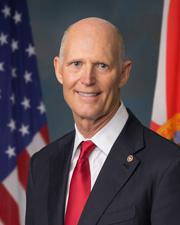
U.S. Senator for Florida
Republican
Senate term end not loaded yet
Missed 0.2% of roll calls. Chamber median 2.1%.
The full voting recordCounts roll calls where most Democrats and most Republicans voted differently, leaving out procedural votes.
How we countFrom FEC filings, Voteview roll calls and Congress.gov.
Republican. In Congress since 2019, 2 terms in total.
Following saves Scott to your list, which Chamber & Street keeps on its server, linked to a cookie on this browser and not to your name or email. Email alerts will come with constituent verification.
Bills and resolutions where Scott is the primary sponsor. Most bills never leave committee; that is normal for every member. Source: Congress.gov, last updated Oct 29, 2026.
42 of 191 have at least one cosponsor from the other party.
Decoupling from Foreign Adversarial Battery Dependence Act
Introduced Feb 6, 2025. 1 cosponsor, 1 from the other party. S. 450 on Congress.gov
Introduced
Decoupling from Foreign Adversarial Battery Dependence Act
This bill prohibits the Department of Homeland Security (DHS) from using appropriated funds to procure a battery produced by certain entities, particularly six specific companies owned and operated in China. This prohibition begins on October 1, 2027.
The bill allows DHS to waive the prohibition if DHS assesses in the affirmative that (1) the batteries to be procured do not pose a risk to U.S. national security, data, or infrastructure; and (2) there is no available alternative to procure batteries that are of similar or better cost and quality and that are produced by an entity not specified in this bill.
DHS may also waive the prohibition upon a determination that the batteries to be procured are for the sole purpose of research, evaluation, training, testing, or analysis.
The bill requires DHS to notify Congress within 15 days after granting a waiver under this bill.
The bill also requires DHS to report to Congress on the anticipated impacts associated with carrying out this bill, including with respect to specified agencies of DHS.
SENIOR Act
Introduced Feb 6, 2025. 3 cosponsors, 2 from the other party. S. 473 on Congress.gov(opens in a new tab)
Introduced
Social Engagement and Network Initiatives for Older Relief Act or the SENIOR Act
This bill expands the scope of authorized Administration on Aging (AOA) grants to include services addressing loneliness in older individuals (i.e., aged 60 or older), and requires a report evaluating whether certain federal programs are adequately addressing this topic.
Under current law, the AOA provides grants to states for disease prevention and health promotion services for older individuals, including services addressing the negative health effects of social isolation. The bill expands the scope of the services eligible for these grants to include services addressing the negative health effects of loneliness.
Also, the bill requires the Department of Health and Human Services to submit to Congress a report (1) evaluating whether its programs for older individuals are adequately addressing loneliness, and (2) recommending measures for reducing the negative health effects of loneliness and fostering multigenerational family connections.
DEMOCRACIA Act
Introduced Feb 6, 2025. 2 cosponsors. S. 488 on Congress.gov(opens in a new tab)
Introduced
Denying Earnings to the Military Oligarchy in Cuba and Restricting Activities of the Cuban Intelligence Apparatus Act or the DEMOCRACIA Act
This bill provides for asset- and visa-blocking sanctions for conduct relating to Cuba. It also establishes an interagency task force to facilitate access to uncensored internet in Cuba.
The President must sanction foreign persons that engage in a transaction with or provide financial, material, or technological support to certain entities or individuals, including
• specified Cuban government sectors (e.g., the defense sector);
• any other government sector that the President certifies is involved in human rights abuses or terrorism;
• foreign persons that are military contractors or mercenaries operating on behalf of the Cuban government; or
• foreign persons that violate laws restricting trade with Cuba.
Other individuals or entities the President must sanction include
• foreign persons responsible for or complicit in human rights abuses in Cuba;
• Cuban officials responsible for or complicit in corruption; and
• members of Cuba's Communist Party.
The bill provides certain exceptions to these sanctions and the President may waive the sanctions in the interest of U.S. national security. The President may not license sanctionable conduct. U.S. persons seeking to engage in a sanctionable financial transaction must submit a written request to the Department of the Treasury's Office of Foreign Asset Control.
The authority to impose sanctions under this bill ends when the President certifies that the Cuban government has taken specified steps to promote political rights and freedoms and Congress enacts a joint resolution approving the certification.
NO GOTION Act
Introduced Feb 3, 2025. 0 cosponsors. S. 369 on Congress.gov(opens in a new tab)
Introduced
No Official Giveaways Of Taxpayers’ Income to Oppressive Nations Act or the NO GOTION Act
This bill prohibits certain entities associated with China, Cuba, Iran, North Korea, Russia, or the Maduro regime of Venezuela from claiming various energy-related federal tax incentives.
Specifically, certain energy-related federal tax incentives may not be claimed by
• the government, a government instrumentality, or an agency of China, Cuba, Iran, North Korea, Russia, or the regime of Nicolas Maduro in Venezuela;
• any entity that is organized under the laws of or is headquartered in one of these countries; or
• any entity that is owned, controlled, directed, or influenced by or that has certain financial or contractual connections with any such government, government instrumentality, agency, or entity.
Such entities may not claim the federal tax credits for
• alternative fuel vehicle refueling property,
• second-generation biofuel,
• biodiesel fuel,
• sustainable aviation fuel,
• renewable electricity production,
• carbon sequestration,
• zero-emission nuclear power production,
• clean hydrogen production,
• clean commercial vehicles,
• advanced manufacturing production,
• clean electricity production,
• clean fuel production,
• investments in energy property,
• advanced energy projects,
• clean electricity investment,
• biodiesel mixtures,
• alternative fuel, and
• alternative fuel mixtures.
Further, such entities are prohibited from claiming the federal tax deduction for energy efficient improvements to commercial buildings.
Finally, such entities are not entitled to a credit or refund of federal excise taxes paid on biodiesel, alternative fuel, or sustainable aviation fuel mixtures produced by the entities.
A bill to require the Commissioner of U.S. Customs and Border Protection to identify and conduct recurrent vetting of evacuees from Afghanistan found not to be properly vetted before entering the United States.
Introduced Jan 30, 2025. 1 cosponsor. S. 344 on Congress.gov(opens in a new tab)
Introduced
This bill requires U.S. Customs and Border Protection to conduct recurrent and periodic screening and vetting of all evacuees from Afghanistan who were paroled into the United States under certain operations. The screening and vetting must include consulting all law enforcement and international terrorist screening databases.
Stop Human Trafficking of Unaccompanied Migrant Children Act of 2025
Introduced Jan 28, 2025. 2 cosponsors. S. 286 on Congress.gov(opens in a new tab)
Introduced
Stop Human Trafficking of Unaccompanied Migrant Children Act of 2025
This bill establishes requirements relating to placing unaccompanied alien children with sponsors. (Under federal law, an unaccompanied alien child is a minor with no lawful immigration status and no parent or legal guardian in the United States to provide care and physical custody.)
Before the Department of Health and Human Services (HHS) may release such a child to a sponsor, the sponsor must complete a fingerprint background check and vetting that includes (1) a public records check, (2) a National Sex Offender Registry check, (3) a Federal Bureau of Investigation National Criminal History Check, (4) a child abuse and neglect check, and (5) state and local criminal history checks. Each adult in the sponsor's household must also undergo such vetting before the placement.
The bill also requires HHS to visit the home of a proposed sponsor before the placement and to conduct periodic home visits after.
A child may not be placed with a sponsor who is unlawfully present in the United States unless the sponsor is the child's parent, relative, or legal guardian.
HHS must retroactively apply these vetting standards to all sponsors for placements made since January 20, 2021.
Extending Limits of United States Customs Waters Act of 2025
Introduced Jan 23, 2025. 4 cosponsors, 3 from the other party. S. 221 on Congress.gov(opens in a new tab)
Introduced
Extending Limits of United States Customs Waters Act of 2025
This bill extends the customs waters territory of the United States to 24 nautical miles from the baselines of the United States.
Under current law, customs waters means waters within four leagues (equivalent to 12 nautical miles) of the coast of the United States. This bill provides statutory authority for two presidential proclamations to extend the customs waters to 24 nautical miles from the baselines of the United States.
Specifically, the bill revises the statutory definition of customs waters to include the waters within (1) the territorial sea of the United States to the limits permitted by international law in accordance with Presidential Proclamation 5928, dated December 27, 1988, that extended such limits to 12 nautical miles from the baselines of the United States; and (2) the contiguous zone of the United States to the limits permitted by international law in accordance with Presidential Proclamation 7219, dated September 2, 1999, that extended such limits to 24 nautical miles from the baselines of the United States.
Stopping Adversarial Tariff Evasion Act
Introduced Jan 21, 2025. 0 cosponsors. S. 172 on Congress.gov(opens in a new tab)
Introduced
Stopping Adversarial Tariff Evasion Act
This bill expands the applicability of certain trade enforcement actions to goods from entities (e.g., businesses) that are owned, controlled, directed, or operated by a foreign adversary (i.e., China, Russia, Iran, North Korea, Cuba, and the Maduro regime of Venezuela). The bill applies to an entity for which, on any date during the most recent 12-month period, at least 25% of the equity interests in such entity are held directly or indirectly by one or more foreign adversary parties.
Currently, the Office of the U.S. Trade Representative may take certain enforcement actions under trade agreements or in response to certain unfair foreign trade practices (Section 301 of the Trade Act of 1974), and the President may take certain actions after a determination of import injury (Section 203 of the Trade Act of 1974) or to safeguard national security (Section 232 of the Trade Expansion Act of 1962).
This bill applies these enforcement actions to any good that is produced, manufactured, or that underwent final assembly by a foreign adversary party or an entity owned, controlled, directed, or operated by a foreign adversary party, as if the good originated in the foreign adversary country. Therefore, these enforcement actions shall apply to goods from companies that are based in other countries and are tied to foreign adversaries. (For example, additional tariffs may be imposed on goods from a Chinese manufacturer that are produced in Vietnam.)
Red Snapper Act of 2025
Introduced Jan 16, 2025. 0 cosponsors. S. 111 on Congress.gov(opens in a new tab)
Introduced
Red Snapper Act of 2025
This bill prohibits the National Oceanic and Atmospheric Administration (NOAA) from restricting certain fishing activities in the South Atlantic until data from the South Atlantic Great Red Snapper Count study is integrated into the next South Atlantic red snapper Southeast Data, Assessment, and Review (SEDAR) stock assessment.
The bill provides that NOAA may not issue an interim rule, final rule, or Secretarial Amendment establishing an area closure or a bottom fishing closure for specified species until (1) the study is complete; and (2) the study data is integrated into the first South Atlantic red snapper SEDAR stock assessment that is carried out after the bill's enactment. The limitation applies to fishing for species managed under the Fishery Management Plan for the Snapper-Grouper Fishery of the South Atlantic Region, including red snapper, grouper, and porgy.
(Closures generally restrict recreational and commercial fishing to prevent overfishing and for other conservation purposes.)
Let's Get to Work Act of 2025
Introduced Jan 14, 2025. 0 cosponsors. S. 87 on Congress.gov(opens in a new tab)
Introduced
Let's Get to Work Act of 2025
This bill modifies and expands work requirements under the Supplemental Nutrition Assistance Program (SNAP) and certain housing programs of the Department of Housing and Urban Development (HUD).
Specifically, the bill expands the applicability of the work requirements for SNAP recipients who are able-bodied adults without dependents (ABAWDs). As background, SNAP recipients who are ABAWDs have work-related requirements in addition to the general SNAP work registration and employment and training requirements.
The bill applies the work requirements for ABAWDs to adults who are not over 60 years old, whereas these requirements currently apply to adults who are not over 55 years old.
Further, the ABAWD exemption for a parent or household member with responsibility for a dependent child is restricted under the bill to a dependent child under the age of six. Currently, the child must be under the age of 18.
The bill allows a member of a household with responsibility for a dependent child to participate in SNAP for up to 6 months (currently 3 months) over a 36-month period without meeting the ABAWD work requirements.
The bill also includes an exception for an individual who (1) is responsible for a dependent individual, and (2) is married to and resides with an individual who complies with the SNAP work requirements.
Additionally, the bill establishes work requirements for families residing in public housing by applying the SNAP work requirements for ABAWDs to the HUD public housing and tenant-based rental assistance (voucher) programs.
No Budget, No Pay Act
Introduced Jan 14, 2025. 13 cosponsors, 1 from the other party. S. 88 on Congress.gov(opens in a new tab)
Introduced
No Budget, No Pay Act
This bill prohibits Members of Congress from being paid in a fiscal year until both chambers approve the budget resolution and pass all regular appropriations bills for that fiscal year. Retroactive pay is prohibited for such a period.
This bill takes effect on September 29, 2027.
A bill to repeal the provision of law that provides automatic pay adjustments for Members of Congress.
Introduced Jan 14, 2025. 0 cosponsors. S. 86 on Congress.gov(opens in a new tab)
Introduced
This bill eliminates automatic increases to pay for Members of Congress, beginning with the 120th Congress.
Current law automatically increases Member pay according to a formula. The annual increase is (1) based on the percentage change in private sector wages as measured by the Employment Cost Index (ECI); and (2) capped at the percentage increase to General Schedule (GS) employees' base pay. The annual adjustment automatically goes into effect unless Congress modifies the increase in legislation.
STOP MADURO Act
Introduced Jan 9, 2025. 4 cosponsors. S. 39 on Congress.gov(opens in a new tab)
Introduced
Securing Timely Opportunities for Payment and Maximizing Awards for Detaining Unlawful Regime Officials Act of 2025 or the STOP MADURO Act
This bill authorizes the Department of State to pay a reward of up to $100 million for certain information directly leading to the arrest and conviction of Nicolas Maduro Moros.
For example, under the bill, the State Department may pay such a reward to one or more individuals who furnish information directly leading to Maduro's arrest and conviction in any country for specified narcotics-related offenses.
The bill also requires that any such payment come solely from the liquidation of assets that the U.S. President or the Department of the Treasury's Office of Foreign Assets Control has withheld pursuant to specified laws and executive orders from Maduro, officials of the Maduro regime, and their co-conspirators.
Preserving Safe Communities by Ending Swatting Act of 2025
Introduced Jan 9, 2025. 2 cosponsors. S. 38 on Congress.gov(opens in a new tab)
Introduced
Preserving Safe Communities by Ending Swatting Act of 2025
This bill makes it a crime to intentionally convey false or misleading information in circumstances where the information may reasonably be expected to cause an emergency response and the information indicates the occurrence of criminal conduct or a threat to health or safety (commonly referred to as swatting).
Protect Our Seniors Act
Introduced Jan 8, 2025. 0 cosponsors. S. 36 on Congress.gov(opens in a new tab)
Introduced
Protect Our Seniors Act
This bill establishes Senate budget enforcement procedures (known as points of order) against measures that (1) reduce Medicare or Social Security benefits, or (2) use revenue or savings from the Medicare program to offset the cost of provisions unrelated to carrying out Medicare.
Points of order are prohibitions against certain categories of legislation or congressional action. A point of order raised on the grounds established under the bill may be waived or suspended only by an affirmative vote of two-thirds of the Senators.
A joint resolution proposing amendments to the Constitution of the United States relative to the line item veto, a limitation on the number of terms that a Member of Congress may serve, and requiring a vote of two-thirds of the membership of both Houses of Congress on any legislation raising or imposing new taxes or fees.
Introduced Jan 8, 2025. 0 cosponsors. S.J.Res. 2 on Congress.gov(opens in a new tab)
Introduced
This joint resolution proposes constitutional amendments that (1) authorize the President to reduce or disapprove any appropriation in a bill or joint resolution using a line-item veto; (2) prohibit Members of Congress from serving more than six terms in the House of Representatives or two terms in the Senate; and (3) prohibit a chamber of Congress from agreeing to legislation that imposes, authorizes, or raises any tax or fee unless the legislation contains no other subject and is agreed to by an affirmative vote of at least two-thirds of the chamber.
Homeowners Premium Tax Reduction Act of 2025
Introduced Jan 8, 2025. 0 cosponsors. S. 35 on Congress.gov(opens in a new tab)
Introduced
Homeowners Premium Tax Reduction Act of 2025
This bill establishes a new deduction of up to $10,000 claimed against gross income (above-the-line tax deduction) for annual policy premiums paid or incurred for homeowners insurance on an individual's principal residence.
Sunshine Protection Act of 2025
Introduced Jan 7, 2025. 18 cosponsors, 8 from the other party. S. 29 on Congress.gov(opens in a new tab)
Introduced
Sunshine Protection Act of 2025
This bill makes daylight saving time the new, permanent standard time.
States with areas exempt from daylight saving time may choose the standard time for those areas.