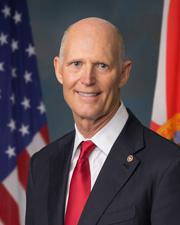
U.S. Senator for Florida
Republican
Senate term end not loaded yet
Missed 0.2% of roll calls. Chamber median 2.1%.
The full voting recordCounts roll calls where most Democrats and most Republicans voted differently, leaving out procedural votes.
How we countFrom FEC filings, Voteview roll calls and Congress.gov.
Republican. In Congress since 2019, 2 terms in total.
Following saves Scott to your list, which Chamber & Street keeps on its server, linked to a cookie on this browser and not to your name or email. Email alerts will come with constituent verification.
Bills and resolutions Scott signed on to as a cosponsor. An original cosponsor signed on the day the bill was introduced. Source: govinfo bill status files, last updated Nov 6, 2026.
Claiming Age Clarity Act
Sponsor Bill Cassidy (R). Joined Feb 10, 2026. 14 cosponsors. S. 1504 on Congress.gov
Introduced
Claiming Age Clarity Act
This bill changes certain terms that are used by the Social Security Administration (SSA) to describe the ages at which a worker may claim Social Security retirement benefits.
First, the SSA must use minimum monthly benefit age instead of early eligibility age. This refers to the earliest age (62 under current law) at which a worker may claim benefits. (Currently, the benefit amount of a worker who claims benefits early is reduced to account for the longer period during which the worker is expected to receive benefits.)
Second, the SSA must use standard monthly benefit age instead of full retirement age and normal retirement age. These terms refer to the age at which a worker may claim benefits without a reduction in the benefit amount. (Currently, this age ranges from 65 to 67, depending on the worker's year of birth.)
Finally, the SSA must use the term maximum monthly benefit age for any reference to age 70 as the maximum age at which a worker may receive delayed retirement credits. The SSA may not use the term delayed retirement credit. These terms refer to the mechanism that increases the benefit amount of a worker who delays claiming benefits after reaching the full retirement age. (Currently, a worker receives a credit for each month between the full retirement age and age 70 that the worker delays claiming benefits. Each credit increases the benefit amount that the worker will receive after claiming benefits by a specified percentage.)
SAVE America Act
Sponsor Mike Lee (R). Original cosponsor. 49 cosponsors. S. 3752 on Congress.gov(opens in a new tab)
Introduced
Safeguard American Voter Eligibility Act or the SAVE America Act
This bill requires individuals to provide documentary proof of U.S. citizenship when registering to vote, and requires photo identification to vote, in federal elections.
Specifically, the bill prohibits states from accepting and processing an application to register to vote in a federal election unless the applicant presents documentary proof of U.S. citizenship. The bill specifies what documents are considered acceptable proof of U.S. citizenship, such as identification that complies with the REAL ID Act of 2005 that indicates U.S. citizenship.
Further, the bill (1) prohibits states from registering an individual to vote in a federal election unless, at the time the individual applies to register to vote, the individual provides documentary proof of U.S. citizenship; and (2) requires states to establish an alternative process to demonstrate U.S. citizenship.
Each state must take affirmative steps on an ongoing basis to ensure that only U.S. citizens are registered to vote, which shall include establishing a program to identify individuals who are not U.S. citizens using information supplied by certain sources.
Additionally, states must remove noncitizens from their official lists of eligible voters.
The bill (1) provides for a private right of action for certain violations, and (2) establishes criminal penalties for certain offenses.
Individuals voting in federal elections must present an eligible photo identification document. An individual who votes by absentee ballot must submit a copy of their identification document with both the request for, and the submission of, the absentee ballot.
Tax Relief for Victims of Crimes, Scams, and Disasters Act
Sponsor Tammy Baldwin (D). Joined Jan 29, 2026. 7 cosponsors. S. 1773 on Congress.gov(opens in a new tab)
Introduced
PREEMIE Reauthorization Act of 2025
Sponsor Michael Bennet (D). Joined Jan 29, 2026. 12 cosponsors. S. 1562 on Congress.gov(opens in a new tab)
Introduced
No Climate Treaties Act of 2026
Sponsor John Barrasso (R). Original cosponsor. 24 cosponsors. S. 3713 on Congress.gov(opens in a new tab)
Introduced
A resolution designating the week of January 25 through January 31, 2026, as "National School Choice Week".
Sponsor Tim Scott (R). Original cosponsor. 35 cosponsors. S.Res. 587 on Congress.gov(opens in a new tab)
Introduced
SAVE Moms and Babies Act of 2026
Sponsor Cindy Hyde-Smith (R). Original cosponsor. 37 cosponsors. S. 3697 on Congress.gov(opens in a new tab)
Introduced
SCAM Act
Sponsor Eric Schmitt (R). Joined Jan 27, 2026. 12 cosponsors. S. 3674 on Congress.gov(opens in a new tab)
Passed committee
A resolution honoring the life, achievements, and legacy of Ben Nighthorse Campbell.
Sponsor Michael Bennet (D). Original cosponsor. 99 cosponsors. S.Res. 585 on Congress.gov(opens in a new tab)
Passed the Senate
A resolution expressing the sense of the Senate in support of Operation Absolute Resolve.
Sponsor John Cornyn (R). Joined Jan 14, 2026. 3 cosponsors. S.Res. 582 on Congress.gov(opens in a new tab)
Introduced
Stop Fraud by SOMALIA Act
Sponsor John Cornyn (R). Original cosponsor. 5 cosponsors. S. 3644 on Congress.gov(opens in a new tab)
Introduced
Pregnant Students’ Rights Act
Sponsor Ashley Moody (R). Original cosponsor. 24 cosponsors. S. 3627 on Congress.gov(opens in a new tab)
Introduced
Pregnant Students' Rights Act
This bill requires each institution of higher education (IHE) that participates in federal student aid programs to provide certain information to prospective and enrolled students on the rights and resources for pregnant students to carry a baby to term or students who may become pregnant while enrolled at the IHE to carry a baby to term.
In particular, this required information must include
• a list of community and on-campus resources that exist to help a pregnant student in carrying the baby to term and caring for the baby after birth,
• information about the accommodations available to help a pregnant student carry the baby to term and parent the baby after birth, and
• information on how to file a discrimination complaint related to the student's determination to carry a baby to term.
Returning Unspent COVID Funds Act
Sponsor Joni Ernst (R). Joined Jan 13, 2026. 3 cosponsors. S. 3166 on Congress.gov(opens in a new tab)
Passed committee
Returning Unspent COVID Funds Act
This bill rescinds certain unobligated funds that were provided to address COVID-19 and requires the funds to be used for deficit reduction.
Specifically, the bill rescinds unobligated funds that were provided by
• the American Rescue Plan Act of 2021;
• Divisions M and N of the Consolidated Appropriations Act, 2021;
• the Paycheck Protection Program and Health Care Enhancement Act;
• the Coronavirus Aid, Relief, and Economic Security Act (CARES Act);
• the Families First Coronavirus Response Act; and
• the Coronavirus Preparedness and Response Supplemental Appropriations Act, 2020.
Funds rescinded by this bill must remain in the Treasury to be used for the sole purpose of deficit reduction.
The bill allows the President to waive the required rescission for an account or program if a notice waiving the rescission for the account or program is submitted to the House Budget Committee and the Senate Finance Committee no later than 60 days after the enactment of this bill.
Public Charge Clarification Act of 2026
Sponsor Roger Marshall (R). Original cosponsor. 1 cosponsor. S. 3602 on Congress.gov(opens in a new tab)
Introduced
School Access to Naloxone Act of 2026
Sponsor Jeff Merkley (D). Original cosponsor. 6 cosponsors. S. 3588 on Congress.gov(opens in a new tab)
Introduced
School Access to Naloxone Act of 2026
This bill authorizes grants for expanding access to drugs or devices to treat opioid overdoses (e.g., naloxone) in elementary and secondary schools.
The Department of Health and Human Services may award the grants to states, Indian tribes, and localities. To receive a grant, recipients must certify that schools in their jurisdictions will stock the drugs and devices and have trained staff on premises during operating hours to administer them.
Additionally, the attorney general of the recipient's state must certify that trained staff are covered by state civil liability protections for individuals who administer aid in an emergency (commonly known as Good Samaritan laws).
REPO Implementation Act of 2025
Sponsor Sheldon Whitehouse (D). Joined Jan 7, 2026. 15 cosponsors. S. 2918 on Congress.gov(opens in a new tab)
Passed committee
Credit Union Board Modernization Act
Sponsor Bill Hagerty (R). Joined Dec 16, 2025. 63 cosponsors. S. 522 on Congress.gov(opens in a new tab)
Introduced
Credit Union Board Modernization Act
This bill revises the required frequency of meetings held by a credit union's board of directors. Specifically, new credit unions and credit unions with a low soundness rating must meet monthly. All other credit unions must hold at least six meetings annually, with at least one meeting held during each fiscal quarter. Currently, all credit union boards must meet at least once a month.
Romance Scam Prevention Act
Sponsor Marsha Blackburn (R). Joined Dec 15, 2025. 3 cosponsors. S. 841 on Congress.gov(opens in a new tab)
Passed committee
Romance Scam Prevention Act
This bill requires online dating service providers (i.e., mobile applications or websites) to provide users with a fraud ban notification if the user has established an account with the service and received a message through the service from a banned user of the service.
The fraud ban notification must include (1) the username or other profile identifier of the banned user and the most recent time when the user who is receiving the notification sent or received a message through the service to or from the banned user, (2) a statement that the banned user may have been using a false identity or attempting to defraud other users, (3) a statement that the user should not send cash (or another form of currency) or personal financial information to another user, (4) information about avoiding online fraud (e.g., a link to another website or a disclosure) and (5) contact information for the provider's customer service department.
The bill provides for enforcement of these requirements by the Federal Trade Commission and state attorneys general.
National Prescribed Fire Act of 2025
Sponsor Ron Wyden (D). Joined Dec 10, 2025. 5 cosponsors. S. 2015 on Congress.gov(opens in a new tab)
Passed committee
National Prescribed Fire Act of 2025
This bill directs the Department of Agriculture (USDA) and the Department of the Interior to increase the number and size of prescribed fires conducted on federal lands.
For 10 years, Interior and USDA must annually conduct prescribed fires on federal land so that the total acreage where prescribed fires are conducted is 10% greater than the previous fiscal year.
Interior and USDA must establish a collaborative prescribed fire program to provide financial assistance to eligible entities to conduct prescribed fires in priority landscapes.
Interior and USDA may enter into cooperative agreements or contracts with states, Indian tribes, counties, municipal governments, fire districts, nongovernmental organizations, or private entities to coordinate prescribed fires on federal land.
Interior and USDA must expand employment opportunities for prescribed fire practitioners, including by expanding hazard pay, supporting underrepresented groups, and establishing additional training centers.
To address the public health and safety risk of the expanded use of prescribed fire, the Environmental Protection Agency must coordinate with state, tribal, and local air quality agencies to support the environmental review of wildland fires.
A joint resolution proposing a balanced budget amendment to the Constitution of the United States.
Sponsor Jon Husted (R). Joined Dec 9, 2025. 2 cosponsors. S.J.Res. 97 on Congress.gov(opens in a new tab)
Introduced
This joint resolution proposes a constitutional amendment that requires federal expenditures and receipts to be balanced, which may occur over more than one year.
Under the amendment, expenditures include all federal expenditures except those for payment of debt. Receipts do not include receipts derived from borrowing.
The amendment requires Congress to achieve balance within 10 years of the ratification of the amendment.
In an emergency situation, Congress may authorize additional expenditures that are not otherwise permitted by the amendment if two-thirds of the House of Representatives and the Senate agree to pass the bill. The additional expenditures must be for a limited time, and debts incurred from the expenditures must be paid as soon as practicable.
Holocaust Expropriated Art Recovery Act of 2025
Sponsor John Cornyn (R). Joined Dec 8, 2025. 21 cosponsors. S. 1884 on Congress.gov(opens in a new tab)
Became law
Holocaust Expropriated Art Recovery Act of 2025
This act permanently extends and expands judicial authority under the Holocaust Expropriated Art Recovery Act of 2016. The law allows and establishes procedures for civil claims and causes of action to recover artwork and other property lost between 1933 and 1945 because of Nazi persecution.
Among the changes, the act removes the deadline for filing civil claims or causes of action. Currently, the filing deadline is December 31, 2026. (Claims must still be filed within six years of the claimant's discovery of the property in question.)
The act permits courts to exercise jurisdiction over civil claims or causes of action against a foreign state without regard to the nationality or citizenship of the alleged victim. The art or property at issue must still have a connection to the foreign state's commercial activities in the United States.
Additionally, the act authorizes nationwide service of process, which allows courts to exercise personal jurisdiction over defendants in any judicial district where they may be found, reside, have an agent, or transact business.
Finally, the act limits the defenses that may be asserted against civil claims or causes of action, including by prohibiting
• defenses based on the passage of time, including equitable defenses such as laches (i.e., unreasonable delays); and
• discretionary bases for dismissal that are unrelated to the merits of the claim, including international comity (i.e., deference to the laws of other countries).
These changes apply to pending and future civil claims or causes of action.
Back the Blue Act of 2025
Sponsor John Cornyn (R). Original cosponsor. 38 cosponsors. S. 3366 on Congress.gov(opens in a new tab)
Introduced
Back the Blue Act of 2025
This bill establishes new criminal offenses for violent conduct against judicial officers and law enforcement officers and makes related changes. The bill also broadens the authority of certain law enforcement officers to carry firearms.
Specifically, the bill prohibits killing, attempting to kill, or conspiring to kill a federal judge, a federal law enforcement officer, or a public safety or judicial officer for a state, local, or tribal agency that receives federal funding. The bill also prohibits fleeing to avoid prosecution, custody, or confinement for an offense.
Additionally, the bill prohibits killing former federal judges, former federal law enforcement officers, or former public safety or judicial officers for state, local, or tribal agencies that receive federal funding.
The bill also prohibits certain assaults on state or local law enforcement officers for state (or District of Columbia) agencies that receive federal funding.
The bill limits federal court review of challenges to state court convictions for killing a public safety officer or judge. The bill also limits the recoverability of damages and attorney's fees in a proceeding to enforce a civil rights violation during or relating to conduct by the injured person that constitutes a felony or crime of violence.
The bill allows federal, state, and local law enforcement officers to carry firearms if authorized by law. The bill also allows qualified law enforcement officers to carry concealed firearms and ammunition (including magazines) in school zones and in certain federal facilities that are open to the public.
National Strategy for Combating Scams Act of 2025
Sponsor Kirsten Gillibrand (D). Original cosponsor. 4 cosponsors. S. 3355 on Congress.gov(opens in a new tab)
Introduced
Halo Act
Sponsor Ashley Moody (R). Joined Dec 3, 2025. 13 cosponsors. S. 3179 on Congress.gov(opens in a new tab)
Introduced
Mikaela Naylon Give Kids a Chance Act of 2025
Original cosponsor. 37 cosponsors. S. 3302 on Congress.gov(opens in a new tab)
Progress not on file
Mikaela Naylon Give Kids a Chance Act of 2025
This bill authorizes certain targeted clinical trials involving combinations of drugs to treat pediatric cancer, and renews the Food and Drug Administration’s (FDA’s) authority to award priority review vouchers (PRVs) to sponsors of new products for rare pediatric diseases.
Specifically, the bill modifies requirements relating to molecularly targeted pediatric cancer investigations to permit research on new drugs used in combination with active ingredients that have already been approved and that (1) have been determined to be part of the standard of care for treating a pediatric cancer, or (2) have been approved to treat an adult cancer and are directed at molecular targets for pediatric cancer.
The FDA must issue guidance on the implementation of these provisions and report to Congress on its efforts to ensure implementation. The Government Accountability Office (GAO) must report on the effectiveness of the bill's changes with respect to the development of pediatric cancer drugs.
The bill also renews the FDA’s authority to issue PRVs to sponsors of new products intended to treat rare pediatric diseases through September 30, 2030. This is known as the Rare Pediatric Disease PRV program. The program expired in December 2024.
GAO must report on the effectiveness of the Rare Pediatric Disease PRV program, including to what extent PRVs were successful in promoting drug development and expediting patient access to drugs for the treatment or prevention of rare pediatric diseases.