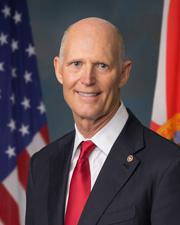
U.S. Senator for Florida
Republican
Senate term end not loaded yet
Missed 0.2% of roll calls. Chamber median 2.1%.
The full voting recordCounts roll calls where most Democrats and most Republicans voted differently, leaving out procedural votes.
How we countFrom FEC filings, Voteview roll calls and Congress.gov.
Republican. In Congress since 2019, 2 terms in total.
Following saves Scott to your list, which Chamber & Street keeps on its server, linked to a cookie on this browser and not to your name or email. Email alerts will come with constituent verification.
Bills and resolutions Scott signed on to as a cosponsor. An original cosponsor signed on the day the bill was introduced. Source: govinfo bill status files, last updated Nov 6, 2026.
ERASER Act
Sponsor Eric Schmitt (R). Original cosponsor. 2 cosponsors. S. 30 on Congress.gov
Introduced
Expediting Reform And Stopping Excess Regulations Act or the ERASER Act
This bill generally requires federal agencies to repeal three rules before issuing a new rule.
In the case of a new nonmajor rule, an agency must repeal at least three rules that, to the extent practicable, are related to the new rule.
In the case of a new major rule, (1) an agency must repeal at least three rules that are related to the new major rule, and (2) the cost of the new major rule must be less than or equal to the cost of the repealed rules. A major rule is a rule that has resulted in or is likely to result in (1) an annual effect on the economy of $100 million or more; (2) a major increase in costs or prices for consumers, individual industries, government agencies, or geographic regions; or (3) significant adverse effects on competition, employment, investment, productivity, or innovation.
These requirements apply to rules issued through the notice and comment process and do not apply to interpretative rules, general statements of policy, or rules of agency organization, procedure, or practice. Further, the requirements do not apply to a rule or major rule that relates to the management, organization, or personnel of an agency or procurement by the agency.
Any rule repealed under this bill must be published in the Federal Register.
Finally, the Government Accountability Office must report on the number and estimated cost of rules and major rules currently in effect.
A joint resolution proposing an amendment to the Constitution of the United States relative to limiting the number of terms that a Member of Congress may serve.
Sponsor Ted Cruz (R). Original cosponsor. 19 cosponsors. S.J.Res. 1 on Congress.gov(opens in a new tab)
Introduced
This joint resolution proposes an amendment to the Constitution establishing term limits for individuals serving in the Senate and the House of Representatives.
The proposed amendment makes an individual who has served two terms in the Senate ineligible for appointment or election to the Senate and an individual who has served three terms as a Member of the House of Representatives ineligible for election to the House of Representatives.
The joint resolution provides that the amendment shall be valid when ratified by the legislatures of three-fourths of the states within seven years after the date of its submission for ratification.
Under Article V of the Constitution, both chambers of Congress may propose an amendment by a vote of two-thirds of all Members present for such vote. A proposed amendment must be ratified by the states as prescribed in Article V and as specified by Congress.
Protection of Women and Girls in Sports Act of 2025
Sponsor Tommy Tuberville (R). Original cosponsor. 44 cosponsors. S. 9 on Congress.gov(opens in a new tab)
Introduced
Protection of Women and Girls in Sports Act of 2025
This bill generally prohibits school athletic programs from allowing individuals whose biological sex at birth was male to participate in programs that are for women or girls.
Specifically, the bill provides that it is a violation of Title IX of the Education Amendments of 1972 for federally funded education programs or activities to operate, sponsor, or facilitate athletic programs or activities that allow individuals of the male sex to participate in programs or activities that are designated for women or girls. (Title IX prohibits discrimination on the basis of sex in federally funded education programs or activities, including in public elementary and secondary schools and in colleges and universities.) Under the bill, sex is based on an individual's reproductive biology and genetics at birth.
Laken Riley Act
Sponsor Katie Britt (R). Original cosponsor. 53 cosponsors. S. 5 on Congress.gov(opens in a new tab)
Became law
Laken Riley Act
This act requires the Department of Homeland Security (DHS) to detain certain non-U.S. nationals (aliens under federal law) who have been arrested for burglary, theft, larceny, shoplifting, assault of a law enforcement officer, or any crime that results in death or serious bodily injury to another person. The act also authorizes states to sue the federal government for decisions or alleged failures related to immigration enforcement.
Under this act, DHS must detain an individual who (1) is unlawfully present in the United States or did not possess the necessary documents when applying for admission; and (2) has been charged with, arrested for, convicted of, or admits to having committed acts that constitute the essential elements of the above crimes.
The act also authorizes state governments to sue for injunctive relief over certain immigration-related decisions or alleged failures by the federal government if the decision or failure caused the state or its residents harm, including financial harm of more than $100. Specifically, the state government may sue the federal government over a
• decision to release a non-U.S. national from custody;
• failure to fulfill requirements relating to inspecting individuals seeking admission into the United States, including requirements related to asylum interviews;
• failure to fulfill a requirement to stop issuing visas to nationals of a country that unreasonably denies or delays acceptance of nationals of that country;
• violation of limitations on immigration parole, such as the requirement that parole be granted only on a case-by-case basis; or
• failure to detain an individual who has been ordered removed from the United States.