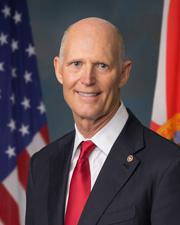
U.S. Senator for Florida
Republican
Senate term end not loaded yet
Missed 0.2% of roll calls. Chamber median 2.1%.
The full voting recordCounts roll calls where most Democrats and most Republicans voted differently, leaving out procedural votes.
How we countFrom FEC filings, Voteview roll calls and Congress.gov.
Republican. In Congress since 2019, 2 terms in total.
Following saves Scott to your list, which Chamber & Street keeps on its server, linked to a cookie on this browser and not to your name or email. Email alerts will come with constituent verification.
Bills and resolutions Scott signed on to as a cosponsor. An original cosponsor signed on the day the bill was introduced. Source: govinfo bill status files, last updated Nov 6, 2026.
A resolution recognizing the 80th anniversary of the amphibious landing on the Japanese island of Iwo Jima during World War II and the raisings of the flag of the United States on Mount Suribachi.
Sponsor Todd Young (R). Original cosponsor. 38 cosponsors. S.Res. 53 on Congress.gov
Passed the Senate
This resolution recognizes the 80th anniversary of the amphibious landing of U.S. troops on the Japanese island of Iwo Jima in 1945 and commemorates the historic raising of the U.S. flag on Mount Suribachi that occurred on February 23, 1945. Additionally, the resolution recognizes the 250th year since the founding of the U.S. Marine Corps and the U.S. Navy.
A joint resolution providing for congressional disapproval under chapter 8 of title 5, United States Code, of the rule submitted by the Environmental Protection Agency relating to "Waste Emissions Charge for Petroleum and Natural Gas Systems: Procedures for Facilitating Compliance, Including Netting and Exemptions".
Sponsor John Hoeven (R). Original cosponsor. 26 cosponsors. S.J.Res. 12 on Congress.gov(opens in a new tab)
Introduced
This joint resolution nullifies the Environmental Protection Agency (EPA) rule titled Waste Emissions Charge for Petroleum and Natural Gas Systems: Procedures for Facilitating Compliance, Including Netting and Exemptions and published on November 18, 2024. The rule outlines compliance requirements under the Methane Emissions Reduction Program. Under the program, the EPA collects an annual charge on emissions of methane and other greenhouse gases from entities in the oil and gas sector if their emissions exceed specified waste emissions thresholds.
Fair Access to Banking Act
Sponsor Kevin Cramer (R). Original cosponsor. 47 cosponsors. S. 401 on Congress.gov(opens in a new tab)
Introduced
Fair Access to Banking Act
This bill places restrictions on certain banks, credit unions, and payment card networks if they refuse to do business with a person who complies with the law. Restrictions include prohibiting the use of electronic funds transfer systems and lending programs, termination of an institution's depository insurance, and specified civil penalties.
Banks and other specified financial institutions are allowed to deny financial services to a person only if the denial is justified by a documented failure of that person to meet quantitative, impartial, risk-based standards established in advance by the institution. This justification may not be based upon reputational risks to the institution.
The bill establishes the right for a person to bring a civil action for a violation of this bill.
Dismantle DEI Act of 2025
Sponsor Eric Schmitt (R). Original cosponsor. 20 cosponsors. S. 382 on Congress.gov(opens in a new tab)
Introduced
Stopping Political Discrimination in Disaster Assistance Act
Sponsor James Lankford (R). Original cosponsor. 10 cosponsors. S. 373 on Congress.gov(opens in a new tab)
Introduced
Stopping Political Discrimination in Disaster Assistance Act
This bill prohibits discrimination on the basis of political affiliation by the Federal Emergency Management Agency (FEMA) and other participating entities (i.e., public or private entities providing or receiving assistance) in carrying out federal major disaster or emergency relief and assistance activities.
Current law requires FEMA and other participating entities to provide federal major disaster or emergency relief and assistance without discrimination on the basis of race, color, religion, nationality, sex, age, disability, English proficiency, or economic status. The bill adds political affiliation to the classes protected under this requirement.
SBA Disaster Transparency Act
Sponsor Tim Scott (R). Original cosponsor. 6 cosponsors. S. 371 on Congress.gov(opens in a new tab)
Passed committee
Hearing Protection Act
Sponsor Mike Crapo (R). Original cosponsor. 39 cosponsors. S. 364 on Congress.gov(opens in a new tab)
Introduced
Secure Rural Schools Reauthorization Act of 2025
Sponsor Mike Crapo (R). Original cosponsor. 28 cosponsors. S. 356 on Congress.gov(opens in a new tab)
Became law
Secure Rural Schools Reauthorization Act of 2025
This act extends and modifies the Secure Rural Schools (SRS) program, under which states and counties containing certain federal land may receive payments from the Forest Service or the Bureau of Land Management (BLM) for schools, roads, and certain other municipal services.
The act modifies the SRS program, including by
• extending payments made to states and counties containing federal land through FY2026,
• providing lapsed payments for FY2024 and FY2025,
• extending the authority of counties to initiate projects using such funds through FY2028, and
• extending the authority to initiate projects proposed by resource advisory committees through FY2028.
A joint resolution providing for congressional disapproval under chapter 8 of title 5, United States Code, of the rule submitted by the Department of Homeland Security relating to "Increase of the Automatic Extension Period of Employment Authorization and Documentation for Certain Employment Authorization Document Renewal Applicants".
Sponsor John Kennedy (R). Original cosponsor. 2 cosponsors. S.J.Res. 8 on Congress.gov(opens in a new tab)
Introduced
This joint resolution nullifies the final rule issued by the Department of Homeland Security titled Increase of the Automatic Extension Period of Employment Authorization and Documentation for Certain Employment Authorization Document Renewal Applicants and published on December 13, 2024. This rule makes permanent the increase of the automatic extension period from 180 days to 540 days for expiring employment authorization documents. The extension applies to eligible noncitizens who renew these authorizations on time.
SHUSH Act
Sponsor Mike Lee (R). Original cosponsor. 8 cosponsors. S. 345 on Congress.gov(opens in a new tab)
Introduced
Silencers Help Us Save Hearing Act or the SHUSH Act
This bill removes silencers from regulation under federal firearms laws.
Specifically, it removes silencers from the list of firearms subject to regulation (i.e., registration and licensing requirements) under the National Firearms Act (NFA). Additionally, it excludes a muffler or silencer from the list of firearms subject to regulation (e.g., background check requirements) under the Gun Control Act of 1968 (GCA).
Additionally, the bill does the following:
• preempts state or local laws that tax or regulate firearm silencers,
• specifies that a person who lawfully acquires or possesses a silencer under provisions of the GCA meets the registration and licensing requirements of the NFA,
• eliminates mandatory minimum prison terms for a crime of violence or drug trafficking offense in which a defendant uses or carries a firearm equipped with a silencer or muffler, and
• permits active and retired law enforcement officers to carry a concealed silencer.
Finally, the bill excludes firearm mufflers and silencers from regulation by the Consumer Product Safety Commission. (Current law generally excludes firearms from regulation by the commission.)
Purple Heart Veterans Education Act of 2025
Sponsor Patty Murray (D). Original cosponsor. 13 cosponsors. S. 342 on Congress.gov(opens in a new tab)
Passed committee
Purple Heart Veterans Education Act of 2025
This bill authorizes certain Purple Heart recipients to elect to transfer to one or more eligible dependents (e.g., a spouse or child) unused portions of such recipients’ entitlement to Post-9/11 GI Bill educational assistance. This authority specifically applies to veterans who are awarded the Purple Heart for service in the Armed Forces occurring on or after September 11, 2001, and who have been discharged or released from active service.
Under the bill, the total number of months of entitlement transferred by a Purple Heart recipient may not exceed 36 months. Additionally, the Purple Heart recipient may modify or revoke any unused portion of the transferred entitlement by submitting written notice.
A transferred entitlement may not be treated as marital property or marital assets in divorce or other civil proceedings.
The death of the Purple Heart recipient must not affect the use of the entitlement by the individual who receives the transferred entitlement.
In the event of an overpayment of educational assistance, the Purple Heart recipient and the transferee of the entitlement must be held jointly and severally liable for the amount.
The bill requires the VA and DOD to coordinate to facilitate the transfer of entitlements under the bill.
American Values Act
Sponsor James Risch (R). Original cosponsor. 14 cosponsors. S. 334 on Congress.gov(opens in a new tab)
Introduced
American Values Act
This bill expands restrictions on using U.S. foreign assistance to pay for or promote abortions, involuntary sterilizations, or other related activities.
Specifically, the bill expands existing prohibitions, including prohibitions against using foreign assistance to pay for abortions or involuntary sterilization for family planning, to apply to all assistance provided under the Foreign Assistance Act of 1961 (FAA). (Currently, these prohibitions apply to only certain parts of the FAA.)
Furthermore, assistance provided under the FAA may not be made available to (1) pay for lobbying for or against abortion, or (2) any organization that supports a program of coercive abortion or involuntary sterilization. (These prohibitions have typically been in appropriations acts, but the bill would make the prohibitions a permanent part of the FAA.)
The bill also makes permanent a prohibition against using funds made available to the Peace Corps to pay for abortions except when the pregnancy is the result of rape or incest or when the life of the mother would be endangered if the fetus were carried to term.
AM Radio for Every Vehicle Act of 2025
Sponsor Edward Markey (D). Original cosponsor. 60 cosponsors. S. 315 on Congress.gov(opens in a new tab)
Passed committee
AM Radio for Every Vehicle Act of 2025
This bill requires the Department of Transportation (DOT) to issue a rule requiring AM radio capabilities to be standard in all new passenger vehicles. (AM radio is often used to deliver emergency alerts and news and entertainment programming; some newer vehicles do not include AM equipment.)
Specifically, this bill applies to passenger vehicles (1) manufactured in the United States for sale in the United States, imported into the United States, or shipped in interstate commerce; and (2) manufactured after the rule's effective date. The rule must require all such vehicles to have devices that can receive signals and play content transmitted by AM stations or digital audio AM stations installed as standard equipment and made easily accessible to drivers.
Prior to the rule's effective date, manufacturers that do not include devices that can access AM radio as standard equipment (1) must inform purchasers of this fact through clear and conspicuous labeling, and (2) may not charge an additional or separate fee for AM radio access.
DOT may assess civil penalties for any violation of the rule. The Department of Justice may also bring a civil action to enjoin a violation.
DOT’s authority to issue the rule expires 10 years after the bill’s enactment.
Further, the Government Accountability Office must study and report on the dissemination of emergency alerts to the public, including by conducting an assessment of AM broadcast stations relative to other Integrated Public Alert and Warning System communication technologies.
Stop Funding Global Terrorists Act of 2025
Sponsor Shelley Capito (R). Original cosponsor. 10 cosponsors. S. 313 on Congress.gov(opens in a new tab)
Introduced
Stop Funding Global Terrorists Act of 2025
This bill prohibits the United States from making any voluntary or assessed contributions to the United Nations (UN) for assistance to Afghanistan until the Department of State certifies to Congress that (1) no U.S. funds are used in cash shipments by the UN to Afghanistan, and (2) terrorist organizations do not receive funds as a result of such cash shipments. If the State Department later determines such a certification is inaccurate, it must revoke the certification and notify Congress.
Defund the CFPB Act
Sponsor Ted Cruz (R). Original cosponsor. 6 cosponsors. S. 303 on Congress.gov(opens in a new tab)
Introduced
Defund the CFPB Act
This bill caps funding of the Consumer Financial Protection Bureau at $0.
Reducing the Federal Workforce Through Attrition Act
Sponsor Ron Johnson (R). Original cosponsor. 1 cosponsor. S. 295 on Congress.gov(opens in a new tab)
Introduced
COOL Online Act
Sponsor Tammy Baldwin (D). Original cosponsor. 1 cosponsor. S. 294 on Congress.gov(opens in a new tab)
Introduced
Country of Origin Labeling Requirement Act or the COOL Online Act
This bill requires sellers of imported products online to conspicuously disclose the country of origin of the products and the country where the seller's principal place of business is located.
This requirement does not apply to specified products, such as agricultural commodities, food or drugs, or previously owned items.
The Federal Trade Commission must enforce violations of this requirement as unfair or deceptive trade practices.
Stop Illegal Reentry Act
Sponsor Ted Cruz (R). Original cosponsor. 9 cosponsors. S. 271 on Congress.gov(opens in a new tab)
Introduced
Stop Illegal Reentry Act
This bill increases criminal penalties for certain non-U.S. nationals (aliens under federal law) who illegally reenter the United States after removal or exclusion.
Generally, an individual who had been denied entry into or removed from the United States and who later enters or attempts to enter the United States without prior approval from the Department of Homeland Security shall be fined, imprisoned for up to five years, or both. Current law requires a fine, imprisonment for up to two years, or both, for such an individual.
An individual who had been denied entry or removed three or more times and who later enters or attempts to enter the United States shall be fined, imprisoned for up to 10 years, or both.
An individual who was convicted of an aggravated felony or convicted at least two times before removal or departure and who subsequently enters or tries to enter the United States shall be imprisoned at least 5 years and for up to 20 years and may also be fined. Currently, there is no minimum term of imprisonment for an individual who reenters after a conviction for an aggravated felony, and there are no criminal penalties for a reentering individual who had been convicted at least two times (other than the penalties for illegal reentry generally).
GOOD Act
Sponsor Ron Johnson (R). Original cosponsor. 15 cosponsors. S. 252 on Congress.gov(opens in a new tab)
Passed committee
Guidance Out Of Darkness Act or the GOOD Act
This bill establishes requirements concerning the posting of agency guidance documents. Specifically, an agency must publish guidance documents online on the dates they are issued, publish all of its guidance documents that are in effect in a single location on a designated website, display a hyperlink on its website that provides access to the guidance documents on such website, and indicate on such website if a guidance document has been rescinded.
The documents must be categorized as guidance documents and further divided into subcategories.
A joint resolution providing for congressional disapproval under chapter 8 of title 5, United States Code, of the rule submitted by the Department of Energy relating to "Energy Conservation Program: Energy Conservation Standards for Consumer Gas-fired Instantaneous Water Heaters".
Sponsor Ted Cruz (R). Original cosponsor. 14 cosponsors. S.J.Res. 4 on Congress.gov(opens in a new tab)
Passed committee
This joint resolution nullifies the rule titled Energy Conservation Program: Energy Conservation Standards for Consumer Gas-fired Instantaneous Water Heaters and submitted by the Department of Energy (DOE) on December 26, 2024. Under the rule, DOE adopted amended energy conservation standards for gas-fired instantaneous water heaters to achieve the maximum improvement in energy efficiency that DOE determined was technologically feasible and economically justified.
FREE Act
Sponsor Cynthia Lummis (R). Original cosponsor. 5 cosponsors. S. 238 on Congress.gov(opens in a new tab)
Introduced
A bill to designate the area between the intersections of 16th Street, Northwest and Fuller Street, Northwest and 16th Street, Northwest and Euclid Street, Northwest in Washington, District of Columbia, as "Oswaldo Paya Way".
Sponsor Ted Cruz (R). Original cosponsor. 3 cosponsors. S. 218 on Congress.gov(opens in a new tab)
Introduced
This bill designates the area in front of the Cuban embassy in the District of Columbia as Oswaldo Payá Way. (Oswaldo Payá was a pro-democracy activist in Cuba.)
Maintaining Academy Culture and Assuring Retention of Tradition, Honor, and Unity of the Republic Act (MACARTHUR) Act
Sponsor Ted Cruz (R). Original cosponsor. 4 cosponsors. S. 215 on Congress.gov(opens in a new tab)
Introduced
Maintaining Academy Culture and Assuring Retention of Tradition, Honor, and Unity of the Republic Act (MACARTHUR) Act
This bill requires the Department of the Army to amend the mission statement of the United States Military Academy to include the phrase “Duty, Honor, Country.”
Main Street Tax Certainty Act
Sponsor Steve Daines (R). Original cosponsor. 45 cosponsors. S. 213 on Congress.gov(opens in a new tab)
Introduced
Main Street Tax Certainty Act
This bill makes permanent the qualified business income (QBI) tax deduction.
Under current law, individuals, estates, and trusts may deduct the lower of (1) 20% of QBI from a qualified business, qualified real estate investment trust dividends, and qualified publicly traded partnership income; or (2) 20% of taxable income less net capital gain. (Some limitations apply.)
However, under current law, the QBI tax deduction expires after December 31, 2025.
PLO and PA Terror Payments Accountability Act of 2025
Sponsor Tom Cotton (R). Original cosponsor. 11 cosponsors. S. 198 on Congress.gov(opens in a new tab)
Introduced
PLO and PA Terror Payments Accountability Act of 2025
This bill requires the President to impose sanctions on foreign persons (individuals and entities) that are involved with the Palestinian Liberation Organization (PLO) or Palestinian Authority (PA) system of compensation supporting acts of terrorism. The bill defines this system of compensation as payments to an individual who (1) has been imprisoned for terrorist acts against Israeli or U.S. citizens after being fairly tried, (2) died while committing such terrorist acts, or (3) is a family member of such individuals. The definition also includes compensation for individuals imprisoned for terrorism where the level of compensation is based on the length of incarceration.
Specifically, the President must impose visa- and property-blocking sanctions on any foreign person that has facilitated this compensation system, including PLO and PA officials as well as entities such as the Institute for the Care of the Families of the Martyrs and the Wounded. The President must also impose visa- and property-blocking sanctions on foreign persons who knowingly provide significant support to, or engage in significant transactions with, any of the aforementioned persons.
The President must sanction foreign financial institutions that facilitate payments or benefits related to this compensation system by (1) prohibiting them from opening correspondent or payable-through accounts in the United States, and (2) prohibiting or imposing strict conditions on the maintenance of such accounts.
The provisions of this bill shall terminate if the Department of State certifies that such compensation system has ceased.