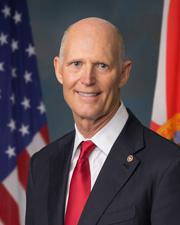
U.S. Senator for Florida
Republican
Senate term end not loaded yet
Missed 0.2% of roll calls. Chamber median 2.1%.
The full voting recordCounts roll calls where most Democrats and most Republicans voted differently, leaving out procedural votes.
How we countFrom FEC filings, Voteview roll calls and Congress.gov.
Republican. In Congress since 2019, 2 terms in total.
Following saves Scott to your list, which Chamber & Street keeps on its server, linked to a cookie on this browser and not to your name or email. Email alerts will come with constituent verification.
Bills and resolutions Scott signed on to as a cosponsor. An original cosponsor signed on the day the bill was introduced. Source: govinfo bill status files, last updated Nov 6, 2026.
A resolution expressing support for the designation of February 15 through February 22, 2025, as "National FFA Week", recognizing the important role of the National FFA Organization in developing the next generation of leaders who will change the world, and celebrating the 90th anniversary of New Farmers of America and the 75th anniversary of the Future Farmers of America Federal charter.
Sponsor Todd Young (R). Original cosponsor. 51 cosponsors.
Passed the Senate
This resolution supports the designation of February 15-22, 2025, as National FFA (Future Farmers of America) Week.
It also celebrates the 90th anniversary of New Farmers of America (NFA), which served Black vocational agriculture students in segregated public schools until NFA and FFA became one organization in 1965.
The resolution also commemorates the 75th anniversary of the federal charter for the Future Farmers of America.
A resolution designating March 7, 2025, as "National Speech and Debate Education Day".
Sponsor Chuck Grassley (R). Original cosponsor. 19 cosponsors. S.Res. 88 on Congress.gov(opens in a new tab)
Passed the Senate
This resolution designates March 7, 2025, as National Speech and Debate Education Day.
LEOSA Reform Act
Sponsor John Kennedy (R). Original cosponsor. 13 cosponsors. S. 679 on Congress.gov(opens in a new tab)
Introduced
LEOSA Reform Act
This bill broadens the authority for certain individuals to carry concealed firearms in school zones and across state lines.
Specifically, the bill exempts the following categories of individuals from the federal prohibition on possessing (or discharging) a firearm in a school zone:
• certain active and retired law enforcement officers who are authorized to carry concealed firearms under federal law, and
• individuals who are allowed to carry concealed firearms under the law of a state.
Additionally, the bill allows qualified active and retired law enforcement officers to carry concealed firearms and ammunition (including magazines) in national parks; on state, local, or private property that is open to the public; and in certain federal facilities that are open to the public.
Finally, the bill permits states to reduce the frequency with which retired law enforcement officers must meet certain qualification standards.
DEFUND Act of 2025
Sponsor Mike Lee (R). Original cosponsor. 2 cosponsors. S. 669 on Congress.gov(opens in a new tab)
Introduced
Disengaging Entirely From the United Nations Debacle Act of 2025 or the DEFUND Act of 2025
This bill directs the President to terminate U.S. membership in the United Nations (U.N.) and all formally affiliated bodies. It also ends U.S. participation in all U.N. conventions and agreements.
Funds may be appropriated to facilitate U.S. withdrawal from the U.N. No funds may be made available for contributions or payments to any U.N. body.
The bill prohibits U.S. participation in any U.N. peacekeeping operation.
The bill also repeals diplomatic immunity for officers and employees of the U.N. and for officers and employees of foreign government missions to the U.N.
The bill repeals various acts related to the U.N., including the United Nations Participation Act of 1945, the United Nations Headquarters Agreement Act, and a joint resolution establishing U.S. membership in the World Health Organization.
The United States may not rejoin the U.N. or any formally affiliated body without the advice and consent of the Senate. Any agreement to rejoin the U.N. or a formally affiliated body must include the right of the United States to withdraw from the agreement.
Stop Tax Penalties on American Hostages Act of 2025
Sponsor Christopher Coons (D). Original cosponsor. 9 cosponsors. S. 655 on Congress.gov(opens in a new tab)
Introduced
Stop Tax Penalties on American Hostages Act of 2025
This bill extends certain federal tax deadlines for U.S. nationals who are unlawfully or wrongfully detained abroad or held hostage abroad and their spouses. The bill also allows for an abatement and refund of additional taxes, interest, and penalties assessed to such individuals for failing to meet a federal tax deadline during a period of detention.
Specifically, under the bill, the time period during which a U.S. national is unlawfully or wrongfully detained abroad or held hostage abroad is disregarded in determining certain federal tax deadlines, including deadlines for
• filing a return for and paying federal income, estate, gift, employment, or excise taxes;
• a tax credit or refund claim; and
• the determination, assessment, and collection of additional taxes, interest, or penalties.
The bill requires the Department of State and the Department of Justice to annually provide the Internal Revenue Service (IRS) with lists to identify U.S. nationals who qualify for an extension.
The bill also requires the IRS to (1) abate and refund additional taxes, interest, and penalties assessed for any tax year ending during a period of detention for which an extension of a federal tax deadline is permitted; and (2) establish a program allowing U.S. nationals unlawfully or wrongfully detained abroad or taken hostage abroad (or their spouse or dependent) to claim a refund of additional taxes, interest, and penalties assessed for any tax year ending during a period of detention from 2021 to the bill’s enactment date.
Unplug the Electric Vehicle Charging Stations Programs Act
Sponsor Joni Ernst (R). Original cosponsor. 2 cosponsors. S. 651 on Congress.gov(opens in a new tab)
Introduced
Unplug the Electric Vehicle Charging Stations Programs Act
This bill repeals grant programs that provide funding for electric vehicle charging infrastructure and alternative fueling infrastructure.
Specifically, the bill repeals the Charging and Fueling Infrastructure Grant Program under which the Department of Transportation provides grants for acquiring and installing publicly accessible electric vehicle charging infrastructure, hydrogen fueling infrastructure, propane fueling infrastructure, or natural gas fueling infrastructure that is directly related to the charging or fueling of a vehicle.
It also repeals the National Electric Vehicle Infrastructure Formula Program under which the Federal Highway Administration (FHWA) provides grants for deploying electric vehicle charging infrastructure and establishing a network to facilitate data collection, access, and reliability. In addition, the bill rescinds unobligated funds that were provided to the FHWA for the program and prohibits funds from being used to carry out the program.
Veterans Homecare Choice Act of 2025
Sponsor Tommy Tuberville (R). Original cosponsor. 1 cosponsor. S. 635 on Congress.gov(opens in a new tab)
Passed committee
Veterans Homecare Choice Act of 2025
This bill includes any nurse registry as an eligible health care provider under the Veterans Community Care Program of the Department of Veterans Affairs. Under the bill, a nurse registry is a person who satisfies applicable state licensure requirements and procures, or attempts to procure, contracts or agreements on behalf of registered nurses, licensed practical nurses, certified nursing assistants, home health aides, companions, or homemakers under which such individuals may furnish health care-related or assistive services and receive compensation.
Ensuring Continuity in Veterans Health Act
Sponsor Tommy Tuberville (R). Joined Feb 19, 2025. 6 cosponsors. S. 540 on Congress.gov(opens in a new tab)
Introduced
Ensuring Continuity in Veterans Health Act
This bill requires the consideration of continuity of care when determining whether care through the Veterans Community Care Program is in the best medical interest of a veteran.
A bill to designate the area of Sumner Row between 16th Street and Northwest and L Street Northwest in Washington, District of Columbia, as "Alexi Navalny Way".
Sponsor Richard Durbin (D). Original cosponsor. 9 cosponsors. S. 614 on Congress.gov(opens in a new tab)
Introduced
Death Tax Repeal Act of 2025
Sponsor John Thune (R). Original cosponsor. 46 cosponsors. S. 587 on Congress.gov(opens in a new tab)
Introduced
EAGLES Act of 2025
Sponsor Chuck Grassley (R). Original cosponsor. 7 cosponsors. S. 560 on Congress.gov(opens in a new tab)
Introduced
EAGLES Act of 2025
This bill reauthorizes the National Threat Assessment Center (NTAC) within the U.S. Secret Service.
It reauthorizes the functions of NTAC through FY2030 and expands them to include additional activities related to the prevention of targeted violence, such as the establishment of a national program on targeted school violence prevention.
Antisemitism Awareness Act of 2025
Sponsor Tim Scott (R). Original cosponsor. 47 cosponsors. S. 558 on Congress.gov(opens in a new tab)
Introduced
Antisemitism Awareness Act of 2025
This bill provides statutory authority for the requirement that the Department of Education’s Office for Civil Rights take into consideration the International Holocaust Remembrance Alliance's (IHRA's) working definition of antisemitism when reviewing or investigating complaints of discrimination based on race, color, or national origin in programs or activities that receive federal financial assistance. According to the IHRA's working definition, antisemitism is a certain perception of Jews, which may be expressed as hatred toward Jews.
Combating Illicit Xylazine Act
Sponsor Catherine Cortez Masto (D). Original cosponsor. 35 cosponsors. S. 545 on Congress.gov(opens in a new tab)
Passed committee
Combating Illicit Xylazine Act
This bill regulates xylazine under the Controlled Substances Act (CSA).
Xylazine, also known as tranq, is a nonopioid sedative and pain reliever that is approved for use in animals. Recently, the Drug Enforcement Administration (DEA) has reported an increase in trafficking of fentanyl mixed with xylazine.
This bill adds xylazine, including its salts, isomers, and salts of isomers, to schedule III of the CSA. Schedule III controlled substances, including anabolic steroids, buprenorphine, and ketamine, have less potential for abuse than a schedule I or II substance, have a currently accepted medical use, and have low or moderate risk of dependence if abused.
Under the bill, manufacturing, distributing, or dispensing xylazine, or possessing with intent to manufacture, distribute, or dispense xylazine for illicit use is subject to criminal penalties under the CSA. The bill also requires xylazine transactions to be tracked in the drug reporting system maintained by the DEA.
The bill exempts from registration under the CSA persons and entities that possess xylazine (1) lawfully dispensed by a veterinarian or pharmacy and (2) for an animal or for use in certain animal-control or wildlife programs.
The bill also exempts xylazine manufacturers from the CSA's physical security requirements.
Finally, the bill requires the DEA, in coordination with the Department of Health and Human Services (HHS), to provide Congress with a report on how the agencies previously determined whether xylazine should be a controlled substance, including the full text of HHS's recommendations to the DEA for scheduling xylazine.
ELITE Vehicles Act
Sponsor John Barrasso (R). Original cosponsor. 14 cosponsors. S. 541 on Congress.gov(opens in a new tab)
Introduced
Eliminate Lavish Incentives To Electric Vehicles Act or the ELITE Vehicles Act
This bill eliminates federal tax credits for the purchase of certain clean vehicles (generally electric vehicles and plug-in hybrid vehicles) and electric vehicle recharging stations.
Specifically, the bill repeals the federal tax credits for
• the purchase of a qualified used clean vehicle (tax credit of up to $4,000 for the purchase of a previously-owned clean vehicle before 2033),
• the purchase of a qualified new clean vehicle (tax credit of up to $7,500 for the purchase of a new clean vehicle before 2033),
• the purchase of a qualified commercial clean vehicle (business tax credit of up to $40,000 for the purchase of a commercial clean vehicle before 2033), and
• alternative fuel vehicle refueling property used to recharge electric vehicles (tax credit of up to $1,000 for individuals or up to $100,000 for businesses for the installation of property before 2033 that is used to recharge electric vehicles).
Protecting Access for Hunters and Anglers Act of 2025
Sponsor Steve Daines (R). Original cosponsor. 36 cosponsors. S. 537 on Congress.gov(opens in a new tab)
Introduced
Protecting Access for Hunters and Anglers Act of 2025
This bill bars the Fish and Wildlife Service (FWS), the Bureau of Land Management (BLM), and the Forest Service from prohibiting or regulating the use of lead ammunition or tackle on federal land or water. The bill makes exceptions for specified existing regulations and where the FWS, the BLM, or the Forest Service determines that a decline in wildlife population at the specific unit of federal land or water is primarily caused by the use of lead in ammunition or tackle, based on the field data from such unit, and the state approves the regulations.
National Right-to-Work Act
Sponsor Rand Paul (R). Original cosponsor. 23 cosponsors. S. 533 on Congress.gov(opens in a new tab)
Introduced
A bill to repeal the Impoundment Control Act of 1974.
Sponsor Mike Lee (R). Joined Feb 12, 2025. 1 cosponsor. S. 515 on Congress.gov(opens in a new tab)
Introduced
This bill repeals the Impoundment Control Act of 1974 (ICA). The ICA generally limits the authority of the President to impound (i.e., withhold from obligation or expenditure) funds that have been appropriated by Congress and establishes related procedures. It also establishes expedited legislative procedures that Congress may use to consider legislation to enact rescissions proposed by the President.
Protecting Taxpayers’ Wallets Act of 2025
Sponsor Joni Ernst (R). Original cosponsor. 1 cosponsor. S. 511 on Congress.gov(opens in a new tab)
Introduced
Protecting Taxpayers’ Wallets Act of 2025
This bill requires labor unions representing federal agency employees to pay agencies for resources and official time they use for union activities.
The bill directs federal agencies to charge unions a fee for using agency resources that is based on (1) the value of time spent by union representatives on union activities rather than agency business, and (2) the value of resources provided by the agency related to these activities, such as parking spaces and equipment. Agencies must track the amount of time union representatives use for union purposes and discipline representatives who fail to properly record such time.
If a union has not paid in full by 90 days following a notice of the fee, the agency (1) may not provide further time or resources to the union until it is paid in full; and (2) is not subject to grievance procedures, binding arbitration, or unfair labor practice complaints or proceedings by the union.
Further, an agency must notify a union and the Federal Labor Relations Authority (FLRA) when a union's unpaid balance has been outstanding for 365 days and, on the 380th day, the FLRA must terminate the union's certification as the exclusive representative of employees of the agency.
The bill requires each agency's Office of Inspector General to periodically report on agency and union compliance with the bill's requirements.
Regulations from the Executive in Need of Scrutiny Act of 2025
Sponsor Rand Paul (R). Original cosponsor. 23 cosponsors. S. 485 on Congress.gov(opens in a new tab)
Introduced
Regulations from the Executive in Need of Scrutiny Act of 2025
This bill expands congressional review of federal agency rules and establishes additional procedures for major rules and agency guidance.
Specifically, the bill requires the enactment of a joint resolution for a major rule to take effect. A major rule is a rule that has resulted in or is likely to result in (1) an annual economic effect of at least $100 million; (2) a major increase in costs or prices for consumers, individual industries, government agencies, or geographic regions; or (3) significant adverse effects on competition, employment, investment, productivity, or innovation.
Additionally, major rules approved by a joint resolution under the bill expire, and are no longer effective, 10 years after the enactment of such joint resolution. Further, each agency must annually designate at least 10% of the agency’s major rules that are currently in effect for review and approval by a joint resolution of Congress. Such rules that are not approved shall no longer be in effect.
Under the bill, agency guidance documents are considered rules and certain significant guidance documents are considered major rules. Significant guidance documents include guidance anticipated to lead to an annual effect of at least $100 million, or adversely affect in a material way the economy, the environment, public health, or state or local government.
The Office of Management and Budget must establish an federal regulatory budget specifying the net amount of incremental regulatory costs allowed by the federal government for the next fiscal year.
PLCAA Federal Jurisdiction Act
Sponsor Mike Lee (R). Original cosponsor. 5 cosponsors. S. 484 on Congress.gov(opens in a new tab)
Introduced
Veterans 2nd Amendment Protection Act of 2025
Sponsor John Kennedy (R). Original cosponsor. 40 cosponsors. S. 478 on Congress.gov(opens in a new tab)
Introduced
Veterans 2nd Amendment Protection Act of 2025
This bill prohibits the Department of Veterans Affairs (VA) from transmitting certain information to the National Instant Criminal Background Check System (NICS) utilized by licensed importers or dealers of firearms.
Specifically, the bill prohibits the VA from transmitting personally identifying information of a veteran or a beneficiary to the NICS solely on the basis that such veteran or beneficiary has an appointed fiduciary to manage their benefits, unless there is an order or finding of a judicial authority that such veteran or beneficiary is a danger to themselves or others.
No CBDC Act
Sponsor Mike Lee (R). Original cosponsor. 2 cosponsors. S. 464 on Congress.gov(opens in a new tab)
Introduced
No Central Bank Digital Currency Act or the No CBDC Act
This bill generally prohibits the Federal Reserve Board, Federal Reserve Banks, the Department of the Treasury, and other agencies from issuing or using a central bank digital currency.
BOWSER Act
Sponsor Mike Lee (R). Original cosponsor. 2 cosponsors. S. 440 on Congress.gov(opens in a new tab)
Introduced
PRO Veterans Act of 2025
Sponsor Dan Sullivan (R). Original cosponsor. 13 cosponsors. S. 423 on Congress.gov(opens in a new tab)
Became law
This bill requires the Department of Veterans Affairs (VA) to provide quarterly budget briefings to Congress, prohibits the VA from providing specified pay incentives to senior-level employees, and establishes an office to carry out customer service initiatives of the VA.
Protecting Regular Order for Veterans Act of 2025 or the PRO Veterans Act of 2025
(Sec. 1) This section requires the VA to provide quarterly budget briefings to Congress, which must include information on any budget shortfalls the VA may be experiencing. The VA must present its plans to address or mitigate shortfalls during such briefings.
Next, the section prohibits the VA from providing certain senior-level employees with a critical skill incentive, which is generally a payment bonus for employees possessing a high-demand skill or skill that is at a shortage. Specifically, the VA may not provide such an incentive to an employee in a Senior Executive Service position or other comparable position in the VA Central Office, regardless of the actual location where the employee performs the functions of the position. Senior-level employees whose positions are primarily in the VA Central Office but perform some portion of their job function based out of non-Central Office VA facilities are eligible for an incentive for their non-Central Office work.
The section also provides that an incentive may only be provided to senior-level employees on an individual basis and upon approval by specified officers (e.g., the Under Secretary for Health).
The VA must report to Congress annually regarding senior-level employees who were provided a critical skill incentive.
Improving Veterans’ Experience Act of 2025
(Sec. 2) This section establishes the Veterans Experience Office through FY2028 to carry out the key customer experience initiatives of the VA relating to veteran and beneficiary satisfaction with and usage of VA benefits and services.
The Government Accountability Office must complete an analysis of and report on the methodology, effectiveness, and implementation of findings and feedback of veterans and beneficiaries used by the VA, including the Veterans Experience Office, to improve customer experience and satisfaction.
A resolution expressing the vital importance of the Panama Canal to the United States.
Sponsor Mike Lee (R). Original cosponsor. 4 cosponsors. S.Res. 54 on Congress.gov(opens in a new tab)
Introduced
This resolution expresses that the Panama Canal is vital to U.S. regional security, hemispheric hegemony, and economic interests. The resolution also assesses that Chinese-backed investment in Panama's port infrastructure and canal operations violates the Neutrality Treaty (i.e., the Treaty Concerning the Permanent Neutrality and Operation of the Panama Canal, signed in 1977) and urges the administration to ensure that the canal remains neutral.