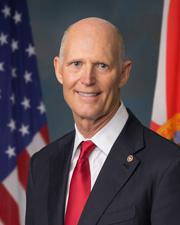
U.S. Senator for Florida
Republican
Senate term end not loaded yet
Missed 0.2% of roll calls. Chamber median 2.1%.
The full voting recordCounts roll calls where most Democrats and most Republicans voted differently, leaving out procedural votes.
How we countFrom FEC filings, Voteview roll calls and Congress.gov.
Republican. In Congress since 2019, 2 terms in total.
Following saves Scott to your list, which Chamber & Street keeps on its server, linked to a cookie on this browser and not to your name or email. Email alerts will come with constituent verification.
Bills and resolutions Scott signed on to as a cosponsor. An original cosponsor signed on the day the bill was introduced. Source: govinfo bill status files, last updated Nov 6, 2026.
Preserving Choice in Vehicle Purchases Act of 2025
Original cosponsor. 20 cosponsors. S. 996 on Congress.gov
Progress not on file
Preserving Choice in Vehicle Purchases Act of 2025
This bill modifies the waiver process under the Clean Air Act related to state emission control standards for new motor vehicles (or new motor vehicle engines).
Under current law, states are preempted from adopting or enforcing emission control standards for new motor vehicles (or new motor vehicle engines) unless the Environmental Protection Agency (EPA) provides a waiver authorizing a state to adopt such standards if certain requirements are met.
The bill provides that state standards that directly or indirectly limit the sale or use of new motor vehicles with internal combustion engines are not eligible for waivers. The bill also prohibits the EPA from determining that any state standards amended after the bill's enactment are within the scope of an existing waiver.
Additionally, the bill requires the EPA to revoke waivers granted between January 1, 2022, and the date of enactment of this bill if the standards directly or indirectly limit the sale or use of new motor vehicles with internal combustion engines.
Choice in Automobile Retail Sales Act of 2025
Sponsor Mike Crapo (R). Original cosponsor. 25 cosponsors. S. 995 on Congress.gov(opens in a new tab)
Introduced
Freedom to Haul Act of 2025
Sponsor Dan Sullivan (R). Original cosponsor. 17 cosponsors. S. 990 on Congress.gov(opens in a new tab)
Introduced
Crucial Communism Teaching Act
Sponsor John Kennedy (R). Original cosponsor. 3 cosponsors. S. 1001 on Congress.gov(opens in a new tab)
Introduced
Crucial Communism Teaching Act
This bill directs the Victims of Communism Memorial Foundation to develop a civic education curriculum and oral history resources for high school students to promote understanding of certain political ideologies (e.g., communism and totalitarianism) that conflict with principles of U.S. democracy.
Space National Guard Establishment Act of 2025
Sponsor Mike Crapo (R). Original cosponsor. 11 cosponsors. S. 963 on Congress.gov(opens in a new tab)
Introduced
Space National Guard Establishment Act of 2025
This bill establishes a Space National Guard as the reserve component of the U.S. Space Force, specifically in Alaska, California, Colorado, Florida, Hawaii, New York, and Ohio. The Space National Guard consists of specified units of the Air National Guard and must use existing facilities, infrastructure, and installations.
Protect Our Military Families’ 2nd Amendment Rights Act
Sponsor Mike Rounds (R). Original cosponsor. 11 cosponsors. S. 961 on Congress.gov(opens in a new tab)
Introduced
Protect Our Military Families' 2nd Amendment Rights Act
This bill broadens the scope of allowable firearms transactions involving active-duty service members and their spouses.
Specifically, the bill allows a licensed gun dealer, importer, or manufacturer to sell or ship a firearm or ammunition to the spouse of a member of the Armed Forces on active duty outside the United States. Current law already allows a licensed dealer, importer, or manufacturer to sell or ship a firearm or ammunition to a member of the Armed Forces on active duty outside the United States.
The bill also specifies that, for purposes of federal firearms laws, a member of the Armed Forces on active duty, or his or her spouse, is a resident of the state in which (1) the member or spouse maintains legal residence, (2) the permanent duty station of the member is located, and (3) the member maintains a home from which he or she commutes to the permanent duty station.
Securing American Agriculture Act
Sponsor Pete Ricketts (R). Original cosponsor. 12 cosponsors. S. 912 on Congress.gov(opens in a new tab)
Introduced
Securing American Agriculture Act
This bill directs the Department of Agriculture (USDA) to assess, on an annual basis, U.S. dependency on critical agricultural products or inputs that could be exploited in the event that China weaponizes such a dependency. USDA must submit a report to Congress on the assessment, which must include recommendations to reduce U.S. dependency on China to supply critical agricultural products or inputs.
Under the bill, critical inputs include all farm management, agronomic, and field-applied production inputs (e.g., agricultural equipment, fertilizers, veterinary drugs, and seed).
The bill specifies that, in conducting the assessment, USDA may not require a private entity to provide information to USDA. Further, the bill requires USDA to comply with certain confidentiality requirements and restricts disclosures of the information.
ATF Transparency Act
Sponsor James Risch (R). Joined Mar 10, 2025. 9 cosponsors. S. 884 on Congress.gov(opens in a new tab)
Introduced
ATF Transparency Act
This bill modifies procedural requirements related to the transfer or making of firearms that are subject to regulation under the National Firearms Act (e.g., machine guns, short-barreled shotguns, and silencers).
The bill generally permits the transfer of a firearm if three business days have elapsed since the application to transfer the firearm was filed, and the application has not been denied. Additionally, the bill establishes an administrative relief process with respect to an application to transfer that is denied.
The bill permits the making of a firearm if three business days have elapsed since the application to make the firearm was filed, and the application has not been denied.
Finally, the bill requires reports on firearms-related background check inquiries that remain unresolved after 90 days and the percentage of firearms-related background check inquiries related to the transfer of a firearm that were administered by the Federal Bureau of Investigation.
Make American Flags in America Act of 2025
Sponsor Ted Cruz (R). Original cosponsor. 7 cosponsors. S. 900 on Congress.gov(opens in a new tab)
Introduced
Unlocking Domestic LNG Potential Act of 2025
Sponsor Tim Scott (R). Original cosponsor. 7 cosponsors. S. 883 on Congress.gov(opens in a new tab)
Introduced
Fighter Force Preservation and Recapitalization Act of 2025
Sponsor Mike Crapo (R). Original cosponsor. 18 cosponsors. S. 873 on Congress.gov(opens in a new tab)
Introduced
Royalty Transparency Act
Sponsor Rand Paul (R). Original cosponsor. 1 cosponsor. S. 855 on Congress.gov(opens in a new tab)
Passed committee
Falun Gong Protection Act
Sponsor Ted Cruz (R). Original cosponsor. 8 cosponsors. S. 817 on Congress.gov(opens in a new tab)
Introduced
Saving Privacy Act
Sponsor Mike Lee (R). Original cosponsor. 1 cosponsor. S. 809 on Congress.gov(opens in a new tab)
Introduced
Saving Privacy Act
This bill eliminates or restricts various financial reporting requirements and requires congressional approval for new and existing regulations issued by specified financial regulatory agencies.
Specifically, the bill eliminates provisions that require financial institutions to report certain financial information to federal agencies. Currently, financial institutions are required to report certain financial transactions (e.g., transfers of over $10,000) for the purpose of detecting illicit activity, such as money laundering or the financing of terrorism. Under the bill, such records are only obtainable through a search warrant. Further, the bill generally prohibits the federal government from accessing an individual’s financial records without a warrant based on probable cause and establishes criminal penalties for violations.
Additionally, the bill requires congressional approval for major rules issued by specified financial regulatory agencies, including rules currently in effect.
The bill also eliminates or reduces reporting requirements applicable to (1) the beneficial ownership of certain corporate entities; (2) third-party settlement organizations (e.g., certain online platforms, apps, and card payment processors); and (3) the Consolidated Audit Trail (i.e., data collected by national securities exchanges to track securities market activity).
The bill generally prohibits federal agencies from issuing or using a central bank digital currency.
The bill prohibits federal agencies from restricting a person's use of convertible virtual currency for their own purposes or to conduct transactions through a self-hosted wallet.
Strategic Ports Reporting Act
Sponsor Ted Budd (R). Original cosponsor. 2 cosponsors. S. 777 on Congress.gov(opens in a new tab)
Introduced
Strategic Ports Reporting Act
This bill requires the Department of State to conduct a study and submit a report to Congress on strategic ports.
The report shall contain various elements related to such ports, including (1) a detailed list of all strategic ports owned, operated, or controlled by China or a foreign person of China; (2) a detailed list of all strategic ports owned, operated, or controlled by the United States or a U.S. person; (3) an assessment of the national security and economic interests relevant to each such port; (4) an analysis of actions by China to gain control or ownership of strategic ports; and (5) courses of action to protect strategic ports and maritime infrastructure from Chinese control.
The bill also requires the State Department to develop and provide to Congress a global mapping of foreign and domestic ports of importance to the United States because of a capability to provide military, diplomatic, economic, or resource exploitation superiority.
WHO is Accountable Act
Sponsor Marsha Blackburn (R). Original cosponsor. 4 cosponsors. S. 774 on Congress.gov(opens in a new tab)
Introduced
Enhanced Iran Sanctions Act of 2025
Sponsor Dan Sullivan (R). Joined Feb 27, 2025. 51 cosponsors. S. 556 on Congress.gov(opens in a new tab)
Introduced
A resolution celebrating Black History Month.
Sponsor Cory Booker (D). Original cosponsor. 42 cosponsors. S.Res. 99 on Congress.gov(opens in a new tab)
Passed the Senate
This resolution recognizes Black History Month as an opportunity to reflect on U.S. history and to commemorate the contributions of African Americans. It calls for the United States to (1) honor the contribution of pioneers who helped to ensure its legacy; and (2) move forward as a nation "indivisible, with liberty and justice for all."
A resolution expressing the sense of the Senate regarding United Nations General Assembly Resolution 2758 (XXVI) and the harmful conflation of China's "One China Principle" and the United States'"One China Policy".
Sponsor James Risch (R). Joined Feb 26, 2025. 16 cosponsors. S.Res. 86 on Congress.gov(opens in a new tab)
Passed committee
Haiti Economic Lift Program Extension Act of 2025
Sponsor Bill Cassidy (R). Original cosponsor. 6 cosponsors. S. 742 on Congress.gov(opens in a new tab)
Introduced
Haiti Economic Lift Program Extension Act of 2025
This bill extends through FY2035 the special duty-free rules for various apparel products imported from Haiti, including the duty-free treatment provided for a limited amount (referred to as tariff preference levels) of certain apparel products assembled in and imported from Haiti.
The bill directs the President to proclaim such modifications to the Harmonized Tariff Schedule of the United States (HTS) that may be necessary to restore preferential treatment to articles that became ineligible for such treatment due to prior revisions to the HTS.
No Bailout for Sanctuary Cities Act
Sponsor James Risch (R). Joined Feb 26, 2025. 10 cosponsors. S. 707 on Congress.gov(opens in a new tab)
Introduced
No Bailout for Sanctuary Cities Act
This bill makes a state or political subdivision of a state ineligible for any federal funds that the jurisdiction intends to use to benefit non-U.S. nationals (i.e., aliens under federal law) who are unlawfully present if the jurisdiction withholds information about citizenship or immigration status or does not cooperate with immigration detainers.
Specifically, such funds are denied to any jurisdiction that has a law, policy, or practice that prohibits or restricts any government entity from
• maintaining, sending, or receiving information regarding the citizenship or immigration status of any individual;
• exchanging information regarding an individual's citizenship or immigration status with a federal, state, or local government entity;
• complying with a valid immigration detainer from the Department of Homeland Security (DHS); or
• notifying DHS about an individual's release from custody.
The funding restriction does not apply to a law, policy, or practice that only applies to an individual who comes forward as a victim of or a witness to a criminal offense.
DHS must annually provide to specified congressional committees a list of jurisdictions that have failed to comply with a DHS detainer or have failed to notify DHS of an individual’s release.
The funding restriction begins 60 days after the bill's enactment or on the first day of the fiscal year following the bill's enactment, whichever is earlier.
United States-Israel Defense Partnership Act of 2025
Sponsor Dan Sullivan (R). Joined Feb 26, 2025. 32 cosponsors. S. 554 on Congress.gov(opens in a new tab)
Introduced
United States-Israel Defense Partnership Act of 2025
This bill requires or authorizes certain actions to increase defense-related cooperation between the United States and Israel.
Specifically, the bill requires the Department of Defense (DOD) to
• establish a cooperative program, with the concurrence of Israel's Ministry of Defense (MOD), to develop and deploy advanced technologies for countering unmanned systems that threaten the United States and Israel;
• establish in Israel an office of the Defense Innovation Unit (an organization that focuses on rapidly fielding and scaling commercial technology across the U.S. military); and
• seek to engage Israel's MOD on the ascension of Israel into the national technology and industrial base (currently defined in law as the persons and organizations engaged in research, development, production, integration, services, or information technology activities conducted within the United States, the United Kingdom, Australia, New Zealand, and Canada).
The bill authorizes DOD, upon request of Israel's MOD, to jointly conduct research, development, test, and evaluation (RDT&E) of emerging technologies such as artificial intelligence and robotics to meet defense challenges.
Additionally, the bill extends the authority for DOD to (1) carry out RDT&E on a joint basis with Israel to establish anti-tunnel and counter unmanned aerial systems capabilities through 2028, and (2) transfer defense articles intended for use as reserve stocks for Israel through January 1, 2029.
Time to Choose Act of 2025
Sponsor Josh Hawley (R). Original cosponsor. 4 cosponsors. S. 731 on Congress.gov(opens in a new tab)
Introduced
Time to Choose Act of 2025
This bill prohibits the federal government from awarding consulting services contracts to any entity that provides consulting services to covered foreign entities.
Foreign entities covered by the bill include
• the government of China, the Chinese Communist Party, the People's Liberation Army, or any Chinese security service or intelligence agency;
• the government of Russia or any entity sanctioned under Executive Order 13662;
• the government of any country determined by the Department of State to have repeatedly provided support for international terrorism; and
• any entity on certain lists maintained by the Department of Commerce, such as the Denied Persons List or the Military End User List.
An agency may waive the prohibition on a case-by-case basis if it is in the national security interests of the United States and no other entity without a conflict of interest can perform the work.
Ending China's Unfair Advantage Act of 2025
Sponsor John Barrasso (R). Joined Feb 25, 2025. 12 cosponsors. S. 680 on Congress.gov(opens in a new tab)
Introduced
Stop Dangerous Sanctuary Cities Act
Sponsor Ted Cruz (R). Original cosponsor. 17 cosponsors. S. 685 on Congress.gov(opens in a new tab)
Introduced