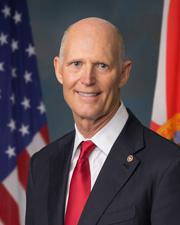
U.S. Senator for Florida
Republican
Senate term end not loaded yet
Missed 0.2% of roll calls. Chamber median 2.1%.
The full voting recordCounts roll calls where most Democrats and most Republicans voted differently, leaving out procedural votes.
How we countFrom FEC filings, Voteview roll calls and Congress.gov.
Republican. In Congress since 2019, 2 terms in total.
Following saves Scott to your list, which Chamber & Street keeps on its server, linked to a cookie on this browser and not to your name or email. Email alerts will come with constituent verification.
Bills and resolutions Scott signed on to as a cosponsor. An original cosponsor signed on the day the bill was introduced. Source: govinfo bill status files, last updated Nov 6, 2026.
A resolution designating the week of May 11 through May 17, 2025, as "National Police Week".
Sponsor Chuck Grassley (R). Original cosponsor. 83 cosponsors. S.Res. 220 on Congress.gov
Passed the Senate
Protecting Privacy in Purchases Act
Sponsor Bill Hagerty (R). Original cosponsor. 32 cosponsors. S. 1715 on Congress.gov(opens in a new tab)
Introduced
STOP China Act
Sponsor John Cornyn (R). Original cosponsor. 10 cosponsors. S. 1711 on Congress.gov(opens in a new tab)
Introduced
Safeguarding Transit Operations to Prohibit China Act or the STOP China Act
This bill prohibits federal transportation funds from being used to purchase rolling stock (e.g., rail cars or buses) or fueling or charging infrastructure from entities with ties to China, North Korea, Russia, or Iran (i.e., a covered nation). In general, this replaces a current prohibition on the use of Federal Transportation Administration (FTA) funds for rolling stock from manufacturers owned or controlled by corporations based in certain countries.
Specifically, Department of Transportation (DOT) funds, which include FTA funds, may not be used for the purchase of rolling stock or bus fueling or charging infrastructure from entities with ties to a covered nation. This prohibition also applies to vehicles that incorporate electric power trains from such entities.
The prohibition broadly applies to corporations, joint ventures, individuals, and organizations with ties to covered nations. Examples of applicable entities include an individual whose activities are directed or financed by a covered nation or an entity that is owned or controlled by a covered nation or such an individual.
The United States Trade Representative (USTR) must publish a list of the applicable entities and update the list annually.
The bill includes an exception for motor vehicles or fueling and charging stations used for (1) inspecting or investigating vehicles or equipment; or (2) vehicle safety research, development, or testing.
A resolution calling on the United Kingdom, France, and Germany (E3) to initiate the snapback of sanctions on Iran under United Nations Security Council Resolution 2231 (2015).
Sponsor Pete Ricketts (R). Joined May 8, 2025. 19 cosponsors. S.Res. 81 on Congress.gov(opens in a new tab)
Introduced
The resolution urges the E3 (the United Kingdom, France, and Germany) to invoke the snapback of United Nations (UN) sanctions against Iran under UN Security Council Resolution 2231 before the option expires on October 18, 2025.
This resolution also (1) recognizes that Iran's possession of a nuclear weapon would threaten U.S. and global security, (2) condemns Iran's repeated violations of certain international commitments related to nuclear weapons, and (3) reaffirms that the United States maintains the right to prevent Iran from acquiring nuclear weapons.
INDEX Act
Sponsor Dan Sullivan (R). Original cosponsor. 9 cosponsors. S. 1670 on Congress.gov(opens in a new tab)
Introduced
INvestor Democracy is EXpected Act or the INDEX Act
This bill establishes guidelines for passively managed funds (e.g., index funds) that vote shares on behalf of fund investors in proxy shareholder votes. Under the bill, these funds generally must vote shares on a proportional basis according to instructions from fund investors.
The bill establishes an exemption for routine matters and matters requiring approval of a majority of outstanding securities. Additionally, the bill establishes a safe harbor from these requirements for investment advisers.
Stop Antisemitism on College Campuses Act
Sponsor Tim Scott (R). Joined May 8, 2025. 7 cosponsors. S. 1182 on Congress.gov(opens in a new tab)
Introduced
Stop Antisemitism on College Campuses Act
This bill prohibits an institution of higher education (IHE) that participates in federal student aid programs from authorizing, facilitating, providing funding for, or otherwise supporting any event that promotes anti-Semitism on the IHE's campus.
RESTORE Act
Sponsor Ted Cruz (R). Original cosponsor. 3 cosponsors. S. 1641 on Congress.gov(opens in a new tab)
Introduced
A resolution seeking justice for the Japanese citizens abducted by North Korea.
Sponsor Dan Sullivan (R). Joined May 6, 2025. 7 cosponsors. S.Res. 190 on Congress.gov(opens in a new tab)
Introduced
No Official Palestine Entry Act of 2025
Sponsor James Risch (R). Original cosponsor. 20 cosponsors. S. 1612 on Congress.gov(opens in a new tab)
Introduced
A resolution expressing support for the designation of the week of May 4, 2025, through May 10, 2025, as "National Small Business Week" to celebrate the contributions of small businesses and entrepreneurs in every community in the United States.
Sponsor Joni Ernst (R). Original cosponsor. 81 cosponsors. S.Res. 201 on Congress.gov(opens in a new tab)
Passed the Senate
This resolution honors the contributions of small businesses in the United States and supports the designation of National Small Business Week.
AUSSOM Funding Restriction Act of 2025
Sponsor James Risch (R). Original cosponsor. 2 cosponsors. S. 1583 on Congress.gov(opens in a new tab)
Introduced
Improving SCRA Benefit Utilization Act of 2025
Sponsor Jon Ossoff (D). Original cosponsor. 1 cosponsor. S. 1550 on Congress.gov(opens in a new tab)
Introduced
Improving SCRA Benefit Utilization Act of 2025
This bill expands interest rate protections under the Servicemembers Civil Relief Act (SCRA) and requires expanded training for and outreach to servicemembers regarding financial literacy and SCRA protections.
The SCRA caps the maximum interest charged on any debt incurred by a servicemember prior to entering active duty at 6% annually if the servicemember's ability to pay is materially affected by active-duty status; servicemembers must provide notice and other documentation to creditors to receive this cap.
The bill requires creditors to apply this cap to all of a servicemember’s obligations or liabilities with that creditor, regardless of whether a certain obligation or liability was specifically mentioned in the required notice provided by the member to invoke SCRA rights. Further, the bill requires creditors to provide all necessary mechanisms to ensure a servicemember is able to submit any required documentation.
The bill also requires that the financial literacy training program provided to servicemembers include information about consumer financial protections afforded to such members and their dependents, including protections regarding interest rate limits under the SCRA.
Additionally, the bill requires the military department concerned to provide written notice of benefits under the SCRA to servicemembers at the time they first enter military service and, for members of the reserve components, at the time they first enter service in the reserves and at any time when they are mobilized or ordered to active duty for more than 30 days.
Veterans Opportunity Act of 2025
Sponsor Jim Banks (R). Original cosponsor. 4 cosponsors. S. 1543 on Congress.gov(opens in a new tab)
Introduced
Veterans Opportunity Act of 2025
This bill establishes the Veterans Economic Opportunity and Transition Administration to administer economic opportunity assistance programs for veterans and their dependents and survivors.
Specifically, the Veterans Economic Opportunity and Transition Administration must administer the following Department of Veterans Affairs (VA) programs:
• vocational rehabilitation and employment programs,
• educational assistance programs,
• veterans' housing loan and related programs,
• the responsibilities of the VA with respect to the Transition Assistance Program, and
• any other VA program that the VA determines is appropriate.
Prior to the transfer of administrative responsibilities, the bill requires the VA to certify that (1) the transition of the provision of services will not negatively affect the provision of such services to veterans, and (2) such services are ready to be transferred.
SHIPS for America Act of 2025
Sponsor Mark Kelly (D). Original cosponsor. 28 cosponsors. S. 1541 on Congress.gov(opens in a new tab)
Introduced
Stand with Israel Act
Sponsor James Risch (R). Original cosponsor. 26 cosponsors. S. 1521 on Congress.gov(opens in a new tab)
Introduced
A resolution supporting the mission and goals of National Fentanyl Awareness Day in 2025, including increasing individual and public awareness of the impact of fake or counterfeit fentanyl pills on families and young people.
Sponsor Chuck Grassley (R). Original cosponsor. 29 cosponsors. S.Res. 186 on Congress.gov(opens in a new tab)
Passed the Senate
This resolution designates April 29, 2025, as National Fentanyl Awareness Day to bring attention to the impact of fake or counterfeit fentanyl pills.
Felony Murder for Deadly Fentanyl Distribution Act of 2025
Sponsor Joni Ernst (R). Original cosponsor. 10 cosponsors. S. 1502 on Congress.gov(opens in a new tab)
Introduced
Felony Murder for Deadly Fentanyl Distribution Act of 2025
This bill makes the distribution of fentanyl resulting in death a first-degree murder.
An individual who is guilty of first-degree murder by distributing fentanyl is subject to death or life in prison.
A resolution designating the week of April 19 through April 27, 2025, as "National Park Week".
Sponsor Steve Daines (R). Original cosponsor. 59 cosponsors. S.Res. 180 on Congress.gov(opens in a new tab)
Passed the Senate
FARMLAND Act of 2025
Sponsor Joni Ernst (R). Joined Apr 10, 2025. 4 cosponsors. S. 886 on Congress.gov(opens in a new tab)
Introduced
Foreign Agricultural Restrictions to Maintain Local Agriculture and National Defense Act of 2025 or the FARMLAND Act of 2025
This bill expands federal authority and oversight over foreign investments in the U.S. agricultural industry.
The bill expands the authority of the Committee on Foreign Investment in the United States (CFIUS) to include the review of land transactions (involving foreign entities) that exceed $5 million or 320 acres of land over the preceding three years. This applies to land that is primarily used for agriculture, the extraction of energy sources, or the extraction of critical precursor materials for biological technology industries, information technology components, or national defense technologies. Further, the bill adds the Secretary of Agriculture and the Commissioner of Food and Drugs to CFIUS membership. As background, CFIUS is an interagency committee that oversees the national security risks of certain foreign direct investment in the U.S. economy, including by reviewing certain real estate transactions.
Further, the bill expands enforcement of the Agricultural Foreign Investment Disclosure Act (AFIDA). The Department of Agriculture (USDA) must appoint a Chief of Operations of Investigative Actions to (1) monitor AFIDA compliance, and (2) conduct investigations on efforts to steal agricultural knowledge and technology and to disrupt the U.S. agricultural base.
The bill prohibits foreign persons who own or operate land from participating in Farm Service Agency programs and establishes penalties for violators.
The bill also requires USDA and the Department of Homeland Security to jointly develop a database of agricultural land owned by foreign persons.
LIABLE Act
Sponsor Ted Cruz (R). Original cosponsor. 8 cosponsors. S. 1487 on Congress.gov(opens in a new tab)
Introduced
Military Installation Retail Security Act of 2025
Sponsor Ted Budd (R). Original cosponsor. 3 cosponsors. S. 1456 on Congress.gov(opens in a new tab)
Introduced
Audit the IRS Act
Sponsor Joni Ernst (R). Original cosponsor. 2 cosponsors. S. 1427 on Congress.gov(opens in a new tab)
Introduced
Audit the IRS Act
This bill prohibits an individual who has a seriously delinquent tax debt from being appointed or continuing to serve as an officer, employee, or contract employee of the Internal Revenue Service (IRS).
The bill defines seriously delinquent tax debt as any tax debt for which the IRS has filed a notice of a tax lien other than a tax debt (1) that is being paid in a timely manner pursuant to an installment agreement or offer in compromise, or (2) for which a collection due process hearing or innocent spouse relief is requested or pending.
The bill requires the IRS to verify annually that IRS officers, employees, and contract employees do not have a seriously delinquent tax debt. The IRS also must verify that applicants for such positions do not have a seriously delinquent tax debt prior to hiring.
Finally, the bill requires Office of Personnel Management to issue regulations necessary to carry out the provisions of this bill.
SAVE Act
Sponsor Mike Lee (R). Joined Apr 10, 2025. 49 cosponsors. S. 128 on Congress.gov(opens in a new tab)
Introduced
Safeguard American Voter Eligibility Act or the SAVE Act
This bill requires individuals to provide documentary proof of U.S. citizenship when registering to vote in federal elections.
Specifically, the bill prohibits states from accepting and processing an application to register to vote in a federal election unless the applicant presents documentary proof of U.S. citizenship. The bill specifies what documents are considered acceptable proof of U.S. citizenship, such as identification that complies with the REAL ID Act of 2005 that indicates U.S. citizenship.
Further, the bill (1) prohibits states from registering an individual to vote in a federal election unless, at the time the individual applies to register to vote, the individual provides documentary proof of U.S. citizenship; and (2) requires states to establish an alternative process under which an applicant may submit other evidence to demonstrate U.S. citizenship.
Each state must take affirmative steps on an ongoing basis to ensure that only U.S. citizens are registered to vote, which shall include establishing a program to identify individuals who are not U.S. citizens using information supplied by certain sources.
Additionally, states must remove noncitizens from their official lists of eligible voters.
The bill allows for a private right of action against an election official who registers an applicant to vote in a federal election who fails to present documentary proof of U.S. citizenship.
The bill establishes criminal penalties for certain offenses, including registering an applicant to vote in a federal election who fails to present documentary proof of U.S. citizenship.
Give Kids a Chance Act of 2025
Joined Apr 8, 2025. 20 cosponsors. S. 932 on Congress.gov(opens in a new tab)
Progress not on file
Give Kids a Chance Act of 2025
This bill authorizes certain targeted clinical trials involving combinations of drugs to treat pediatric cancer, and renews the Food and Drug Administration’s (FDA’s) authority to award priority review vouchers (PRVs) to sponsors of new products for rare pediatric diseases.
Specifically, the bill modifies requirements relating to molecularly targeted pediatric cancer investigations to permit research on new drugs used in combination with active ingredients that have already been approved and that (1) have been determined to be part of the standard of care for treating a pediatric cancer, or (2) have been approved to treat an adult cancer and are directed at molecular targets for pediatric cancer.
The FDA must issue guidance on the implementation of these provisions and report to Congress on its efforts to ensure implementation. The Government Accountability Office (GAO) must report on the effectiveness of the bill's changes with respect to the development of pediatric cancer drugs.
The bill also renews the FDA’s authority to issue PRVs to sponsors of new products intended to treat rare pediatric diseases through September 30, 2029. This is known as the Rare Pediatric Disease PRV program. The program expired in December 2024.
GAO must report on the effectiveness of the Rare Pediatric Disease PRV program, including to what extent PRVs were successful in promoting drug development and expediting patient access to drugs for the treatment or prevention of rare pediatric diseases.
Tyler’s Law
Sponsor Jim Banks (R). Joined Apr 8, 2025. 13 cosponsors. S. 921 on Congress.gov(opens in a new tab)
Passed the Senate